Varuna, among the most ancient deities of the Vedic corpus, is revered as guardian of Rita (ṛta)the cosmic order that sustains both the universe and ethical life. The expression “Four Faces of Varuna” serves as a powerful interpretive lens for understanding a divine vision that encompasses all creation. While classical iconography more commonly depicts Varuna with a noose (pāśa), waters, and as Dikpala of the western direction rather than with four heads, the “four faces” function here as an exegetical metaphor rooted in Vedic symbolism and lived spiritual reflection.
Seen through this metaphor, Varuna’s fourfold vision articulates an all-encompassing awareness: of directions and domains, of moral law and mercy, of vows and truth, and of the integrated frameworks that have guided dharmic traditions for millennia. In Rigvedic hymns (e.g., 7.86–7.89), Varuna’s omniscience is inseparable from compassionhe “sees” human action yet responds to contrition with clemency, maintaining cosmic balance without abandoning care for persons.
The first face symbolizes Rita, the metaphysical and moral architecture of reality. As guardian of Rita, Varuna upholds predictable celestial rhythms and ethical accountability. The pāśa signifies consequence and responsibility, reminding communities that order and justice arise from alignment with truth. Many practitioners recognize in this symbolism the familiar movement from error to acknowledgment to renewalan ethical cycle that strengthens integrity in households, institutions, and social life.
The second face looks toward waters, over which Varuna presides. The ocean’s vastness conveys plenitude, protection, and purificationassociations central to Hindu symbols and Vedic imagination. Observers often describe a quiet steadiness when contemplating rivers or seas; this affective resonance mirrors Varuna’s compassionate dimension, where sustaining life and restoring balance are inseparable. In this way, water becomes a living emblem of care that holds individuals and communities through change.
The third face concerns vow, speech, and truth. In Vedic literature, Mitra–Varuna oversee agreements and right speech; broken promises disturb Rita, while truthful words restore relational harmony. In everyday contextskeeping a promise, honoring a contract, or offering a sincere apologythis symbolism translates into practical ethics. The result is a culture of trust that links personal responsibility with the stability of the social order.
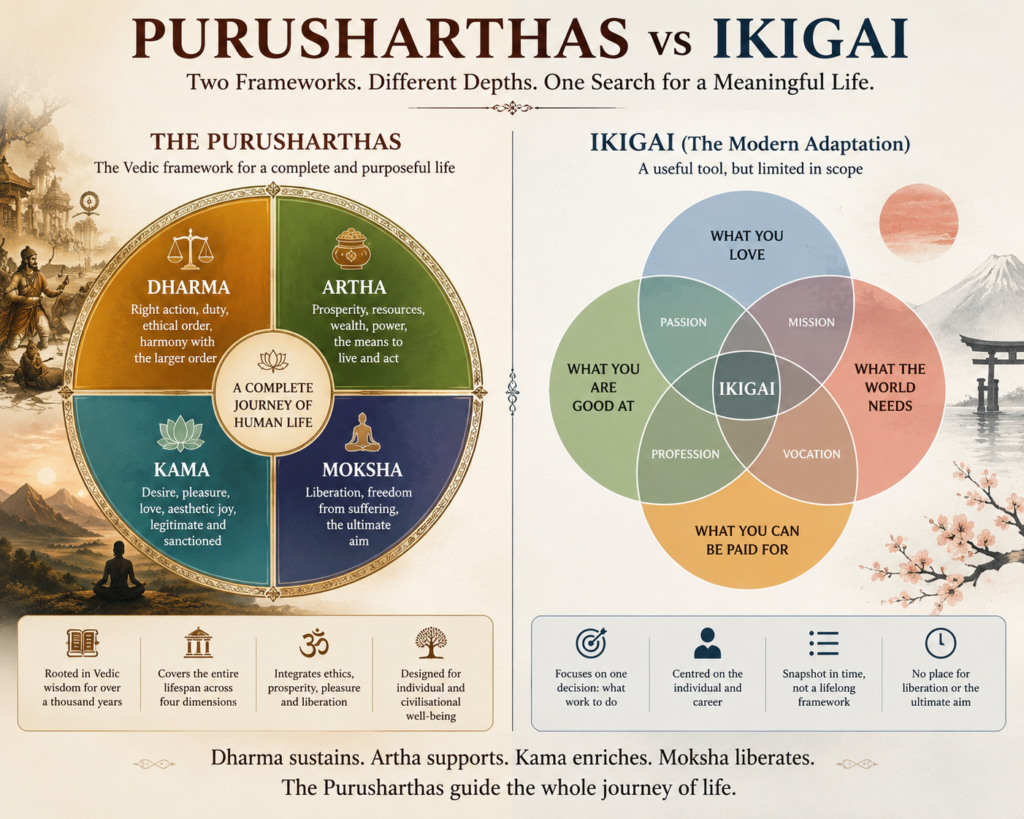
The fourth face integrates the great “fours” that structure dharmic life: the four Vedas (Rig, Yajur, Sama, Atharva), the four Purusharthas (dharma, artha, kama, moksha), and the four Ashramas (brahmacharya, grihastha, vanaprastha, sannyasa). Read together, these frameworks suggest that Varuna’s encompassing vision is not only cosmic but pedagogicalguiding learners to harmonize knowledge, duty, desire, and liberation through life’s stages.
Directionally, Varuna as Dikpala of the West complements a four-directional view of reality common across dharmic traditions. In Buddhism, protective deities guard the quarters; in Jainism, ethical restraint and right knowledge orient the practitioner in every direction; in Sikh thought, Hukam (cosmic order) pervades all bearings. These resonances demonstrate a shared civilizational intuition: cosmic order and moral order are mutually informing, and wisdom unfolds as attention expands to encompass the whole.
Such convergences underscore unity in spiritual diversity. Hinduism’s Rita, Buddhism’s emphasis on interdependent order, Jainism’s commitments to truth and non-violence, and Sikhism’s Hukam all affirm that ethical living aligns human action with a larger, intelligible cosmos. Rather than erasing difference, this unity honors distinctive paths while revealing a common horizon of truth, compassion, and responsibility.
A contemplative exercise flows naturally from this symbolism. One reflective practice involves attending to the four directions in silenceacknowledging a commitment in each: truth in speech, fairness in action, care in relationship, and humility before the vastness symbolized by water and sky. Such practice does not replace tradition-specific sādhanā; instead, it complements it by cultivating attentiveness to Rita in daily life.
Interpreting the “Four Faces of Varuna” in this way preserves textual fidelity and illuminates contemporary relevance. The metaphor clarifies how a Vedic symbol can orient ethical decision-making, deepen emotional steadiness, and foster inter-tradition respect. In doing so, it aligns with the broader dharmic aim: to see clearly, act justly, and live in harmony with the cosmic order that sustains all beings.
Inspired by this post on Hindu Blog.