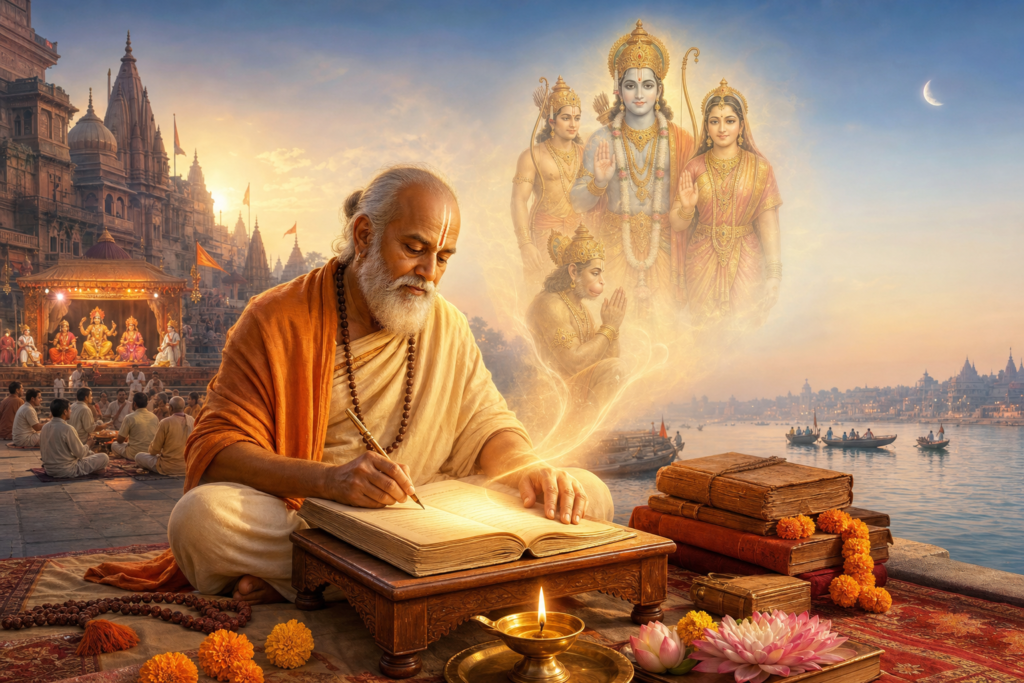
Panchavati, the sacred grove on the banks of the Godavari River, occupies a central place in the cultural memory of the Ramayana. Far more than a geographical setting, it serves as a living symbol of dharma, inner discipline, and harmony with nature. In this forest abode, Lord Rama, Sita, and Lakshmana spent a significant period of their vanvas, and the events that unfolded there shaped the moral arc of the epic and the spiritual imagination of generations.
The very name Panchavati evokes layered meaning. Traditionally associated with “five trees,” the grove reflects a sacred ecology where the natural world is not a backdrop but a participant in the ethical drama. Many interpret the five trees as symbols of the five senses (indriyas) or the five elements (pañcha mahābhūtas), suggesting that Panchavati represents a disciplined state where the senses are harmonized, and human life is aligned with cosmic order. This reading resonates with the wider Indic understanding of sacred geography, in which place and practice are inseparable.
Narratively, Panchavati is the stage for pivotal episodes: the establishment of a humble hermitage, the encounter with Śūrpaṇakhā, the appearance of the golden deer, the abduction of Sita, and the heroic sacrifice of Jatayu. Each episode is not merely plot; it is a moral inquiry. The grove witnesses love and loss, restraint and provocation, courage and griefcomposing a spectrum of human experience embedded within a sacred frame. Later folk memory even preserves the idea of the Lakshmana Rekha as a metaphor of protective boundaries and ethical caution, illustrating how Panchavati has continued to inspire interpretive traditions.
As a symbol of vanvas, Panchavati reframes exile not as deprivation but as disciplined living. In the Ramayana, exile becomes an intentional path toward clarity of purpose, ethical steadfastness, and spiritual refinement. This aligns with a broader dharmic insight: that external simplicity can illuminate inner abundance. The forest hermitage did not isolate Rama’s family from responsibility; it amplified their commitment to dharma by placing them in direct relationship with nature, community, and consequence.
Ethically, Panchavati invites reflection on boundaries, dignity, and response to provocation. The confrontation with Śūrpaṇakhā, complex in its emotional and social dimensions, is often read as a lesson in discernment (viveka) and the limits of desire and anger. The narrative does not flatten moral questions; rather, it reveals how situational judgment, intention, and consequence interact within the vast field of dharma. The grove thus becomes a contemplative classroom where choices echo beyond the individual to shape collective wellbeing.
Jatayu’s stand near Panchavati embodies valor infused with compassion. His sacrifice to defend Sita exemplifies courage that is protective rather than aggressive, rooted in duty and empathy. This moment, revered across traditions, highlights that ethical action is measured not only by strength but by the moral purpose that guides it. Such episodes remind readers that compassion (karuna), non-violence (ahimsa), and service (seva) are not abstract ideals; they are lived commitments that safeguard the vulnerable.
Panchavati’s symbolism naturally harmonizes with the shared values of the dharmic traditions of Hinduism, Buddhism, Jainism, and Sikhism. The grove’s emphasis on self-restraint, mindful presence, and reverence for life echoes Jain ahimsa, Buddhist mindfulness and compassion, Sikh seva and maryada, and the Hindu pursuit of dharma. Read in this inclusive light, Panchavati invites unity in spiritual diversity, affirming that ethical living and inner awakening transcend sectarian boundaries while honoring each path’s distinctive insights.
As sacred geography, Panchavati underscores an ecological ethic integral to the Ramayana. The hermitage is sustained through simplicity, reciprocity, and care for the living world. This sacred ecology is formative: the forest disciplines the senses, reorients desire, and teaches interdependence. Readers often find that imagining the quiet canopy, the river’s steady flow, and the rhythm of daily austerities evokes a contemplative stillnessan experience of being held within a larger order that nourishes moral clarity.
Historically associated with present-day Nashik, the Panchavati area continues to draw pilgrims who seek to connect narrative memory with place. Visiting the riverbanks, local shrines, and caves associated with the epic, many report a heightened sense of continuity between past and present. Standing by the Godavari at dawn, one might sense what the epic suggests: that sacredness arises where attention, restraint, and devotion convergewhere the ordinary landscape becomes a mirror of inner transformation.
Philosophically, Panchavati can be read as an inner grove. The five trees become five disciplines that steady life: regulation of the senses, clarity of thought, purity of speech, right action, and compassionate relationship. Practiced together, these disciplines cultivate resilience and peace, enabling individuals and communities to meet conflict without hatred and to uphold dignity without pride. In this way, the grove’s symbolism offers a practical ethics for contemporary lifeat home, in civic engagement, and across interfaith encounters.
For those exploring the Ramayana’s enduring relevance, Panchavati serves as a complete guide to living dharma amid uncertainty. It teaches that simplicity is not withdrawal but heightened responsibility; that courage without compassion is incomplete; and that true strength lies in self-mastery. Above all, Panchavati demonstrates how unity can be realized through shared virtues: restraint, service, and reverence for lifevirtues cherished across the dharmic family.
In sum, the sacred grove of Panchavati is a map and a mirror: a map for ethical navigation and a mirror reflecting the aspirational self. Discovering its “secrets” does not require esoteric knowledge; it requires steady practice, generous attention, and a willingness to let the forest teach. Read this way, Panchavati invites every reader into a transformative relationship with place, with community, and with the quiet, sustaining power of dharma.
Inspired by this post on Hindu Blog.