

Śrīmad-Bhāgavatam 4.8.69 captures a decisive moment in the history of Dhruva Mahārāja. King Uttānapāda is overwhelmed by remorse after allowing palace conflict, personal weakness, and misplaced attachment to drive his young son away. Nārada Muni responds not merely with consolation but with a confident spiritual assessment: Dhruva is protected, capable, and destined to accomplish something beyond the reach of celebrated rulers and sages. The verse therefore speaks simultaneously about devotional determination, self-mastery, responsible leadership, parental regret, the authority of the guru, and the transformation of suffering into spiritual purpose.
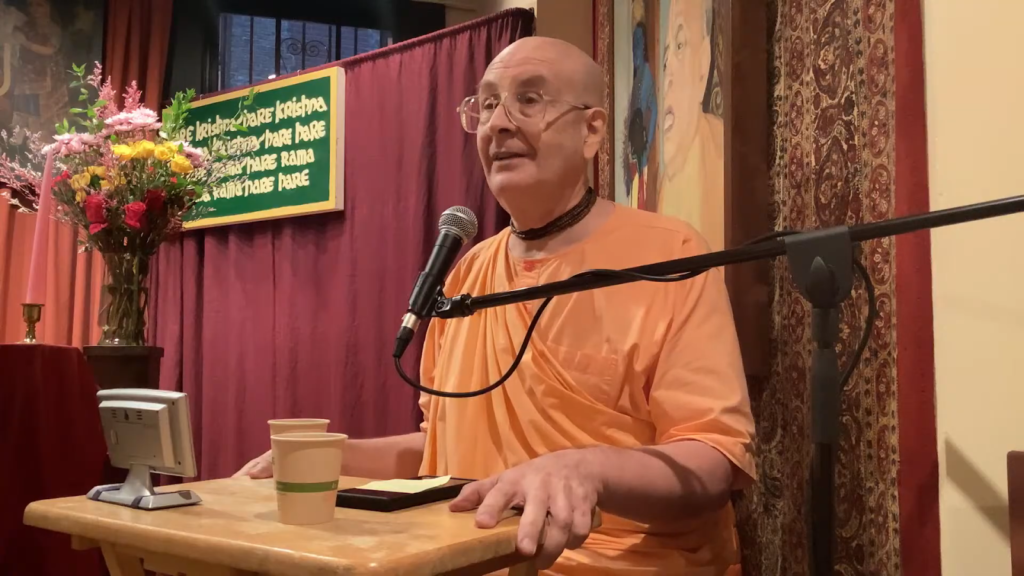
The textual focus of Gaudacandra Prabhu’s class is the following verse:
सुदुष्करं कर्म कृत्वा लोकपालैरपि प्रभुः ।
ऐष्यत्यचिरतो राजन् यशो विपुलयंस्तव ॥ ६९ ॥
suduṣkaraṁ karma kṛtvā
loka-pālair api prabhuḥ
aiṣyaty acirato rājan
yaśo vipulayaṁs tava
An interpretive translation reads: “O King, after accomplishing a deed exceedingly difficult even for the guardians of the worlds, this capable son will return before long, causing your fame to expand.” The prediction is remarkable because Dhruva is still a child living in the forest. His father sees vulnerability and danger, whereas Nārada sees spiritual competence, divine protection, and an emerging ācārya. The full translation, word meanings, and traditional purport are preserved in the [Vedabase edition of Śrīmad-Bhāgavatam 4.8.69](https://vedabase.io/en/library/sb/4/8/69/).
The narrative setting: Dhruva’s journey begins with an injury to his sense of dignity. When he attempts to sit on the lap of King Uttānapāda, his stepmother Suruci tells him that he has no right to that position because he was not born from her womb. Her words are not presented as a minor domestic disagreement. They expose a failure of justice within the royal household, intensified by the king’s unwillingness to intervene. Dhruva experiences rejection not only from a stepmother but also from a father whose silence gives power to the injustice.
Dhruva turns to his mother, Sunīti, who neither denies his pain nor encourages retaliation. She acknowledges that worldly favor is unstable and directs him toward the Supreme Lord. Her counsel gives his wounded emotion a transcendent direction. Instead of teaching him to defeat Suruci through palace intrigue, she teaches him to seek a form of grace that no political arrangement can confer or withdraw. This response establishes an important principle of bhakti: painful circumstances need not determine the final quality of a person’s consciousness.
Dhruva leaves for the forest with a strong desire to obtain a kingdom greater than any possessed by his ancestors. His initial motivation is therefore spiritually mixed. It combines faith, ambition, pain, and a desire for recognition. The narrative does not conceal this complexity. It shows how sincere practice can purify an imperfect beginning. Bhakti does not require a practitioner to pretend that anger, grief, or ambition is absent; it requires those energies to be brought into a disciplined relationship with sacred instruction.
Nārada Muni meets Dhruva and initially asks him to reconsider. This exchange is sometimes misunderstood as discouragement. Within the guru–śiṣya framework, however, the questions test the depth and stability of Dhruva’s purpose. A teacher must distinguish a passing emotional reaction from a commitment capable of sustaining disciplined practice. When Dhruva remains firm, Nārada does not reject him because his motives are immature. He gives him a practical path involving mantra, meditation, regulated worship, bodily discipline, and contemplation of the personal form of the Supreme Lord.
While Dhruva advances under Nārada’s guidance, King Uttānapāda becomes consumed by remorse. In the verses immediately preceding 4.8.69, he remembers his son’s lotuslike face, fears that the child may be hungry or exposed to wild animals, and condemns his own hardhearted conduct. His grief contains affection, but it also reveals the delayed awakening of moral responsibility. The king recognizes that he allowed attachment to one relationship to override justice toward another. Nārada’s reassurance addresses this anxiety without excusing the failure that caused it.
The force of suduṣkaram: The expression suduṣkaraṁ karma means an action exceedingly difficult to perform. The prefix su- functions as an intensifier, while duṣkara denotes something hard to accomplish. The verse is not praising difficulty for its own sake. Severe effort becomes spiritually meaningful only when it is directed by valid knowledge and a worthy purpose. Undisciplined hardship can produce exhaustion or pride; Dhruva’s austerity becomes transformative because it is shaped by Nārada’s instruction and oriented toward divine realization.
The grammatical construction karma kṛtvā means “having performed the work.” The absolutive kṛtvā presents the accomplishment as preceding Dhruva’s return. He is not predicted to abandon his task when discomfort appears. He will complete it and then come home. This sequence makes perseverance central to the verse. A serious vow is not measured by the intensity of its first emotional moment but by the steadiness that carries it to completion.
Beyond the capacity of the loka-pālas: The phrase loka-pālair api intensifies Nārada’s prediction by declaring that Dhruva will accomplish something difficult even for the great protectors or governors of the worlds. The comparison is not primarily about physical strength, political territory, or public spectacle. Dhruva’s extraordinary achievement is the concentration of consciousness required to satisfy the Supreme Lord. Authority over others may be obtained through office or inheritance, but authority over one’s own impulses requires sustained inner discipline.
This contrast gives the passage continuing relevance. A ruler may command an army while remaining controlled by fear, anger, praise, appetite, or factional pressure. A scholar may possess vast information while lacking mastery over attention. A spiritual practitioner may understand doctrine while repeatedly surrendering to distraction. Dhruva’s greatness lies in bringing desire, body, breath, mind, and purpose into an increasingly unified act of devotion.
Why Dhruva is called prabhu: Nārada describes the child as prabhuḥ, a term associated with mastery, competence, authority, and lordship. In Vaiṣṇava usage, Prabhu may respectfully address the Supreme Lord or a servant who represents divine teaching. Its application to Dhruva does not erase the distinction between the individual self and the Supreme. It recognizes that he is becoming an exemplary teacher through conduct and that his senses no longer exercise unchallenged rule over him.
The relationship between prabhu and self-mastery is especially significant. Spiritual authority is not established merely by a title, institutional position, audience, or display of learning. It is tested by the capacity to regulate the senses, remain faithful to sacred instruction, and direct personal power toward service. Dhruva’s authority emerges from discipline before it becomes visible as social influence. The narrative thus places character before recognition.
The traditional explanation also illuminates the honorific Prabhupāda. Within Vaiṣṇava theology, the genuine spiritual master represents the Supreme Lord’s instruction and therefore occupies a position worthy of profound respect. Representation is not identity in an unrestricted sense. The guru’s authority is fiduciary and devotional: it is valid insofar as divine knowledge is transmitted faithfully, personal conduct supports that teaching, and disciples are directed toward the Supreme rather than toward exploitation or personality worship.
Determination without fickleness: Dhruva’s name is traditionally associated with firmness, constancy, and the fixed pole star. That symbolism agrees with the narrative’s emphasis on unwavering purpose. His determination is not stubborn refusal to learn. He accepts instruction, changes his method, regulates his behavior, and ultimately allows his original ambition to be purified. Authentic steadiness therefore differs from rigidity. Rigidity resists correction, whereas spiritual determination remains fixed on the goal while becoming increasingly responsive to truth.
This distinction matters in practical spiritual life. Some efforts fail because the goal changes whenever discomfort appears. Others fail because a person clings to an ineffective method out of pride. Dhruva demonstrates a more mature combination: a stable aspiration joined to obedience, adaptability, and concentrated practice. Nārada supplies a tested method, and Dhruva applies it with unusual seriousness.
From wounded ambition to purified devotion: Dhruva enters the forest seeking a superior kingdom, but direct realization changes the scale by which he evaluates success. The broader account presents devotion as a transformation of desire rather than a simple transaction in which austerity purchases status. His initial objective becomes small when compared with the spiritual treasure he encounters. This is one of the narrative’s most psychologically credible features: profound experience does not merely grant the old desire; it changes the person who formed that desire.
Such transformation does not require the original wound to be denied. Dhruva’s rejection remains part of his history, but it no longer governs his identity. The insult becomes an occasion for disciplined seeking, and disciplined seeking opens into devotion. Readers who have experienced exclusion, unequal treatment, or parental disappointment may recognize the emotional structure of this journey. The account does not claim that every injury is beneficial. It demonstrates that injury can be answered without allowing resentment to become the permanent ruler of consciousness.
Effort and grace: Dhruva’s achievement depends upon both. His austerity is rigorous, but the narrative does not treat divine realization as the mechanical product of bodily severity. Nārada’s guidance, the Lord’s protection, Dhruva’s receptivity, and his sustained effort operate together. Grace does not make discipline unnecessary, and discipline does not place grace under human control. Bhakti holds these truths in a productive tension: the practitioner acts wholeheartedly while recognizing that the highest realization is received rather than manufactured.
This balance prevents two common distortions. One is passivity—the assumption that sincere intention eliminates the need for training, ethical restraint, or perseverance. The other is spiritual self-sufficiency—the belief that extraordinary effort makes a practitioner independent of guidance and divine mercy. Dhruva avoids both errors. He works with astonishing intensity, yet his practice remains rooted in instruction and dependence upon the Supreme.
The guru as diagnostician and guide: Nārada does more than deliver abstract philosophy. He observes Dhruva’s temperament, tests his resolve, and provides a discipline suited to his condition. Effective spiritual teaching must similarly account for the student’s actual motives and capacities. A method becomes pedagogically meaningful when it can move a person from the present state toward a more integrated one. Nārada neither flatters Dhruva’s ambition nor demands that the child possess perfect motives before beginning.
This model also sets limits on legitimate authority. A true guru does not intensify dependency for personal benefit. The teacher equips the disciple to regulate the mind, understand sacred teaching, act ethically, and develop a direct life of service. Nārada’s success becomes visible in Dhruva’s spiritual maturity. The disciple’s growth, rather than the teacher’s self-promotion, is the evidence of sound guidance.
Parental responsibility and repentance: Uttānapāda’s sorrow gives the episode an ethical dimension that should not be overlooked. He is not portrayed as powerless. As father and king, he had the responsibility to protect a child and preserve fairness within his household. His emotional attachment to Suruci weakened his judgment. The resulting crisis demonstrates how private partiality can become a public failure when the person involved holds authority.
Repentance begins when the king stops defending himself. He remembers the moment when Dhruva sought affection and recognizes that he withheld it. This honesty is painful but necessary. Nārada’s assurance that Dhruva will return does not mean the king’s conduct was acceptable. Divine protection of the injured person does not erase the responsibility of the one who failed to act. Spiritual consolation and moral accountability remain compatible.
The narrative therefore offers a serious lesson for families. Adults may interpret a conflict as temporary while a child experiences it as a defining judgment about belonging. Silence from a trusted parent can deepen the wound. Fairness, affection, and timely intervention are not sentimental additions to family life; they are duties. When failure occurs, repair requires acknowledgment, changed conduct, and renewed responsibility rather than an appeal to good intentions alone.
Why Dhruva expands his father’s fame: The phrase yaśo vipulayaṁs tava indicates that Dhruva will enlarge Uttānapāda’s reputation. At first this may appear morally puzzling because the father failed him. Yet the verse illustrates a traditional understanding of relational identity. A person’s virtue can honor a family, lineage, teacher, community, and civilization. Dhruva does not become great through inherited prestige; his spiritual character creates a new basis for the lineage’s honor.
The causative sense of vipulayan—making wide or causing to expand—suggests that reputation is an effect of character rather than the primary objective. Dhruva seeks the Supreme, and honor follows. When reputation itself becomes the goal, ethical compromise becomes tempting. When truth, devotion, and service remain primary, a trustworthy reputation may arise as a secondary consequence.
A lesson in leadership: Uttānapāda possesses formal power but initially lacks moral courage. Dhruva has no throne, yet he develops mastery over himself. The contrast challenges conventional definitions of leadership. Position grants jurisdiction; it does not automatically grant wisdom. Leadership becomes credible when responsibility is stronger than attachment, justice stronger than favoritism, and self-regulation stronger than the desire for approval.
The verse also provides a standard for evaluating achievement. The most impressive accomplishment is not necessarily the most visible one. Public success can coexist with inner fragmentation, while quiet discipline can transform the foundations of a life. Dhruva’s practice becomes cosmically significant because it addresses the center from which action arises: consciousness itself.
An important ethical caution: The account should not be used to romanticize child abandonment, unsafe austerity, or the literal imitation of extraordinary practices. Sacred narratives communicate theological and ethical meaning through exceptional lives. Dhruva acts within a specific scriptural world, receives direct guidance from Nārada, and is described as specially protected. In contemporary life, children require safety, nourishment, affection, education, and responsible adult care. The imitable principle is disciplined devotion under qualified guidance, not unsupervised exposure to danger.
The same caution applies to asceticism. Greater physical severity does not automatically mean greater realization. Classical dharmic disciplines generally connect austerity with discernment, ethical conduct, and the regulation of ego. Practices that cause avoidable injury, inflate pride, or evade ordinary duties require careful scrutiny. Dhruva’s austerity is meaningful because it serves concentration and devotion under authoritative instruction.
Dharmic unity without erasing difference: Dhruva’s story belongs specifically to the Vaiṣṇava and wider Hindu scriptural tradition, with its own theology of the Supreme Person, bhakti, guru, mantra, and grace. It should be understood on those terms. At the same time, several ethical themes resonate across Hindu, Buddhist, Jain, and Sikh traditions: disciplined attention, restraint of destructive impulses, reverence for realized guidance, truthfulness, compassion, and the transformation of self-centered desire.
These traditions do not teach identical metaphysics, and respectful unity does not require them to do so. Buddhist teachings analyze craving and cultivate freedom from attachment; Jain disciplines emphasize ahiṁsā, restraint, and purification; Sikh teachings unite remembrance of the Divine with honest work, humility, courage, and seva; Hindu traditions offer diverse paths of bhakti, jñāna, karma, yoga, and meditation. Dhruva’s determination can support constructive inter-dharmic reflection precisely when each tradition’s vocabulary and integrity are preserved.
Unity is strongest when it grows from shared ethical seriousness rather than forced sameness. Dhruva’s example encourages practitioners to master resentment rather than weaponize it, to seek guidance rather than cultivate arrogance, and to turn spiritual attainment toward service rather than domination. These principles strengthen relationships within and among dharmic communities.
A practical framework for contemporary practice: The first step is to identify the governing desire. Dhruva knows what he wants, even though the desire is initially mixed. Modern practitioners can similarly ask whether a spiritual discipline is being pursued for truth, healing, recognition, control, belonging, or escape. Honest diagnosis is more useful than presenting a purified public image while hidden motives remain unexamined.
The second step is to seek qualified guidance. Sacred texts contain profound teachings, but application requires context. A trustworthy guide respects scripture, demonstrates ethical stability, welcomes sincere questions, avoids exploitation, and directs attention toward spiritual growth rather than personal aggrandizement. Dhruva’s resolve becomes fruitful after Nārada gives it structure.
The third step is to establish a sustainable discipline. Regular mantra meditation, prayer, scriptural study, ethical restraint, service, and reflective silence can train attention more reliably than irregular bursts of intensity. A modest practice maintained daily often produces deeper integration than an ambitious routine repeatedly abandoned. The principle of Dhruva-like firmness concerns continuity, not theatrical severity.
The fourth step is to evaluate transformation by character. Useful questions include whether anger is becoming less controlling, attention more stable, speech more truthful, relationships more responsible, and service less dependent upon praise. Spiritual progress cannot be reduced to emotional experiences or public identity. Its social evidence appears in conduct.
The fifth step is to revisit the original desire. Practice may begin with distress, ambition, fear, or the wish to solve a particular problem. Over time, that desire should be examined again. Dhruva’s story suggests that maturation changes what counts as success. The deepest benefit of spiritual discipline may not be the acquisition of the first object sought but the purification of the person seeking it.
Working with distraction: Self-mastery is sometimes imagined as the total absence of unwanted thoughts. Dhruva’s example points instead toward unified direction. Attention may wander, emotion may fluctuate, and old injuries may return to memory. Discipline consists of repeatedly bringing the mind back to its chosen sacred center. Each return strengthens the relationship between intention and action.
This process also requires intelligent regulation of the environment. Sleep, food, digital stimulation, companionship, work patterns, and speech all influence attention. A person cannot continually cultivate agitation and then expect effortless meditation. Dhruva’s forest setting symbolizes radical simplification, but contemporary practitioners can apply the principle through reasonable boundaries, protected periods of practice, and deliberate reduction of avoidable distraction.
From pain to service: One of the most valuable insights of Śrīmad-Bhāgavatam 4.8.69 is that suffering need not end in self-absorption. Dhruva’s pain initiates the journey, but it does not remain the journey’s final meaning. Under guidance, private injury becomes disciplined seeking; seeking becomes realization; and realization becomes an example capable of benefiting others. This movement from wound to wisdom is not automatic. It requires truthfulness, instruction, effort, grace, and a willingness to release the identity built around grievance.
Nārada’s prediction is therefore more than reassurance that a missing child will return. It announces that Dhruva will return transformed. The palace rejected a vulnerable boy, but the forest will reveal a spiritually competent person. His homecoming will not simply restore the previous arrangement; it will expose the difference between inherited authority and realized character.
The enduring message: Dhruva Mahārāja demonstrates that determination becomes sacred when it is educated by wisdom, purified of egoistic demand, and directed toward the Supreme. Nārada demonstrates that compassionate guidance neither flatters immaturity nor abandons the sincere seeker. Sunīti demonstrates how pain can be redirected without hatred. Uttānapāda demonstrates the danger of passive injustice and the necessity of honest remorse.
Śrīmad-Bhāgavatam 4.8.69 ultimately asks where true competence resides. It is not confined to age, rank, scholarship, or political power. It appears wherever a person learns to govern the senses, persevere in a worthy discipline, receive guidance with humility, and allow devotion to transform desire. Dhruva’s achievement is called exceedingly difficult because the conquest involved is inward before it becomes outward. That conquest remains one of the most powerful and practical ideals offered by the Bhāgavata tradition.
Primary textual resources include [Śrīmad-Bhāgavatam 4.8.69 on Vanisource](https://vanisource.org/wiki/SB_4.8.69) and the [complete context of Chapter 4.8](https://vanisource.org/wiki/SB_4.8:_Dhruva_Maharaja_Leaves_Home_for_the_Forest). The associated recording is available as the [Gaudacandra Prabhu lecture on ŚB 4.8.69](https://www.youtube.com/watch?v=yl9QsChaaRs).
Inspired by this post on Dandavats.







Leave a Reply
You must be logged in to post a comment.