
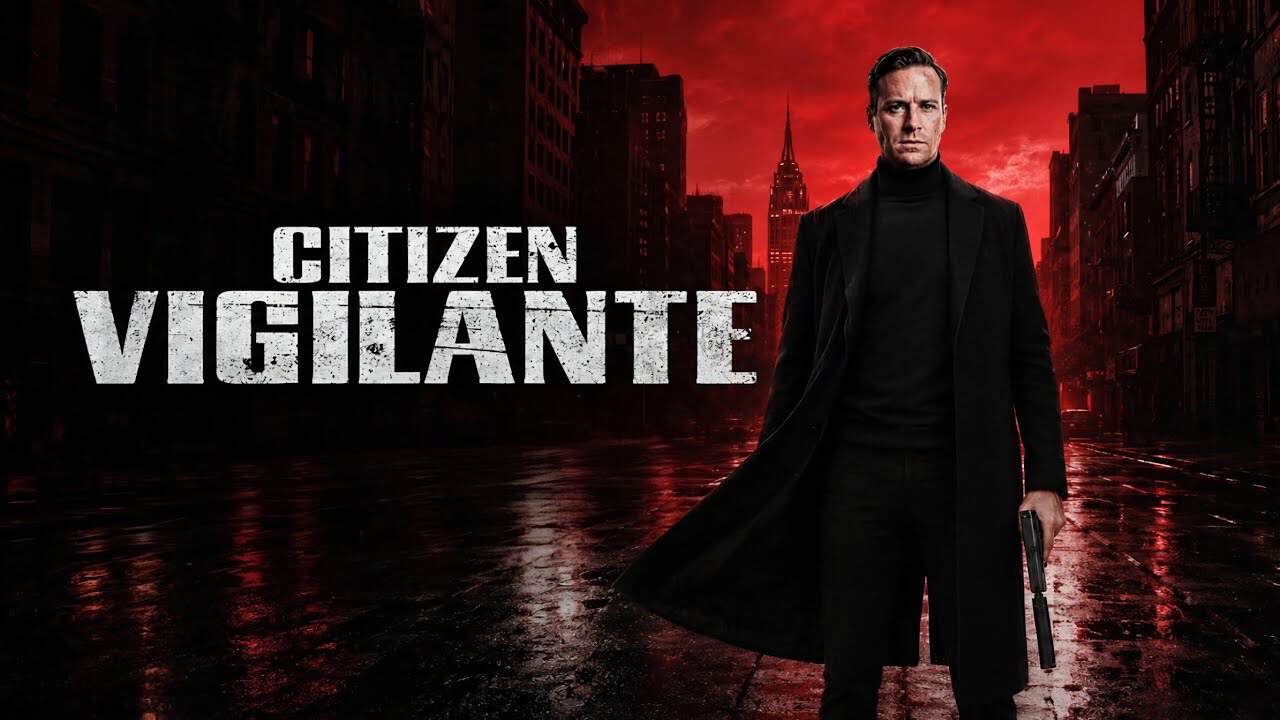
A July 5, 2026, News18 opinion essay advances a provocative argument about Citizen Vigilante: Uwe Boll’s film may be technically inept, narratively incoherent and ethically troubling, yet the anger it dramatizes should not be dismissed as mere cinematic provocation. Its importance lies less in what it achieves as a film than in what its reception reveals about political polarization, immigration politics, public safety and declining confidence in Western institutions.
Written, produced and directed by German filmmaker Uwe Boll, Citizen Vigilante stars Armie Hammer as Sanders, a wealthy American living in an unnamed European city. The character concludes that police, courts and political leaders have become unwilling or unable to protect ordinary residents. He responds by appointing himself judge, investigator and executioner, targeting people whom he associates with violent crime and institutional impunity. Costas Mandylor plays Henry, the police official charged with stopping him, creating the basic opposition between lawful authority and privately administered punishment.
The plot is constructed as a succession of escalating confrontations. Sanders challenges young migrants over bus fares, later assaults them, attacks police officers and eventually kills members of a Muslim immigrant family whom the film presents as involved in, or complicit with, rape. These incidents are not treated as incidental action sequences. They form the film’s political thesis: when the state appears to abandon its protective function, an individual may claim a moral mandate to use unrestricted force.
That thesis contains an immediate contradiction. Sanders condemns lawlessness while repeatedly violating the law. He portrays immigration violations and violent crime as intolerable threats, yet he operates outside the legal order, kills state agents and inflicts punishment without trial. The film asks audiences to regard one form of lawbreaking as proof of social collapse while presenting another form as an emotionally satisfying cure. This contradiction could have supported a serious tragedy about moral corrosion, but the screenplay rarely examines it with sufficient depth.
As cinema, the production suffers from weaknesses too conspicuous to ignore. Scenes are often composed without a clear visual hierarchy, camera movement can appear unstable, and the editing does not consistently establish where characters are, how much time has passed or why one episode follows another. Uneven sound, abrupt transitions and unconvincing effects further weaken immersion. Violence intended to feel shocking can instead appear artificial because the staging, performance and post-production do not create a believable physical world.
The surveillance problem is especially damaging to narrative credibility. Sanders does not consistently conceal his face or identity, even though he operates in a contemporary European setting saturated with closed-circuit cameras, mobile phones, payment records, vehicle tracking and digital location data. A competent investigation would ordinarily combine video analytics, witness statements, telecommunications metadata, financial records and travel information. The failure of both local police and Interpol to identify or contain such a visible offender is therefore not a minor gap. It is the mechanism required to keep the revenge fantasy functioning.
This implausibility also distorts the institutional critique. If the police fail because they are politically constrained, the film must demonstrate those constraints. If they fail through incompetence, the screenplay must establish the organizational causes. If officials are corrupt, their incentives and networks must be shown. Instead, institutional failure frequently operates as an assumption. Police and courts are ineffective because the plot requires Sanders to appear uniquely capable, not because their breakdown has been carefully dramatized.
The pacing produces a similar problem. Moments of sudden brutality are separated by exposition, speeches and loosely connected episodes whose chronology is not always intuitive. Supporting characters often exist to embody a political position rather than to behave like psychologically complete people. Dialogue consequently becomes declarative: characters announce what the film believes about migration, crime, masculinity, government and social disorder instead of allowing those ideas to emerge through credible choices and consequences.
Hammer’s physical presence gives Sanders a degree of menace, but the performance is constrained by a screenplay that supplies certainty where complexity is needed. A compelling vigilante character usually moves through grief, doubt, obsession, rationalization and self-destruction. Sanders more often functions as a delivery system for grievance. The supporting cast receives even less space for development, leaving victims, offenders, officials and bystanders reduced to narrative instruments.
The film’s low production values are not automatically disqualifying. Exploitation cinema has often used limited budgets, compressed schedules and crude imagery to confront subjects that prestige filmmaking avoids. Technical roughness can even intensify a story when it reflects the disorder of the world being depicted. In Citizen Vigilante, however, the roughness seldom feels deliberate. Form and theme do not reinforce one another reliably enough to transform limitation into style.
Nevertheless, dismissing the film solely because it is badly made would miss the phenomenon surrounding it. International reviews have been sharply divided not merely over craft but over whether its political message represents candour, propaganda or incitement. A hostile Guardian review described it as an incoherent collection of revenge tropes, while sympathetic reactions praised its willingness to depict fears that viewers believe established media and political institutions minimize. The intensity of this disagreement is sociologically more significant than the film’s aesthetic quality.
The central issue is a crisis of institutional trust. Liberal democracies ask citizens to surrender private retaliation in exchange for impartial policing, reliable courts and predictable punishment. This arrangement depends on more than formal legality. Citizens must believe that officials hear victims, investigate consistently, communicate honestly and apply standards without ideological favoritism. When that belief erodes, the state’s legal authority may remain intact while its moral legitimacy begins to weaken.
Criminology distinguishes recorded risk from perceived insecurity. The two can diverge because fear is shaped not only by aggregate crime rates but also by the visibility of particular offences, personal experience, neighbourhood change, media repetition and confidence in official explanations. Public-safety research has described a related reassurance gap between statistical trends and citizens’ sense of safety. Telling frightened communities that their concerns are statistically exaggerated may therefore be accurate in one dimension and politically disastrous in another.
This does not mean every viral claim about migrants and crime is reliable. Crime data can be distorted by selective time frames, differences in age and sex distribution, underreporting, inconsistent legal definitions, neighbourhood concentration and confusion between suspects, arrests, charges and convictions. Responsible analysis must distinguish immigration status, citizenship, country of origin and religious identity rather than treating them as interchangeable categories. It must also compare like populations and disclose uncertainty.
At the same time, methodological caution must not become a pretext for silence. Sexual violence, gang exploitation, assault and intimidation require investigation regardless of an alleged offender’s background. Victims should not be neglected because officials fear that acknowledging a case could strengthen prejudice. A democratic state protects social cohesion by enforcing the law impartially, not by suppressing inconvenient facts or assigning collective blame.
Citizen Vigilante fails this test of distinction. It moves too easily from crimes committed by particular characters to suspicion directed at a broader migrant and Muslim population. That transition is ethically and analytically unsound. Immigrants are not a single political, cultural or moral category, just as native-born citizens are not collectively responsible for offences committed by people who share their ancestry or religion. Individual guilt must remain individual if justice is to differ from vengeance.
The massacre of an entire family crystallizes the danger. The film presents relatives as complicit, but its compressed characterization leaves little room to establish degrees of knowledge, coercion, participation or legal responsibility. Collective punishment replaces adjudication. Once familial, ethnic or religious association becomes sufficient evidence, the boundary between retribution and sectarian violence collapses.
Due process is sometimes caricatured as excessive sympathy for offenders, yet its practical purpose is to separate accusation from proof. Investigation tests claims; disclosure exposes weaknesses; defence challenges state power; judicial reasoning identifies the applicable law; and appeal corrects error. These procedures can be slow and imperfect, but vigilante punishment eliminates every safeguard at once. It offers speed by discarding the mechanisms designed to prevent irreversible mistakes.
The vigilante genre has always exploited this tension. From frontier narratives to urban revenge thrillers, the genre imagines a society in which institutions are too corrupt, timid or bureaucratic to defend the innocent. Its protagonist then restores order through violence that ordinary law prohibits. The fantasy is emotionally potent because it converts fear into agency and humiliation into control. It is also politically volatile because it can make domination feel like justice.
The most effective vigilante films understand that the avenger is damaged by the power being exercised. Violence may stop an immediate threat, but it also narrows moral perception, encourages escalation and attracts imitators. Citizen Vigilante gestures toward these costs when Sanders clashes with police, yet it often frames his certainty and lethality as proof of clarity. The result is less a study of vigilantism than a fantasy structured around institutional humiliation.
Social media magnifies this structure. Within the story, the vigilante becomes a public symbol; outside it, provocative clips and political endorsements helped turn the film into an online event. Reports noted that the full film was made available on X for a limited period, allowing viewers to circulate scenes independently of their narrative context. Short-form distribution rewards the confrontational monologue, the humiliating encounter and the violent payoff—the exact elements most likely to intensify outrage.
Once detached from the complete film, such clips function as political tokens. Supporters can share them as evidence that forbidden truths are finally being spoken. Opponents can present them as proof of extremism. Neither side needs to engage with the film’s inconsistencies, because the cultural value of the clip lies in declaring identity and provoking an adversary. Cinema becomes ammunition in a battle of narratives.
The gap between critical reception and enthusiastic audience reactions should therefore be interpreted cautiously. It may reflect different judgments about artistic quality, but it may also show that viewers are rating political recognition rather than filmmaking. A person who feels ignored by mainstream institutions can experience even a crude narrative as emotionally truthful. Conversely, a viewer who recognizes collective stereotyping may reject the film before considering the grievances to which it appeals.
Distribution controversy added another layer. Germany’s refusal to provide the film with a conventional classification was widely described as an effective barrier to ordinary commercial release. Supporters interpreted the decision as censorship, while critics argued that the film risked legitimizing targeted violence. This dispute illustrates a familiar democratic dilemma: restrictions intended to prevent incitement can also strengthen a work’s reputation as suppressed truth.
A proportionate response requires precise distinctions. Criticism of immigration policy is not automatically hostility toward immigrants. Reporting an offence is not collective defamation. Depicting violence is not necessarily endorsing it. At the same time, repeated dehumanization, generalized guilt and explicit encouragement of unlawful attacks cannot be excused merely by calling them political debate. Regulators and platforms must examine context, intent, likelihood of harm and the difference between description and exhortation.
The dark storm suggested by the film is therefore not simply migration, multiculturalism or any one religious community. It is the convergence of several destabilizing forces: unresolved crime, selective political communication, declining trust, sensational media, ideological segregation and digital systems that reward anger. When these forces interact, each side begins to regard the other as evidence that ordinary democratic compromise has become impossible.
This process can be described as a legitimacy spiral. A shocking crime generates fear; hesitant or opaque official communication generates suspicion; partisan media assign collective motives; counter-speech minimizes or exaggerates the event; and citizens retreat into rival information systems. A violent fantasy then appears to one group as self-defence and to another as terrorism. Each reaction validates the other side’s worst expectations.
Vigilantism worsens that spiral because it attacks the state’s monopoly on legitimate force. Once private actors decide who deserves punishment, rival groups have equal incentive to arm, organize and retaliate. The likely outcome is not restored order but fragmented sovereignty: neighbourhood intimidation, reciprocal radicalization, politicized policing and escalating demands for exceptional state power. The promise of freedom through private violence can end in both communal conflict and authoritarian control.
An ethical reading grounded in dharmic traditions provides a useful alternative without collapsing their differences. Hindu, Buddhist, Jain and Sikh traditions contain distinct teachings on duty, Ahimsa, compassion, justice, protection of the vulnerable and legitimate force. Across those differences, action is not evaluated solely by anger or immediate effectiveness; intention, restraint, proportionality, responsibility and consequences matter. Moral courage cannot be reduced to vengeance, and social unity cannot be built through inherited or collective guilt.
This framework neither demands passivity nor excuses institutional failure. Protecting victims, confronting violent offenders and correcting unjust policy are legitimate duties. The crucial question is whether force remains accountable to law and ethical discipline. A society that abandons protection in the name of sensitivity fails the vulnerable, while a society that abandons restraint in the name of protection creates new victims.
A serious policy response begins with transparent crime measurement. Governments should publish disaggregated, privacy-protecting data with clear definitions, methodological notes and comparable population baselines. Independent auditing can reduce both official manipulation and partisan misuse. Public communication should acknowledge uncertainty without using uncertainty as an excuse to evade direct questions.
Victim-centred institutions are equally important. Reporting systems must be accessible, witnesses must receive protection, and survivors of sexual violence need timely medical, legal and psychological support. Investigators require specialist training, while prosecutors need adequate resources to handle complex networks. Visible competence is one of the strongest defences against both vigilantism and conspiracy narratives.
Immigration and integration policy must also be enforceable. Admission rules, asylum procedures and removal decisions lose legitimacy when they exist only on paper. At the same time, collective suspicion undermines cooperation with law-abiding migrant communities whose information can help prevent crime and radicalization. Effective security depends on lawful enforcement and community trust rather than choosing one at the expense of the other.
Political leaders carry a special responsibility. Euphemism can be as corrosive as demagoguery. Minimizing legitimate concerns creates an audience for extremists, while exaggerating isolated crimes converts individuals into symbols of an entire population. Democratic leadership requires the more difficult language of specificity: naming the offence, identifying verified facts, protecting the accused until guilt is established and refusing to assign responsibility beyond the evidence.
Media institutions should apply the same discipline. Responsible reporting separates allegation from conviction, incident from trend and community identity from individual conduct. It also gives victims serious attention without turning suffering into spectacle. Trust is not restored by asking audiences to ignore disturbing events; it is restored by demonstrating that facts will be investigated consistently, even when they complicate a preferred narrative.
Evaluated strictly as a film, Citizen Vigilante remains deeply flawed. Its erratic editing, weak effects, implausible investigation, uneven acting and underdeveloped characters prevent it from becoming the rigorous political thriller its subject requires. It raises difficult questions but repeatedly answers them through simplification, spectacle and punishment.
Evaluated as a cultural signal, however, it deserves careful attention. The enthusiasm surrounding it indicates that a significant audience feels unseen by conventional political and media narratives. That feeling does not validate the film’s stereotypes or its celebration of extrajudicial violence, but ignoring it would repeat the institutional blindness the film claims to expose.
The enduring warning is not that Sanders represents a solution. He represents the point at which citizens cease to believe solutions can emerge from law. Western democracies can prevent that outcome only by combining security with due process, candour with social responsibility and cultural confidence with equal citizenship. Citizen Vigilante is a poor vehicle for that lesson, but the storm visible behind its crude revenge fantasy is real enough to merit sober examination.
Inspired by this post on Hindu Post.










Leave a Reply
You must be logged in to post a comment.