
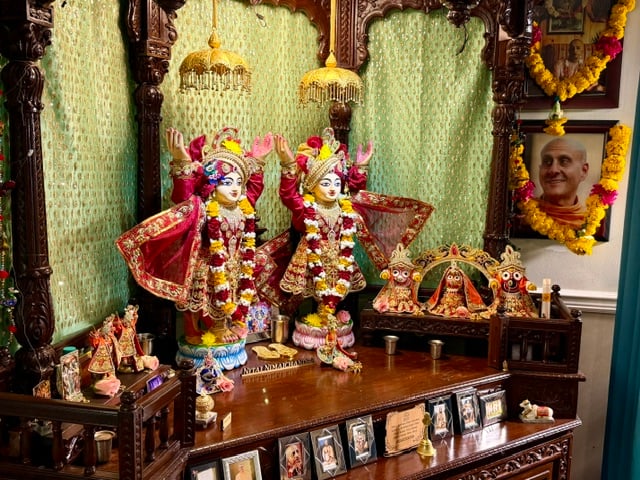
The seventh anniversary of the installation of Sri Sri Nitai Nimai Chandra offered Seattle’s Gaudiya Vaishnava community an occasion to unite sacred memory, domestic worship and collective celebration. Held in the home of Vraja Raman and his family, the gathering demonstrated how a household shrine can become a stable spiritual center whose influence extends beyond the immediate family. The anniversary was therefore more than a recollection of an event seven years earlier; it was a renewal of an enduring relationship between the deities, their caretakers and the surrounding community.
Ramai Swami attended the celebration one day after arriving in Seattle. The invitation brought him into a setting that was personal in scale yet connected to a much wider devotional network. In Hindu traditions, hospitality toward visiting teachers and fellow practitioners is often inseparable from hospitality toward the divine. Welcoming a spiritual guest into a home where regular deity worship is performed can consequently deepen both the ceremonial character of the occasion and the bonds among participants.
The name Sri Sri Nitai Nimai Chandra situates the celebration within Gaudiya Vaishnavism, the Krishna-centered bhakti tradition associated with Sri Chaitanya Mahaprabhu and Sri Nityananda Prabhu. “Nimai” is a beloved name of Sri Chaitanya, while “Nitai” is an affectionate name for Sri Nityananda. The honorific repetition “Sri Sri” expresses reverence, and “Chandra,” meaning “moon,” carries poetic associations of radiance, beauty and cooling spiritual grace. Together, the names communicate intimacy as well as transcendence: the divine is worshiped with formal respect while also being approached through affection.
Gaudiya Vaishnava theology understands Sri Chaitanya and Sri Nityananda as inseparable manifestations of divine compassion. Their teachings place particular emphasis on bhakti, the cultivation of loving devotion, and on the congregational chanting of sacred names. The presence of Sri Sri Nitai Nimai Chandra in a home therefore signifies more than the possession of sacred images. It establishes a continuing discipline of remembrance, service, prayer and hospitality centered on the ideals represented by Their Lordships.
Within this devotional framework, the installation of deities marks the beginning of sustained seva rather than the completion of a single ceremony. Daily worship may involve offerings of food, water, flowers, incense, lamps, clothing, music and prayer according to the household’s capacity and authorized practice. The essential principle is regular, attentive service. An anniversary allows the community to recognize the consistency required to maintain that service across changing schedules, family responsibilities and the practical demands of life.
The first arrival and installation of Sri Sri Nitai Nimai Chandra had drawn a particularly large assembly. According to the account preserved by the hosts, nearly three hundred people attended that original function. HH Gopala Krishna Maharaja and HG Hari Vilasa Prabhu were among the devotees present. The scale of that inaugural gathering indicates that the installation was understood not simply as a private family milestone but as an event of importance to the broader devotional community.
The seventh-anniversary celebration was smaller than the installation ceremony, although a good number of devotees still attended. This contrast is significant. Foundational events often attract exceptional crowds, while anniversaries reveal whether the practices established at the beginning have endured. A smaller gathering can possess its own depth: participants may have greater opportunity to listen closely, sing together and experience the warmth of devotional fellowship within the intimate environment of a home.
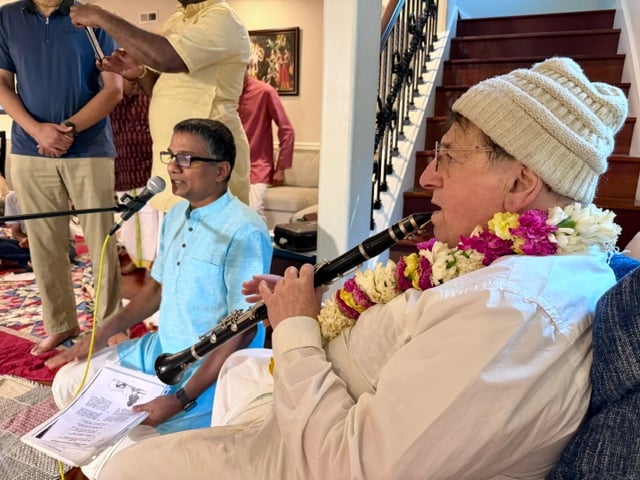
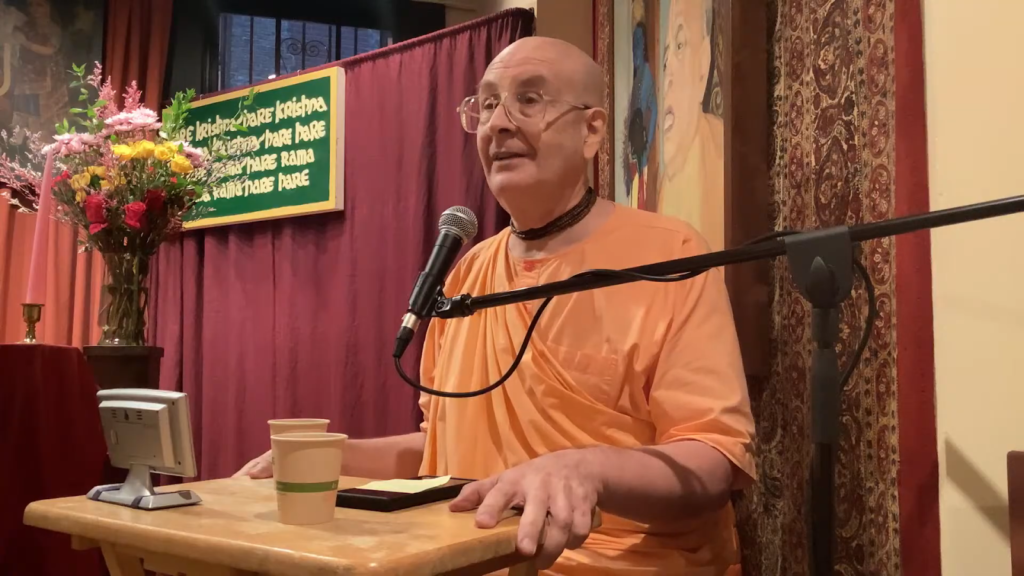
The program included talks by HG Hari Vilasa Prabhu and Ramai Swami. Spiritual discourse serves an important interpretive function during a religious anniversary. Ritual activity can become familiar through repetition, but thoughtful instruction returns attention to its purpose. By connecting external observances with teachings on devotion, service and remembrance, such talks help participants understand why an anniversary matters and how its principles can be carried into ordinary life.
The talks were followed by beautiful bhajans, arati and kirtan. Although these practices frequently appear together, each contributes a distinctive dimension to the devotional experience. Bhajans generally create a contemplative musical atmosphere in which sacred names and devotional poetry guide attention toward the divine. Kirtan is often more explicitly congregational, inviting participants to respond, repeat and join their voices. Arati places the worship of the deities at the visible center of the assembly through the ceremonial offering of auspicious items, especially light.
In Gaudiya Vaishnavism, sacred sound is not treated merely as artistic accompaniment. The chanting of divine names is itself a primary spiritual practice. Nama-sankirtana joins theology, music and community participation in a form accessible to people with different levels of learning or ritual expertise. A person unfamiliar with the structure of the ceremony can still listen, respond and gradually enter its devotional mood. This accessibility helps explain why kirtan remains central to Krishna consciousness in temples, homes and public gatherings around the world.
Bhajans contribute another form of devotional concentration. Their melodies may be gentle or exuberant, but their purpose is not simply entertainment. The repeated names and carefully transmitted verses orient memory toward divine qualities, sacred relationships and exemplary lives. In a domestic setting, this musical practice can transform an ordinary room into a shared contemplative space. Participants do not need identical emotional responses; some may sing energetically, while others may listen quietly and reflect.
Arati expresses worship through embodied symbols. Light is offered before the deities, commonly accompanied by bells, incense, flowers and song according to the tradition and circumstances. The circular movement of the lamp directs collective attention toward the sacred forms, while the gathered community participates through sight, sound and reverence. Academically, arati may be understood as ritual hospitality, yet practitioners experience it more intimately as an offering of love and an opportunity to receive divine grace.
The sequence of discourse, bhajans, arati and kirtan brought reflection and participation into a coherent whole. The talks clarified meaning; the bhajans cultivated inward attention; arati focused the senses on worship; and kirtan allowed the entire assembly to respond collectively. This progression illustrates the integrated character of bhakti practice, in which intellectual understanding, emotion, bodily participation and community life reinforce one another rather than functioning as separate religious domains.
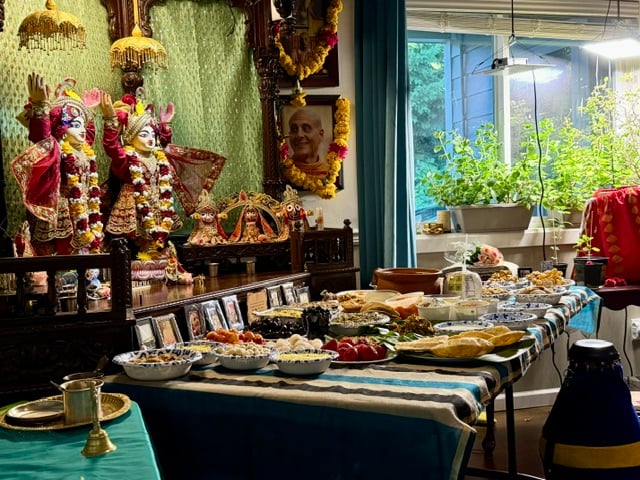
The evening concluded with a sumptuous feast consisting of many preparations. The shared meal was not an incidental addition after the “religious” portion of the event. Food has a central place in Vaishnava hospitality, and meals associated with deity worship are commonly understood through the principle of prasadam: food prepared with care, offered to the divine and then respectfully shared. The meal thus extends worship into nourishment, fellowship and gratitude.
A feast also creates a valuable social space. People who may have arrived as acquaintances sit together, exchange experiences and strengthen relationships. Children encounter religious life through taste, sound, color and the conduct of adults around them. New participants can meet established members of the community without the pressure of formal discussion. In this way, the distribution and honoring of food support both spiritual practice and community cohesion.
The household location is especially important for understanding the anniversary. Temples provide public institutions, established schedules and dedicated sacred architecture, but home worship demonstrates that spiritual life is not confined to institutional buildings. A domestic shrine places devotion within the rhythms of waking, cooking, working, receiving guests and caring for relatives. The sacred is encountered not only on designated festival days but through repeated acts of service performed within everyday life.
Maintaining home deity worship for seven years represents continuity. Such continuity depends on practical organization as much as devotional aspiration. Offerings must be prepared, the worship area cared for, festival arrangements coordinated and visitors accommodated. These tasks often remain less visible than the public ceremony, yet they form the material foundation of the celebration. The anniversary implicitly honors the steady service of Vraja Raman and his family as well as the support of the devotees around them.
For Hindu communities living outside South Asia, home-based observances can also preserve tradition across geography and generations. Seattle is far from the historic centers of Gaudiya Vaishnavism in Bengal, Odisha and Vrindavan, but devotional practice creates meaningful continuity between those sacred geographies and life in the Pacific Northwest. This continuity is not a simple duplication of the past. It is a living adaptation in which inherited practices take root within new homes, languages, schedules and social environments.
Anniversaries serve as forms of ritual memory. A seventh anniversary recalls the original installation, the nearly three hundred attendees and the respected Vaishnava figures who participated, while also directing attention to the present condition of the community. Memory in this context is active rather than nostalgic. The earlier event becomes a reference point for renewed service, and each subsequent celebration adds another layer to the history shared by the household and its guests.
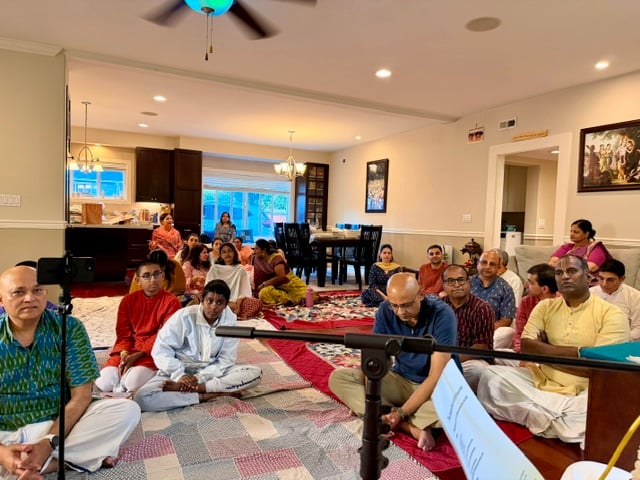
The celebration also illustrates how scale should be interpreted carefully. A large inauguration can display broad enthusiasm, while a more intimate anniversary can reveal durable commitment. Attendance alone does not measure the significance of a devotional gathering. The quality of participation, continuity of worship, sincerity of hospitality and strength of relationships may offer a more meaningful account of its long-term value.
From a broader perspective, the event reflects themes found across the dharmic traditions: disciplined practice, reverence for sacred presence, transmission through community, hospitality and the ethical sharing of food. Buddhist chanting, Jain puja and Sikh kirtan arise from distinct doctrines and histories, and those differences should not be erased. Nevertheless, recognizing shared commitments to self-cultivation, compassion, remembrance and community service can encourage respectful dialogue among Hindu, Buddhist, Jain and Sikh practitioners.
Kirtan provides a particularly meaningful point of connection. Sikh and Vaishnava traditions both give sacred music a prominent communal role, although their scriptures, theology and liturgical forms remain distinct. Similarly, carefully prepared offerings and disciplined household observances appear in multiple Hindu, Buddhist and Jain settings with different interpretations. Unity among dharmic traditions is strongest when it is grounded in informed respect rather than in claims that every tradition is identical.
The anniversary of Sri Sri Nitai Nimai Chandra ultimately joined several dimensions of religious life within one evening: theology was communicated through talks, devotion was expressed through bhajans and kirtan, worship was enacted through arati, and fellowship was completed through a generous feast. None of these elements stood alone. Together, they created an environment in which learning, emotion, ritual and community could support one another.
The enduring lesson of the Seattle celebration lies in the strength of sustained devotion. The original installation was memorable for its large attendance and distinguished guests, but the seventh anniversary showed that the relationship established at that time remained active. Through the continuing care of Vraja Raman’s family and the participation of the local community, Sri Sri Nitai Nimai Chandra remained at the center of a living tradition shaped by service, sacred sound and shared hospitality.
Such gatherings demonstrate how a home can become a place of spiritual education and collective belonging. Their influence is carried forward not only through formal teachings but through remembered melodies, the sight of arati, conversations among devotees and the experience of sharing food. The seventh anniversary was therefore both a celebration of the past and a practical affirmation of the future: devotion continues when sacred ideals are translated into consistent service and generously shared with others.
Inspired by this post on Dandavats.






Leave a Reply
You must be logged in to post a comment.