
The Banana Trap: Why Grasping Becomes a Form of Captivity
The Success Sadhana reflection dated July 10, 2026, and presented through the Vaisesika Dasa channel, is organized around a vivid image: the “banana trap.” The metaphor describes a creature reaching into a narrow opening, closing its hand around a desired piece of fruit, and becoming unable to withdraw the clenched fist. Release is physically possible, but only if the coveted object is relinquished. The trap therefore does not depend entirely on an external barrier. Its power lies in the refusal to let go.
This image offers a compact model of attachment. Human beings rarely become trapped by bananas, yet they may remain psychologically clenched around status, possessions, resentment, approval, control, habits, relationships, ideological certainty, or a preferred image of themselves. The object may initially appear to promise satisfaction or safety. Over time, however, the effort to retain it may consume attention, distort judgment, and prevent movement toward a more meaningful life. What is held eventually begins to hold the person.
The banana-trap story should be understood primarily as a teaching parable rather than as a scientific description of primate behavior or a universal account of traditional hunting methods. Its value does not depend on proving that every detail has been used literally in every culture. Like many philosophical narratives, it isolates one pattern of conduct so that the pattern becomes easier to recognize: an available path to freedom remains unused because desire has narrowed the range of perceived choices.
The Anatomy of the Trap
The metaphor can be translated into a behavioral sequence: a cue attracts attention; attention intensifies wanting; wanting produces grasping; grasping brings a brief reward or reduction in discomfort; and that immediate consequence strengthens the probability of repeating the behavior. The loop can be represented as cue → craving → grasping → short-term payoff → reinforced attachment. The long-term cost often remains invisible during the moment of urgency because the mind is evaluating what can be obtained or protected now, not what continued grasping will require tomorrow.
Everyday versions of this loop are easy to observe. A notification appears, and a person reaches for a phone despite intending to concentrate. A critical comment is remembered, and the mind rehearses an argument long after the conversation has ended. An unnecessary purchase promises relief from boredom. A position in an organization becomes inseparable from personal worth. A relationship is preserved through fear and control rather than trust. In each case, the “banana” is not necessarily evil. The trap emerges from the relationship between the mind and the object.
Contemporary reward research helps clarify why this relationship can become so persistent. Neuroscientists Kent Berridge and Terry Robinson distinguish reward-related “wanting” from “liking.” Their work indicates that the motivational pull of a cue can become partly dissociated from the pleasure actually received. A person may therefore continue wanting something that no longer provides much enjoyment. This framework was developed especially in relation to addiction and should not be applied casually as a diagnosis of ordinary desire, but it illuminates the central paradox of the banana trap: motivational force can remain powerful even after satisfaction has diminished. The relevant research is reviewed in Berridge and Robinson’s account of incentive salience.
Habit research adds another layer. Repeated actions performed in stable contexts can become increasingly responsive to cues rather than fresh deliberation. A familiar time, place, emotional state, or device can begin prompting behavior automatically. Wendy Wood and Dennis Rünger’s review of the psychology of habit explains how context-response associations allow conduct to persist even when conscious intentions have changed. This is why moral resolve alone may be insufficient. If the cue remains visible, the reward remains immediate, and the alternative remains vague, the hand tends to close again.
The trap is also sustained by temporal asymmetry. Immediate rewards are concrete: the message can be checked now, the purchase can be made now, the retaliatory sentence can be delivered now, and the uncomfortable feeling can be avoided now. Costs such as distraction, debt, damaged trust, or spiritual stagnation accumulate gradually. Sadhana corrects this asymmetry by bringing distant consequences into present awareness. It trains the practitioner to ask not merely, “What does this offer at this moment?” but also, “What pattern is this action strengthening?”
Attachment in the Bhagavad Gita
The Bhagavad Gita provides one of the clearest classical analyses of escalating attachment. In Bhagavad Gita 2.62–63, sustained contemplation of sense objects is described as giving rise to attachment; attachment generates desire; frustrated desire produces anger; and anger contributes to delusion, disturbed memory, and impaired discernment. The sequence is psychologically precise because it begins before an obvious crisis. Captivity starts when attention repeatedly circles the object and invests it with exaggerated significance.
This teaching does not demand sensory numbness or hostility toward the world. Bhagavad Gita 2.64–65 describes disciplined engagement in which the senses move among their objects without domination by attraction and aversion. The central problem is therefore not perception, contact, work, or responsible enjoyment. The problem is loss of inner governance. Freedom means that discernment can still operate in the presence of desire.
Bhagavad Gita 6.5–6 further depicts the mind as capable of functioning as either friend or adversary. This is not a claim that every hardship is self-created, nor does it erase social, economic, medical, or political causes of suffering. It identifies a narrower but crucial domain: even when external circumstances cannot be changed immediately, the mind’s trained or untrained response affects whether difficulty becomes wisdom, compulsive reaction, or despair.
The yogic principle of aparigraha, commonly translated as non-grasping or non-possessiveness, develops the same insight. Aparigraha is not careless neglect of property, family, health, or public responsibility. It is the disciplined refusal to build identity and security upon unlimited acquisition. Possessions may remain in practical use without occupying the center of consciousness. The hand can hold a tool while remaining capable of opening.
Bhakti and the Transformation of Desire
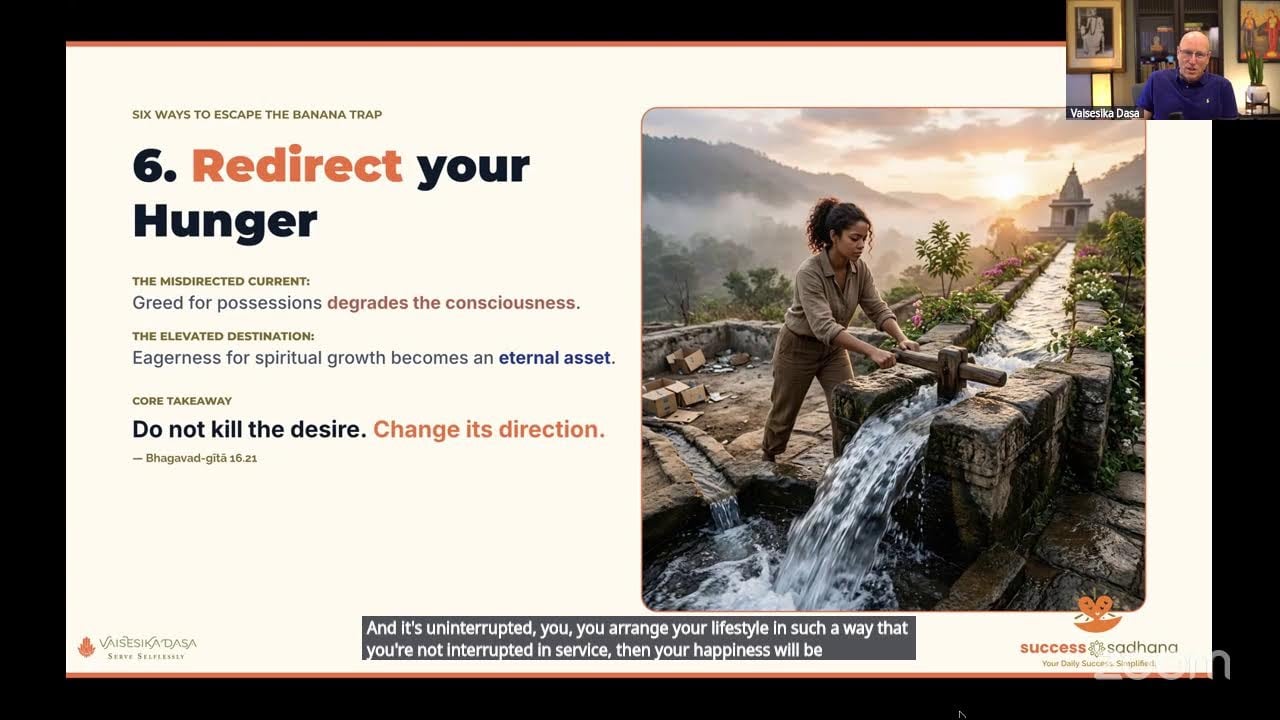
Bhakti Yoga does not treat desire merely as an enemy to be crushed. It seeks to educate and redirect desire. In the Vaishnava understanding, the deepest problem is not that the living being loves, serves, values, or acts; it is that these capacities become confined within possessiveness and self-centered appropriation. Sadhana gradually reorients them toward loving service, gratitude, remembrance of Krishna, ethical responsibility, and care for other living beings.
This distinction is expressed through the principle of yukta-vairagya, associated with Rupa Gosvami: appropriate engagement without material possessiveness. A home, occupation, talent, technology, wealth, or institution need not be rejected merely because it belongs to worldly life. Its moral and spiritual significance depends on purpose, method, and consciousness. Renunciation becomes mature when resources are used responsibly without being treated as the ultimate source of identity or happiness.
Such a view prevents the banana-trap metaphor from becoming anti-life. Family affection is not automatically bondage. Professional excellence is not automatically vanity. Financial planning is not automatically greed. Aesthetic enjoyment is not automatically indulgence. Each becomes binding when fear, domination, entitlement, or self-definition makes release impossible even when dharma clearly requires change.
Devotional practice supplies a positive object of attention rather than leaving an empty psychological space. Mantra meditation, study of scripture, prayer, kirtan, seva, gratitude, association with spiritually serious people, and regulated daily conduct provide alternative sources of meaning. This matters because a habit is rarely transformed by deprivation alone. A durable transition normally requires a more coherent and valuable way of living.
A Shared Dharmic Concern with Grasping
The concern with grasping extends across the dharmic traditions, although their metaphysical explanations are not identical. Hindu traditions analyze attachment through concepts such as raga, moha, karma, vairagya, bhakti, and aparigraha. Buddhist teachings examine tanha, or craving, and upadana, or clinging, as conditions that perpetuate suffering. Jain ethics gives aparigraha a central place among the vows and connects both external accumulation and internal possessiveness with karmic bondage. Sikh teachings identify moh, delusive attachment, as a major obstacle and emphasize remembrance of the Divine, honest work, seva, and sangat.
These parallels support respectful dialogue without erasing meaningful differences. Buddhism does not simply reproduce Hindu accounts of an eternal self. Jain teachings possess a distinctive doctrine of the jiva and karmic matter. Sikh thought has its own scriptural, devotional, and communal framework. Hindu schools themselves differ substantially in their accounts of selfhood, liberation, grace, knowledge, and devotion. Unity among dharmic traditions is strengthened by accurate comparison, not by forcing every tradition into a single vocabulary.
A shared practical insight nevertheless remains visible: craving becomes dangerous when it governs perception, conduct, and identity. Each tradition offers methods for weakening that governance through disciplined awareness, ethical restraint, compassion, service, remembrance, wisdom, and community. The common objective is not emotional coldness but freedom from compulsive appropriation.
This shared concern also carries an ethical implication. A person cannot claim spiritual detachment while exploiting employees, neglecting dependents, humiliating opponents, or remaining indifferent to suffering. Authentic non-attachment reduces selfish domination; it does not provide a sophisticated excuse for irresponsibility. A hand truly released from grasping becomes more available for service.
Letting Go Is Not Suppression
Letting go is frequently confused with suppression. Suppression attempts to force a thought, emotion, or desire out of awareness without examining its cause. Non-attachment allows the experience to be observed without automatically obeying it. The difference is substantial. Suppression says that the feeling must not exist; disciplined awareness recognizes that the feeling exists but does not grant it unquestioned authority.
Psychological distancing offers one contemporary parallel. It involves viewing an emotionally charged event from a more objective or temporally removed perspective. Research reviewed by Powers and LaBar suggests that distancing can reduce emotional intensity and engage processes associated with cognitive control, although effectiveness varies by context and method. The evidence does not prove a spiritual doctrine, but it supports the practical value of creating space between stimulus and response. Their taxonomy and meta-analysis are available in Regulating Emotion Through Distancing.
Non-attachment must also be distinguished from dissociation, passivity, and avoidance. A person may claim to have “let go” while actually refusing to grieve, apologize, make restitution, seek medical care, or address an injustice. Genuine release increases clarity and capacity for appropriate action. Avoidance merely postpones contact with the problem.
Diagnosing the Personal Banana
The first practical task is identification. A useful inquiry examines repeated sources of disproportionate agitation. What outcome feels absolutely necessary? Which criticism continues to replay? What possession, role, relationship, belief, or habit appears impossible to loosen? What is being protected: comfort, reputation, control, belonging, certainty, superiority, or relief from pain? The answer is often less visible than the object itself.
A second inquiry measures cost. The relevant question is not whether the object has value, but whether the mode of attachment is consuming more than it gives. Costs may appear in lost sleep, fragmented attention, secrecy, debt, ethical compromise, damaged relationships, neglected duties, or declining spiritual practice. Written observation is useful because vague unease becomes more intelligible when linked to specific behavior and consequences.
A third inquiry maps the cue. Grasping rarely occurs at random. It may intensify after fatigue, loneliness, praise, humiliation, conflict, boredom, hunger, stress, or exposure to a particular digital environment. The same behavior may serve different functions on different occasions. One person checks a device for stimulation, another for reassurance, and another to avoid a difficult task. Effective sadhana addresses the function rather than condemning the surface action alone.
A Practical Release Protocol
When the cue appears, the first intervention is a pause. One slow exhalation, a brief mantra, or several seconds of stillness interrupts immediate enactment. The pause is not expected to erase desire. Its purpose is to restore a minimal interval in which discernment can operate. Even a short interval changes the structure of the moment: the urge becomes an event being observed rather than an order being executed.
The second intervention is accurate naming. A statement such as “approval is being sought,” “anger is being rehearsed,” or “the urge to escape discomfort is present” is more useful than a global judgment such as “this person is weak.” Precise labeling separates behavior from identity. It also makes compassionate correction possible, whereas shame often drives the same behavior underground.
The third intervention is consequence simulation. The mind briefly compares two trajectories: the likely condition ten minutes, ten days, and ten months after grasping, and the likely condition after releasing. This practice counters the dominance of immediate reward. It does not guarantee perfect prediction, but it restores neglected temporal information to the decision.
The fourth intervention is alignment with dharma. The choice is evaluated through responsibility, truthfulness, non-harm, self-control, compassion, and service. In devotional practice, another question becomes central: which action supports remembrance of the Divine and the welfare of others? This shifts the decision from “What does the urge demand?” to “What kind of consciousness and character will this action cultivate?”
The fifth intervention is a predetermined alternative. Behavioral research describes such preparation as an implementation intention: if a defined cue occurs, then a defined response follows. A plan might state, “If criticism triggers an immediate reply, then three calm breaths will precede any response,” or “If the phone is reached for during focused work, then it will be placed outside the room for twenty minutes.” A meta-analysis by Gollwitzer and Sheeran found that such if-then planning improved goal attainment across many studies, although effect sizes depend on context and study design. The research is summarized in Implementation Intentions and Goal Achievement.
The sixth intervention is environmental design. Spiritual discipline should not be reduced to an endless contest between intention and temptation. Removing stored payment details, disabling nonessential notifications, keeping intoxicants out of the home, setting a defined spending threshold, or avoiding a context associated with destructive behavior can reduce cue exposure. The environment then supports the value the practitioner already intends to honor.
The seventh intervention is substitution. A compulsive behavior often performs a real, though limited, function. It may regulate anxiety, create stimulation, offer social contact, or produce temporary relief. A replacement should address that function in a healthier manner: walking, chanting, contacting a trusted person, performing seva, resting, journaling, or completing one small constructive task. Merely removing the banana without understanding the hunger leaves the hand searching for another object.
Daily Sadhana for an Open Hand
A sustainable practice begins in the morning before competing cues accumulate. A brief period of mantra meditation, prayer, scriptural study, or silent reflection establishes the day’s governing intention. The practitioner may identify one likely trigger and prepare one dharmic response. The aim is not to predict every difficulty but to enter the day with a consciously chosen orientation.
During the day, micro-pauses preserve that orientation. A pause before opening an application, making a purchase, replying to criticism, or entering a meeting converts routine transitions into moments of sadhana. The practice remains practical because it is attached to events that already occur. Spiritual life is thus integrated into work, family, technology, and public conduct rather than confined to a separate devotional interval.
An evening review completes the cycle. The practitioner notes where grasping appeared, what cue preceded it, which response followed, and what might be adjusted. The review should be factual rather than punitive. Harsh self-condemnation can itself become another banana: the mind clings to an identity of failure and gains a strange familiarity from rehearsing it. Honest accountability is firmer and more useful than shame.
Regular association also matters. Sangat, sangha, satsanga, or spiritually constructive community can reveal blind spots that private reflection misses. A trustworthy community combines encouragement with accountability and should never demand the surrender of conscience, financial transparency, personal safety, or critical reasoning. Healthy guidance enlarges discernment; manipulation replaces one form of grasping with another.
The Banana Trap in Relationships
Relationships become traps when love is confused with possession. A person may grasp another’s attention, agreement, availability, or identity in the name of care. The resulting control weakens the very intimacy it seeks to secure. Non-attachment in relationships does not mean emotional distance. It means affection without ownership, loyalty without domination, and honest boundaries without vengeance.
Resentment is another powerful object of attachment. It may initially preserve the memory that a wrong occurred, but repeated rehearsal can make the injury central to identity. Releasing resentment does not require denying facts, abandoning justice, or restoring unsafe access. It means refusing to let the offender occupy unlimited mental space. Accountability and inner release can proceed together.
The same principle applies to being right. Intellectual conviction is necessary in scholarship, ethics, and public life, yet attachment to victory can make evidence irrelevant and opponents inhuman. Dharmic dialogue requires the capacity to revise a claim without experiencing correction as annihilation. A view held responsibly remains open to examination; a view grasped as identity becomes difficult to evaluate.
Digital Attention and Manufactured Bananas
Digital environments intensify the banana-trap dynamic by presenting rapid, personalized, and frequently renewed cues. Notifications, infinite feeds, recommendation systems, social metrics, and intermittent rewards can repeatedly redirect attention. These systems do not eliminate individual agency, but they alter the environment in which agency must operate. Treating digital overuse solely as a failure of character overlooks the deliberate design of attention-capturing systems.
A technically informed spiritual response therefore combines self-control with architecture. Devices can be kept outside spaces used for prayer, study, sleep, and conversation. Applications can be accessed during defined windows rather than continuously. Visual and auditory cues can be reduced. The objective is not a theatrical rejection of technology but the restoration of intentional use. Technology becomes a tool again when it no longer dictates the rhythm of awareness.
Ambition, Wealth, and Leadership
Ambition is another morally mixed object. It can energize scholarship, enterprise, public service, artistic excellence, and care for a family. It becomes binding when achievement is required to prove personal worth or justify disregard for others. The test is not simply whether a goal is large. The test is whether the person can pursue it ethically, receive criticism, share credit, tolerate delay, and release the goal when it conflicts with a higher duty.
Wealth likewise functions as a resource, a responsibility, and a potential source of bondage. Responsible provision, saving, investment, and generosity are compatible with non-attachment. Captivity appears when accumulation has no concept of sufficiency, when fear persists regardless of security, or when money becomes the primary measure of human value. Aparigraha asks how much is enough and what surplus is for.
Leadership exposes grasping because authority can easily merge with identity. A leader trapped by position resists succession, conceals error, silences disagreement, and treats institutional welfare as secondary to personal control. A leader practicing non-attachment develops others, distributes knowledge, creates transparent processes, and remains capable of stepping aside. The open hand is not weak; it is evidence that responsibility has become more important than possession.
Why Release Often Feels Like Loss
Letting go can initially produce grief, anxiety, or emptiness because the attachment may have organized daily life for years. Even an unhealthy pattern can provide predictability. This explains why insight does not always produce immediate change. The nervous system, social environment, and personal narrative may all be adapted to the old arrangement. Gradual, supported change is not spiritual failure; it is often the realistic form of transformation.
Mindfulness-based interventions have shown potential for reducing craving in some clinical research, but the evidence should be described cautiously. A 2023 systematic review and meta-analysis reported favorable aggregate results while also finding high inconsistency, generally high risk of bias, and low overall certainty. Spiritual or mindfulness practices should therefore complement, not automatically replace, evidence-based treatment. The review is available through BMC Neuroscience.
Serious substance dependence, gambling disorder, eating disorders, compulsive sexual behavior, self-harm, trauma-related symptoms, or severe anxiety and depression may require qualified clinical care. The banana metaphor can support understanding, but it is not a diagnostic instrument or a complete treatment plan. Medical supervision can be essential because abruptly stopping some substances may be dangerous. Seeking help is an expression of responsibility rather than a deficiency of faith.
How Progress Can Be Evaluated
Progress is better measured by increased freedom than by the total disappearance of desire. Useful indicators include a longer pause before reaction, fewer episodes of automatic behavior, faster recovery after a lapse, greater honesty, improved fulfillment of duties, reduced secrecy, more stable attention, and increased capacity to act for another’s welfare. These changes show that desire is losing its monopoly over conduct.
A lapse should be treated as data. It identifies a cue, an unmet need, an unrealistic plan, or an environment that requires redesign. Repeated lapses do require stronger intervention, but despair adds no precision. Sadhana is repetition guided by discernment. The hand learns to open through many deliberate releases.
The deepest sign of release is not indifference but availability. Attention becomes available for prayer and study. Time becomes available for family and service. Wealth becomes available for responsible use. Intelligence becomes available for truth rather than self-defense. Authority becomes available for stewardship. When grasping weakens, life does not become empty; it becomes less obstructed.
From Captivity to Inner Freedom
The banana trap endures as a powerful image because its solution is both simple and difficult. No elaborate escape is required: the hand must open. Yet opening means surrendering an object that the mind has temporarily equated with happiness, identity, or survival. The decisive work of sadhana is to examine that equation and discover that freedom has greater value than possession.
This insight unites contemplative wisdom with practical behavioral understanding. Attention feeds attachment; cues activate learned responses; immediate rewards obscure distant costs; and repeated practice can establish a different pattern. Hindu, Buddhist, Jain, and Sikh traditions approach these matters through distinct doctrines, but all offer resources for ethical restraint, awareness, compassion, service, and liberation from compulsive grasping.
The final lesson is not that every valued object must be abandoned. It is that nothing finite should be held so tightly that truth, dharma, compassion, and spiritual growth become impossible. A possession may remain. A goal may remain. A relationship may remain. What changes is the clenched relationship to it. The practitioner no longer asks only how to secure the banana, but whether holding it is preventing the hand from becoming free.
Original reflection: 2026-07-10 Success Sadhana – The Banana Trap, Vaisesika Dasa channel.
Inspired by this post on Dandavats.











Leave a Reply
You must be logged in to post a comment.