Dhata is venerated in ancient Hindu texts as one of the Dwadasha Adityasthe twelve solar deities born to Aditi and Kashyapa. Recognized as a benefactor of health, wealth, and peace, Dhata is invoked through the sacred mantra “OM SRI DHATA DEVAYA NAMAHA”. In many household traditions, Dhata is worshipped alongside Mata Lakshmi Devi to cultivate a synthesis of material prosperity (śrī) and inner tranquility (śānti), reflecting the enduring Hindu understanding that well-being is both outer and inner.
Etymologically, the name “Dhata” derives from the Sanskrit verbal root dha (“to place, to support, to establish”). Dhata thus means “Establisher” or “Sustainer,” a semantic range that aligns closely with the role of upholding rita, the cosmic order. In the Vedic corpus, the term dhata or dhatri often functions as an epithet for the creative and ordering principle; later Puranic narratives personify this function as the Aditya Dhata, an aspect of the solar divinity that stabilizes and harmonizes the world.
Within the Dwadasha Adityas, enumerations vary across puranic and regional sources (such as the Vishnu Purana, Matsya Purana, and Bhagavata Purana), but Dhata consistently appears as one among the twelve. Collectively, the Adityas safeguard temporal cycles, seasons, directions, and moral law. Ritual manuals frequently link the Adityas to the twelve solar months, underscoring Dhata’s association with stability, auspicious continuity, and the measured flow of time that sustains life.
Genealogically, Dhata is named among the sons of Aditi and Kashyapa, an origin that reflects the Adityas’ shared identity as luminous, beneficent deities. The Adityas are not separate from Surya but rather complementary solar manifestations with specialized functions. In this framework, Dhata’s “establishing” power is integral to the maintenance of health (arogya), wealth (artha), and social order (dharma), which together support an integrated human life.
As “Establisher,” Dhata is traditionally approached for the consolidation of well-being: the stabilization of vitality (prana), the firming of resolve, and the harmonization of family and community life. Devotional practice framed around Dhata often centers on three sought-after blessingshealth, wealth, and peaceunderstood not as isolated goals but as an interdependent triad that matures under dharmic restraint and mindful living. This emphasis resonates with the broader Hindu insight that prosperity without ethical clarity, or health without inner calm, remains incomplete.
Mantra practice is concise yet profound. The name is invoked as “OM SRI DHATA DEVAYA NAMAHA”, traditionally recited at sunrise facing east, ideally after a simple purification and with a calm, attentive mind. Many householders adopt a japa count of 108 repetitions on a rudraksha or crystal mala, offering arghya (water oblation) to Surya at dawn. A small ghee lamp, red or yellow flowers, and simple naivedya (such as fruits or jaggery) are customary. Regularity of practice matters more than elaboration; the steadiness of japa mirrors Dhata’s sustaining function, anchoring the practitioner’s day in clarity and composure.
Worshipping Dhata with Mata Lakshmi Devi is common where devotees expressly seek both śrī (prosperity) and śānti (peace). After lighting a lamp and invoking Ganapati for auspicious beginnings, devotees offer fragrance (gandha), flowers (pushpa), water (arghya), and food (naivedya) to Dhata and Lakshmi, followed by the joint recitation of the dhyana and name-mantras. Simple, heartfelt sankalpa (statement of intent)for personal health, family harmony, or righteous livelihoodhelps align inner aspiration with ritual form, ensuring that material goals remain tethered to ethical purpose.
Dhata’s worship integrates seamlessly with the Dwadasha Aditya Vratam, a vrata observed in diverse ways across regions. Many traditions observe it on Sundays, on monthly solar transitions (Sankranti), or as a twelve-month cycle honoring each Aditya. A typical pattern includes partial fasting, sunrise arghya to Surya, recitation of Aditya names and mantras (including the Aditya Hridayam for those inclined), and charitable giving. Regional paddhatis (procedural handbooks) may prescribe different sequences; fidelity to one’s lineage instruction (parampara) or family custom (kulachara) preserves continuity and depth.
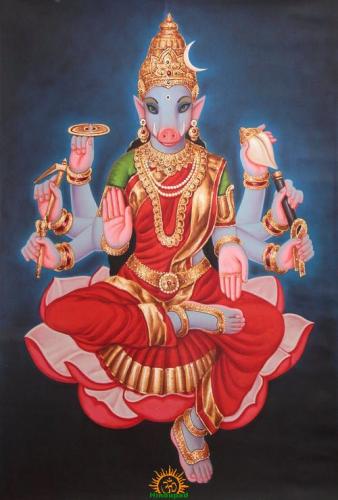
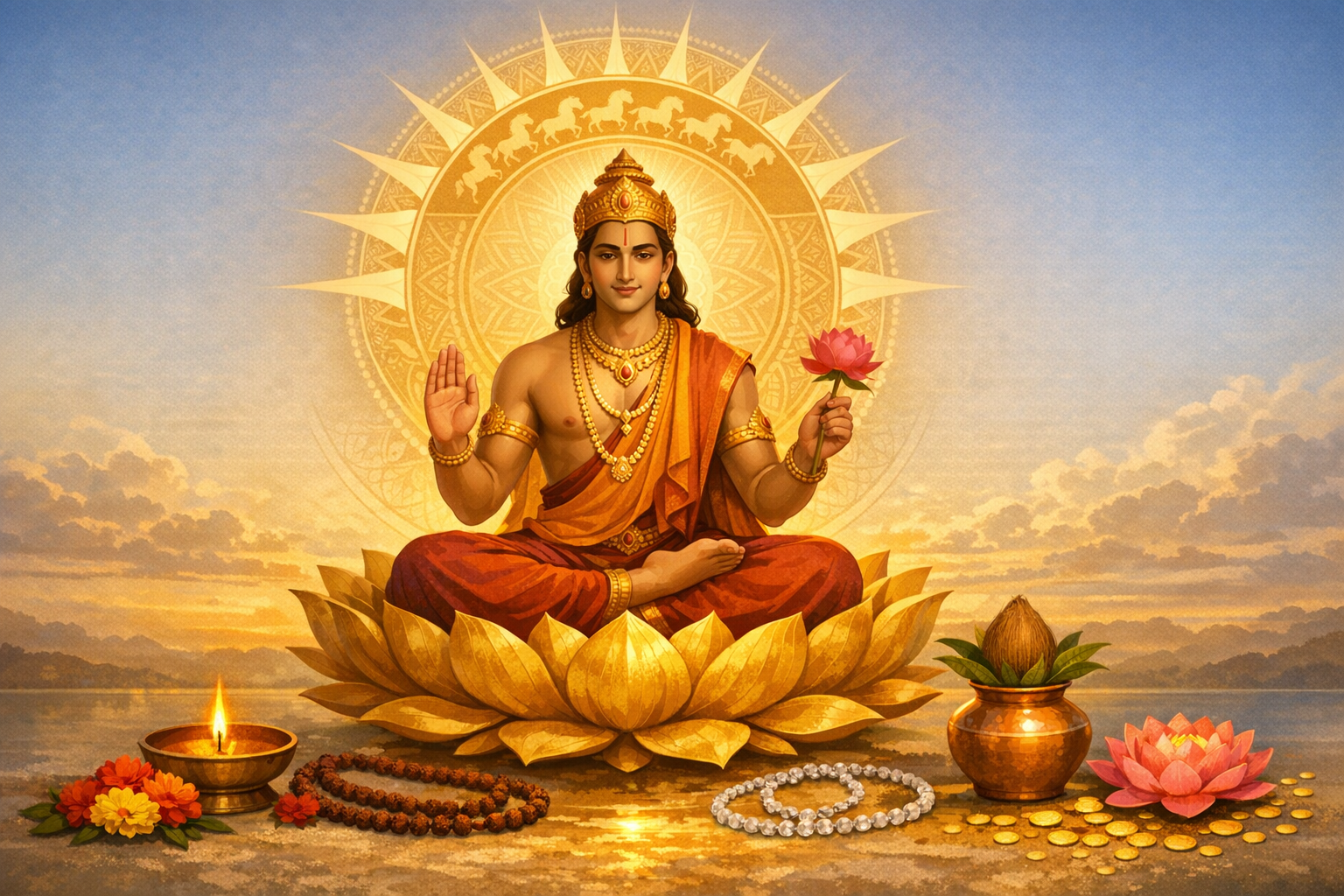
Iconographically, Adityas are depicted with a radiant golden hue, often seated or standing upon a lotus, sometimes with a chariot drawn by seven horses signifying the spectrum of light and the rhythms of time. Dhata is typically shown with two or four arms, holding lotuses or gestures (mudras) of assurance and boon-granting. The visual grammar communicates serenity, order, and beneficencequalities devotees seek to internalize through darshana and meditation.
Scriptural threads linking Dhata span the Vedas and Puranas. In Vedic literature, the term “dhata” highlights the creative-supportive aspect of divinity sustaining the cosmos, while puranic narratives consolidate this into the specific personhood of the Aditya Dhata. Puranas such as the Vishnu Purana and Matsya Purana list and praise the Adityas as guardians of cosmic law; the Bhagavata Purana elaborates the solar cosmology (surya-mandala) within which the Adityas operate. The continuity from Vedic epithet to puranic personality illustrates how Hindu thought transmits core meanings through evolving theological forms.
In calendrical and astrological practice, Sunday (Ravivara) is widely favored for Aditya worship, and many observances align with sunrise, when solar energy is ritually accessible and symbolically purifying. While Dhata is not a separate graha in Jyotisha, the Adityas collectively embody facets of Surya’s vitality and ethical luminosity. Aligning puja and japa with the sun’s daily ascent reinforces the sadhana aim of “establishing” clarity at the outset of action.
The “Story of Dhata” in practice is thus a lived narrative: devotees rise at dawn, offer arghya, and settle the mind in mantra. Many report a palpable sense of order and calm that carries through the day, a felt correspondence between the sun’s steady course and one’s inner poise. Over time, these small acts become formative disciplines that shape decision-making, relationships, and professional life, expressing the classical Hindu conviction that spirituality matures through daily steadiness rather than occasional intensity.
Parallels across dharmic traditions reinforce this integrative vision. In Buddhism, the sun frequently symbolizes clarity and awakening; in Jainism, solar deities are acknowledged within a broader cosmography that values restraint and right conduct; in Sikh tradition, the language of hukam (cosmic order) evokes a luminous sovereignty that harmonizes creation. While doctrines differ, the shared motif of the sun as life-sustainer and moral compass offers common ground for mutual respect and learning among Hinduism, Buddhism, Jainism, and Sikhism.
A frequent point of clarification concerns Dhata and Brahma. Certain texts use “Dhata” as a title for the creator, which can overlap with Brahma’s creative function; yet within the Dwadasha Adityas, Dhata is specifically a solar deity whose role is to establish and uphold order as part of the Aditya collective. Context, therefore, is decisive: “Dhata” may function as a theological epithet in some passages and as the name of a particular Aditya in others.
In sum, Dhata’s worship offers a balanced path that addresses the practical realities of health, wealth, and peace while rooting these aims in the ethical and contemplative heart of dharma. The mantra “OM SRI DHATA DEVAYA NAMAHA”, sunrise offerings, and optional Dwadasha Aditya Vratam together form a coherent sadhanaaccessible to householders and serious practitioners alike. By honoring Dhata’s establishing power, devotees align personal life with cosmic order, transforming everyday routines into steady steps toward clarity, prosperity, and compassionate living.
Inspired by this post on Hindu Pad.