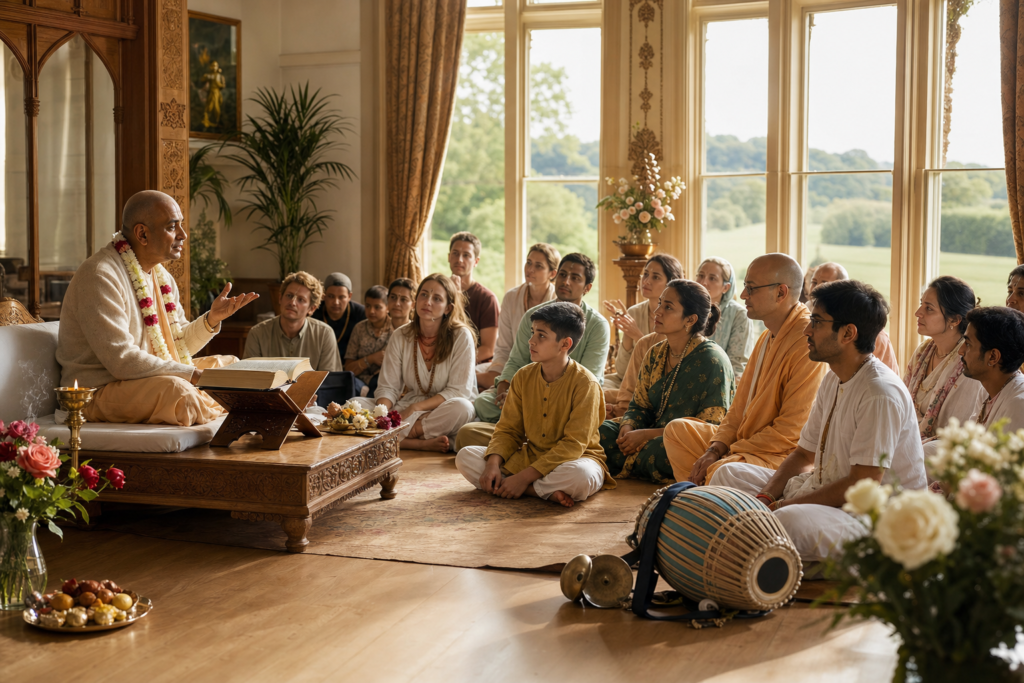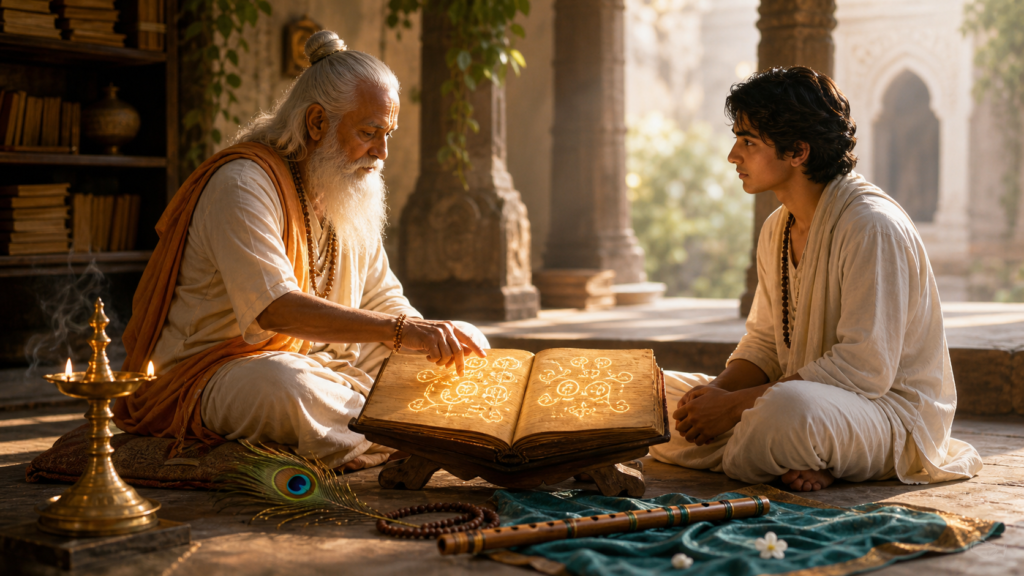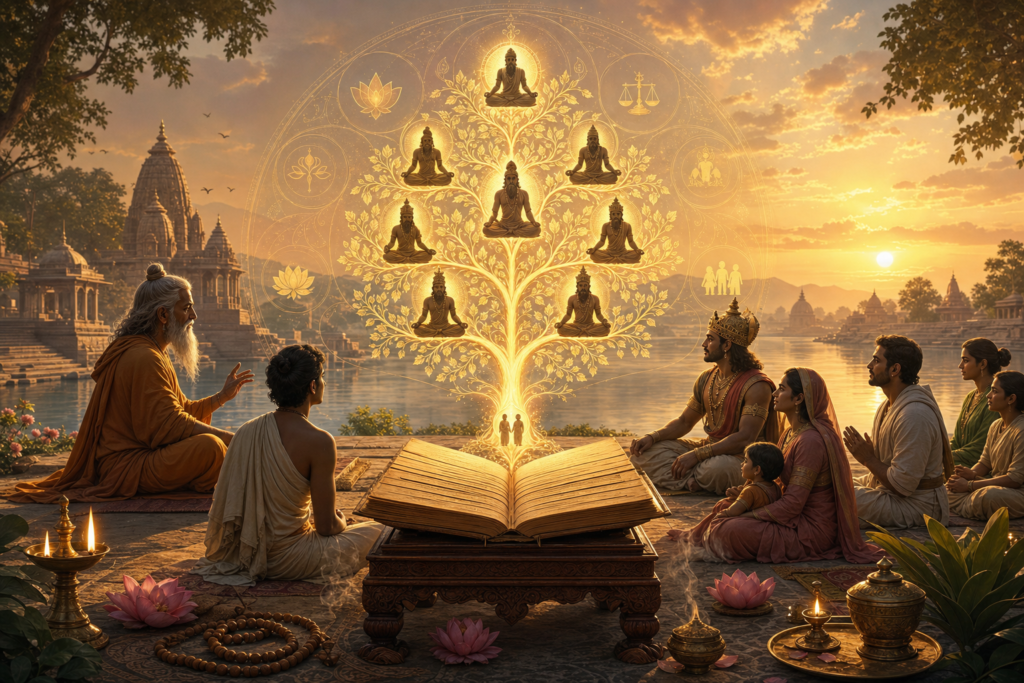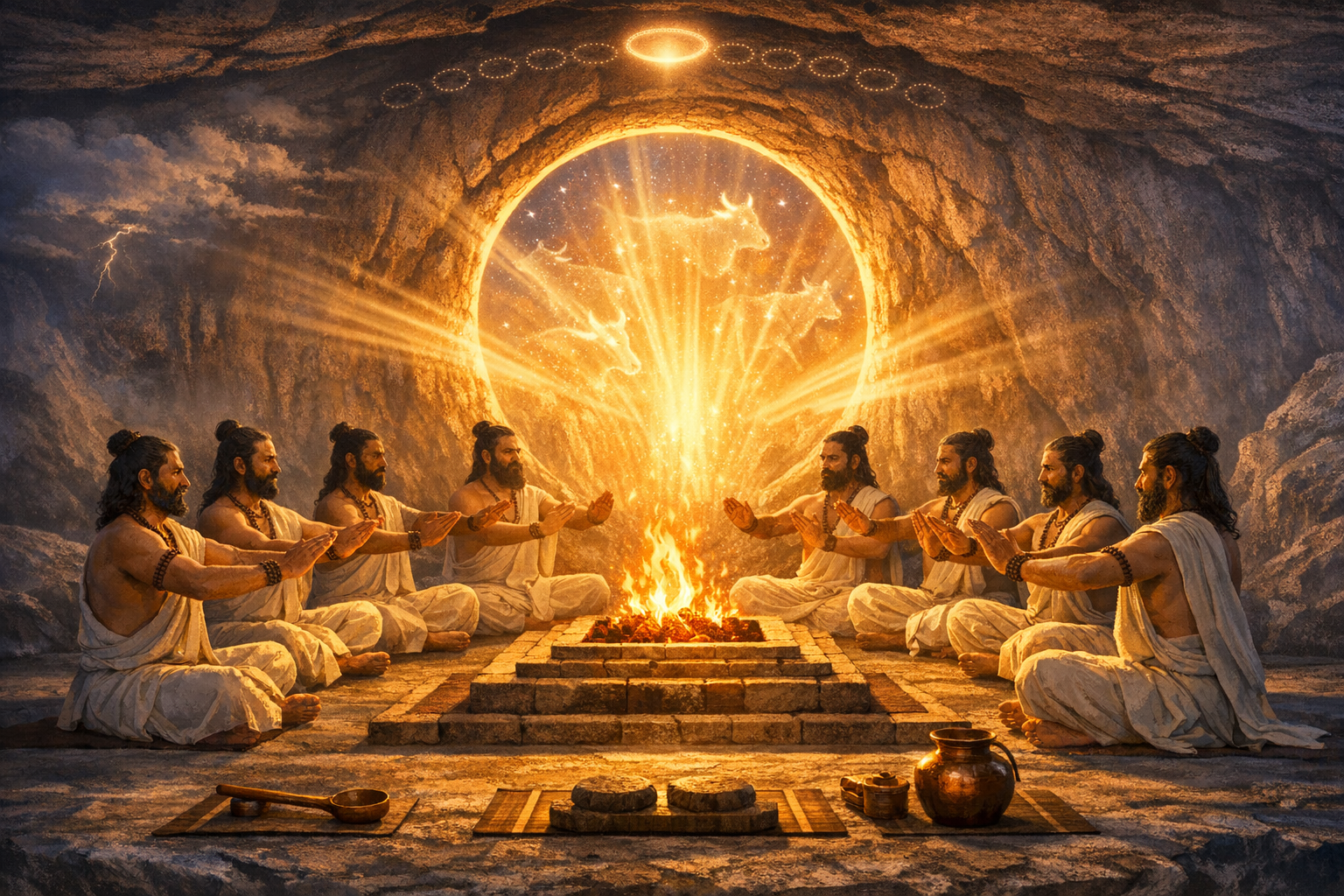
Within the vast landscape of Vedic tradition, the Saptarishis stand as archetypes of insight and ritual mastery, and among them Angiras occupies a distinct place as a progenitor of visionary priestly lineages. In that Angirasa stream appear the Dashagvas, a celebrated cohort remembered in the Rigveda for their disciplined zeal, ritual swiftness, and their role in unlocking the hidden wealth of light and knowledge. The Dashagvas do not merely belong to mythic memory; they represent a liturgical ideal where precision in mantra, timing in rite, and collaborative intent converge to transform sacrifice into revelation.
In Rigvedic diction, Dashagvas (often paired with Navagvas) surface as Angiras-aligned priests whose hymns and observances aided Indra’s epochal act of breaking Valathe cavern of hoarded radiance guarded by the Panisthus releasing the cows of light and ushering the dawns. Across multiple hymns, the names Navagvas and Dashagvas occur in formulaic tandem, signaling two kindred groups whose identities are intertwined with the success of extended Soma sacrifices and the restoration of cosmic order. Their ritual agency is not incidental; it is constitutive of the Vedic vision of how sound, intention, and action recalibrate the world.
Traditional exegesis, especially in the Brāhmaṇa and later commentarial strands, reads the names as numerically significant: Navagvas are linked with “nine” and Dashagvas with “ten.” One influential interpretation associates these designations with the duration and rhythm of sacrificial sessions (satra), suggesting nine- and ten-month cycles of Soma pressing and hymn chanting that culminate in a decisive, light-releasing turn. Even where philological debate nuances the exact derivation of “-gva,” the long-standing liturgical understanding remains: the Dashagvas epitomize the upper threshold of disciplined continuity, carrying the rite to its perfected, timely completion.
This traditional reading aligns with a pervasive Vedic intuition: numbers are not mere counts but patterns of power. In sacrificial performance, a carefully staged sequencemantras set to meters, offerings timed to celestial markers, refrains coordinated with breathsbecomes a time-engine that hastens the arrival of light. The Dashagvas, as “ten” specialists, are thus remembered for speed not as haste, but as impeccably orchestrated timing. Their swiftness is the fruit of sustained discipline that allows a rite to crest at precisely the right moment.
From a ritual-technical perspective, the Dashagvas inhabit the Soma-sacrificial world where roles are distributed among Adhvaryu, Hotr, Udgatr, and Brahman functions, and where the success of the whole depends on the exactitude of each part. Their association with Indra’s victory over Vala underscores the Vedic conviction that liturgical speech (vac), when properly intoned and ethically grounded, becomes a force as real as thunder. The “cows” they help release are at once herds and metaphors: the rays of dawn (Ushas), streams of inspiration, and the manifold insights that nourish a dharmic society.
Later Vedic and classical commentators, such as Sāyaṇa, preserve the memory of the Dashagvas as an Angirasa branch distinguished by stamina, cadence, and efficacy. On this reading, the very name encodes a vow to carry rites through a full, season-spanning arclong enough for inner and outer atmospheres to synchronize. In modern terms, the Dashagvas are models of project integrity: they do not simply begin a sacred undertaking; they shepherd it to fulfillment, ensuring that outcomes (phala) match intent (sankalpa).
The pairing with Navagvas further clarifies the picture. If Navagvas signal a preparatory discipline extending through nine measures, the Dashagvas seal the work in a culminating tenth. The two together embody a pedagogy of phases: groundwork and completion, method and mastery, promise and delivery. Ritual lore thus uses them as pedagogical emblems for students of the Veda: excellence is cumulative, and the final measure of “speed” is the readiness achieved by long fidelity to form.
Philologically, the debate over the compound’s second member (“-gva”) has produced several scholarly options, ranging from connections to “go” (cow, light) to suggestions that it may encode a specialized ritual function. What matters across commentarial consensus is the sign-function of “ten”: ritual culmination, threshold, and power-to-deliver. The Dashagvas, therefore, stand at a hinge where the rite’s latent potency becomes kineticwhere hidden light becomes shared light.
The Dashagvas are inseparable from the Vala myth’s hermeneutics. In Vedic cosmology, Vala is not merely a cavern; it functions as an image of constriction. Within it are sequestered resourcescows, waters, the dawnsthat rightly belong to the world’s flourishing. The Panis who guard that hoard symbolize forces of miserliness with respect to light: they “trade” but do not “give.” Against this, the Dashagvas appear as liturgical liberators, whose hymns condition the atmosphere for Indra’s act of release. Here, rite, ethics, and cosmos become one weave.
This cosmology of opening speaks to a recognizable human experience. Readers who have sat through even a fraction of a śrauta sequence may recall the moment when careful, steady chantwork suddenly “clicks,” and the rite acquires lift. That felt accelerationa widening of attention and brightnessis the experiential correlate of the Dashagvas’ “speed.” It is not acceleration by shortcut but by ripeness, when practice has slowly aligned breath, meter, meaning, and mind.
Because Angiras is counted among the Saptarishis, the Dashagvas also function as a memory-thread tying together several Vedic schools. Atharvan–Angiras traditions in the Atharvaveda preserve a cognate intuition: that mastery of sacred sound and fire disciplines transfigures the field of life. In genealogy and lived practice alike, the Dashagvas represent an Angirasa promise that learning, when rightly tended, becomes protection and light.
Beyond textual memory, Dashagva lore frames a philosophy of agency. In this philosophy, swift outcomes emerge from cultivated stability; luminous insight is the blossom of patient sowing. The moral is old yet perennially relevant in dharmic life: true efficiency is ethical excellence in motionsteadiness that arrives on time. In a culture where “fast” can mean careless, the Dashagvas remind that sacred “swift” is careful, communal, and accountable.
Symbolically, the “cows of light” point to knowledge resourceslanguage competencies, contemplative clarity, social trustthat sustain a plural civilization. The Dashagvas align with a civilizational ethic that treats knowledge as nourishment to be circulated, not monopolized. In that sense, their role in freeing the cows is a paradigm for how shared wisdom elevates the many without diminishing the few.
Interpreted through a comparative dharmic lens, this Vedic narrative resonates with allied motifs in sister traditions. In Buddhism, right speech (samyag-vac) and sustained community practice (sangha) open pathways from ignorance to insight through disciplined time; in Jainism, vows (vrata) and meticulous attention to moral detail yield clarity without violence; in Sikhism, the collective cadence of simran and kirtan transforms inner darkness into actionable light. Across Hinduism, Buddhism, Jainism, and Sikhism, the shared grammar is unmistakable: continuity of right practice releases resources of illumination for all.
This shared grammar of practice has practical implications. Communities that ritualize timethrough observances that track seasons, moons, or learning milestonesbuild momentum that individuals cannot easily achieve alone. The Dashagvas exemplify this: they are less solitary prodigies than a team whose cohesion generates swiftness. Their accomplishment is a case study in how communal rhythm quickens beneficent change.
Historically minded readers may also appreciate the Dashagvas as evidence of early organizational sophistication in Vedic liturgy. The distribution of tasks, the alignment of chant with ritual action, and the sensitivity to temporal thresholds indicate a high degree of institutional knowledge. Such sophistication does not negate spontaneity; it nurtures it responsibly, so that inspiration can land and endure.
Methodologically, caution matters. Rigvedic diction is poetic, multivalent, and deliberately layered. While traditional commentaries highlight nine- and ten-month satras, modern philology attends to alternative semantic possibilities for compounds like Dashagva. Yet both vantage points converge on a central fact: these groups, as remembered, represent a ritual elite whose excellence mattered for Vedic society’s imagination of order.
For students of scripture, the pedagogical utility is straightforward. Read the Dashagvas as a mirror for one’s own sādhanā: begin with nine measures of preparation, seal with a tenth act of delivery. In study cycles, this can mean nine units of groundworklanguage, meter, context, memorizationfollowed by a tenth unit dedicated to integrative articulation or service. The model is transferable, from liturgy to ethics to civic projects.
For communities, the lesson is equally salient. Liturgical “speed” arises when roles are clear, accountability is shared, and time is honored. Whether in temple management, educational programs, or interfaith collaborations, the Dashagva template suggests that the most graceful outcomes emerge from well-held process rather than last-minute improvisation.
At a symbolic level, the Dashagvas also clarify what Vedic texts mean by “victory.” Indra’s power is necessary, but it is catalyzed by human arta chorus of priestly voices tuned to truth. The deepest victories in the dharmic imagination, therefore, are cooperative: devas, sages, and communities aligned to release light for the common good.
In scholarship, the Dashagvas have drawn attention to the way the Rigveda memorializes lineages not only as biological descent but as schools of performance. A “family” in the Vedic sense is equally a method, a transmission stream, and an ethic. The Angirasa–Dashagva identity exemplifies how practice and belonging entwine: to belong is to enact a way of doing sacred work together.
Contemporary relevance follows naturally. In an era saturated with information yet starved for clarity, the Dashagva lesson is to curate cadence: to let practices that honor attention, language, and time do their quiet, transformative work. When words are weighed and time is treasured, social light increases.
Finally, read as a unity motif, the Dashagvas offer a bridge among the dharmic traditions. Their narrative honors plurality in method while holding fast to a shared telosillumination that benefits all beings. That unity-through-plurality is foundational to Hinduism and finds resonances in Buddhism, Jainism, and Sikhism, each bringing its own liturgical and ethical genius to the collective task of releasing light from the caves of forgetfulness.
In sum, the Dashagvas of the Angirasa lineage embody the Vedic thesis that true swiftness is matured care. They are swift because they are steady, decisive because they are prepared, and powerful because they serve the whole. Remembered this way, they cease to be a distant priestly clan and become an enduring discipline for learning, living, and liberating lighttoday as in the age of the Rigveda.
Inspired by this post on Hindu Blog.