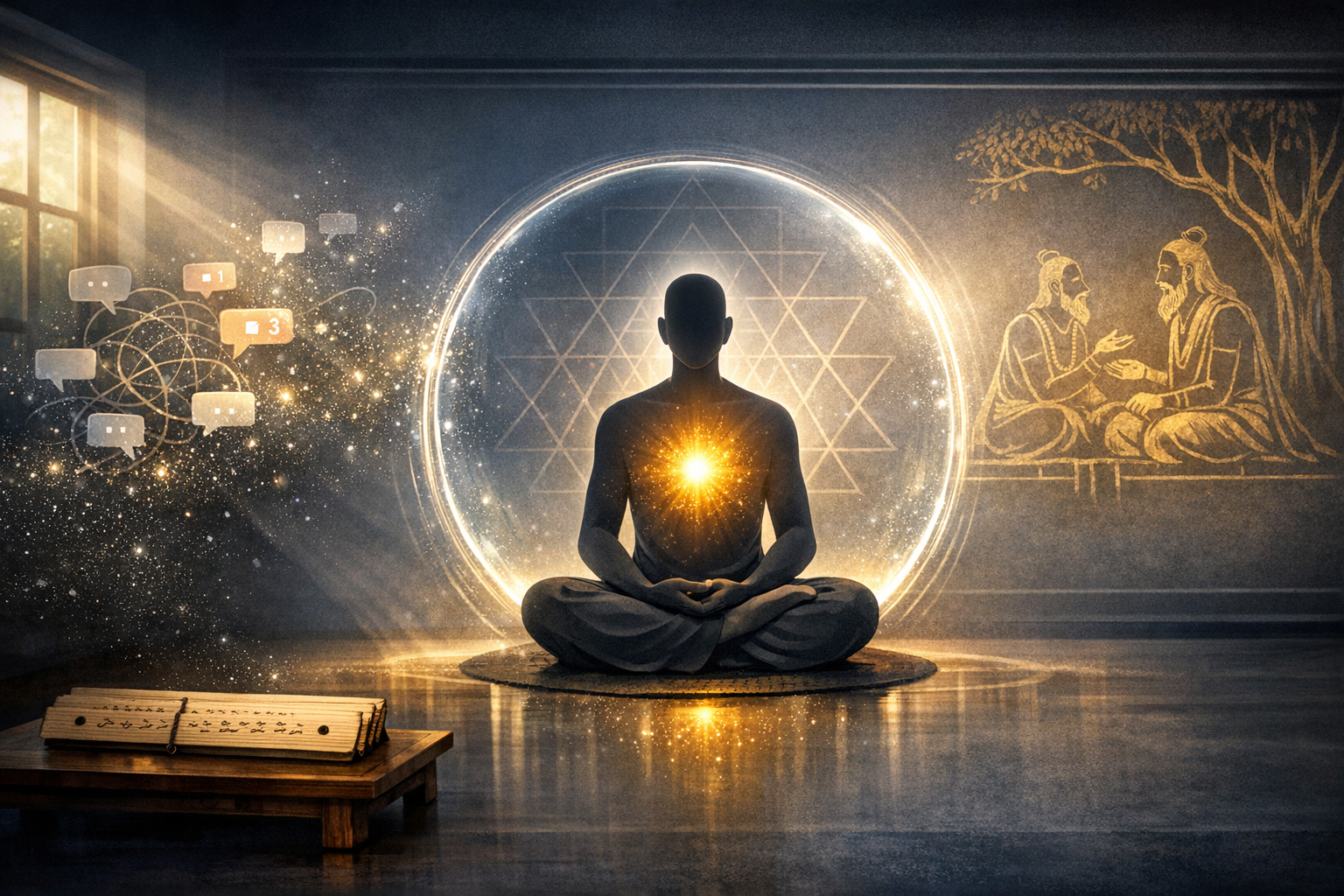
In an age saturated with opinions, algorithms, and performative certainty, the Yoga Vasistha proposes a precise counter-move: turn from noise to knowing. Rather than valorizing endless debate, this classical Hindu scripture privileges direct experience as the decisive means to clarity. Its perspective is not anti-intellectual; it is a disciplined redirection from conceptual accumulation to transformative seeing, a shift from second-hand claims to aparoksha-anubhuti—immediate realization.
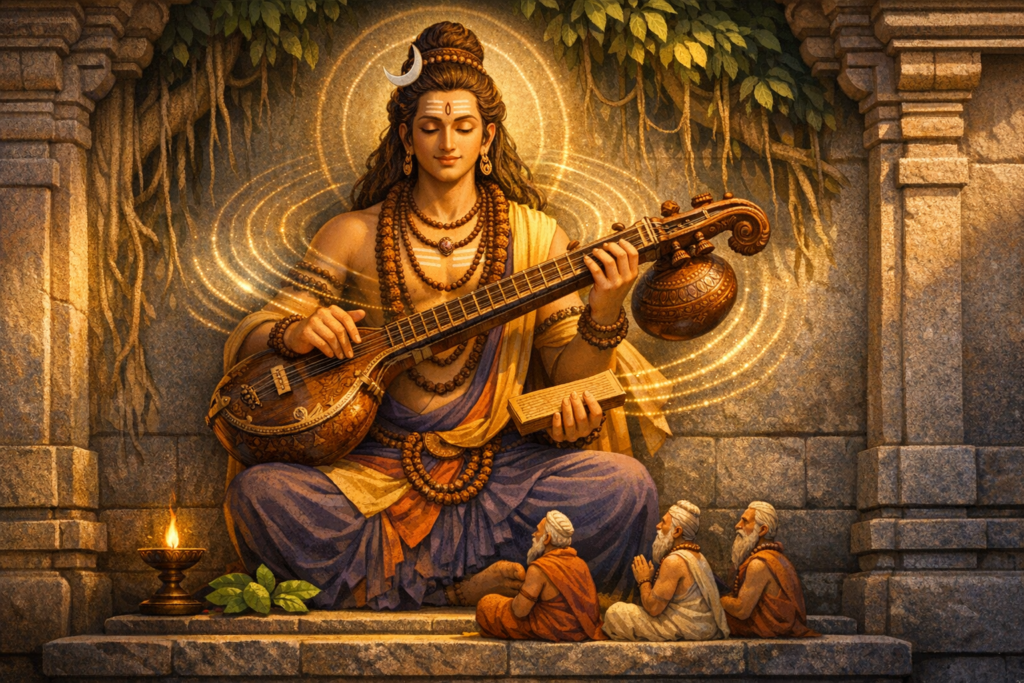
The Yoga Vasistha, also known as Vasistha Ramayana, frames its teaching as a dialogue between the sage Vasishta and Prince Rama. Set within the wider Indic tradition of soteriological inquiry, it functions as both philosophical treatise and contemplative manual. It belongs among Hindu scriptures that advance a non-dual understanding consonant with Advaita Vedanta (advait), while employing stories, metaphors, and rigorous analysis to communicate an experiential path to Moksha and Self-Realization.
At the heart of the text lies a methodical critique of overreliance on discursive victory. Conceptual knowledge (paroksha-jnana) is acknowledged as provisionally useful, yet the scripture insists that only lived knowledge—aparoksha-jnana—dissolves existential confusion. In contemporary terms, the difference resembles reading innumerable articles about meditation versus sitting still long enough to learn how attention, breath awareness, and mind-body connection actually interact. The former can inspire; the latter transforms.
Scholars typically describe the work in six thematic movements (prakaranas): dispassion, the conduct of a seeker, origination, sustenance, quiescence, and liberation. This arc mirrors the experiential arc of practice: a turn away from compulsive grasping; the establishment of inward discipline; inquiry into the arising of appearances; stabilization of insight; quieting of residual agitation; and the unbinding that Hindu philosophy calls Moksha. The sequencing is pedagogical, not dogmatic—each movement prepares, supports, and verifies the next through direct experience.
Epistemologically, Yoga Vasistha accords primacy to anubhava (lived experience) without dismissing scripture (shabda) or reason (anumana). The invitation is to verify. If Upanishadic insights such as tat tvam asi and neti neti articulate the horizon, Yoga Vasistha asks that horizon to be walked, not merely admired. In practice, this means maintaining a contemplative posture of inquiry—vichara—until the knowing subject and the known field are recognized as non-separate.
The scripture’s core analytic moves pivot on the mind’s constructive power. Phenomena are shown as dependently displayed with the mind’s participation, a stance often called drishti-srishti-vada within Vedantic discourse. The point is not solipsism but to expose how habitual projection, memory (smriti), and latent tendencies (vasanas) color experience. When these forces are seen clearly, their grip loosens; when their grip loosens, the clarity that Advaita Vedanta signals as non-dual awareness becomes evident, not as a theory but as the ground of experience.
To map maturation in practice, Yoga Vasistha describes progressive stabilizations of insight sometimes summarized as seven stages. A sincere impulse toward truth ripens into sustained inquiry; the mind thins of compulsions; clarity stabilizes; detachment becomes unforced; appearances lose their compulsive reality; and non-dual presence, beyond speech and thought, ceases to alternate with distraction. These descriptions are not milestones for comparison; they are functional diagnostics for steady, humble refinement.
The text’s narrative pedagogy is deliberately memorable. The story of Chudala and Sikhidhvaja demonstrates that outward renunciation is insufficient without inner recognition. Chudala realizes the Self through inquiry and disciplined abhyasa, while her husband, despite severe austerities, remains bound by subtle assumptions. Only when instruction pierces his concepts does direct experience dawn. The lesson is unmistakable: transformation is not measured by external form but by the cessation of misidentification within.
Likewise, the story of Lila illustrates how worlds arise, layer, and dissolve within consciousness, much like dreams within dreams. The teaching here is neither escapist nor anti-world; it reveals how the seeming solidity of events depends on the mode of seeing. When perception is purified, the same world is encountered as transparent to awareness, allowing ethical responsiveness to flourish without clinging.
Importantly, Yoga Vasistha does not denigrate rigorous thinking; it cultures a higher standard for it. Debate untethered from practice easily hardens into identity performance. The scripture reorients discourse toward sadhana—methodical contemplative training—so that reasoning is tested against stillness, and conclusions are refined by what meditation and mindfulness disclose in real time.
This emphasis on verification resonates across dharmic traditions. Buddhism enjoins ehipassiko—come and see—inviting practitioners to test claims through vipassana and samatha. Jainism’s Anekantavada tempers dogmatic certainty by honoring multiple standpoints, an epistemic humility essential for mature inquiry. Sikh tradition points seekers to direct anubhav through remembrance, simran, and alignment with Shabad. Yoga Vasistha stands within this shared civilizational commitment: unity in experiential discovery, diversity in skilful means.
For contemporary practitioners, the scripture’s blueprint can be understood as a sequence of trainable capacities. Dispassion (vairagya) is not indifference but freedom from compulsive preference. Inquiry (vichara) is a precise attentional movement that asks what the “I” truly refers to, without seeking a conceptual answer. Meditation stabilizes this inquiry by establishing non-reactivity. Ethical alignment (dharma) safeguards the clarity thus gained, ensuring that insight manifests as compassion and steadiness in community.
Applied in the daily rhythms of the digital age, the counsel is concrete. Before entering debates online or offline, pausing for a few breaths reveals the energy driving engagement—restlessness, self-importance, or genuine care. Returning to the felt sense of awareness allows response to replace reactivity. Over time, this shift becomes measurable: fewer impulsive posts, deeper listening, and clearer discernment about when speech is helpful and when silence is skill.
Yoga Vasistha also refines how progress is recognized. Rather than seeking extraordinary states, it looks for ordinary markers: reduced compulsiveness in thought, greater ease in the body, effortless kindness, and resilience under pressure. These signal that knowledge has moved from head to heart, from argument to embodiment. Experiential learning is cumulative; small verifications compound into abiding insight.
Two misunderstandings deserve careful avoidance. First, non-dual realization does not negate dharma. Recognizing the dreamlike nature of appearances does not free one from ethical responsibility; it dissolves self-centeredness so that action becomes clearer and less harmful. Second, prioritizing experience over debate does not mean rejecting scriptures, teachers, or community. It means testing all three in the crucible of practice and retaining what conduces to freedom.
Within the broader sweep of Hindu philosophy and the Upanishads, Yoga Vasistha refines a core proposition: that the Self is immediate and self-luminous, and that it is obscured not by distance but by habitual misidentification. The recommended remedies—viveka (discernment), vairagya (dispassion), abhyasa (consistent practice), and pratyahara (drawing inward)—are time-tested. They render the mind transparent enough that the background of awareness is recognized as the foreground of life.
The scripture’s relevance to unity among dharmic traditions is practical as well as philosophical. By insisting that truth be realized, not merely professed, it opens generous space for multiple upayas—effective means—suited to diverse temperaments. This acceptance of plurality while aiming at a shared experiential summit allows Hindus, Buddhists, Jains, and Sikhs to find common cause in disciplined compassion and contemplative depth.
In sum, Yoga Vasistha’s call is radical only because it is simple: exchange compulsive talking for careful seeing. Let meditation, mindfulness, and self-inquiry turn borrowed ideas into verified knowledge. Allow direct experience to become the arbiter of what is real, useful, and kind. In that shift, debate regains its value as exploration rather than combat, and philosophy recovers its original purpose—the alleviation of suffering through wisdom lived, not just defended.
Inspired by this post on Hindu Blog.