

A confrontation may last only a few minutes, yet the identity built around it can survive for years. Śrīmad-Bhāgavatam 8.19.13 examines this unsettling transformation: anger arising from a particular injury becomes enduring enmity when ignorance and self-importance continue to nourish it. The verse is brief, but it offers a sophisticated account of emotional escalation, distorted identity, moral responsibility, and spiritual freedom.
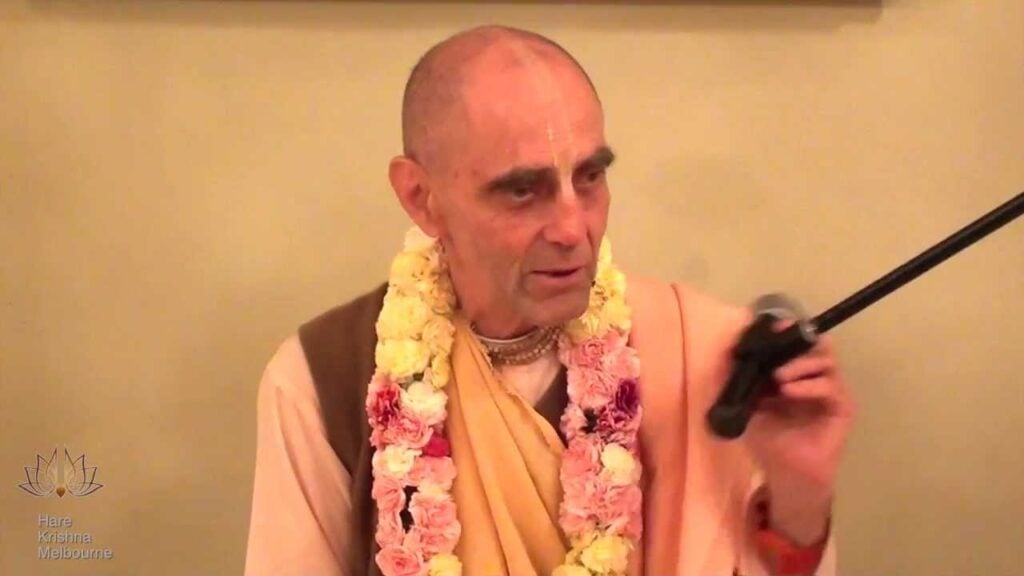
The source item identifies a Śrīmad-Bhāgavatam class on this verse by HG Vaiyasaki Dasa. Because the preserved source contains a title and thumbnail rather than a transcript, the study below does not attribute unverified statements to the lecturer. It instead develops the Sanskrit verse, its immediate narrative setting, its wider Bhāgavata context, and its practical significance for contemporary life.
The central verse
वैरानुबन्ध एतावानामृत्योरिह देहिनाम् ।
अज्ञानप्रभवो मन्युरहंमानोपबृंहित: ॥ १३ ॥
vairānubandha etāvān
āmṛtyor iha dehinām
ajñāna-prabhavo manyur
ahaṁ-mānopabṛṁhitaḥ
A close contextual rendering may be expressed as follows: Hiraṇyakaśipu’s hostility toward Lord Viṣṇu remained attached to him until death; among embodied beings, anger arises from ignorance and grows when inflated by egoistic self-estimation. The verse therefore identifies both a historical-narrative example and a general mechanism through which anger acquires continuity.
The Sanskrit does not name Hiraṇyakaśipu or Viṣṇu directly because the preceding verses have already established them as the subject. Its compressed syntax must consequently be read within the larger passage. The standard anuṣṭubh structure, with four compact units of eight syllables, allows the verse to move rapidly from the observable condition—lifelong enmity—to its interior causes: ignorance, anger, and magnified self-regard. The primary text and traditional translation can be consulted at the Bhaktivedanta Vedabase edition of Śrīmad-Bhāgavatam 8.19.13.
Why this verse appears in the Vāmana and Bali narrative
The verse occurs in Canto Eight, Chapter Nineteen, during Lord Vāmanadeva’s encounter with Bali Mahārāja. Bali has welcomed the young brahmacārī and invited him to request a gift. Before asking for three paces of land, Vāmanadeva recounts the character of Bali’s lineage: its generosity, courage, determination, and association with Prahlāda Mahārāja. The chapter’s narrative sequence places verse 13 between the account of Hiraṇyakaśipu’s futile search for Viṣṇu and the praise of Bali’s father, Virocana.
Vāmanadeva’s praise is deliberately layered. Hiraṇyākṣa and Hiraṇyakaśipu possessed extraordinary courage and resolve, but power alone did not make their conduct spiritually sound. Prahlāda represented devotion and equanimity; Virocana represented generosity; Bali would be tested in truthfulness and surrender. A single dynasty thus contains markedly different responses to loss, status, duty, and the divine. Lineage provides a moral inheritance, but it does not eliminate individual responsibility.
Hiraṇyakaśipu’s hostility began after Lord Viṣṇu, appearing as Varāha, killed his brother Hiraṇyākṣa. Grief and loyalty to a slain brother were intelligible human-like starting points within the story. The decisive moral failure occurred when grief was transformed into limitless retaliation. Hiraṇyakaśipu did not confine his response to the perceived adversary; he ordered attacks on religious communities, settlements, agriculture, forests, and social institutions. The grievance expanded until whole populations became targets of a private vendetta.
An especially revealing tension appears in Śrīmad-Bhāgavatam 7.2. Hiraṇyakaśipu gives his grieving relatives a technically sophisticated discourse on the distinction between the eternal self and the temporary body. He explains that bodily identification creates divisions between kin and outsiders, and he succeeds in calming others. Yet he does not apply that understanding to his own grief. The episode distinguishes possession of philosophical information from realized wisdom: a person may explain detachment persuasively while remaining governed by resentment.
The account in Chapter Nineteen intensifies the irony. Hiraṇyakaśipu searches the universe for Viṣṇu, but Viṣṇu remains beyond the reach of his externally directed vision and is described as entering the core of his heart. The enemy imagined as wholly external is already present at the deepest interior level. In theological terms, rage narrows perception so drastically that omnipresence becomes invisible. In psychological terms, obsessive external pursuit prevents examination of the mental process that keeps the conflict alive.
Verse 13 marks the culmination of that search. Hiraṇyakaśipu cannot find Viṣṇu, cannot release the grievance, and cannot perceive how his own identity has become organized around opposition. His hostility persists until Lord Nṛsiṁhadeva ends his oppressive rule, a conclusion narrated in Śrīmad-Bhāgavatam 7.8. The tragedy is therefore not merely that he experiences anger; it is that anger becomes the enduring principle by which he interprets family, power, religion, and reality.
Bali Mahārāja later supplies a significant contrast from within the same family. Once Vāmanadeva reveals His cosmic form and takes the three worlds, Bali’s followers become angry and prepare to fight. Bali restrains them. Although he loses wealth, authority, freedom, and public standing, he refuses to let humiliation dictate his conduct. In Chapter Twenty and Chapter Twenty-one, he protects his promise and prevents further violence even when Viṣṇu appears to act for the opposing side.
This contrast clarifies the function of verse 13. Hiraṇyakaśipu loses a brother and turns loss into lifelong enmity; Bali loses an empire and turns loss into truthfulness, restraint, and surrender. Circumstances alone do not determine the moral quality of a response. The interpretation assigned to loss—and the identity defended through that interpretation—shapes whether suffering becomes wisdom or hostility.
A technical reading of the Sanskrit
Vaira-anubandhaḥ joins vaira, hostility or enmity, with anubandha, an attachment, continuation, binding connection, or consequence. The compound conveys more than a momentary flash of anger. It suggests hostility that remains linked to the person and repeatedly carries itself forward. The adversary may be absent, but the relationship continues internally through memory, interpretation, and intention.
Etāvān indicates such an extent or such magnitude, while āmṛtyoḥ carries the sense of continuation up to death. Read with the earlier narrative, the expression emphasizes the exceptional durability of Hiraṇyakaśipu’s antagonism. The verse does not claim that every episode of anger lasts throughout life. It identifies an extreme case that exposes the mechanism by which temporary emotion can harden into a lasting orientation.
Iha dehinām refers, at its most literal level, to embodied beings here in conditioned existence. The traditional explanation connects embodiment with the bodily conception of identity: the assumption that the complete self is exhausted by physical form, possessions, relationships, social rank, and the labels attached to them. This teaching is not contempt for the body. Vaiṣṇava ethics treats the body as an entrusted instrument of service and responsibility. The error lies in mistaking an instrument and its temporary designations for the totality of the self.
Ajñāna-prabhavaḥ describes something whose source or arising is ajñāna, ignorance. Here ignorance is more than an absence of facts. Hiraṇyakaśipu is powerful, educated, politically capable, and able to deliver philosophical instruction. His ignorance is a failure of perception and realization: he misconstrues the self, the divine, control, permanence, and the meaning of loss. Knowledge remains external to character.
Manyuḥ may denote anger, wrath, resentment, or forceful indignation according to context. The word names an affective and motivational condition, not merely an intellectual disagreement. Anger mobilizes attention and action around an injury or obstruction. That energy can sometimes alert a person to danger or injustice, but when governed by ignorance it becomes increasingly unable to distinguish protection from punishment.
Ahaṁ-māna-upabṛṁhitaḥ describes anger enlarged, nourished, or made to swell by ahaṁ-māna. The expression concerns egoistic self-estimation, conceit, or false prestige. It should not be mechanically equated with every technical use of ahaṅkāra in Indian philosophy or with the modern psychological term ego. In this verse, the practical emphasis falls on the inflated claim that personal status, control, or honor must never be contradicted.
The vocabulary therefore presents a compact causal structure: misperception gives rise to anger; self-importance enlarges it; repeated attachment converts it into enmity; and enmity can persist until death. The verse does not deny the original event. It asks what continues feeding the response after the immediate event has passed.
From injury to identity: the verse’s psychology of escalation
A useful analytical sequence can be drawn from the text: ajñāna → threatened self-conception → ahaṁ-māna → manyu → repeated hostile attention → vaira-anubandha. This sequence is an interpretive model rather than a replacement for the Sanskrit grammar. It shows how a painful event becomes a durable identity when the mind repeatedly organizes experience around being insulted, defeated, deprived, or wronged.
Ignorance distorts the scale of the event. A loss of position becomes a loss of self; disagreement becomes disrespect; criticism becomes annihilation; an adversary’s success becomes proof that reality itself is intolerable. Once the event is interpreted this way, the restoration of proportion feels like surrender. Ego then preserves anger because anger appears to defend existence, dignity, or moral certainty.
The distinction between anger and enmity is crucial. Anger is an episodic emotion that may arise in response to perceived wrongdoing. Enmity is a continuing relational stance in which another being is fixed as an enemy. Anger can communicate that a boundary has been crossed; enmity seeks a stable object to blame. Anger may end when danger ends or repair occurs; enmity often resists evidence that would make release possible.
Repetitive thought helps bridge those states. The mind replays the incident, imagines alternative confrontations, rehearses accusations, and interprets new events through the old injury. Memory no longer serves learning alone; it repeatedly reactivates the emotional system. A person may physically leave the scene while mentally returning to it hundreds of times.
Contemporary psychology offers a limited but useful parallel through research on angry rumination. A review of anger regulation in interpersonal contexts reported that angry rumination tends to perpetuate anger and aggression, while cognitive reappraisal and mindfulness can buffer some anger-related responses. An experimental study indexed by PubMed likewise found that rumination produced higher remaining anger than reappraisal or distraction in its study conditions.
These findings do not scientifically prove the Bhāgavata’s metaphysical teachings, nor does the ancient verse function as a clinical model. The comparison is narrower: both bodies of thought recognize that repeated cognition can maintain an emotion after the original stimulus has passed. The Bhāgavata adds a moral and spiritual analysis by asking why the person remains attached to that cognition and which conception of self is being defended.
Anger, justice, and the danger of false equivalence
The verse should not be reduced to the claim that all anger is sinful, irrational, or spiritually inferior. Anger can disclose mistreatment, energize protection, or motivate resistance to injustice. Even the Bhāgavata depicts Lord Nṛsiṁhadeva’s formidable anger while protecting Prahlāda and ending Hiraṇyakaśipu’s persecution. Within Vaiṣṇava theology, however, divine action is not classified as conditioned anger born from ignorance and false prestige. Human beings cannot use divine wrath as an uncomplicated license for personal vengeance.
Hiraṇyakaśipu’s grief had a real narrative cause, but the reality of pain did not make every subsequent action ethical. He universalized a personal vendetta, attacked uninvolved communities, demanded ideological submission, and eventually threatened his own son. The text therefore preserves a vital distinction: an injury may be real while the story constructed around it becomes distorted, disproportionate, and destructive.
Dharma requires more than emotional suppression. It may require a clear boundary, truthful testimony, lawful accountability, restitution, protection of vulnerable persons, or firm resistance to violence. The decisive question is whether action is directed toward stopping harm and restoring order or toward humiliating, dehumanizing, and endlessly punishing an enemy. Restraint is not passivity, and accountability is not synonymous with hatred.
Forgiveness must also be defined carefully. Spiritual release does not automatically restore trust, erase consequences, or require renewed proximity to an unsafe person. Reconciliation needs truth, changed conduct, and appropriate conditions. A person can relinquish the desire for revenge while continuing to document wrongdoing, maintain distance, seek justice, and protect others.
The teaching becomes harmful when used to silence those who disclose abuse or injustice. Labeling another person’s distress as false ego can itself become an expression of pride and avoidance. The verse is most responsibly used as a mirror for examining the persistence of one’s own hostility, not as a weapon for invalidating another person’s pain.
A shared Dharmic concern, expressed through distinct traditions
Within the Vaiṣṇava framework of the Śrīmad-Bhāgavatam, anger becomes spiritually binding when it grows from ignorance of the self’s relation to Bhagavān and is enlarged by false prestige. Bhakti redirects attention from injured proprietorship toward loving service, remembrance, humility, and surrender. A related cognitive sequence appears in Bhagavad-gītā 2.62 and 2.63, where fixation contributes to attachment, frustrated desire, anger, delusion, and the impairment of discernment.
Buddhist traditions employ a different account of selfhood, yet identify a closely related practical danger. The opening verses of the Dhammapada connect the repeated mental rehearsal of injury with the continuation of hatred and present non-hatred as the means by which hostility is pacified. The similarity lies in the refusal to let retaliatory thought perpetuate suffering; the doctrinal difference lies in Buddhism’s analysis of impermanence and non-self rather than the Vaiṣṇava affirmation of an eternal individual self related to Bhagavān.
Jain philosophy classifies anger, pride, deceit, and greed among the kaṣāyas, passions that contribute to karmic bondage. The pairing of krodha and māna is especially relevant to the Bhāgavata verse’s connection between manyuḥ and ahaṁ-māna. Jain disciplines of ahiṃsā, kṣamā, self-restraint, confession, and many-sided reflection seek to prevent passionate reaction from governing thought, speech, and conduct. The place of these passions in Jain doctrine is discussed in resources on the Tattvārtha-sūtra.
Sikh ethics similarly examines the relationship between haumai, self-centeredness, and krodh, destructive anger. Nām, truthful living, humility, remembrance, and seva reorient the person away from ego-governed reaction. Sikh tradition also preserves a strong ethic of courage and resistance to oppression, making an important distinction between vice-driven rage and principled action not generated by haumai. A recent academic treatment of this distinction appears in Sikh Ethics.
These traditions should not be collapsed into a single doctrine. Hindu, Buddhist, Jain, and Sikh accounts differ regarding the self, karma, liberation, divine personhood, revelation, and spiritual authority. Their meaningful convergence is practical and ethical: ignorance or narrowed perception sustains hostility; pride intensifies it; disciplined awareness interrupts it; and compassion must coexist with truth and responsibility. Unity is strengthened when genuine parallels are recognized without erasing distinct teachings.
A practical discipline for preventing anger from becoming enmity
1. Establish safety before interpretation. When immediate danger exists, the first duty is protection rather than abstract contemplation. A person may need to leave the setting, seek assistance, contact appropriate authorities, or create physical distance. Spiritual reflection becomes clearer after imminent risk and physiological escalation have been addressed.
2. Name the experience without turning it into identity. A practitioner can acknowledge that anger is present without concluding that anger defines the whole self or dictates the next action. Precise language distinguishes anger, grief, fear, humiliation, betrayal, and moral concern. Several emotions may coexist, and recognizing them reduces the tendency to make rage carry every part of the experience.
3. Separate observable facts from the narrative built around them. Useful questions include: What demonstrably occurred? What harm must be stopped or repaired? Which motives have been inferred rather than established? Which predictions are being treated as certainties? This inquiry does not deny wrongdoing; it prevents incomplete knowledge from expanding into total judgment.
4. Locate the threatened form of ahaṁ-māna. The threatened object may be status, control, reputation, intellectual certainty, family pride, political identity, or the demand never to appear weak. Identifying that investment often explains why a limited disagreement feels existential. Humility does not require humiliation; it allows dignity to be grounded more deeply than public victory.
5. Interrupt repetitive hostile attention. Replaying the grievance may feel like preparation, but it can keep the nervous system and imagination tied to the adversary. A temporary shift toward prayer, measured breathing, walking, constructive work, or conversation with a calm and trustworthy person can create enough distance for discernment. The goal is neither denial nor compulsive venting, but a reduction in reactivity.
6. Test the intended response against dharma. A response can be evaluated by asking whether it protects life, clarifies truth, reduces future harm, preserves proportion, and remains accountable to ethical standards. A plan centered on public humiliation, indiscriminate punishment, or permanent dehumanization reveals that enmity has begun to replace justice.
7. Redirect attention through spiritual practice. In a Vaiṣṇava setting, śravaṇa, kīrtana, japa, prayer, scriptural study, service, and association with mature practitioners help move attention from wounded proprietorship toward Bhagavān. The purpose is not to place devotional language over an unexamined wound. Practice creates a wider field of identity in which the grievance no longer occupies the center.
8. Pursue repair with boundaries. Where appropriate and safe, repair may involve an apology, restitution, mediated dialogue, changed behavior, or a clearly stated boundary. Where reconciliation is impossible, non-retaliatory distance may be the more ethical choice. Releasing hostility does not require granting access to someone who remains dangerous or deceptive.
9. Treat recurrence as a practice problem, not proof of failure. Deep resentment is rarely dissolved by one insight. It may return through memory, bodily activation, or renewed contact. Repeated reflection, community support, and disciplined action gradually weaken its authority. When rage, trauma, violent impulses, or compulsive rumination become difficult to manage, qualified mental-health or safety support can complement rather than contradict spiritual practice.
Contemporary applications
In families, a specific injury can become an inherited narrative in which later generations are expected to preserve hostility as proof of loyalty. Verse 13 challenges that inheritance. Honoring the suffering of relatives does not require transmitting their enmity. A family can remember accurately, seek repair, and protect its members without making resentment a sacred obligation.
In workplaces and communities, criticism can become fused with personal worth. A correction is then experienced as an attack on identity, and disagreement produces camps rather than solutions. Separating role, performance, and dignity enables precise accountability. It becomes possible to correct conduct without declaring a person permanently reducible to a mistake.
In digital and political life, repeated exposure to grievance can reward certainty, outrage, and collective humiliation. Groups begin to interpret compassion as betrayal and complexity as weakness. The verse offers a demanding alternative: public wrongs must be confronted, but opposition must not become the sole basis of identity. A movement governed entirely by hatred risks reproducing the domination it claims to resist.
For leaders, the story carries an institutional warning. Hiraṇyakaśipu converts private grief and wounded prestige into policy, persecution, and social destruction. Personal resentment becomes especially dangerous when backed by political, economic, religious, or technological power. Ethical leadership therefore requires structures that restrain retaliation, protect dissent, preserve evidence, and prevent an individual’s emotional fixation from becoming collective punishment.
The deeper theological movement: from possession to surrender
Hiraṇyakaśipu demonstrates that correct concepts do not transform character unless they are practiced. Prahlāda demonstrates inner steadiness under persecution. Bali demonstrates fidelity when possessions, rank, and security are removed. Together, the three figures form a progression from knowledge used rhetorically, to devotion embodied under pressure, to surrender enacted through costly choice.
Bali’s response ultimately reverses the logic of ahaṁ-māna. When Vāmanadeva’s first two steps encompass everything Bali claimed to possess, no external territory remains for the third. In Śrīmad-Bhāgavatam 8.22, Bali offers his own head. Symbolically and theologically, proprietorship gives way to self-offering. The king who could have treated loss as unforgivable humiliation discovers freedom by relinquishing the identity that depended on ownership.
This outcome also clarifies the difference between defeat and degradation. Bali is externally defeated but internally enlarged. Hiraṇyakaśipu commands vast power but becomes progressively confined within a single grievance. Spiritual freedom is therefore not measured by control over circumstances; it is measured by the degree to which circumstances can no longer compel falsehood, cruelty, or hatred.
The enduring insight of Śrīmad-Bhāgavatam 8.19.13 is not that anger must never arise. It is that anger must not be granted permanent residence, unquestioned authority, or a sacred identity. Ignorance supplies the misperception, ego supplies the fuel, and repetition supplies the duration. Knowledge, humility, disciplined attention, devotion, and ethical action loosen that bond.
A mature reading consequently asks three questions whenever anger persists: What truth still requires action? What pain still requires care? What form of self-importance continues to demand an enemy? Those questions preserve moral seriousness while opening a path beyond vengeance. They allow justice to remain firm, compassion to remain intelligent, and spiritual practice to become a lived transformation rather than an abstract ideal.
Primary references: Śrīmad-Bhāgavatam 8.19.13; Canto Eight, Chapter Nineteen; Canto Seven, Chapter Two; Canto Seven, Chapter Eight; and Canto Eight, Chapter Twenty-two.
Inspired by this post on Dandavats.






Leave a Reply
You must be logged in to post a comment.