
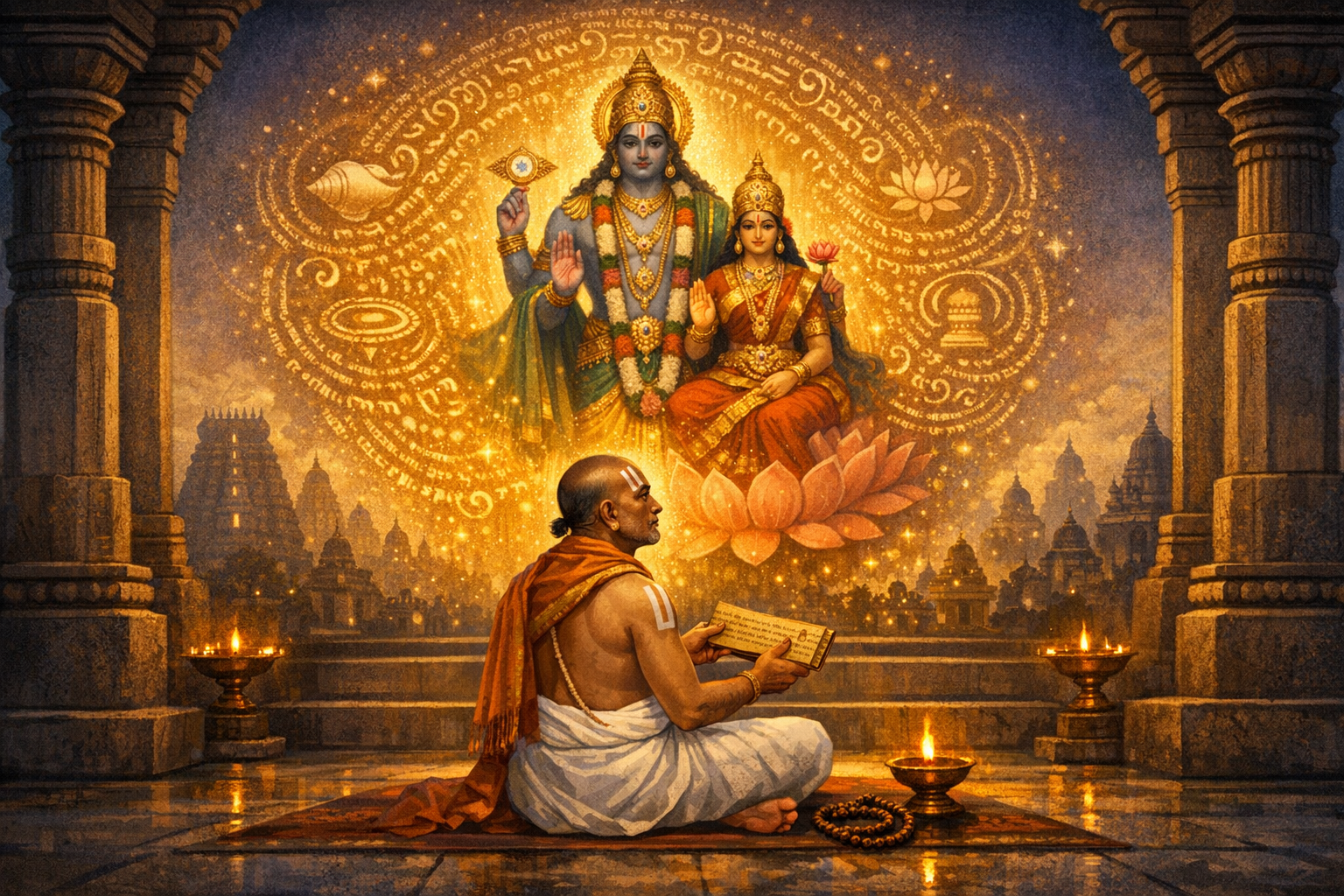
Azhwar designates the saint-poets of Tamilakam whose lives and verses exemplify unwavering devotion to Lord Vishnu. The name traces to the Tamil root “azhndu,” meaning to sink or be deeply immersed, signaling a consciousness steeped in bhakti. Active broadly between the sixth and ninth centuries CE, these poet-sages articulated a theology of intimacy with the Divine through a vast Tamil canon that later came to be revered as Dravida Veda, shaping the liturgy, music, temple ritual, and spiritual imagination of Sri Vaishnavism.
Etymologically, the form Azhwar encapsulates immersion as an inner state of devotion, aligning with the experiential tenor of their hymns. A philological note sometimes distinguishes between spellings that could denote ‘one who rules’ and those that denote ‘one who is immersed’; within Sri Vaishnava tradition, the devotional reading grounded in “azhndu” remains normative. Beyond the technical debate, the literary and theological record itself demonstrates that these poets cultivated a poetics of surrender and love in which the devotee’s self is absorbed in the gracious presence of Vishnu and Sri (Lakshmi).
Historically, the Azhwars flourished under the Pallava, Pandya, and Chera polities, when urbanized temple culture and Agamic worship were expanding across South India. Their contemporaries in Shaivism, the Nayanmars, were shaping parallel currents of Tamil bhakti. Rather than signaling any sectarian polarization, the simultaneous efflorescence of these traditions illustrates a shared dharmic renaissance that privileged personal experience of the sacred, public liturgy, vernacular sacred poetry, and ethical transformation rooted in compassion and duty (dharma).
The core textual corpus, the Nalayira Divya Prabandham (the Four Thousand Sacred Hymns), was compiled in the tenth century by Nathamuni, who is credited with recovering, systematizing, and transmitting the verses of twelve Azhwars. The canon functions as a Tamil complement to the Sanskrit Veda and the Bhagavata Purana, and it is liturgically recited in temples recognized as Divya Desams. Poetic architectures such as antadi (verses linked by successive opening and closing words), viruttam, and chanda meters enable an ecstatic, mnemonic flow that aids congregational chant and meditative contemplation.
The earliest triad, known as the Mudhal Azhwars—Poigai, Bhuthath, and Pey—authored the first three Tiruvandadis. Their verses radiate a terse, aphoristic devotion that establishes foundational Vishnu bhakti themes: the Lord’s immanence, the saving power of the divine name, and the experiential joy of remembrance. These poems condense metaphysical assurance into compact devotional syntax, ideal for liturgical repetition.
Nammalvar, often hailed as Satakopa, stands as a theological and literary summit within the tradition. His Tiruvaymoli (1102 verses) unfolds a vast devotional cosmology in which Vishnu is both paratattva (supreme reality) and the tender beloved. Complementary works—Tiruviruttam, Tiruvasiriyam, and Periya Tiruvandadi—elaborate existential surrender (prapatti), the salvific grace of Sri, and the intimacy of the soul’s service (kainkarya). Nammalvar’s disciple, Madhurakavi, composed Kanninun Sirutambu, a brief yet profound testimony to the guru-disciple bond that Sri Vaishnavism upholds as a conduit of grace and knowledge.
Periyalvar’s hymns, centered on the Lord’s protective care, and Andal’s luminous Tiruppavai (30 verses) and Nachiyar Tirumoli (143 verses) articulate layers of loving service and bridal mysticism. Andal—singular as the woman Azhwar—integrates ritual time (Margazhi observances), temple aesthetics, and a fervent yearning that has inspired ethical and devotional vows across centuries. Together, Periyalvar and Andal anchor Srivilliputhur as a living locus of Sri Vaishnava devotion and Tamil literature.
Tirumazhisai Azhwar offers the Naanmugan Tiruvandadi and Tiruchanda Viruttam, stressing Vishnu’s supremacy within a unifying vision of reality. Kulasekara Azhwar’s Perumal Tirumoli reflects royal devotion steeped in humility. Thondaradippodi Azhwar’s Tirumalai and Tiru-palli-yezhuchi frame the Lord’s temple as the axis of life, while Tiruppaan Azhwar’s Amalanadhipiran renders an exquisitely compact meditation on the divine body of Ranganatha. Tirumangai Azhwar, prolific and peregrine, celebrates the Lord’s presence in a sweeping arc of Divya Desams through the Periya Tirumoli and related compositions, reinforcing the pan-regional, pilgrimage-centered fabric of Vishnu bhakti.
Sri Vaishnava theology synthesizes these poetic insights into a rigorous framework identified with Visistadvaita Vedanta. Here, ultimate reality comprises Brahman (Narayana) with attributes, and individual selves and matter as inseparable modes. Soteriologically, two complementary paths are honored—loving discipline (bhakti-yoga) and wholehearted surrender (prapatti)—with Sri (Lakshmi) revered as the compassionate mediatrix. This doctrinal core takes practical form as ubhaya Vedanta, the equal authority accorded to Sanskrit revelation and the Divya Prabandham, allowing philosophical subtlety and vernacular immediacy to coexist in a single stream of revelation.
Ritually, Azhwar hymns empower temple worship governed by Agamas such as the Pancharatra and Vaikhanasa traditions. The Lord’s archa (iconic) presence in the sanctum is encountered through daily puja, seasonal utsavams, and the ceremonial recitation of the Divya Prabandham. This living liturgy transforms poetic theology into an embodied communal experience where music, procession, alankara, and chant converge.
The Divya Desams—108 Vishnu temples extolled by the Azhwars—form a geographic and spiritual map of devotion. From Srirangam, Kanchipuram, Tirupati, and Alwar Tirunagari in the South to temples like Badrinath in the Himalaya, these sites illustrate a pan-Indic reach. Pilgrimage circuits shaped by the Prabandham promote cultural memory, regional interconnection, and a federated sacred geography where language, ritual, and ethics reinforce one another.
Central to temple practice is the Adhyayana Utsavam, during which the Nalayira Divya Prabandham is ceremonially recited in full, culminating in Satrumurai. The festival not only honors the composers but also renews a community’s covenant to cherish both scriptural learning and service. The recitation orders, responsories, and concluding benedictions embed the Azhwars within the daily, monthly, and annual cycles of worship.
Araiyar Sevai at Srirangam exemplifies how performance arts interpret the Prabandham. Hereditary practitioners render verses through codified ragas, mudras, and narrative gestures, echoing the older Tamil musical system of panns that later aligned with Carnatic ragas. This intersection of text, melody, and movement is didactic and devotional, sustaining doctrinal subtleties while engaging collective emotion and memory.
Poetically, the Azhwars adopted metrical ingenuity to cultivate affect. Antadi structures build continuity of remembrance; viruttam meters accommodate contemplation and praise; and raga-pann alignments aid recall. The result is an integrated pedagogy where aesthetics function as upasana—meditative worship—guiding listeners from sound to sense to surrender.
Socially, the Azhwars embody accessibility. Andal as a woman saint, Tiruppaan Azhwar from the Paanar community, and Kulasekara Azhwar as a king demonstrate devotion across gender, social location, and vocation. Their works repeatedly affirm the equality of souls before Narayana, and Sri Vaishnava history preserves accounts of gurus welcoming seekers from varied backgrounds. The vernacular medium of Tamil amplified this inclusivity, enabling lay participation without requiring specialized scholastic training.
Within the broader dharmic sphere, the Azhwars share affinities with the Nayanmars’ emphasis on love, service, and ethical living. Resonances also appear with Jain and Buddhist values of non-violence, self-cultivation, and compassion, as well as with Sikh kirtan’s celebration of communal hymnody. Far from encouraging sectarianism, the Azhwar tradition exemplifies unity-in-diversity, illustrating how distinct paths within Hinduism, Buddhism, Jainism, and Sikhism can sustain mutual respect while celebrating their unique revelations of truth.
Intellectually, the Azhwar legacy is interwoven with the Sri Vaishnava acharya lineage. Nathamuni’s recovery of the canon, Yamunacharya’s systematizing insights, and Ramanujacharya’s articulation of Visistadvaita established a robust philosophical scaffold for the Prabandham. Later luminaries such as Vedanta Desika and Manavala Mamuni elaborated comprehensive commentaries, glosses, and liturgical guidelines, ensuring semantic fidelity and devotional potency over centuries of transmission.
This continuity enabled the tradition to travel. As Vaiṣṇava communities formed across India and, later, around the world, the Divya Prabandham and temple utsavams adapted to new contexts while conserving core principles. In diaspora settings, congregational recitations of Tiruppavai during Margazhi, children’s learning of select pasurams, and public festivals at temples inspired by Srirangam or Tirupati exemplify how Azhwar-centered devotion nurtures identity, ethical formation, and intergenerational cohesion.
Theologically, the Azhwars articulate a relational vision where the Lord is both goal (upeya) and means (upaya). The Ashtakshara, the Dvaya mantra, and the Gita’s charama shloka, when contemplated through the Prabandham’s affective lens, translate doctrine into lived practice—daily remembrance, service to community and temple, and compassionate conduct. In this synthesis, head and heart converge, fulfilling the Sri Vaishnava ideal that knowledge matures as devotion and devotion deepens as knowledge.
Culturally, the Azhwars fortified the institutional functions of temples as centers of learning, charity, music, and community self-organization. Their emphasis on Vishnu bhakti normalized vernacular catechesis, encouraged public participation in sacred arts, and framed governance of temple endowments as a trust for the common good. This holistic vision—scripture, song, service—remains a touchstone for contemporary heritage conservation and community development.
Experientially, devotees frequently attest that repeated recitation of the Prabandham cultivates resilience, ethical clarity, and joy. Pilgrims describe how hearing Amalanadhipiran at Srirangam, chanting Tiruppavai at dawn in Margazhi, or walking the prakaras during Adhyayana Utsavam fosters a sense of being carried by grace. Such testimonies show how Azhwar hymns operate as spiritual technologies—forming habits of attention, expanding empathy, and orienting life toward the service of the Divine present in all beings.
In sum, the Azhwars are not merely historical figures but perennial guides. Their name, grounded in “azhndu,” captures a mode of being: to live immersed in remembrance of Vishnu with humility and courage, to honor Sri as the font of compassion, and to serve the community as worship. By sustaining a dialogue between Sanskrit revelation and Tamil bhakti, temple ritual and personal ethics, the tradition offers a durable blueprint for unity among dharmic paths and for a life steeped in wisdom, beauty, and love.
Inspired by this post on Hindu Blog.







Leave a Reply
You must be logged in to post a comment.