
An 81-foot statue of Lord Rama at the Sri Radha Govinda Temple in Gaibandha, Bangladesh, has been halted at approximately 80% completion following explicit threats circulated online. The statue—planned as the tallest depiction of Lord Rama in Bangladesh and reportedly budgeted at around 220 million Bangladeshi taka—has become a focal point in ongoing debates about religious freedom, minority protection, and social cohesion. This analysis compiles verified details available in the public domain, examines the legal and governance context, and proposes constructive, non-violent responses that align with dharmic values and reinforce unity across Hindu, Buddhist, Jain, and Sikh communities.
Available reporting, including the India Vector segment by Nikita Kapoor, indicates that a viral video of a radical preacher publicly threatened to destroy the idol with bulldozers. In the wake of this incitement, the temple committee paused work to “maintain peace.” While such decisions may be intended to de-escalate tensions, they also raise serious questions about the adequacy of protective measures for religious minorities and the threshold at which intimidation can successfully derail constitutionally protected religious expression.
The Sri Radha Govinda Temple project holds cultural significance for the local Vaishnava community and symbolic value for Bangladesh’s Hindus, who constitute roughly 8% of the population. Beyond its devotional purpose, the planned statue represents a public claim to space, identity, and heritage. When projects of this magnitude are interrupted by threats, the impact is not only physical and financial; it reverberates psychologically across communities that have experienced episodic cycles of violence and intimidation in the region.
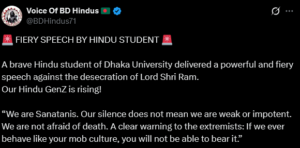
A particularly salient response to the threats emerged from Dhaka University, where a young Hindu student delivered a widely shared speech that captured the emotions of many peers: “We are Sanatanis. Our silence does not mean we are weak or impotent. We are not afraid of death. A clear warning to the extremists: If we ever behave like your mob culture, you will not be able to bear it.” While the speech reflects deep frustration and resolve, responsible civil discourse must keep the focus on non-violence, rule of law, and inclusive solidarity—especially to avoid tarring entire communities for the actions of a few radical actors.
The intimidation documented in this case is a form of Hinduphobia—hostility toward the presence, symbols, or practices of Hindu traditions in public life. It is important to distinguish such bigotry from the beliefs of Bangladesh’s Muslim majority, many of whom affirm pluralism and the constitutional guarantees of religious freedom. Effective responses must therefore isolate and counteract violent incitement without fostering communal stereotyping, mutual suspicion, or retaliatory rhetoric.
Bangladesh’s legal framework contains tools to address threats of this nature. The Constitution (Article 41) guarantees the right to profess, practice, and propagate religion, and Article 2A reiterates equal status and equal rights in the practice of other religions despite Islam’s status as state religion. Relevant provisions of the Penal Code (Sections 295–298) criminalize acts intended to insult religion or outrage religious feelings; Bangladesh’s cyber and public order laws prohibit incitement to violence. A threat to “bulldoze” a religious icon directly implicates public order and should trigger timely, proportionate law enforcement responses—preventive protection, investigation, and, where evidence supports, prosecution.
Security planning for vulnerable religious sites benefits from predictable, institutional mechanisms rather than ad hoc crisis management. Risk assessments, police–community liaison units, clear permitting and compliance checklists, rapid rumor-control protocols, CCTV and access controls consistent with local norms, and escalation matrices tied to local administration can reduce opportunities for intimidation to succeed. Transparent communication from authorities—stating what protections are in place and what legal steps are underway—helps restore trust when a project is paused.
Socio-culturally, the proposed statue of Lord Rama carries layered meaning. For Vaishnava devotees, the iconography embodies Maryada Purushottama—virtue, justice, and ethical statecraft. Public artworks of this scale also interact with heritage discourses: they become visible markers that communities exist, contribute, and wish to be seen. When intimidation halts such markers, it risks signaling that threats are an effective veto over minority cultural expression, undermining pluralism.
Civic responses have not been confined to Bangladesh. Diaspora groups and student organizations have organized peaceful demonstrations and vigils in multiple cities—appealing to parliaments, human rights bodies, and media outlets to spotlight the vulnerability of Hindu minorities. Advocacy is most impactful when it is evidence-led, avoids sensationalism, and channels concern into concrete, rights-based recommendations: security guarantees for sites under threat, accountability for incitement, and structured interfaith dialogue at the district level.
In that spirit, a dharmic unity approach—bringing together Hindus, Buddhists, Jains, and Sikhs—can amplify voices for non-violence and constitutionalism. Joint statements condemning any attack on places of worship, coordinated legal aid, and shared platforms for documenting incidents of religious intimidation can demonstrate that threats against one tradition are affronts to all. Equally, inter-community partnerships with Muslims who publicly defend pluralism are essential to avoid polarization and to reaffirm Bangladesh’s own historical ideals of syncretism and convivencia.
Public communication matters. Influencers, community leaders, and spiritual teachers serve audiences that often form their first impressions from short clips and captions. Replacing rhetoric that shames communities for “silence” with language that encourages courageous, lawful action—filing complaints, preserving evidence, liaising with authorities, supporting victims, and donating to legal defense and reconstruction through transparent channels—keeps the response aligned with ahimsa and satya. Assertions that the “biggest threat” is spiritual weakness risk dividing an already vulnerable community; a more constructive frame stresses discipline, organization, and principled resilience.
Accountability requires documentation. Community committees should maintain incident logs; collect copies of threats, sermons, and posts; and preserve chain-of-custody for digital evidence. Legal teams can then map applicable statutes, draft complaints, and track case progress. Measurable indicators—resumption of construction, police deployments, prosecution outcomes, public interfaith endorsements, and decreased rumor-sparked incidents—allow stakeholders to evaluate whether de-escalation and protection strategies are working.
For readers seeking primary material related to this case, several videos are publicly available. A concise report on the halt and the threat environment: http://www.hinduhumanrights.info/wp-content/uploads/2026/06/YTDown_YouTube_Why-Was-Bangladesh-s-Biggest-Lord-Ram-St_Media_fz2CgWNHUlg_004_360p.mp4. A short clip capturing youth reaction: http://www.hinduhumanrights.info/wp-content/uploads/2026/06/ssstwitter.com_1781853526122.mp4. A segment discussing the “bulldozer” threat narrative: http://www.hinduhumanrights.info/wp-content/uploads/2026/06/YTDown_YouTube_BULLDOZER-ULTIMATUM-TO-LORD-RAM-STATUE-I_Media_yGHh-8lApZU_004_360p.mp4. These materials should be viewed with standard media-literacy practices: cross-checking claims, noting dates and locations, and distinguishing commentary from verified reporting.
Ultimately, this episode underscores three imperatives. First, intimidation aimed at suppressing minority religious expression is a public-order challenge the state must address promptly, lawfully, and transparently. Second, civic responses are strongest when dharmic traditions act in concert, partner with pluralist Muslim voices, and reject retaliatory frames. Third, durable solutions come from institutions—predictable security planning, responsive policing, and a justice system that treats incitement and threats with the gravity they deserve. With these guardrails in place, projects like the Sri Radha Govinda Temple’s Lord Rama statue can proceed in safety, honoring Bangladesh’s constitutional commitments and its plural cultural fabric.
Inspired by this post on Hindu Human Rights Blog.






Leave a Reply
You must be logged in to post a comment.