
Among the decisive moments in the Mahabharata, few are as quietly powerful as Arjuna’s choice in the Udyoga Parva. The scene appears simple: two warriors approach Bhagavan Krishna for support before the Kurukshetra War. Yet beneath that simplicity lies a profound study of dharma, leadership, humility, strategy, and the difference between material strength and moral clarity. The episode becomes one of the great turning points of the Mahabharata because it reveals not only what Arjuna and Duryodhana wanted, but also what each one understood about power.
As conflict between the Kauravas and the Pandavas became unavoidable, both sides knew that the Yadavas of Dwaraka could alter the military balance. Krishna was not merely a ruler or diplomat; he was the central moral and spiritual force in the epic. His presence carried political influence, strategic intelligence, personal authority, and divine significance. For this reason, Duryodhana and Arjuna both set out to seek his assistance, each hoping to secure an advantage before the war began.
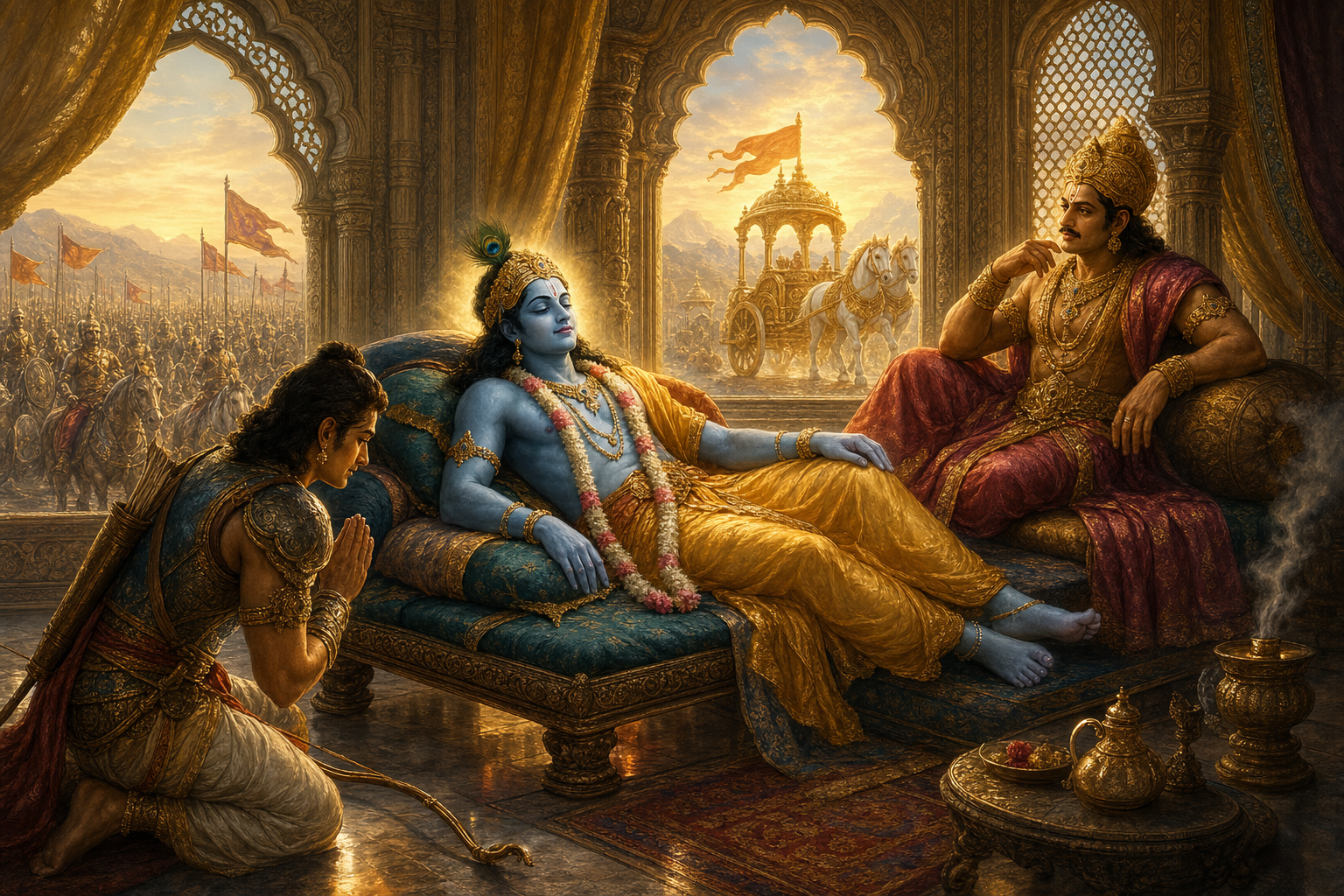
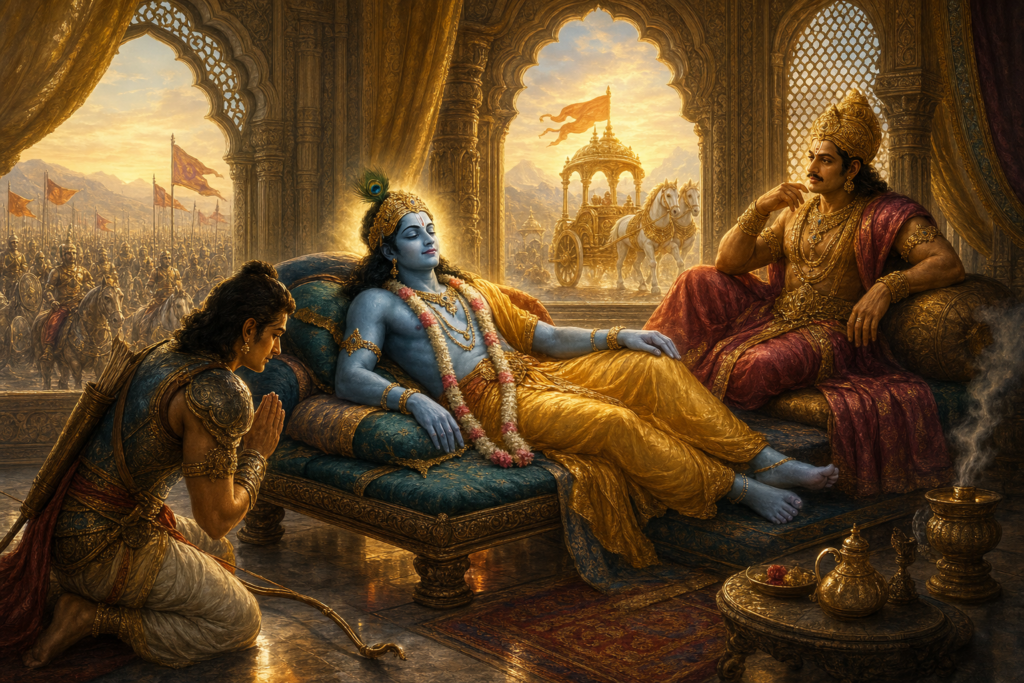
The Mahabharata’s Udyoga Parva describes the famous encounter in Krishna’s chamber. Duryodhana arrived first and sat near Krishna’s head while Krishna was resting. Arjuna arrived later and stood near Krishna’s feet with reverence. When Krishna awoke, his eyes first fell upon Arjuna. Duryodhana immediately argued that he had arrived earlier and therefore deserved the first claim. Krishna, however, responded with a carefully balanced decision: he had seen Arjuna first, and Arjuna was younger, so Arjuna would be offered the first choice.
The options Krishna placed before them were extraordinary. On one side was Krishna himself, unarmed and resolved not to fight in the war. On the other side was his powerful Narayani Sena, a formidable military force. The choice appeared, on the surface, to be between symbolic presence and practical strength. Duryodhana, shaped by a political mind that valued numbers, weapons, and visible power, naturally desired the army. Arjuna, guided by devotion and deeper insight, chose Krishna.
This choice did not simply divide resources; it revealed character. Duryodhana saw Krishna primarily through the lens of utility. If Krishna would not wield weapons, then the army seemed more useful. Arjuna saw Krishna as the source of wisdom, stability, and dharmic direction. In an ordinary military calculation, Duryodhana’s decision might appear rational. In the moral universe of the Mahabharata, however, Arjuna’s choice disclosed a greater intelligence: the recognition that guidance can outweigh force when the crisis is civilizational rather than merely territorial.
The contrast between sitting at the head and standing near the feet has often been interpreted as a silent test. The epic does not need to state this symbolism bluntly for the scene to carry meaning. Duryodhana’s place near the head suggests entitlement, calculation, and confidence in status. Arjuna’s place near the feet suggests humility, surrender, and reverence. In Indian spiritual culture, the feet of the guru, elder, or divine guide are associated with learning, devotion, and the willingness to be corrected. The episode therefore becomes more than a contest for alliance; it becomes a study in inner orientation.
Arjuna’s decision also belongs within the larger framework of dharma. The Mahabharata never presents war as a casual or glorious act. The Kurukshetra War emerges only after repeated failures of negotiation, repeated violations of justice, and the refusal to restore what was rightfully due to the Pandavas. Krishna’s role before the war is not that of an instigator but of a mediator who attempts peace. His later role as Arjuna’s charioteer must be understood in this ethical context. He stands with the side that must act, but he also restrains, instructs, and morally disciplines that action.
The choice of Krishna over the Narayani Sena becomes even more significant when the Bhagavad Gita is considered. On the battlefield, Arjuna’s courage collapses under the emotional and ethical weight of fighting relatives, teachers, and friends. At that moment, armies cannot help him. Weapons cannot resolve his inner conflict. Only Krishna’s teaching can restore clarity. The Gita, delivered from the chariot rather than a throne, becomes possible because Arjuna chose Krishna’s presence before he knew how deeply he would need it.
This is why the episode continues to speak across generations. Human beings often face choices that resemble Arjuna’s dilemma, even outside the battlefield. One option may offer immediate advantage, social approval, institutional power, or measurable gain. Another may offer guidance, conscience, discipline, and truth. The Mahabharata suggests that the second option may appear weaker at first, but it can become decisive when circumstances become morally complex. In moments of pressure, the presence of wisdom is not ornamental; it is strategic.
Duryodhana’s mistake was not that he valued military strength. In political and military affairs, strength matters. His error was that he treated strength as self-sufficient. He failed to see that power without dharma becomes unstable, and strategy without moral restraint becomes destructive. The Kaurava side possessed great warriors, including Bhishma, Drona, Karna, Kripa, and Ashwatthama. Yet the epic repeatedly shows that brilliance, loyalty, and weaponry cannot compensate for a cause weakened by adharma.
Arjuna’s choice did not make the Pandavas passive or magically victorious. They still had to fight, suffer, lose loved ones, and bear the consequences of war. The Mahabharata is too serious a text to offer easy triumphalism. Krishna’s presence did not remove hardship; it gave direction within hardship. This distinction is central to understanding the episode. Dharma does not always prevent conflict, but it prevents action from becoming blind, selfish, and chaotic.
Krishna’s vow not to fight also deserves careful attention. By refusing to take up arms, Krishna prevents the war from becoming dependent on divine violence. Instead, he becomes the charioteer, counselor, diplomat, and witness. His role elevates the meaning of leadership. The highest guide does not always dominate events from above; sometimes the guide holds the reins, steadies the warrior, and ensures that action remains aligned with duty. This is one of the most refined images of leadership in Indian epic literature.
The image of Krishna as sarathi, the charioteer, also reverses worldly expectations. A king, statesman, and divine figure accepts a role that appears subordinate. Arjuna, the warrior, sits in the chariot, but Krishna directs its movement. The relationship is not one of ego but of trust. In this arrangement, the Mahabharata teaches that true guidance does not diminish human agency. Arjuna must still choose, aim, and act. Krishna provides the knowledge by which action becomes meaningful.
From a strategic perspective, Arjuna’s choice had far-reaching consequences. Krishna understood personalities, vows, weaknesses, timings, and the moral psychology of the battlefield. His counsel shaped crucial moments in the war, including how the Pandavas responded to warriors who seemed undefeatable under ordinary rules. These moments remain ethically complex, and the Mahabharata intentionally preserves that complexity. Yet the epic consistently shows Krishna as the one who understands that dharma-yuddha is not a mechanical contest; it is a struggle in which justice must confront power, deception, attachment, and fate.
The episode also offers an important lesson for the unity of dharmic traditions. Hindu, Buddhist, Jain, and Sikh traditions all preserve, in different ways, the value of inner discipline, humility, self-mastery, and ethical action. Arjuna’s decision reflects a civilizational insight shared across these traditions: external power must be governed by wisdom. Whether described through dharma, ahimsa, viveka, seva, or spiritual discipline, the underlying principle remains that strength becomes noble only when guided by truth and responsibility.
In this light, the choice between Krishna and the Narayani Sena becomes a philosophical model. It asks whether civilization is sustained by numbers alone or by the quality of consciousness guiding those numbers. It asks whether victory is merely the defeat of an opponent or the restoration of order. It asks whether leadership is possession of force or alignment with a higher principle. These questions make the Mahabharata enduringly relevant, not only as sacred literature but also as political and ethical reflection.
Arjuna’s humility should not be mistaken for weakness. He was one of the greatest warriors of the epic, trained in celestial weapons and unmatched in discipline. His reverence for Krishna did not reduce his power; it refined it. The Mahabharata repeatedly suggests that the most dangerous warrior is not the one driven by anger, pride, or insecurity, but the one whose strength has been disciplined by wisdom. Arjuna’s greatness lies not only in his skill with the bow but in his willingness to be taught.
Duryodhana’s confidence, by contrast, is tragic because it is incomplete. He is not portrayed as lacking intelligence or courage. He understands politics, alliance-building, and the psychology of power. Yet his intelligence is repeatedly narrowed by envy and entitlement. He can calculate advantage, but he cannot recognize grace. He can secure an army, but he cannot receive guidance. This is why his victory in obtaining the Narayani Sena becomes, in the deeper structure of the epic, a loss.
The silent test of head and feet therefore becomes a mirror. It reflects how people approach wisdom in moments of ambition. Some approach it as something to be used; others approach it as something before which the ego must soften. The Mahabharata does not condemn practical intelligence, but it refuses to separate intelligence from character. The scene in Krishna’s chamber shows that the destiny of great events can turn on subtle inner dispositions before any weapon is raised.
The emotional depth of the episode comes from its restraint. There is no battlefield noise, no dramatic weapon, and no public declaration. There is only Krishna resting, Duryodhana waiting near the head, Arjuna standing near the feet, and a choice that will shape the war. The quietness of the scene makes it more powerful. Many decisive moments in life happen in similar silence, when the visible world has not yet changed but the direction of destiny has already shifted.
For readers of the Mahabharata, this moment encourages a more mature understanding of success. The epic does not teach that material resources are irrelevant. Rather, it teaches that resources must be subordinated to dharma. Armies, wealth, learning, institutions, and influence can serve justice or injustice depending on the consciousness that directs them. Arjuna’s choice is remembered because it placed wisdom above possession and relationship above calculation.
The outcome of the Kurukshetra War cannot be reduced to this one decision, but this decision illuminates the entire war. The Pandavas did not merely acquire Krishna as a charioteer; they accepted the burden of being guided. Arjuna did not choose an easy victory; he chose the presence that would force him to confront fear, grief, duty, and truth. Duryodhana did not merely choose an army; he chose the comfort of visible strength over the challenge of inner correction.
That is why Arjuna’s choice changed the course of the Mahabharata War. It transformed the conflict from a contest of armies into a revelation of dharma. It made the battlefield the setting for the Bhagavad Gita. It established Krishna not as a weapon-bearing combatant but as the guiding intelligence behind righteous action. Above all, it showed that when history reaches its most difficult crossroads, the decisive question is not always who has more power, but who is willing to be guided by wisdom.
Inspired by this post on Hindu Blog.



Leave a Reply
You must be logged in to post a comment.