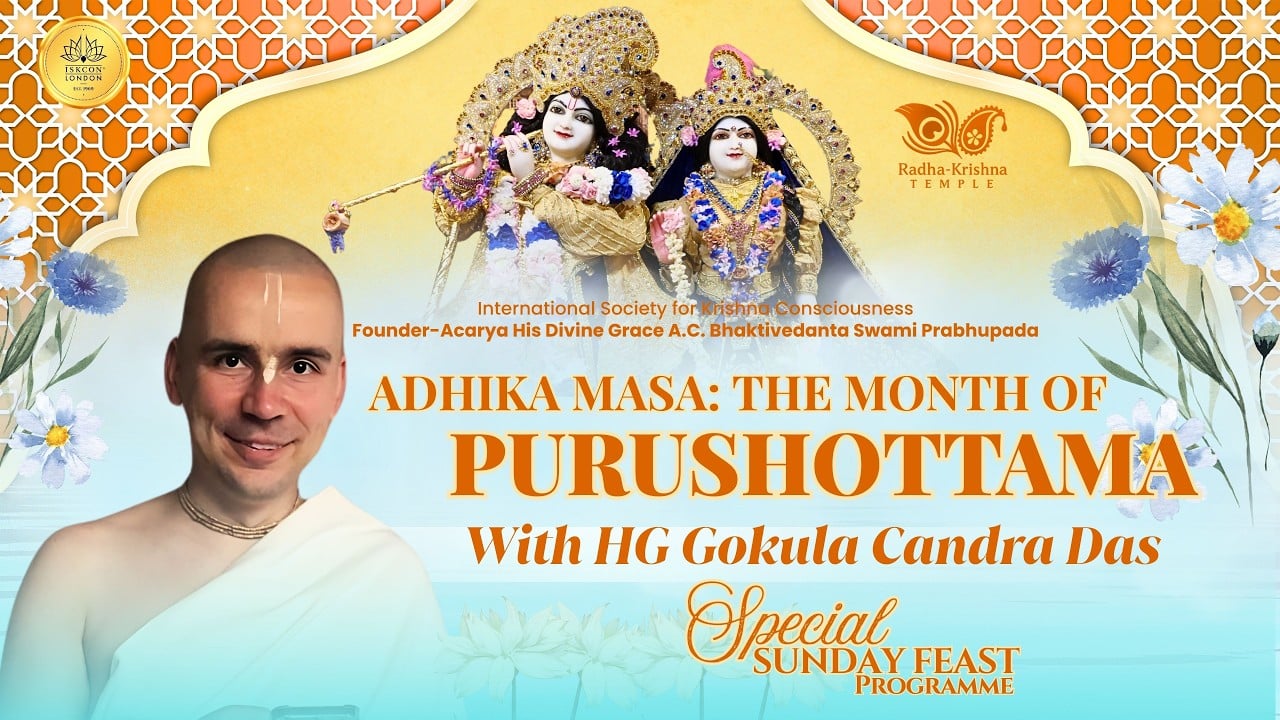
Anchored to the Sunday Feast discourse by HG Gokula Chandra Das at the ISKCON London Radha-Krishna Temple on 17.05.2026, this in-depth primer examines Adhika Masarevered in the Vaishnava tradition as Purushottama Masathrough the lenses of Hindu calendar science, scriptural theology, and practical sadhana. The analysis equips practitioners and learners with a rigorous understanding of why the intercalary month occurs, how it is calculated in the panchang tradition, and how it can be embraced as a month of intensified bhakti. In keeping with the dharmic spirit of harmony, it also highlights resonances across Hindu, Buddhist, Jain, and Sikh traditions.
Adhika Masa (intercalary month) arises to reconcile the lunar year with the solar year in the Hindu calendar. Because twelve lunar months total approximately 354 days, an 11-day annual shortfall accumulates; when the gap approaches one synodic month (roughly 29.5 days), an additional lunar month is inserted to realign the cycles. In the Vaishnava context, this intercalary month is honored as Purushottama Masa, a period specially dedicated to deepening devotion to Sri Krishna (Vishnu).
Technically, a lunar month becomes adhika when no solar saṅkrānti (solar ingress into a new rāśi/zodiac sign) occurs within that lunar month. Panchang compilers determine this by tracking the Sun’s longitudinal motion and verifying whether any ingress falls between two consecutive new moons (amānta convention) or full moons (pūrṇimānta convention). When no saṅkrānti occurs, the month is designated adhika; the rare opposite casetwo saṅkrāntis within one lunar monthcreates a kṣaya (omitted) month.
Naming follows a precise convention: the adhika month assumes the name of the following regular month. Thus, when the intercalation falls just before Jyeṣṭha, it is termed Adhik Jyeṣṭha. Regional calendars may follow amānta (South India) or pūrṇimānta (North India) systems for month demarcation, yet the underlying astronomical ruleabsence of saṅkrāntiremains the decisive criterion across traditions.
Modern panchangs typically employ drik-siddhānta (observational/astronomical) computations using updated planetary models, while classical works such as the Sūrya-siddhānta provide the foundational framework. This harmonization of traditional siddhānta with contemporary astronomy ensures that the insertion of Adhika Masa is both scripturally grounded and astronomically precise.
In many regional almanacs, the intercalation in 2026 is identified as Adhik Jyeṣṭha, placing Purushottama Masa in the late spring to early monsoon window. Local panchang variations can occur, so temple schedules, regional sampradāya guidelines, and community announcements remain the most reliable references for exact observances around May–June 2026.
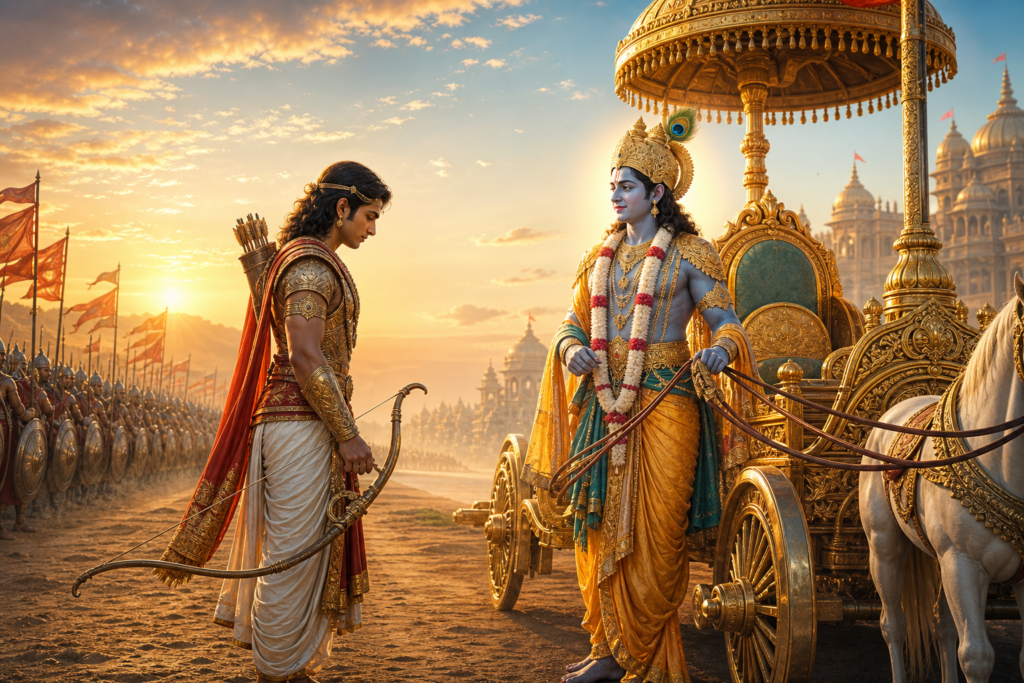
The designation “Purushottama” reflects a theological center of gravity. In Bhagavad Gita 15.18, the Supreme declares: “yasmāt kṣaram atīto’ham akṣarād api cottamaḥ tasmād asmi loke vede ca prathitaḥ puruṣottamaḥ.” Vaishnava ācāryas correlate this revelation with the month’s honorific name, emphasizing that practices performed with humility, śraddhā, and sevā-bhāva during this period draw one closer to the PurushottamaSri Krishnawho stands beyond both the perishable (kṣara) and the imperishable (akṣara).
Puranic narratives, especially in the Padma Purana and Skanda Purana, extol the spiritual potency of the intercalary month. A well-known account personifies the previously neglected “mala-māsa” seeking refuge, after which the Supreme sanctifies it as Purushottama Masa, granting it primacy among months for the cultivation of bhakti. While poetic and allegorical in tone, such narratives convey a clear prescription: intensify sādhana and align intention with seva to the Divine.
Vaishnava practice during Purushottama Masa typically centers on śravaṇa (attentive hearing), kīrtana (glorification of the Holy Names), smaraṇa (remembrance), and svādhyāya (systematic scriptural study). ISKCON communities often emphasize steady japa of the Hare Krishna mahā-mantra, congregational kīrtana, and engagement with the Bhagavad Gita and Śrīmad-Bhāgavatam, consistent with the Gaudiya Vaishnava hermeneutic of bhakti as the highest dharma.
Fasting and vratas are customarily intensified with due care. Many devotees observe Ekadashi with added attentionrefraining from grains and beans as per Vaishnava guidelinesand may adopt daytime fasts, water-only fasts, or fruit-and-milk fasts according to health, family tradition, and guidance from gurus or temple authorities. The principle is progressive sincerity rather than extremity; the vrata should elevate sattva and steadiness, not compromise well-being.
Dāna (charity) and seva (service) are central to Purushottama Masa. Alleviating suffering through anna-dāna, supporting dharma-centered education, and volunteering time at temples or community kitchens reflect the month’s emphasis on outward compassion grounded in inner discipline. These offerings, pursued without vanity, strengthen both individual character and social cohesion.
Pilgrimage (tīrtha-yātrā) and sacred study complement each other during this month. For those unable to travel, “digital pilgrimages” through lecture series and guided readings can be structured as at-home sādhanas. A purposeful plansuch as daily recitation of select Bhagavad Gita chapters and thematic readings from the Puranashelps anchor practice in a measurable, nourishing rhythm.
Many households avoid initiating major material undertakingsweddings, housewarmings, or high-stakes business launchesduring Adhika Masa. Instead, communities prioritize spiritual commitments, reconciliation of relationships, and long-postponed acts of self-correction. Such customs vary regionally; local guidance should be followed with respect.
A practical 30-day blueprint can be valuable. For example: commit to a fixed daily japa quota, schedule weekly kīrtana participation (temple or home), complete a full reading of the Bhagavad Gita across 18 days with summary reviews, and allocate the remaining days to curated passages from the Padma Purana or Skanda Purana that elucidate Purushottama-māhātmya. Layer in a realistic Ekadashi plan, a modest charity budget, and weekly sevā milestones.
Progress tracking elevates sincerity into sustained habit. Short daily journal entriesthree lines on intention, one line on a realized insight, and one line on gratitudehelp metabolize learning and transform temporary zeal into stable character. The emphasis is not on quantity of austerity but on quality of remembrance and consistency.
Adhika Masa’s call to interiority resonates across the broader dharmic family. Buddhism’s Uposatha observances organize regular cycles of intensified meditation and ethical recommitment; Jain traditions cultivate poshadha and extended fasting regimens that purify attention and conduct; Sikh practice centers on nām-simran, kīrtan, and sevā as vehicles of remembrance and service. While calendars and doctrines differ, the shared arcdiscipline, compassion, truthfulness, and non-harmfosters mutual respect and unity.
The calendar science underpinning Purushottama Masa embodies a sophisticated synthesis of astronomy and dharma. By using the objective criterion of solar saṅkrānti to time an intercalary insertion, the Hindu calendar avoids drift while keeping the sacred year in conversation with celestial realities. This is an elegant example of how scriptural tradition and observational exactitude can work together without conflict.
Acknowledging rare anomalies such as kṣaya-māsa underscores the robustness of the system. Although infrequent, these cases are fully anticipated by the siddhānta-based rules, demonstrating that the tradition accommodates complexity without surrendering coherence or predictability.
Health, family obligations, and occupational constraints require prudence. Those with medical needs should adapt fasting and sleep routines, prioritizing safety while preserving the essence of vratamindful restraint coupled with devotional remembrance. Elders, mentors, and temple guides can help calibrate effort to capacity.
Collectively observed, Purushottama Masa strengthens communities. Discourses like the Sunday Feast talk by HG Gokula Chandra Das offer shared reflection, invite questions, and cultivate a spirit of collaborative learning. Within the Gaudiya Vaishnava ethos, this learning culminates in service to Sri Krishna; within the larger dharmic canvas, it ripens as humility, empathy, and steadfast ethical life.
In summary, Adhika Masa is more than a calendrical correction. As Purushottama Masa, it is a deliberate season for deepening bhakti, integrating scripture with practice, and aligning personal conduct with timeless virtues. Approached with clarity, compassion, and steady resolve, the month becomes a living laboratory of transformationbenefiting not only individual seekers but also the shared fabric of the dharmic community.
Inspired by this post on Dandavats.