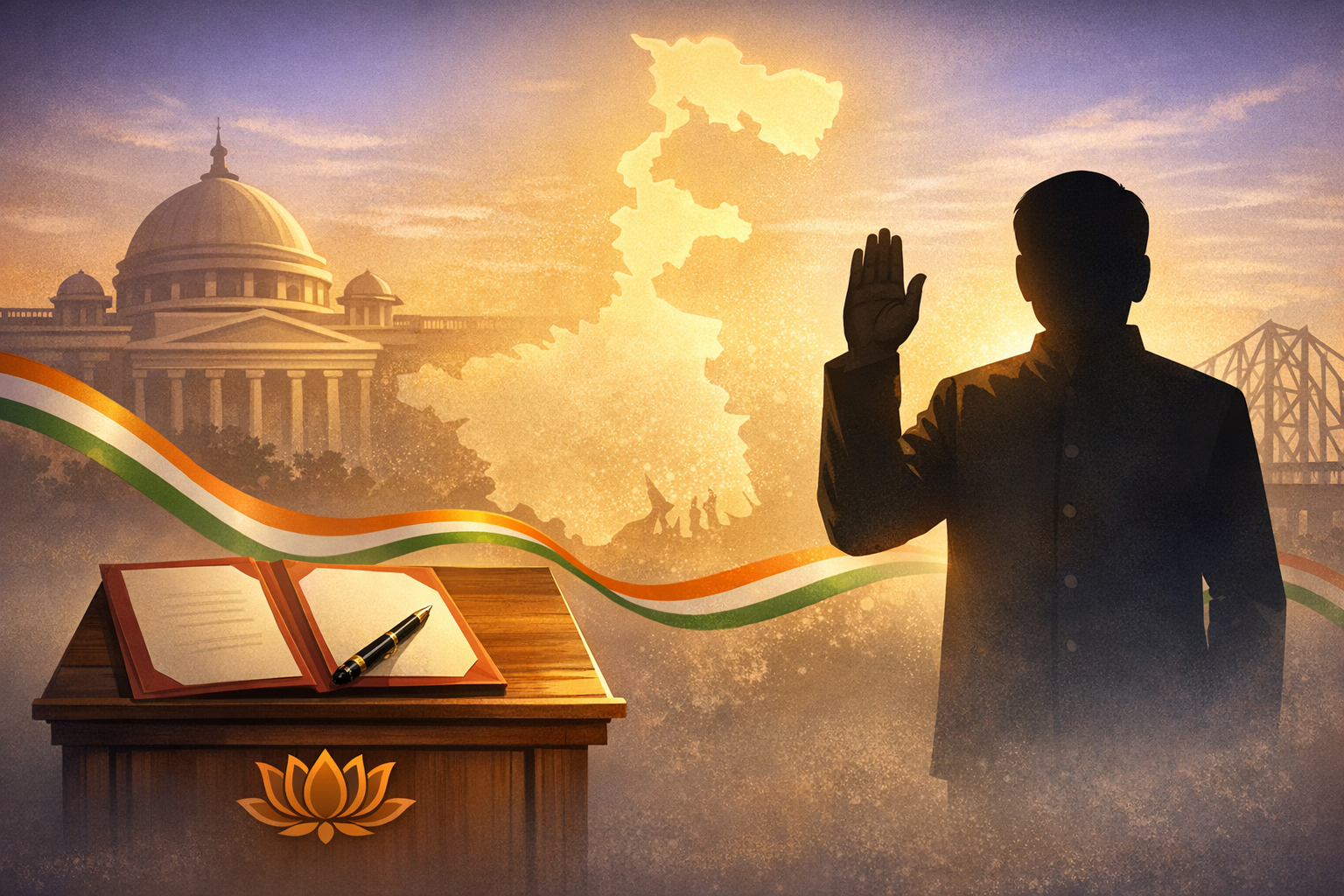
On 8 May 2026, multiple political and media reports from Kolkata indicated that Suvendu Adhikari is set to be sworn in on 9 May as West Bengal’s first Bharatiya Janata Party (BJP) Chief Minister, subject to formal confirmation by Raj Bhavan and standard government-formation protocols. If the oath-taking proceeds as scheduled, it would mark a historic realignment in West Bengal politics, inaugurating the state’s first BJP-led executive since independence and signaling a decisive shift in the balance of power after decades of Left Front and Trinamool Congress (TMC) dominance.
To appreciate the significance of this transition, it is instructive to recall the arc of West Bengal’s post-independence political history: the Congress-led era (intermittently in the early decades), the 34-year Left Front tenure from 1977 to 2011, and the TMC’s uninterrupted stewardship since 2011. A BJP-led government would therefore represent a new ideological and organizational chapter, testing a different approach to governance, federal cooperation with the Union government, and policy delivery across the state’s 23 districts.
Suvendu Adhikari’s trajectory helps explain the moment’s salience. Emerging as a key organizer during the Nandigram movement (2007–08), Adhikari consolidated a mass base in Purba Medinipur and adjoining belts, later serving as a TMC parliamentarian and minister before joining the BJP in December 2020. In 2021, he won a closely watched contest in Nandigram and served as Leader of the Opposition in the West Bengal Legislative Assembly, positioning himself as the BJP’s principal face in the state’s legislative politics.
Government formation in West Bengal follows constitutional procedure rather than political rhetoric. The 294-member Assembly requires 148 for a simple majority. As per convention under Article 164 of the Constitution, the Governor invites the leader who demonstrates majority support to take oath as Chief Minister, with the Council of Ministers subsequently sworn in. The oath’s text is provided in the Third Schedule. A floor test ordinarily follows within a reasonable timeframe to establish the government’s confidence in the House.
Judicially evolved norms reinforce these conventions. Landmark rulings such as S.R. Bommai v. Union of India (1994) and subsequent jurisprudence emphasize that questions of legislative majority must be resolved on the Assembly floor. More recent directions in cases concerning expedited trust votes reaffirm the principle of transparent, time-bound floor tests where numbers are contested. In practice, Raj Bhavan, the Assembly Secretariat, and party whips coordinate the scheduling, while the Election Commission of India’s certified results and notifications provide the necessary formal backdrop.
Described by many observers as a “Hindutva shift in Bengal,” the anticipated oath-taking invites a careful, scholarly understanding of “Hindutva” within the state’s plural public sphere. In the mainstream political lexicon, Hindutva in West Bengal has increasingly been framed by its proponents as a civilizational-cultural idiom that emphasizes dharmic values, social order, and national integration. Yet Bengal’s social fabric is irreducibly diverse, drawing strength from Hindu, Buddhist, Jain, Sikh, and other faith traditions; any durable political realignment will be evaluated by its commitment to constitutional rights, inclusive development, and communal harmony.
For many Bengalis who remember the civic ferment of Singur and Nandigram, this impending transition resonates emotionally as a test of accountable governance, law-and-order professionalism, and administrative delivery. It equally evokes hope and caution among youth and working households seeking dignified livelihoods, predictable public services, and fair access to opportunities irrespective of religion, caste, language, or region. The measure of success will be less in rhetorical polarization and more in tangible improvements to everyday life.
Immediate governance priorities are likely to revolve around peace, stability, and unity. West Bengal’s leadership will be expected to signal zero tolerance for political violence, strengthen impartial policing, and revitalize local peace committees that include representatives of Hindu, Buddhist, Jain, Sikh, and other communities. Early, visible steps to uphold the rule of lawpaired with clear grievance-redress mechanismscan help rebuild public trust across partisan lines while reinforcing the principle that democratic competition ends at the ballot box and gives way to cooperative citizenship thereafter.
Economic strategy will be central. West Bengal’s locationanchored by the Kolkata-Haldia port complex, the terminus of the Eastern Dedicated Freight Corridor near Dankuni, and multimodal links into the Northeast and the Bay of Bengalpositions it for logistics-led growth. A BJP-led administration will be scrutinized for how effectively it leverages these structural advantages to boost manufacturing, modernize warehousing, streamline customs interfaces, and incubate export-oriented MSMEs in clusters such as Howrah engineering, Siliguri logistics, and Medinipur agro-processing.
MSME vitality is especially critical given the sector’s large employment footprint. Policy instruments that matter here include timely working-capital access, transparent state procurement with prompt payments, plug-and-play estates for small manufacturers, quality certification support, and design/technology upgradation. Synchronizing state incentives with Union schemescredit guarantees, PLI where applicable, and skilling initiativescan tighten the virtuous loop between productivity and job creation.
Agriculture and rural livelihoods will require sustained attention. West Bengal remains a leading producer of rice and vegetables, with a distinctive jute ecosystem that integrates farmers, retting infrastructure, and mills. Enhancing farmgate prices through better aggregation, storage, and direct marketing; investing in flood-resilient irrigation; and upgrading rural roads and cold chains can cushion climate shocks and raise incomes. Jute sector revitalizationthrough product diversification, modernized mills, and predictable procurementwould directly benefit tens of thousands of workers and upstream farm households.
Social protection must remain firmly wedded to data integrity and inclusion. Building a single, consent-based beneficiary registry; eliminating ghost entries; and enabling portable entitlements will help ensure that nutrition, housing, and income-support programs reach intended families. A transparent, publish-what-you-fund approachbacked by independent social auditscan minimize leakage, raise citizen confidence, and align assistance with the state’s poverty and malnutrition maps.
Education and health are long-horizon growth multipliers. Resolving teacher recruitment litigation expeditiously, rebalancing pupil-teacher ratios in rural and peri-urban blocks, and investing in school infrastructure and digital learning can lift learning outcomes. In health, strengthening primary care, referral pathways, and emergency responsewhile expanding cancer and cardiac care networks beyond Kolkatawill save lives and reduce catastrophic health expenditure for low- and middle-income households.
Centre–state federal cooperation will be pivotal. Historically, friction over fiscal devolution, central schemes’ branding, and compliance audits has impeded delivery. A constructive resetprioritizing GST compensation issues, rapid release of sanctioned funds, and joint monitoring dashboardswould pay immediate dividends. Regular, public-facing coordination between Nabanna (the state secretariat) and relevant Union ministries can depoliticize delivery chains and keep the focus on outcomes.
Border management and cross-border trade with Bangladesh are economically and socially consequential. West Bengal shares a long international boundary with Bangladesh, and orderly, rules-based facilitation at Petrapole-Benapole and other points can reduce transaction costs while sustaining local livelihoods. Simultaneously, professional border managementconsistent with human rights and due processhelps contain trafficking and other illicit flows. The balance to strike is secure connectivity that undergirds formal commerce and people-to-people ties.
Urban governance in the Kolkata Metropolitan Area and fast-growing municipalities will benefit from predictable capital expenditure pipelines for water supply, drainage, solid waste management, and public transport. Model PPP frameworks, user-friendly building permissions, and transit-oriented development around metro and EMU nodes can crowd in private investment while raising quality of life. Brownfield renewalrather than greenfield sprawlwill protect peri-urban agriculture and reduce infrastructure unit costs.
Climate resilience is a non-negotiable priority. The Sundarbans and coastal districts face recurrent cyclones and saline ingress, while the northern hills and Dooars grapple with landslides and riverine erosion. Nature-based solutions for embankments, mangrove restoration, resilient housing typologies, and decentralized renewable energy can reduce vulnerability. Embedding climate risk into all public investment decisions will avert costly retrofit cycles and protect the poorest households who are most exposed.
Governance reform underpins every policy promise. A strong signal of administrative neutralitytransparent postings, performance-linked reviews, time-bound service delivery (via a guaranteed citizen charter), and open, merit-based recruitmentswill help depoliticize institutions. Complementing this with a state-level integrity architecturee-procurement by default, beneficial ownership disclosure for vendors, and real-time expenditure analyticscan measurably reduce corruption risk.
Digital public infrastructure can accelerate inclusion and accountability. Interoperable registries, GIS-tagged assets, anonymized microdata for researchers, and grievance portals that track resolution timelines create a culture of measurable delivery. Public dashboardsupdated monthlyon jobs, crime, health, schools, and municipal services allow citizens, media, and legislators to objectively track progress and course-correct early.
The first 100 days typically set tone and tempo. Announcing a limited set of auditable prioritieslaw-and-order stabilization, MSME working-capital relief, expedited teacher appointments consistent with court directions, and a monsoon-preparedness planwould demonstrate focus. Equally, avoiding overreach by limiting policy churn and protecting administrative continuity where systems work can prevent disruption fatigue.
Risks and constraints remain real. Revenue buoyancy may lag ambitions without rapid investment inflows; legal challenges can slow appointments and procurement; and lingering partisan animosities could test law-and-order professionalism. These risks are manageable if the government privileges constitutionalism over confrontation, data over dogma, and service delivery over symbolism.
As 9 May approaches, procedural markers merit attention: a Raj Bhavan communique confirming the oath schedule; the list of ministers and portfolio logic; a floor-test timeline published by the Assembly Secretariat; and early administrative circulars on law-and-order, treasury controls, and beneficiary audits. Clear, consistent communication from the Chief Minister’s Office can anchor expectations and reduce rumor-driven volatility.
Ultimately, the historical weight of this transition will be judged less by partisan triumphalism and more by its civic dividends. West Bengal’s civilizational heritage invites a contemporary ethos of dharmic unityhonoring the plural traditions of Hinduism, Buddhism, Jainism, and Sikhismalongside equal respect for all communities under the Constitution. If the oath-taking proceeds on 9 May, success will be defined by whether governance choices widen opportunity, deepen social trust, and make everyday life safer, fairer, and more prosperous for every household from the Sundarbans to Siliguri.
Inspired by this post on Struggle for Hindu Existence.