Modern life often celebrates accumulation as success, yet the inner experience frequently tells a different story: more things rarely resolve restlessness. Hinduism’s rich wisdom tradition explains why, linking unchecked materialism to anxiety, craving, and an unending cycle of dissatisfaction. This insight resonates across dharmic paths—Hinduism, Buddhism, Jainism, and Sikhism—each affirming that inner peace grows when desire is refined rather than indulged.
Within Hindu philosophy, materialism is framed as an over-identification with external objects and status, diverting attention from dharma and the cultivation of inner wealth. The Bhagavad Gita describes how repeated dwelling on objects triggers attachment, which engenders desire (kāma), frustration, and instability. The result is a feedback loop: the more one chases, the more elusive contentment becomes.
This dynamic is not only spiritual but psychological. The “hedonic treadmill” explains how people adapt quickly to gains, resetting expectations and seeking the next upgrade. Hindu frameworks name this pattern as rāga (clinging) and moha (delusion), which obscure discernment (viveka) and disturb balance (samatva). When desire outruns purpose, anxiety proliferates.
A powerful antidote in the dharmic toolkit is Aparigraha—non-hoarding and right relationship with possessions. Rooted in Yoga philosophy and foundational in Jain ethics, Aparigraha aligns with Buddhist teachings on tanhā (craving) and Sikh principles of santokh (contentment) and seva (selfless service). Together, they offer a unified call: simplify, serve, and seek freedom from compulsive wanting.
Consider a relatable scenario: a professional earns a promotion, upgrades a phone, then a car, and soon scans listings for a bigger home. Satisfaction flickers, then fades. Social comparisons intensify through constant media exposure. The pattern is clear—without a dharmic compass, more becomes never enough, and anxiety quietly expands its territory.
Hinduism does not reject artha (material prosperity); instead, it subordinates it to dharma, emphasizing ethical acquisition and purposeful use. When wealth supports family, community wellbeing, and Lokasangraha (the welfare of all), it nourishes stability rather than feeding restlessness. The shift is from possession as identity to possession as instrument.
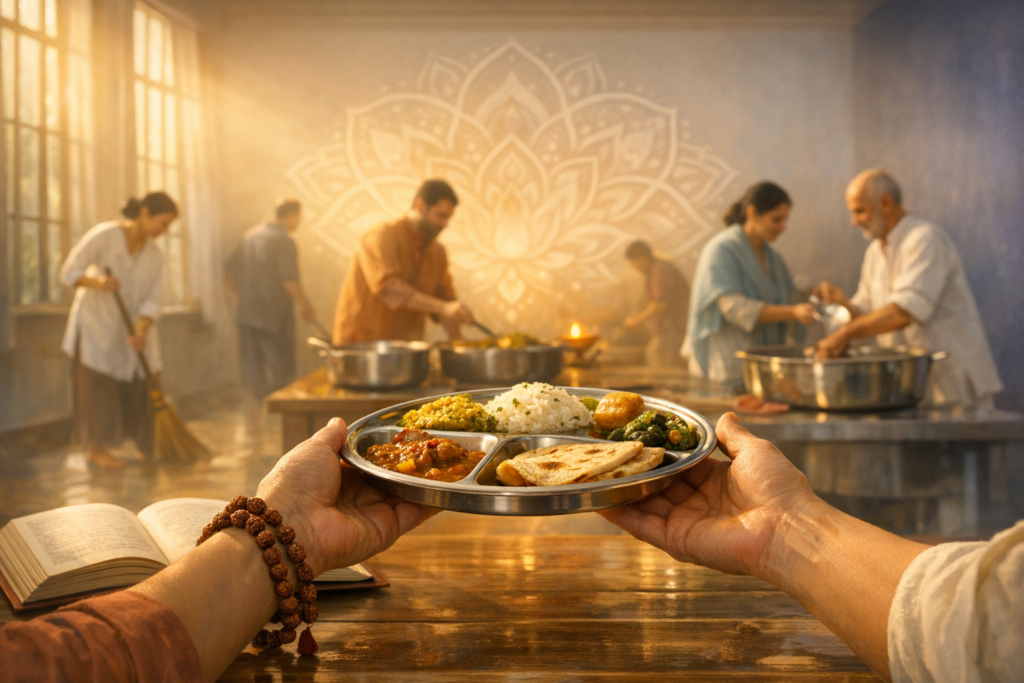
Practical disciplines help translate insight into habit. Viveka (discernment) and vairāgya (non-attachment) refine choices before desire hardens into compulsion. Pratyāhāra (sensory regulation) and dhyāna (meditation) steady the mind. Gratitude practice counters scarcity narratives. Dāna (generosity) and seva (service) loosen the grip of egoic ownership while strengthening social bonds—values celebrated across Hinduism, Buddhism, Jainism, and Sikhism.
For householders (gṛhastha āśrama), balance is the guiding principle. Pursuits of artha and kāma are honored when harmonized with dharma and ultimately oriented to mokṣa (liberation). This integrated model reframes success: not the volume of assets, but the clarity of intention and tranquility of mind.
Simple, measurable practices can ease anxiety while strengthening Aparigraha. These include a periodic inventory of possessions, a “one-in, one-out” rule for goods, a mindful pause before purchases, dedicated digital-sabbath intervals, and a commitment to repair and reuse over constant replacement. Such habits cultivate mindfulness, reduce environmental strain, and support ethical consumption.
As dependence on acquisition recedes, emotional steadiness often rises. Individuals report improved sleep, fewer comparison-driven thoughts, and deeper satisfaction in relationships and meaningful work. The mind, trained in discernment and anchored in service, grows resilient, calm, and capable of sustained focus.
Across dharmic traditions, the conclusion converges: materialism without wisdom intensifies anxiety, while guided engagement with resources fosters freedom. Hinduism’s counsel—supported by kindred insights in Buddhism, Jainism, and Sikhism—invites a decisive pivot from compulsive desire to conscious living. In choosing inner wealth over endless wanting, life regains coherence, purpose, and peace.
Inspired by this post on Hindu Blog.