
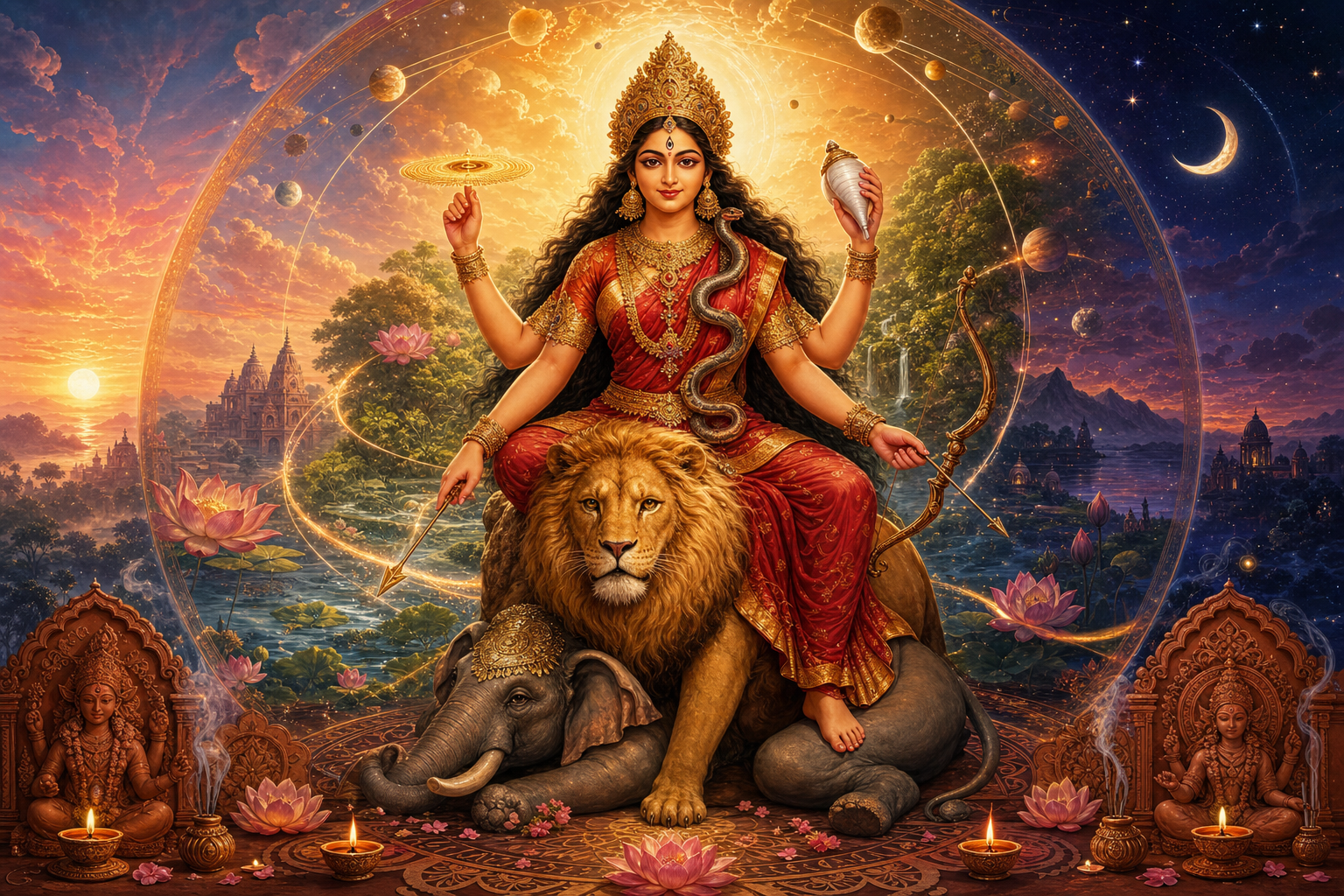
Jagaddhatri, the sustaining presence within a changing universe
At dawn, the world appears to emerge from stillness. At noon, it reaches its most visible intensity. By evening, forms recede into shadow and activity turns toward rest. The Tantric worship of Goddess Jagaddhatri across these three phases of the day treats this familiar rhythm as a revelation: creation, continuity, and withdrawal are not disconnected events but movements of one indivisible Shakti. Tri-Sandhya worship consequently presents time itself as a sacred field in which the cosmic Mother may be contemplated.
Within the diverse traditions of Shakta Tantrism, Jagaddhatri is revered as the power that bears, sustains, and nourishes the universe. Her name combines jagat, the moving world or manifested cosmos, with dhātrī, a feminine term for one who supports, maintains, or nourishes. The name therefore identifies a function more comprehensive than protection alone. Jagaddhatri is the ground of stability within movement, the intelligence that prevents manifestation from dissolving into disorder, and the maternal power through which living beings receive the conditions necessary for existence.
This understanding gives Jagaddhatri an especially significant place in Shakta theology. The universe is not imagined as a mechanism created once and then left to operate independently. It is continuously upheld by conscious power. Every breath, biological process, planetary motion, moral choice, and act of renewal depends upon an underlying capacity to remain integrated. Jagaddhatri personifies that capacity. Her worship directs attention toward an easily overlooked truth: maintenance is itself a sacred act.
Jagaddhatri in the Tantric textual landscape
Jagaddhatri belongs to a broad textual and ritual environment rather than to a single universally standardized scripture. Bengali accounts associate her with works and compilations such as the Mayatantra, the Tantrasāra of Krishnananda Agamavagisha, and later ritual digests. Banglapedia’s account of Jagaddhatri Puja also notes references in medieval and early modern ritual literature. Traditional discussions additionally connect her with the Kubjika Tantra and the Katyayani Tantra. These associations establish her place within Shakta practice, although manuscripts, regional recensions, and ritual manuals do not always present identical descriptions.
The expression Kubjika Tantra requires particular care. Kubjika is both the name of a powerful Tantric goddess and the center of an extensive initiatory current, especially associated in scholarship with the western transmission, or Paścimāmnāya, of Shaiva-Shakta Tantra. At the same time, traditional catalogues and regional sources may use closely related titles for different works. It is therefore more accurate to speak of Jagaddhatri’s worship as being attributed to, preserved within, or interpreted through Kubjika-related Tantric traditions than to assume that every surviving text bearing a similar title contains one uniform liturgy.
This textual caution does not diminish the tradition. It reveals how Tantra actually developed: through scriptures, transmitted teachings, ritual handbooks, commentaries, temple customs, household observances, and living lineages. A Tantric deity is rarely reducible to one printed passage. Her identity emerges through the interaction of mantra, visualization, iconography, philosophy, initiation, and repeated worship. Jagaddhatri’s threefold daily worship should be understood within this dynamic ritual ecology.
Shakti as the bearer of manifestation
Shakta traditions regard Shakti not as a secondary energy possessed by a separate deity but as the active reality through which consciousness manifests, knows, and transforms the cosmos. Without Shakti, pure consciousness would remain without expression; without consciousness, power would lack intelligible direction. Jagaddhatri makes this philosophical relationship emotionally and ritually accessible. She is the universe-bearing Mother whose sovereignty appears through care, order, resilience, and the restoration of balance.
The title “cosmic sustainer” should not be interpreted as passive preservation. Sustaining a living system demands continual adjustment. A body maintains equilibrium through countless changes; a community survives by renewing its relationships; an ecosystem persists through cycles of growth, decay, and regeneration. Jagaddhatri’s power similarly includes measured transformation. She preserves the world by enabling it to change without losing its deeper coherence.
Later devotional interpretations frequently connect Jagaddhatri with the celebrated episode of the Kena Upanishad in which the gods become proud after a victory. A mysterious divine presence demonstrates that Agni cannot burn a blade of grass and Vayu cannot carry it away. Uma then discloses that their power depended upon Brahman. The Upanishad does not name Jagaddhatri in this episode, so the identification is theological rather than a literal claim about the oldest text. Nevertheless, the connection is meaningful: both narratives expose the error of treating borrowed power as independent possession.
What Tri-Sandhya means
Tri-Sandhya refers to the three junctions of the day: morning, midday, and evening. The word sandhyā suggests a joining, conjunction, or transitional interval. Dawn joins night to day; midday marks the turning point between the day’s ascent and decline; dusk joins day to night. Such thresholds receive special attention throughout Hindu ritual culture because an established condition is loosening while another is taking form. Transition is considered spiritually potent precisely because ordinary boundaries become less rigid.
Tri-Sandhya discipline appears in several Hindu settings, including forms of Sandhyāvandana, mantra recitation, meditation, and deity worship. Jagaddhatri’s threefold observance belongs to this larger sacred understanding of daily time while retaining a distinct Shakta character. The practitioner does not merely repeat the same action according to a clock. Each worship encounters divine power under a different temporal emphasis.
The three observances may also be correlated with the cosmic processes of manifestation, maintenance, and withdrawal. Morning evokes emergence and awakened awareness. Midday expresses fullness, action, and support. Evening turns attention toward dissolution, inwardness, and release. These processes are not separate territories governed by competing powers. Each is an activity of the same Goddess, and each is already present within the others.
This is the central theological insight of Tri-Sandhya Shakti. Jagaddhatri does not become three unrelated goddesses as the hours pass. Rather, the movement of the day reveals three modalities of one reality. The apparent plurality is pedagogical: it trains perception to recognize unity without erasing difference.
The morning contemplation: emergence, clarity, and possibility
Morning worship approaches Jagaddhatri as the power of awakening. Some ritual interpretations describe this phase through a peaceful, youthful, or luminous form and associate it with purity, knowledge, and the opening of possibility. Certain paddhati-based explanations further relate the morning form to Brahma, a white complexion, or the swan. Such details should be understood as lineage-dependent correspondences rather than an iconographic rule followed by every Jagaddhatri Puja.
The deeper function of the morning rite is easier to identify. Sleep has temporarily withdrawn the ordinary world of responsibilities, names, and social roles. On awakening, that world is reconstructed with remarkable speed. Morning worship interrupts this automatic reconstruction. Before habit fully takes control, awareness is directed toward the sustaining Shakti from whom both the worshipper and the day’s activities arise.
For a devotee, this phase can produce a distinctive emotional experience. The day is no longer approached as an external burden already crowded with demands. It is received as a field of sacred possibility. Intention, attention, and ethical direction become offerings. In this sense, the morning Jagaddhatri is not only the Mother who awakens the cosmos; she awakens discernment within the individual.
The midday contemplation: power, nourishment, and responsible action
At midday, solar brightness and human activity commonly reach their height. The corresponding worship emphasizes Jagaddhatri as the active sustainer: the power that feeds, organizes, protects, and enables work to bear fruit. Some threefold ritual schemes associate this phase with Vishnu, a red or radiant form, or Garuda. These associations express preservation and dynamic sovereignty, although the precise visualization varies among traditions.
Midday exposes an important paradox. Activity is necessary, but activity easily produces the illusion of personal self-sufficiency. Success may be claimed as an isolated achievement, while the networks of life that made it possible are forgotten. Worship at the center of the day interrupts that inflation. It recalls that strength depends upon food, society, teachers, inherited knowledge, ecological conditions, and ultimately Shakti.
Jagaddhatri’s sustaining power therefore carries an ethical demand. Power should support the world rather than exhaust it. Authority should protect rather than dominate. Knowledge should illuminate rather than humiliate. Wealth should circulate in ways that preserve dignity. The Goddess who holds the cosmos offers a standard by which human action may be judged: genuine power increases the conditions under which life can flourish.
The midday rite can consequently transform ordinary labor into disciplined service. Responsibilities remain real, yet they are no longer interpreted solely through competition or personal ambition. The devotee is invited to ask whether each action strengthens or fragments the larger field of life. This question gives Jagaddhatri worship a practical relevance extending beyond the ritual enclosure.
The evening contemplation: withdrawal, integration, and release
Evening introduces decline in light and outward activity. In some Tantric mappings, Jagaddhatri’s third phase is contemplated through a darker, more inward, or Rudra-associated form; occasional ritual summaries connect it with the bull and with the power of dissolution. The point is not that darkness is evil. Within Hindu cosmology, withdrawal is indispensable. Without endings there can be no rest, assimilation, or renewal.
The evening worship gathers the day back into its source. Actions are reviewed, attachments loosened, and unresolved emotions placed before the Goddess. Where the morning phase establishes intention and the midday phase tests it through action, evening allows experience to be digested. Success and failure are both relinquished. This surrender prevents memory from hardening into pride, resentment, or shame.
Jagaddhatri remains the sustainer even here. Rest is not the absence of support; it is one of support’s most necessary forms. A nervous system cannot remain perpetually activated, a field cannot yield without renewal, and a mind cannot remain clear without periods of silence. The evening Goddess teaches that preservation sometimes requires cessation.
The three guṇas and the danger of oversimplification
Tri-Sandhya worship is often interpreted through the three guṇas: sattva, rajas, and tamas. In classical Hindu philosophical usage, these are the interwoven qualities of prakṛti, or manifest nature. Sattva is associated with luminosity, balance, and intelligibility; rajas with motion, desire, and exertion; and tamas with inertia, concealment, density, and resistance.
They should not be reduced to the moral labels “good,” “ambitious,” and “bad.” All embodied existence involves their interaction. Sattva permits understanding, rajas makes action possible, and tamas provides stability and rest. Difficulty arises when any quality dominates without proportion or awareness. Clarity can become detached self-satisfaction, action can become compulsive agitation, and stability can become stagnation.
Some traditions map morning, noon, and evening respectively onto sattva, rajas, and tamas. Others arrange the symbolism differently according to the ritual purpose. The value of the model does not depend upon forcing every hour into a rigid category. Its value lies in teaching that the Goddess pervades every condition of nature while remaining greater than all three.
From a Tantric perspective, liberation is not achieved by pretending that activity and darkness do not exist. Their energies are recognized, disciplined, and returned to their source. Jagaddhatri holds the total field. She is present in illumination, movement, and repose, yet she cannot be confined to any one of them.
Reading the iconography of Goddess Jagaddhatri
Jagaddhatri’s best-known Bengali iconography presents her as a radiant, four-armed Goddess riding a lion that overcomes an elephant. Museum collections preserve important nineteenth-century examples of this visual tradition. A British Museum lithograph identifies the conch, discus, arrow, and bow in her four hands, while the Philadelphia Museum of Art describes her as a martial form of Durga defeating the elephant demon Karindrasura.
The conch and discus recall a vocabulary strongly associated with Vishnu. Within Jagaddhatri’s image, however, they belong to the Goddess and proclaim her comprehensive sovereignty. The conch may be read as ordered vibration, proclamation, or the awakening sound through which sacred presence becomes perceptible. The discus suggests revolving time, discriminating power, and the restoration of cosmic order.
The bow and arrow express concentrated intention. A bow stores potential energy; an arrow releases that energy toward a selected point. Together they offer an exact image of disciplined consciousness. Spiritual power is not merely intensity. It requires direction, restraint, timing, and the capacity to act without scattering attention.
The lion is both vehicle and active force. It conveys courage, royal authority, and controlled ferocity. Beneath it lies the elephant, commonly identified as Karindrasura. Devotional interpretation frequently reads this elephant as ahaṃkāra, the inflated ego that mistakes dependent power for independent supremacy. The Government of India’s Utsav account of Jagaddhatri Puja similarly records the traditional comparison between the elephant and the restless, difficult-to-control mind.
The image should not be interpreted as contempt for elephants, which possess many positive and sacred associations across Indian traditions. The defeated elephant belongs to a specific mythic and symbolic context. It represents force that has become disordered through arrogance or lack of control. Jagaddhatri does not destroy strength as such; she restores strength to its proper relationship with wisdom.
Descriptions of the Goddess also commonly mention three eyes, a complexion resembling the rising sun, red garments, ornaments, and a serpent worn as a sacred thread. The third eye indicates a mode of knowledge that exceeds ordinary dualistic sight. The solar color unites warmth, awakening, and sovereign presence. The serpent evokes concentrated life-force, transformation, and yogic power, while its position as a sacred thread brings knowledge and energy into a single emblem.
The ritual logic of three worships
Traditional Jagaddhatri Puja may be celebrated through three formal services conducted on one principal day, especially during the Navami observance in the bright fortnight of the month of Kartika. In other settings, preparatory and concluding rites extend across several days. Local custom may preserve one principal image while changing the meditation, offerings, or ritual emphasis at different times. Elsewhere, the three phases are described through distinct visualizations of the Goddess.
A developed Tantric worship ordinarily includes more than external offerings. Its ritual grammar may encompass purification, resolve, the placement of mantra through nyāsa, visualization through dhyāna, invocation, hospitality to the deity, mantra repetition, offering, fire ritual, and respectful conclusion. The outward sequence is intended to reorganize perception. The deity is approached not as a distant object but as sacred presence awakened in image, mantra, body, mind, and environment.
In this framework, repetition at morning, noon, and evening is not redundancy. Each return tests whether awareness can survive changing conditions. Contemplation may appear natural during a quiet dawn but difficult amid midday pressures. Evening may bring fatigue or emotional residue. Tri-Sandhya practice carries remembrance through all three states and thereby resists the division of life into “spiritual” and “ordinary” compartments.
Offerings also vary by region, lineage, household practice, and institutional setting. Flowers, water, light, incense, food, recitation, music, and fire offerings may all appear. Some historical Tantric customs used substances or forms of sacrifice that modern communities interpret symbolically or omit. No single popular description can substitute for an inherited paddhati or qualified ritual guidance.
This distinction is important because Tantric ritual is traditionally initiatory. Public theology and iconographic study may be undertaken openly, but restricted mantras, internal visualizations, and specialized procedures should not be reconstructed casually from disconnected internet sources. Respect for guru, sampradāya, and ritual context is not secrecy for its own sake; it protects both the integrity of the tradition and the practitioner.
From textual tradition to the public culture of Bengal
Jagaddhatri Puja is especially prominent in West Bengal, notably in Krishnanagar and Chandannagar, where elaborate images, lighting, processions, community organization, and artistic innovation have given the festival a major public presence. Popular narratives often credit Maharaja Krishnachandra of Nadia with establishing or expanding the celebration in the eighteenth century. Historical study, however, indicates that textual references and some local observances predate that royal association. The modern festival is best understood as the result of both older ritual foundations and later forms of patronage.
Krishnanagar became renowned for refined clay modeling, while Chandannagar developed a celebrated culture of illumination and public display. These artistic environments do more than decorate a theological idea. They translate Jagaddhatri’s cosmic function into material form. Clay, pigment, fabric, architecture, electricity, music, and collective labor temporarily converge around the image of the world-bearing Mother.
The festival’s temporary image also creates a powerful theological tension. Jagaddhatri represents the power that sustains the world, yet her festival image is shaped from perishable materials and ultimately withdrawn. Permanence is therefore not confused with an unchanging object. What endures is Shakti’s capacity to manifest repeatedly through changing forms.
Jagaddhatri worship also entered the devotional life associated with Sri Sarada Devi and the Ramakrishna tradition. In that setting, the Goddess is approached with an emphasis on universal motherhood, service, spiritual discipline, and the divinity present in living beings. This development demonstrates how Tantric imagery can participate in a broader devotional and ethical vision without losing its Shakta foundation.
A disciplined psychological reading
Modern readers often find Jagaddhatri’s symbolism psychologically compelling. The elephant of uncontrolled ego, the lion of disciplined courage, and the four implements of awakened power form an intelligible map of inner conflict. Such interpretation can be valuable, provided that it does not reduce the Goddess to a metaphor created by the human mind. For devotees, she is a real sacred presence; psychological meaning is one dimension of her worship, not an exhaustive explanation.
The three daily phases offer a practical framework for self-observation. Morning reveals the quality of intention. Midday exposes how intention behaves under pressure. Evening shows whether action can be released without denial or self-deception. Across this cycle, Jagaddhatri represents the awareness capable of holding conflicting emotions without collapsing into them.
Her lesson concerning ego is equally precise. Hindu traditions do not necessarily treat functional identity as an enemy. A person requires memory, responsibility, and agency to participate in the world. The problem is ahaṃkāra when it claims absolute ownership, forgets interdependence, and turns strength into domination. The lion standing over Karindrasura depicts mastery rather than self-erasure.
This symbolism can evoke an immediate and relatable recognition. Many lives are maintained by labor that receives little attention: preparing food, caring for children or elders, preserving knowledge, cleaning shared spaces, repairing damaged relationships, and protecting ecological resources. Jagaddhatri’s theology dignifies such work. Sustenance is not secondary to dramatic achievement; it is what makes every achievement possible.
Jagaddhatri and unity among Dharmic traditions
Jagaddhatri’s worship is distinctly Hindu and Shakta, and its integrity depends upon acknowledging that specificity. At the same time, its central concerns can support respectful conversation among Hindu, Buddhist, Jain, and Sikh traditions. Each possesses its own teachings concerning ego, disciplined awareness, ethical action, compassion, impermanence, and service. Similar concerns do not make these traditions identical, but they create space for mutual understanding without appropriation.
The principle of sustenance is especially constructive in this wider Dharmic setting. A tradition survives when its practitioners preserve texts, languages, institutions, sacred places, artistic skills, and relationships of trust. Preservation should not require hostility toward another path. Jagaddhatri’s image suggests a stronger model: power becomes sacred when it supports a world in which diverse forms of disciplined spiritual life can flourish.
Her threefold worship also resists sectarian reduction. Conch and discus may recall Vaishnava imagery; the serpent and yogic symbolism resonate with Shaiva settings; the Goddess herself stands at the heart of Shakta theology. These elements do not erase differences among sampradayas. They demonstrate the long history of conversation, reinterpretation, and shared symbolic vocabulary within Sanatana Dharma.
Why Tri-Sandhya Shakti remains relevant
Contemporary life is often governed by uninterrupted stimulation. Dawn is absorbed by immediate communication, midday by accelerated work, and evening by continued consumption of information. The three natural junctions of the day lose their reflective character. Tri-Sandhya worship offers a counter-discipline by restoring meaningful pauses within time.
Its relevance does not depend upon converting an initiatory ritual into a generic productivity technique. The tradition asks for something deeper than scheduled relaxation. It asks whether consciousness remains connected to its sacred ground while conditions change. It also asks whether human action genuinely sustains the worlds—familial, social, ecological, intellectual, and spiritual—that have been entrusted to it.
Morning, noon, and evening then become more than chronological divisions. They form a complete spiritual anthropology. Human beings awaken into possibility, act within limitation, and eventually surrender every result. Jagaddhatri accompanies all three movements because she is not confined to beginnings, achievements, or endings. She is the continuity within them.
The most compelling insight of Jagaddhatri’s Tantric worship is therefore both cosmic and intimate. The same Shakti imagined as holding the universe is encountered in the capacity to remain present, nourish life, govern power, master pride, and release what cannot be retained. Tri-Sandhya practice makes that insight rhythmic. It returns awareness to the Goddess before action, within action, and after action.
Jagaddhatri is thus more than a protective form of Durga and more than the focus of a magnificent Bengali festival. She is a theology of sacred maintenance. At dawn she discloses the source of possibility; at noon she reveals the responsibility carried by power; at evening she teaches the sustaining necessity of release. Across all three phases, she remains what her name declares: the Mother who bears the moving world.
Inspired by this post on Hindu Blog.




Leave a Reply
You must be logged in to post a comment.