The Soul in Stone: Ancient Principles of Life and Consciousness in Hindu Sculpture
Across the dharmic traditions of Hinduism, Buddhism, and Jainismwhile Sikhism centers the living Word rather than imagesacred art converges on a remarkable premise: when craft submits to knowledge, discipline, and devotion, matter discloses consciousness. Nowhere is this more lucidly theorized than in the Vishnudharmottara Purana, whose third khanda preserves the celebrated Chitra-sutra. Chapter 43, in particular, is frequently cited for drawing the line between artisanal skill and true artistry, insisting that sculpture and painting embody life only when allied sciences, canons of proportion, and the grammar of expression are rigorously mastered.
The Vishnudharmottara Purana positions the visual arts within an integrated matrix of knowledge. It links chitra (painting), pratimā-śilpa (image-making), nāṭya (dramatic movement), and gīta-vādya (music) so that form, measure, gesture, and mood cohere. The Chitra-sutra codifies the famed ṣaḍaṅgasix limbs of paintingrūpa-bheda (discrimination of forms), pramāṇa (proportion/measure), bhāva (expressive state), lāvaṇya-yojana (infusion of grace), sādṛśya (resemblance), and varṇika-bhaṅga (the science of pigments). Although framed for painting, these principles migrate seamlessly into sculpture: a stone form that lacks pramāṇa will not persuade the eye; a bronze without bhāva will not stir the heart; an image without lāvaṇya remains inert.
Classical Hindu sculpture is constructed on exacting iconometric canons (śilpa-śāstra). Units such as aṅgula (finger breadth) and tāla (a canonical module often derived from head/face measure) calibrate vertical height and the distribution of aṅga, pratyaṅga, and upāṅgamajor and minor limbs and features. Proportional systems differ across lineages (e.g., Mānasāra, Mayamata, and Śilpa-prakāśa), but all pursue pramāṇa so that the center of gravity, axial alignments, and rhythmic intervals feel inevitable to the viewer. In this grammar, a standing viṣṇu in samapāda stability, a tribhaṅga Kṛṣṇa, or the whirl of Śiva Naṭarāja are not stylistic choices alone; they are precise solutions to problems of balance, dynamism, and visual breathing.
Movement in stone is articulated through principles shared with the Nāṭyaśāstra: sthāna (postural base), karaṇa (coordinated limb-action), and a codified repertoire of hasta (hand) and dṛṣṭi (gaze). The insistence in the Chitra-sutra that artists understand dance and drama before painting or carving lends the body its kinetic plausibility. A torso twisted in tribhaṅga, a lifted heel, or a sidelong glance must be supported by counter-curves, torque, and muscular logic that the connoisseur’s eye intuitively recognizes. Sculpture thus becomes choreographed silence: nāṭya without stage or sound.
The transition from crafted form to living presence is ritually named prāṇa-pratiṣṭhā. Yet the ritual presupposes a visual, tactile, and proportional groundwork that can host consciousness. The image (mūrti) is the ālambanathe chosen supportthrough which attention steadies and awareness deepens. When pramāṇa is exact, bhāva is truthful, and lāvaṇya suffuses surface with inner radiance, viewers report a distinct phenomenology: breath slows, peripheral noise fades, and a sense of presence gathers around the icon. In classical aesthetics, the sensitive beholder (sahṛdaya) completes the circuit; the sculpture suggests (dhvani), the mind resonates, and rasa is savored.
This experience was theorized with philosophical precision by the pan-Indic aesthetic tradition from Bharata’s Nāṭyaśāstra to Ānandavardhana and Abhinavagupta. Although formulated for dramaturgy and poetry, rasa theory illuminates why great sculpture feels alive. Abhinavagupta explains that artistic emotion is universalized, lifted from the private to the archetypal; in parallel, the sculpted bhāva is purified of contingency and becomes available to any prepared viewer. The gaze of the Sārnāth Buddha (Gupta period), the contained heroism of a Chalukya guardian, or the compassionate tilt of a Pāla-sena Avalokiteśvara thus operate as transmitters of refined states rather than depictions of individuals.
Technical practice supports this metaphysics. For Chola bronzes, the lost-wax (cire perdue) method begins with a beeswax core modeled to final detail, sheathed in clay, then replaced by molten pañcaloha (a five-metal alloy). The alloy’s composition affects tensile strength, surface sheen, and the bell-like vibratory quality many practitioners regard as conducive to mantra and ritual. In stone, regional materialskhandolite and laterite in Odisha, chloritic schist (soapstone) in Hoysala territory, granite in Tamilakamdetermine tooling strategies: toothed chisels for rough-out, flat chisels for planes, abrasives for polish. Joinery, undercutting to articulate jewelry or hair, and the subtle modulation of plane and edge produce the tactile lāvaṇya that classical texts prize.
Representative case studies clarify how theory, technique, and vision coalesce. The Chola Śiva Naṭarāja stabilizes boundless motion within a geometric armature: the ūrḍhva-tāṇḍava leg creates a diagonal thrust balanced by the sweeping arc of the prabhāmaṇḍala. Hands encode philosophical claimsabhaya assures, gajahasta grounds, agni dissolveswhile the lifted foot promises refuge. In Gupta Sārnāth Buddhas, the razor-thin robe, downcast lids, and unbroken contours pursue inwardness through restraint; here, bhāva is achieved not by florid gesture but by the suppression of all that is not essential. Hoysala sculpture, by contrast, relishes rhythmic profusion: friezes read like visual alaṅkāra, yet proportions lock the turbulence into legibility.
Jain sculpture demonstrates a parallel commitment to pramāṇa and bhāva through quietude. The Jina in kāyotsarga or padmāsana resists anecdotal detail; standardized lakṣaṇasdowncast eyes, subtle ūrṇā, symmetrical limbsconvey the ideal of equanimity. Early Buddhist art moves from aniconic signs (empty throne, Bodhi tree, footprints) to iconic serenity in Gandhāra and Mathurā: Gandhāran drapery models body volume; Mathurā favors smoother corporeality. Despite stylistic divergence, a single aesthetic ambition persists: to render citta (mind) palpable. Sikh tradition, while eschewing figural mūrti, embodies the same aesthetic aspiration through the sanctified space of the Gurudwara, the luminous discipline of Gurmukhi calligraphy, and the sonic architecture of Kīrtan. Across dharmic paths, then, form, sound, and space are varied vehicles for the same inner realization.
Iconography (pratimā-lakṣaṇa) refines meaning through attributes and posture. Viṣṇu’s śaṅkha, cakra, gadā, and padma declare cosmic order; Śrī’s presence sanctions royal prosperity; the śivaliṅga abstracts transcendence beyond anthropomorphic limit. In Devi images, particularly in Odisha and Bengal, the calculus of āyudha, vāhana, and facial bhāva clarifies whether the mood is benign (saumya) or fierce (ugra). Such choices are not interchangeable; they answer to textual matrices (Purāṇas, Āgamas) and the regional grammars of śilpa-śāstra, thereby preserving continuity while allowing local genius to flower.
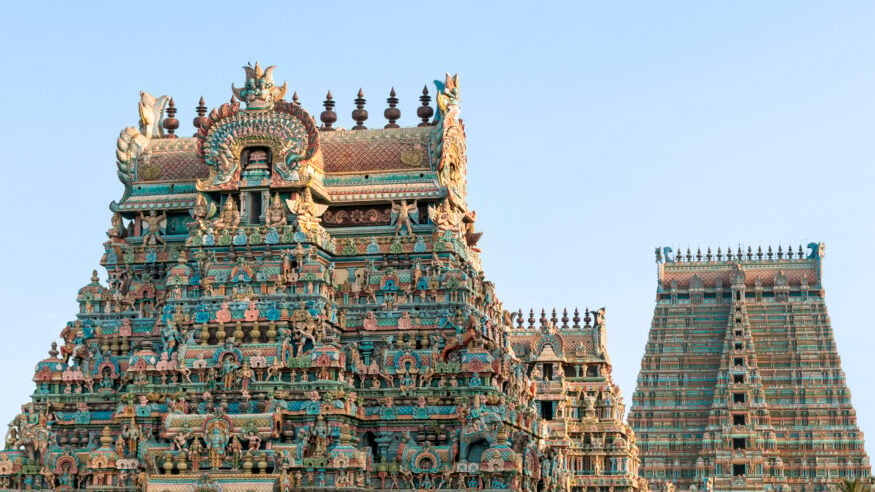
Sacred architecture frames and amplifies sculptural presence. The vāstu-puruṣa-maṇḍala orders a temple plan; axial processions align images to circumambulation and light. In Drāviḍa temples, the garbhagṛha’s compressed volume concentrates attention on the mūrti, while circumambulatory paths, subsidiary shrines, and sculpted gopura narratives progressively expand vision. In Nāgara forms of central and northern India, śikhara profiles ascend like fossilized flame, pulling the gaze upward and cueing the body to move around rather than into the sanctum. Sculpture participates in this choreography, positioned so that gestures, glances, and diagonals converse with architectural lines.
The distinction between accomplished craft and living art returns, finally, to the Chitra-sutra’s demand for integration. Skill without allied knowledge yields correctness without conviction; devotion without discipline risks sentimentality. When the disciplines convergeiconometry (māna), expressive logic (bhāva), and the quiet polish that carries light (lāvaṇya)the work assumes the condition that practitioners call chaitanya, an enlivened presence. Many visitors, even without prior training, describe a consistent pattern of response: an immediate recognition that “it is here,” a felt stillness, and a clarifying of the attention that outlasts the viewing.
This unity of vision across the dharmic sphere is not accidental. Hindu, Buddhist, and Jain sculptural canons, and Sikh devotion to the sanctified Word, embody a shared civilizational commitment: aesthetics in service of realization. Whether through the poised equipoise of a Jina, the compassionate gaze of a Buddha, the cosmic dance of Naṭarāja, or the resonant cadence of Gurbāṇī in a Gurudwara, art is tasked with making the subtlest truths sensible. The “soul in stone” is not a metaphor alone; it is a disciplinetextual, technical, and contemplativemeant to turn matter transparent to consciousness.
Read as a whole, the Vishnudharmottara Purana’s Chitra-sutra, especially Chapter 43 of the third khanda, offers both a manual and a mirror. It teaches how to see as much as how to make, revealing why classical Hindu aesthetics, informed by śilpa-śāstra, nāṭya, and rasa theory, continues to guide temple architecture, Hindu sculpture, Jain and Buddhist image-making, and the sanctified atmospheres of dharmic worship. The tradition’s most enduring lesson remains uncompromising and generous: perfect the means, purify the intention, and life will show itselfquietly, unmistakablythrough form.
Inspired by this post on Hindu Blog.