
One of the most persistent misunderstandings about Hinduism is the reduction of Shiva to a fertility god because of a superficial reading of the Shivalinga. This interpretation appears simple, but its simplicity is precisely the problem. It treats a profound symbol of Shaiva philosophy, Vedic insight, yogic discipline, Tantra, and Agamic worship as though it were merely an object of biological symbolism. Such a reading does not explain why Shiva is revered as Mahayogi, Mahadeva, Rudra, Nataraja, Dakshinamurthy, Pashupati, Bhairava, and the supreme consciousness in many Shaiva traditions. It also fails to explain why the Shivalinga is worshipped by ascetics, householders, philosophers, temple communities, and meditative lineages as a sign of transcendence rather than as a narrow emblem of fertility.
The central point is not that Hindu tradition denies the sacredness of life, creation, or generative power. Hindu Dharma does not treat creation as shameful. It does not separate the spiritual from the material in the rigid manner seen in some other religious frameworks. Yet Shiva cannot be accurately described as a fertility god in the limited sense in which that term is often used. Shiva is better understood as the deity of transformation, dissolution, stillness, austerity, consciousness, and liberation. His symbolism includes creation, but it is never confined to reproduction. In Shaiva traditions, creation itself is only one movement in a much wider cosmic rhythm of manifestation, preservation, withdrawal, concealment, and grace.
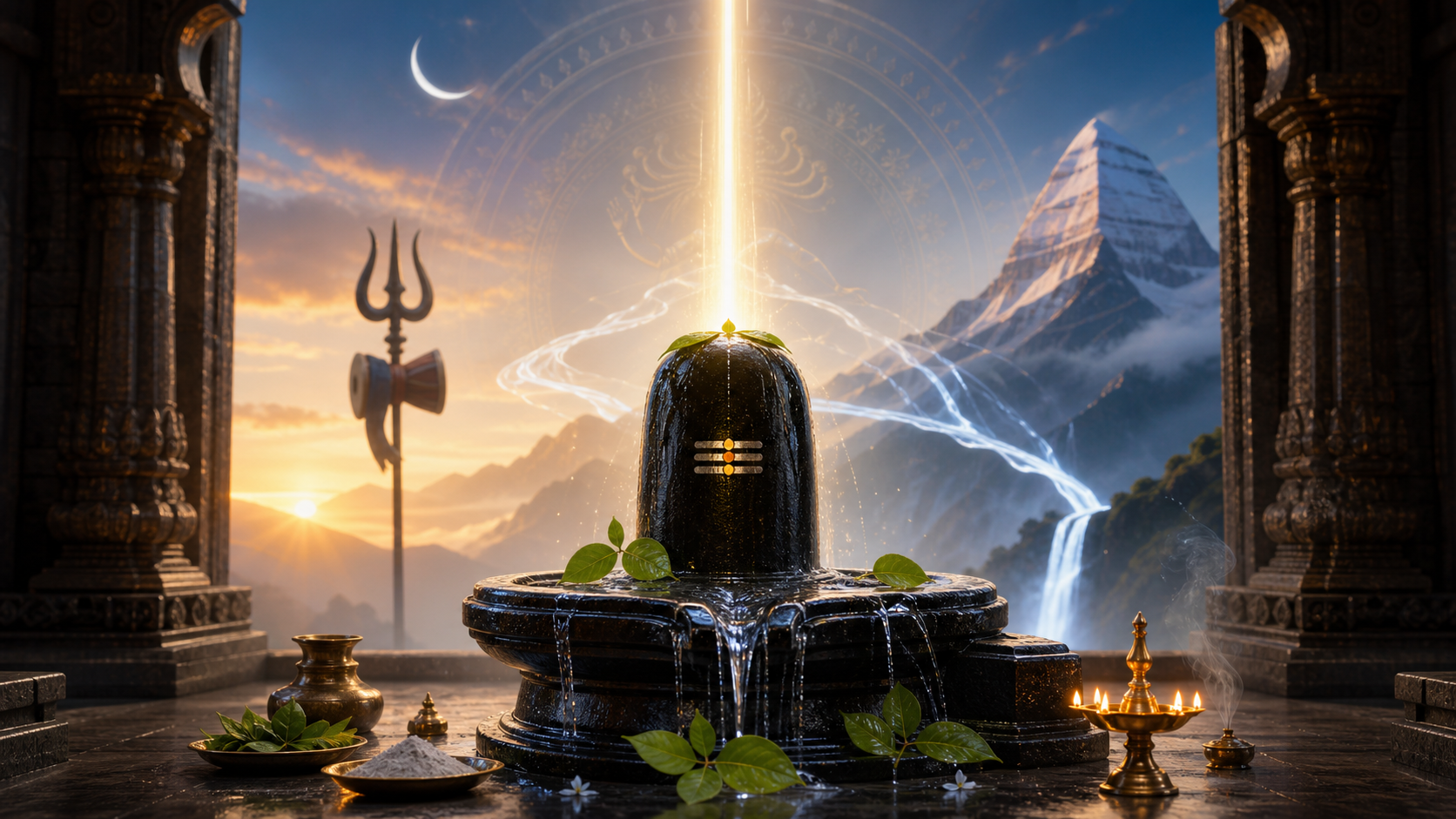
The word linga is central to this discussion. In Sanskrit, linga means a mark, sign, token, characteristic, or indicator. It points beyond itself. The Shivalinga is therefore not merely an image; it is a sign of the formless through form. It gives the mind something to approach while reminding it that Shiva ultimately exceeds all forms. This is why the Shivalinga is often described as an aniconic symbol: it does not depict Shiva with a human face, ornaments, weapons, or bodily features, yet it represents his presence with extraordinary force. The devotee encounters not a portrait of a god but a symbol of consciousness that cannot be reduced to human anatomy.
The Shivalinga is also inseparable from the idea of the cosmic axis. In many Shaiva narratives, especially the Lingodbhava tradition, Shiva appears as an endless pillar of light that neither Brahma nor Vishnu can fully measure. The story is not about fertility. It is about metaphysical infinity. The linga becomes the axis that joins the visible and invisible, the finite and infinite, the earthbound and transcendent. The form is simple because its meaning is vast. It is a vertical sign of the Absolute, a reminder that the highest reality is not exhausted by name, image, argument, ritual, or sensory perception.
This is why the common phallic interpretation is inadequate. It takes one possible visual association and turns it into the whole meaning of the symbol. Academic honesty requires a broader reading. The Shivalinga is connected to the language of signs, the metaphysics of consciousness, the symbolism of the cosmic pillar, the yogic ascent from the gross to the subtle, and the temple ritual system of the Agamas. It is possible to acknowledge that ancient cultures often saw generative power as sacred while still rejecting the claim that Shiva is simply a fertility deity. The Shaiva understanding is more sophisticated: what appears as creative energy at one level is pure consciousness at a deeper level.
Shiva himself complicates any attempt to define him through fertility. He is the great ascetic, the one who sits in meditation on Mount Kailash, smeared with vibhuti, clothed in simplicity, detached from possessions, pride, and social display. He is called Mahayogi because his power is not restless desire but absolute mastery over desire. He burns Kama, the god of desire, when disturbed in meditation. This episode does not present Shiva as anti-life; it presents him as the one who transforms desire into tapas, awareness, and spiritual force. A deity whose defining image is yogic stillness cannot be reduced to biological fertility without ignoring the structure of his mythology and worship.
At the same time, Shiva is not merely a renouncer who rejects the world. He is also the husband of Parvati, the father of Ganesha and Kartikeya, and the center of many household traditions. This paradox is essential. Shiva holds together asceticism and family life, silence and dance, destruction and compassion, wilderness and temple ritual. The presence of Parvati, Shakti, and the divine family shows that Hindu thought does not divide life into crude opposites. The highest consciousness and the dynamic power of manifestation are not enemies. Shiva and Shakti are understood together because consciousness and energy are inseparable. Yet even this union is not reducible to fertility. It is a metaphysical principle describing how reality appears, moves, and returns to its source.
In Shaiva philosophy, especially in non-dual traditions such as Kashmir Shaivism, Shiva represents pure consciousness while Shakti represents the power of that consciousness to manifest. Their union is the basis of existence itself. This is not a biological statement. It is an ontological statement. The cosmos appears because consciousness has the freedom to reveal itself in countless forms. Human birth is one expression within that field, but so are thought, sound, light, time, knowledge, movement, devotion, and liberation. To describe this entire framework as fertility worship is to mistake the surface of a symbol for the depth of a doctrine.
The Agamic traditions also make the matter clearer. In temple worship, the Shivalinga is installed, consecrated, bathed, adorned, and worshipped according to precise ritual principles. Abhishekam with water, milk, curd, honey, ghee, bilva leaves, sandal paste, and sacred ash is not a fertility rite in any narrow sense. It is an act of purification, offering, cooling, surrender, and inner alignment. Water flowing over the linga signifies the continuous offering of the mind into the divine. The devotee does not stand before the Shivalinga merely to ask for progeny; the devotee stands before it to dissolve ego, seek clarity, cultivate humility, and remember the presence of the sacred within all existence.
This is visible in the emotional life of worship. For many devotees, the Shivalinga is approached in silence rather than spectacle. The atmosphere of a Shiva temple often draws the mind inward. The sound of the bell, the fragrance of bilva leaves, the rhythm of mantra, the coolness of stone, and the sight of sacred water flowing across the linga create a contemplative experience. The worshipper may arrive with grief, exhaustion, confusion, ambition, or longing, but the form of Shiva does not flatter the ego. It asks for surrender. It reminds the devotee that life changes, identities dissolve, bodies age, possessions vanish, and only consciousness remains as the ground of experience.
Shiva as Rudra in the Vedic tradition further resists a narrow fertility classification. Rudra is fierce, healing, wild, and awe-inspiring. He is associated with storms, mountains, animals, medicine, and the unsettling force that breaks complacency. The later Shiva preserves this complexity. He is not simply a creator but the one who dissolves forms so that bondage can end. His destructive aspect is often misunderstood as negativity. In Hindu philosophy, dissolution is not mere annihilation. It is transformation. A seed must break for a plant to emerge; ignorance must break for knowledge to arise; ego must break for liberation to become possible. Shiva is feared only when one clings to what must pass away.
The title Pashupati is also important. Shiva is Lord of pashu, a term that can mean animals but also bound beings. In Shaiva theology, the human being is bound by ignorance, attachment, karma, and limitation. Shiva as Pashupati is not merely a protector of herds or a rustic fertility figure; he is the lord who releases beings from bondage. This liberation-oriented meaning is central to Shaiva Siddhanta and other Shaiva schools. The true concern is not reproduction but freedom from the conditions that keep consciousness trapped in narrow identity.
Nataraja, the dancing Shiva, offers another powerful corrective. The dance of Shiva is the dance of cosmic process. It contains creation, preservation, destruction, concealment, and grace. The small drum suggests the pulse of manifestation. The fire suggests dissolution. The raised foot offers refuge and liberation. The dwarf underfoot represents ignorance. None of this can be explained by fertility alone. Nataraja is one of the most refined visual philosophies in world religious art. It teaches that reality is movement, rhythm, transformation, and consciousness. The dance is not merely about life beginning; it is about existence itself unfolding and returning to the divine.
Dakshinamurthy, Shiva as the silent guru, makes the same point in another register. Here Shiva teaches not through fertility, conquest, or command, but through silence. Sages sit at his feet and receive knowledge beyond words. This image places Shiva at the heart of jnana, contemplation, and self-realization. The highest teaching is not external possession but inner awakening. In this form, Shiva is the guru of gurus, the principle by which ignorance is removed. A fertility-centered interpretation has no serious way to account for Dakshinamurthy, because this form belongs to the world of knowledge, meditation, and liberation.
Even the sacred ash, vibhuti, associated with Shiva points away from fertility reductionism. Ash is what remains after fire has consumed form. It represents impermanence, renunciation, purification, and the truth that all embodied forms return to the elements. When devotees apply vibhuti, they remember mortality and the need to live with spiritual awareness. This symbolism is the opposite of mere biological celebration. It does not reject life, but it refuses to let life be reduced to body, desire, status, or continuation through lineage. Shiva asks the human being to confront death so that life can be lived with clarity.
The association of Shiva with cremation grounds is equally profound. In many traditions, Shiva dwells where society sees fear, impurity, and finality. He is present at the edge of human certainty. The cremation ground strips away social rank, beauty, wealth, and vanity. It reveals the temporary nature of embodied existence. Shiva’s presence there is not morbid; it is liberating. He sanctifies what people avoid. He teaches that spiritual truth cannot be built on denial. The person who understands Shiva learns to look directly at impermanence and still find peace.
This is why Shiva’s symbolism has such emotional force. Many people turn to Shiva during periods of loss, transition, failure, or deep inward questioning. Shiva does not represent comfort in the sentimental sense. He represents the strength to pass through fire without losing the center. In personal and communal life, transformation often feels like destruction before it reveals its purpose. Old identities collapse. Certainties dissolve. Relationships, ambitions, and beliefs are tested. Shiva’s presence in Hindu spirituality gives these experiences a sacred grammar. It tells the devotee that dissolution is not always punishment; it may be the beginning of freedom.
The misunderstanding of Shiva as a fertility god often arises from reading Hindu symbols through external categories without entering their philosophical world. This has happened repeatedly in colonial, missionary, and shallow academic interpretations of Indian traditions. A symbol is isolated from its texts, rituals, languages, and living communities, and then assigned a meaning that appears familiar to the outside observer. Such interpretations may claim to be rational, but they often reveal more about the observer’s assumptions than about Hindu Dharma. Serious study requires humility before Sanskrit terms, temple practices, oral traditions, Agamic ritual, Puranic narratives, and the lived experience of devotees.
There is also a broader issue of cultural sensitivity. Hindu symbols have often been interpreted through sensationalism because their meanings do not fit neatly into modern Western categories of religion. The Shivalinga, in particular, has been subjected to reductionist readings that ignore its own vocabulary. Yet no responsible interpretation of a sacred tradition should begin by stripping a symbol from its internal meanings. The linga is not a museum object waiting to be renamed by outsiders. It is a living symbol within Hindu worship, philosophy, and spiritual practice. Its meaning must be understood through the traditions that preserve and revere it.
At the same time, a balanced account should not replace one exaggeration with another. Hindu tradition does recognize fertility, prosperity, family continuity, and the blessing of children as legitimate parts of life. Devotees may pray to Shiva and Parvati for marriage, harmony, health, or progeny. Such prayers are part of the compassionate breadth of Hindu worship. The error lies in mistaking one devotional request for the whole identity of the deity. A patient may pray to Shiva for healing, but Shiva is not merely a medical deity. A student may pray to Shiva for concentration, but Shiva is not merely an examination deity. A couple may pray for children, but Shiva is not merely a fertility god.
This distinction matters because Hindu deities are not one-dimensional functions. They are theological, philosophical, and symbolic centers with many layers of meaning. Shiva can bless household life while remaining the supreme ascetic. He can grant worldly welfare while pointing beyond the world. He can appear as a family man while embodying detachment. He can destroy ignorance while overflowing with compassion. These tensions are not contradictions; they are the genius of Hindu thought. The divine is not flattened into a single psychological or social function. It is allowed to hold paradox because reality itself holds paradox.
The Shivalinga also invites a disciplined understanding of form and formlessness. Hinduism has both murti worship and aniconic worship, both image and symbol, both narrative and abstraction. The Shivalinga stands at a remarkable intersection of these modes. It is visible, touchable, and ritually present, yet it refuses to become a fully anthropomorphic image. This makes it a powerful spiritual aid. The mind can focus on it, but the intellect is also pushed beyond ordinary representation. The linga teaches that the divine can be approached through form without being imprisoned by form.
In yogic terms, Shiva is associated with stillness, awareness, and the witnessing consciousness. Yogic practice aims to calm the movements of the mind and realize a deeper identity beyond thought, emotion, and bodily impulse. Shiva represents that immovable awareness. The Shivalinga, with its still and centered presence, visually supports this contemplative orientation. It does not depict action; it gathers attention. It does not dramatize personality; it points toward essence. This is why the symbol remains powerful across centuries. It is simple enough for devotion and deep enough for metaphysics.
Tantric traditions add another layer, but they too should not be caricatured. Tantra is often misunderstood because its symbolic language is read literally by those unfamiliar with its discipline. In many Shaiva and Shakta Tantric frameworks, the union of Shiva and Shakti represents the union of consciousness and energy, stillness and dynamism, transcendence and immanence. It is a map of reality and spiritual realization. The goal is not indulgence but transformation of limited awareness into awakened consciousness. To read Tantra as mere sexuality is as mistaken as reading the Shivalinga as mere fertility. Both errors arise from ignoring philosophical context.
The relationship between Shiva and Shakti also has a unifying significance for Dharmic traditions. Hinduism, Buddhism, Jainism, and Sikhism differ in theology, practice, and philosophical emphasis, but they share a civilizational respect for discipline, inner transformation, ethical life, and liberation from ignorance or bondage. Shiva’s symbolism, when understood properly, belongs to this wider Dharmic vocabulary of self-mastery and awakening. The point is not to erase differences among traditions. It is to recognize that reductionist interpretations harm the shared dignity of Dharmic spiritual cultures by replacing inner meaning with shallow labels.
Jain emphasis on restraint, Buddhist emphasis on overcoming craving, Sikh emphasis on remembrance and disciplined living, and Hindu emphasis on yoga, bhakti, jnana, and karma all resist the reduction of spirituality to bodily instinct. Shiva as Mahayogi stands comfortably within this larger Dharmic intuition. The human being is not asked to despise the body, but to stop being enslaved by it. Desire is not merely condemned; it is refined. Energy is not denied; it is directed. Life is not rejected; it is sanctified through awareness. This is the deeper meaning lost when Shiva is casually called a fertility god.
The importance of accurate language cannot be overstated. Calling Shiva a fertility god may appear harmless, but it quietly changes the framework through which people understand Hinduism. It shifts attention away from moksha, tapas, jnana, vairagya, dhyana, mantra, and cosmic transformation. It trains readers to view Hindu symbols through biological reduction rather than philosophical depth. It also contributes to the wider problem of Hindu religious symbols being misunderstood in public discourse. A tradition as old, diverse, and intellectually rich as Shaivism deserves more careful treatment.
Shiva’s connection with transformation is visible across his major forms. As Rudra, he shakes the world out of complacency. As Mahakala, he stands beyond time. As Nataraja, he dances the universe into rhythm. As Dakshinamurthy, he reveals knowledge in silence. As Ardhanarishvara, he shows the inseparability of masculine and feminine principles. As Pashupati, he releases bound beings. As Bhairava, he confronts fear and limitation. As Shankara, he is auspicious and compassionate. These forms cannot be organized around fertility as their central principle. They revolve around consciousness, power, dissolution, knowledge, and liberation.
Ardhanarishvara deserves special attention because it is often misunderstood in the same way as the Shivalinga. The form, half Shiva and half Parvati, does not merely represent sexual complementarity. It expresses the non-duality of consciousness and power, the wholeness of existence, and the inadequacy of rigid binaries. It teaches that reality is not complete when divided into isolated opposites. The divine includes stillness and movement, transcendence and embodiment, asceticism and relational life. This is a philosophical vision, not a fertility diagram.
The Shivalinga’s placement in the yoni base is also frequently misread. In traditional interpretation, this union represents Shiva and Shakti, consciousness and creative energy, the unmanifest and manifest. The base is not an invitation to vulgar reduction; it is a symbol of cosmic integration. Hindu metaphysics does not treat manifestation as separate from the Absolute. The world emerges from consciousness, rests in consciousness, and returns to consciousness. The linga and its base together express this integral vision. The symbol is therefore cosmological and spiritual before it is anything else.
The daily worship of Shiva reinforces this interpretation. Mantras such as Om Namah Shivaya are not fertility chants. They are instruments of purification and self-offering. The five syllables are traditionally associated with the five elements and the sanctification of the whole being. The repetition of the mantra quiets the mind and aligns the devotee with Shiva’s presence. The goal is not merely to obtain external results but to undergo inner refinement. The devotee offers water, flowers, leaves, and mantra, but the deeper offering is ego.
Maha Shivaratri provides a living example. The night is marked by fasting, vigil, mantra, meditation, abhishekam, and remembrance of Shiva. Its spiritual mood is one of wakefulness. The devotee stays awake not only physically but inwardly. Darkness becomes a setting for awareness. The night becomes a symbol of the unknown, and Shiva becomes the light of consciousness within it. While some householders may seek blessings for family life, the larger meaning of Maha Shivaratri is ascetic, contemplative, and transformative. It is a night of discipline, not a festival of fertility in the narrow sense.
The philosophical depth of Shiva also appears in the relationship between destruction and grace. In ordinary language, destruction sounds negative. In Shaiva thought, destruction can be compassionate when it destroys ignorance, bondage, arrogance, and false identification. The ego experiences this as loss because it wants continuity. The soul experiences it as liberation because what falls away was never ultimate. Shiva’s fire burns what prevents awakening. This is why devotees can fear him and love him at the same time. He is not destructive out of cruelty; he is transformative because truth cannot coexist with illusion forever.
Such an understanding is especially relevant in modern life. People live under constant pressure to define themselves through productivity, consumption, status, appearance, and desire. Shiva disrupts this pattern. His ash-covered body rejects vanity. His meditation rejects restlessness. His third eye rejects superficial sight. His trident cuts through the threefold limitations of body, mind, and ego. His damaru reminds the world that existence has rhythm. His river Ganga shows grace descending into the world. His crescent moon suggests mastery over time and mind. Every symbol directs attention toward transformation rather than mere biological continuity.
The third eye of Shiva is particularly significant. It is the eye of insight, not ordinary vision. When opened, it burns illusion. This symbolism belongs to the domain of knowledge and awakening. The third eye does not create more objects of desire; it reveals the unreality of being ruled by desire. It is the fire of discrimination, the power to see through appearances. In this sense, Shiva is not the god who multiplies attachment but the deity who exposes attachment and leads the seeker toward freedom.
The Ganga flowing from Shiva’s locks also has transformative meaning. The river descends with overwhelming force, and Shiva receives and regulates it for the welfare of the world. This image presents Shiva as the one who absorbs intensity and turns it into blessing. Spiritually, it suggests that raw power must be held by awareness. Emotion, knowledge, social energy, and cosmic force can all become destructive without steadiness. Shiva’s matted locks symbolize disciplined consciousness capable of channeling grace into life. Again, the theme is transformation, not fertility.
The crescent moon on Shiva’s head indicates a relationship with time, rhythm, and the mind. The moon waxes and wanes, just as human emotions and thoughts rise and fall. Shiva wears the moon, showing mastery over these fluctuations. He is not ruled by the mind; he holds it in balance. This is why Shiva remains deeply relevant to meditation and mental clarity. The symbolism speaks to anyone who has experienced anxiety, grief, confusion, or inner turbulence. Shiva does not merely grant external success; he represents the stillness from which inner balance becomes possible.
The serpent around Shiva’s neck is another symbol of mastery. The serpent can represent danger, energy, time, death, or awakened power. Around Shiva’s neck, it is neither denied nor uncontrolled. It is held. This image captures a central Dharmic insight: spiritual life does not always mean destroying energy; it means mastering and transforming it. Fear becomes awareness. Desire becomes tapas. Instinct becomes discipline. Time becomes a reminder of the eternal. Such symbolism cannot be contained within the label of fertility worship.
To understand Shiva correctly, one must also understand Hindu symbolism as layered rather than literalistic. A single symbol can carry ritual, philosophical, psychological, cosmological, and devotional meanings at once. The Shivalinga is one such symbol. It may speak differently to a village devotee, a temple priest, a Sanskrit scholar, a yogi, a child, a householder, and a renunciate. This plurality is not confusion. It is the strength of Hindu tradition. Symbols are not exhausted by one explanation because reality itself is approached through many levels of understanding.
Therefore, the question is not whether fertility exists anywhere in the broader symbolic universe of Shiva. The better question is whether fertility is the defining and sufficient category for Shiva. The answer is no. It is too small, too external, and too disconnected from Shaiva theology. Shiva is the principle before creation, within creation, and beyond creation. He is the witness of birth and death, not merely a patron of birth. He is the silence before sound and the consciousness in which all experience arises. Fertility is a part of life; Shiva is the ground in which life, death, and liberation are understood.
This distinction protects both scholarship and devotion. For scholarship, it prevents careless reduction and encourages textual, ritual, and philosophical accuracy. For devotion, it preserves the dignity of a sacred symbol that has guided countless seekers. The Shivalinga is not an embarrassment to be explained away, nor is it a crude object to be sensationalized. It is a profound sign of the formless Absolute, a center of worship, a focus for meditation, and a reminder that the deepest reality cannot be captured by ordinary categories.
Shiva is best understood as the god of transformation because every major symbol associated with him points toward the refinement of consciousness. The ash points to impermanence. The third eye points to insight. The Ganga points to grace. The crescent moon points to mastery of the mind. The serpent points to transformed energy. The damaru points to cosmic rhythm. The trident points to the overcoming of limitation. The cremation ground points to fearlessness before death. The Shivalinga points to the formless through form. Together they reveal a spiritual vision far greater than fertility.
The enduring power of Shiva lies in this ability to meet the human being at every level. To the frightened, he is protection. To the grieving, he is stillness. To the seeker, he is the guru. To the ascetic, he is the ideal of renunciation. To the householder, he is the compassionate lord with Parvati and their children. To the philosopher, he is consciousness. To the devotee, he is Mahadeva, the great god whose presence is both intimate and infinite. This is why the reduction of Shiva to a fertility god fails. It cannot hold the fullness of the tradition.
A more accurate understanding restores the depth of Shaiva traditions and offers a better way to approach Hindu Dharma as a whole. Shiva is not a symbol of mere reproduction. He is the great ascetic, the cosmic dancer, the silent teacher, the lord of beings, the destroyer of ignorance, and the compassionate presence that transforms bondage into liberation. The Shivalinga is not a crude emblem; it is a sacred sign pointing beyond all limited forms. To stand before it with understanding is to encounter one of the most powerful teachings of Hindu spirituality: everything that changes can become a doorway to the changeless.
Inspired by this post on Hindu Blog.




Leave a Reply
You must be logged in to post a comment.