Goddess Kali powerfully embodies a sacred paradox at the heart of Hindu symbols: she is simultaneously creator and destroyer, nurturer and annihilator. This duality expresses the full arc of cosmic process—creation (sṛṣṭi), preservation (sthiti), dissolution (saṁhāra), concealment (tirobhāva), and grace (anugraha)—and invites a mature, non-dual reading of reality in which endings and beginnings are inseparable phases of transformation. Positioned within the Śākta tradition and echoed across Dharmic philosophies, Kali’s imagery encodes a rigorous metaphysics that is both spiritually evocative and technically precise.
Across Hinduism, Buddhism, Jainism, and Sikhism, time and transformation are treated not as threats but as teachers. Kali, whose very name resonates with kāla (time), stands as an archetype of this insight: all phenomena arise, abide, and pass, only to reconfigure in new forms. Read in this interdisciplinary Dharmic lens, Kali’s form unites wisdom traditions around impermanence (anicca), fearlessness (abhaya), ethical self-restraint (ahiṁsā), and the sovereignty of the timeless (akāl).
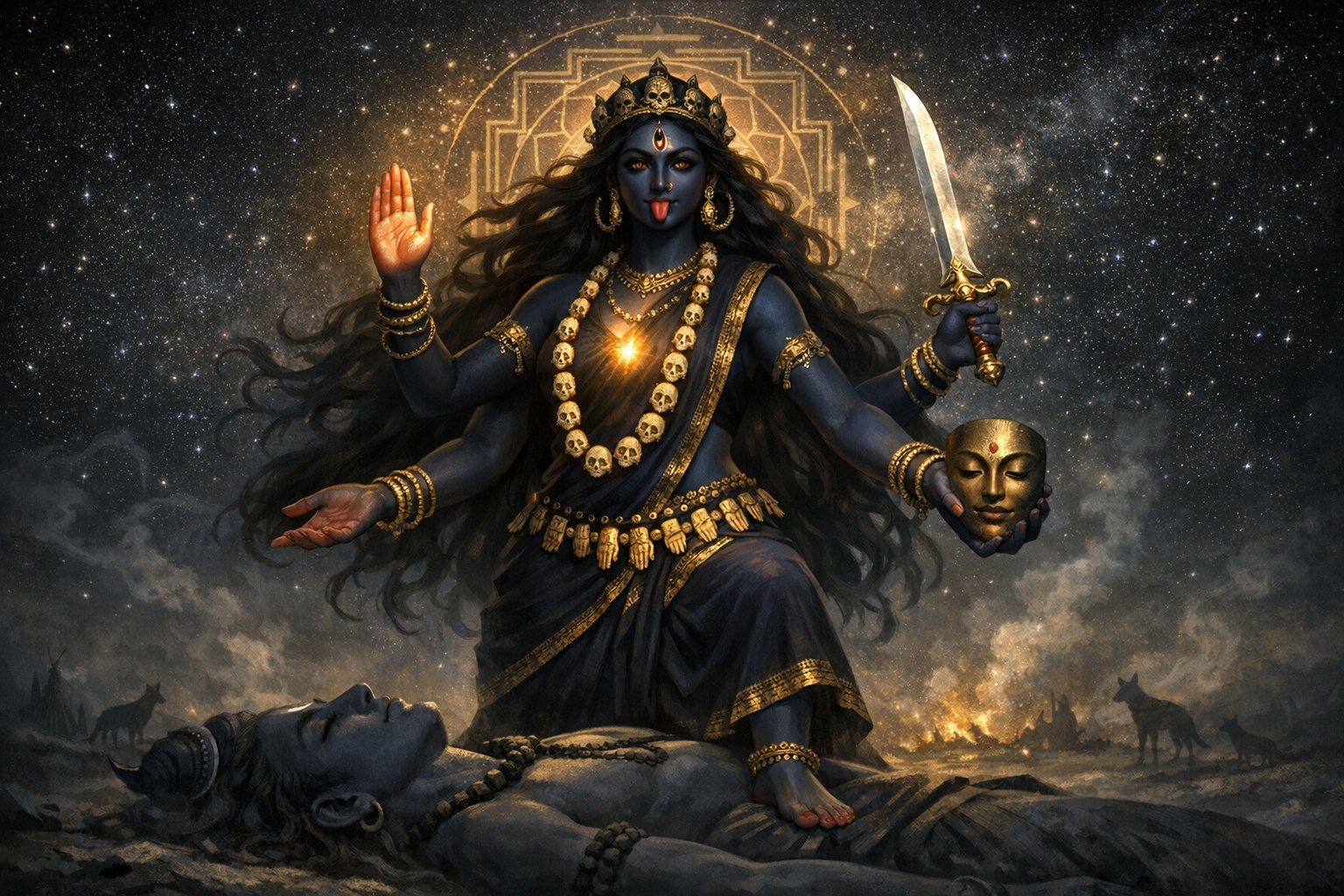
Kali’s iconography is deliberately startling to unmask deeper truths. She is commonly depicted dark-blue or black like star-strewn space, with disheveled hair (muktakeśī), three eyes signifying the three times (past, present, future), and four arms—two bestowing fearlessness (abhaya) and boons (varada), two bearing a sword (khadga) and a severed head (kapāla). She wears a garland of severed heads (muṇḍamālā), often interpreted as the 50/51 Sanskrit phonemes (varṇamālā), and a girdle of severed arms—symbols of speech and action, the raw materials of karma that she both dissolves and redeems.
The lolling tongue carries multiple layers of meaning. In the Devī Māhātmya narrative, it arrests the demon Raktabīja’s proliferating blood; in devotional lore, it can signify bashful remorse after stepping upon Śiva; in Tantric hermeneutics, it gestures toward the uncompromising cut of non-dual awareness that drinks up egoic residues. Standing upon the still body of Śiva (śava), Kali discloses a central Śaiva-Śākta axiom: without Śakti, consciousness remains inert; without consciousness, energy is blind. Their union is the dynamic pulse of becoming.
The cremation ground (śmaśāna) setting is pedagogical rather than macabre. It compels a direct encounter with impermanence, teaching that fear dissolves when clung-to identities and outcomes are surrendered. Thus, the “terrifying” elements—skulls, jackals, ashes—become meditative prompts that return attention to what is deathless within. Devotees and practitioners often report that contemplating these symbols cultivates psychological resilience, ethical clarity, and a grounded empathy in the face of loss or transition.
Scriptural sources illuminate these motifs with rigor. The Devī Māhātmya narrates Kali’s emergence from the enraged brow of Durgā to subdue Raktabīja, whose blood births replicas at every drop—a parable for proliferating desires and thoughts that must be checked at their root. The Kālīkā Purāṇa, Mahanirvāṇa Tantra, and Kularṇava Tantra offer theological and ritual frameworks for her worship, while hymns like the Karpūrādi Stotra encode mantric and contemplative methods. Together, these sources articulate an integrated soteriology: Kali severs ignorance (avidyā), safeguards dharma, and restores the equilibrium of the cosmos.
Philosophically, Kali is not merely within time; as Mahākālī she is also beyond it. She is the ground of appearing and disappearing, the unbounded awareness in which cycles unfold. This dual register—temporal and trans-temporal—supports a non-dual (advaita) reading of Śākta thought aligned with insights from Kashmir Śaivism and Vedānta: the world is neither to be clung to nor denied, but recognized as a living revelation of Śakti’s play (līlā).
Kali’s forms reflect this spectrum of meaning. Dakṣiṇā Kālī, often seen as more immediately compassionate, stands upon Śiva with her right foot and offers unmistakable abhaya and varada mudrās. Smashāna Kālī emphasizes austerity and the cremation-ground pedagogy. Bhadrakālī softens the ferocity into protective benevolence, while Mahākālī extends her reach to cosmic scale. Regional expressions—Śyāmā in Bengal, Bhavatāriṇī at Dakshineswar, Kaliamman in Tamil regions, and Bhadrakālī across Kerala—demonstrate how local cultures integrate the pan-Indian Śākta vision into living heritage.
As one of the Daśa Mahāvidyā (Ten Wisdom Goddesses), Kali represents the uncompromising face of liberating knowledge. Where some Mahāvidyās refine, expand, or harmonize awareness, Kali cuts: the khadga symbolizes the incisive discernment (viveka) that cleaves through self-deception. Her severed head is the ego-principle (ahaṁkāra) released into spacious awareness; her girdle of arms is action unbound from compulsive doership, capable of service (seva) without attachment.
The varṇamālā garland signals a subtle linguistic metaphysics: all names and forms are phonemic crystallizations. By wearing the alphabet, Kali wears the world; by transcending it, she points to the silence that holds every sound. For many practitioners, meditating on this symbol reframes speech as sacred responsibility—language can either bind through reactivity or liberate through truthfulness and compassion.
Practice traditions align with this hermeneutic precision. Mantras such as “oṁ krīṁ kālikāyai namaḥ” deploy the bīja krīṁ (krīm), traditionally associated with cutting through inertia and galvanizing transformative energy. In advanced sādhanā streams—always undertaken with qualified guidance—contemplations of the cremation ground, the breath, and the body’s energy centers (cakras) aim to stabilize fearless awareness. Responsible lineages emphasize ethical preparation, mental balance, and ahiṁsā as non-negotiable foundations.
Festival cycles place Kali in the heart of community life. In Bengal and Assam, Kālī Pūjā on the new moon (Amāvasyā) of Kārtika coincides with Dīpāvalī, invoking the Fierce Mother as the revealer of inner light amid the year’s darkest night. Devotional song traditions—Śyāma saṅgīt of Rāmaprasād Sen and Kāmalākānta—translate Tantric subtlety into accessible bhakti. The living stream continues at Dakshineswar, where Bhavatāriṇī Kālī inspired the mystical realizations of Śrī Rāmakṛṣṇa and informed Swami Vivekananda’s inclusive vision of spiritual unity.
Kali’s presence in Navarātri as Kālarātrī (among the Nava Durgā) underscores the integrality of her energy within the larger Devī cycle: serenity (śānta) and fierceness (raudra) are not opposites but complementary modes of grace. Similarly, temple traditions across South India celebrate Kaliamman and Bhadrakālī as guardians of village ethics, agriculture, and communal well-being—an ecological and social reading of Śakti that remains highly relevant.
A cross-Dharmic perspective clarifies deeper convergences. In Vajrayāna Buddhism, wrathful protectors like Vajrayoginī and Śrī Devī (Palden Lhamo) mirror the principle that fierce compassion uproots delusion; Jain iconography centers the abhaya mudrā, the very gesture that Kali offers, emphasizing fearlessness grounded in ahiṁsā; Sikh thought venerates the Timeless One (Akal) and invokes Mahākāl in poetic and martial contexts, affirming courage anchored in the eternal. These are not equations of deities but resonances of shared values—fearlessness, discipline, compassion, and devotion to truth—that sustain unity in spiritual diversity.
Misreadings often arise when Kali’s imagery is torn from its philosophical ground. The severed heads are not endorsements of violence but metaphors for the termination of ignorance; the cremation ground is not morbidity but the university of impermanence; the sword is not cruelty but discriminative insight. Historically, Śākta traditions have also included debates about offerings and conduct; contemporary practice across Dharmic communities commonly privileges ahiṁsā, dana (charity), and meditative self-restraint as the ethical core of worship.
Psychologically, Kali speaks to the human encounter with fear, grief, and change. Devotees frequently attest that placing anxiety “in Her hands” reframes distress as material for awakening. The icon’s abhaya mudrā functions as a somatic cue: shoulders soften, breath steadies, the nervous system down-regulates. Over time, contemplation of Kali cultivates the capacity to meet pain without collapse and joy without grasping—hallmarks of mature spirituality across Hinduism, Buddhism, Jainism, and Sikhism.
From a systems perspective, Kali’s fivefold action maps to ethical life-cycles: projects begin, mature, end, integrate learning, and receive grace. Organizational thinkers have even read her symbolism as a guide to courageous decision-making—naming problems clearly (the sword), letting go of sunk costs (the severed head), acting without egoic attachment (the girdle of arms), and maintaining psychological safety (abhaya) and resource generosity (varada) within teams.
Kali also reframes gendered conversations on power. While celebrated as the Divine Feminine (Śakti), she ultimately dissolves binary categories, revealing a consciousness-energy continuum beyond male/female dualism. This has empowered communities to honor feminine leadership and protect vulnerable lives while emphasizing that spiritual realization is open to all, regardless of gender, caste, or background—a theme deeply consonant with Dharmic inclusivity.
Iconographic details repay careful study. The skull-crown signals wisdom distilled from mortality; the unbound hair indicates freedom from social constraints; serpents symbolize awakened prāṇa; the three eyes track tri-kāla awareness; jackals and attendants (bhūta, preta) acknowledge neglected parts of the psyche, welcomed and integrated rather than suppressed. Each element functions as a mnemonic in meditation and as a didactic device in temple art, preserving cultural heritage while transmitting subtle teachings.
In regional literatures and performance traditions—Theyyam in Kerala, Śāktic narratives in Bengal, village festivals across Tamil Nadu—the Kali motif harmonizes myth, music, dance, and ethics. These living arts demonstrate how symbolism matures into communal virtues: courage, generosity, humility, and steadfastness under pressure. In this sense, Kali is not only a metaphysical proposition but a civilizational technology for resilience.
Contemporary relevance is immediate. In a world navigating ecological stress, social fragmentation, and rapid technological change, Kali’s teaching is unsentimental and healing: what no longer serves must end; what serves life must be protected; and what is true must be honored even when inconvenient. The promise is not the avoidance of endings but the discovery of grace within them.
For seekers engaging in daily practice, simple contemplations can be transformative: a few breaths visualizing the abhaya mudrā to meet anxiety; a brief recitation of “oṁ krīṁ kālikāyai namaḥ” to cultivate clarity; a reflection on language as sacred stewardship inspired by the muṇḍamālā. Such practices, undertaken with humility and respect for lineage guidance, align personal growth with the ethical heart of the Śākta path.
Ultimately, Kali’s duality is not contradiction but completion. She holds the terror of change and the tenderness that receives what change reveals. To encounter her is to learn that creation and destruction are movements of one compassionate intelligence, and that fearlessness arises not from denial of death but from intimacy with the timeless. In this light, the Fierce Mother is a unifier: across sects and regions, across Hinduism, Buddhism, Jainism, and Sikhism, the values she encodes—truthfulness, courage, compassion, and non-attachment—sustain unity in spiritual diversity.
Inspired by this post on Hindu Blog.