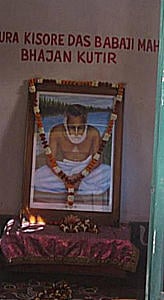
Widely remembered as renunciation personified, Srila Gaura-Kisora dasa Babaji embodied an uncompromising ideal of vairagya (renunciation) within the Bhakti Tradition. His material footprint was minimal and intentional: a Tulasi-mala (Tulasi beads) worn around the neck, another Tulasi-mala for continuous japa, and a small set of devotional textsmost notably Narottama Dasa Thakura's Prarthana and Prema Bhakti Chandrika. He consistently declined all personal service, despite persistent offers, preserving an inner freedom that became the hallmark of his life.
Placed within the historical milieu of late nineteenth- and early twentieth-century Bengal, his life represents a countercurrent to the growing commodification and social prestige sometimes attached to religious identity. Traditions recount that, after early life in East Bengal and a period of intense bhajana in Vraja (Vrindavan), he resided primarily in the Navadvip–Mayapur region, protecting his practice from the distractions of public acclaim. The core of his sadhana (spiritual discipline) was unadorned: nama-japa, kirtana, and constant remembrance of Krishna.
His refusal to accept service was not a rejection of seva as a spiritual principle; rather, it was a methodologically precise stance to guard niskiñcana-bhavathe state of having no material shelter or claim. In practical terms, that stance functioned as an ethical and psychological safeguard against attachment, praise, and dependency. In philosophical terms, it modeled an advanced application of aparigraha (non-acquisitiveness), a value shared across Dharmic traditions and central to authentic spiritual transformation.
Tulasi worship and practice were integral to his identity. Wearing Tulasi-mala signaled Vaishnava commitment while simultaneously serving as an embodied reminder of vows. Japa on Tulasi beads cultivated one-pointedness and rhythm in remembrance. In Gaudiya Vaishnavism, Tulasi (revered as Vrinda Devi) sanctifies the very process of bhakti; by keeping Tulasi near constantlyon the neck and in the handhe operationalized an uninterrupted loop of remembrance, restraint, and devotion.
His reliance on Narottama Dasa Thakura's Prarthana and Prema Bhakti Chandrika is instructive. These texts, concise yet profound, are pragmatic manuals for cultivating humility, remorse, longing, and servicethe inner architecture of prema-bhakti. Rather than broad textual accumulation, his method privileges deep internalization of a few luminous sources, demonstrating that qualitative assimilation can outweigh quantitative study for those oriented toward realization.
Accounts portray him as deeply wary of social entanglements that can intrude upon nirjana-bhajana (solitary absorption). Yet this caution was paired with a robust theology of grace: the Holy Name (nama) as both means and end. Loud or soft, public or secluded, his practice revolved around sustained nama-japa that shaped perception, quieted rajas and tamas (agitation and inertia), and stabilized sattva (clarity). The method was drastic in form yet precise in intentionremove every nonessential stimulus so the Name could shine.
In pedagogy, Srila Gaura-Kisora dasa Babaji refused ritualized prestige. He avoided displays of learning and often eschewed formal debate, thereby centering transformation over performance. The metric of progress was not erudition but softened ego, steadfast remembrance, and spontaneous compassionthe unmistakable signatures of internalized bhakti.
His relationship to the Guru-Shishya Tradition also shaped modern Gaudiya history. Traditions hold that he gave mantra-diksha to Bhaktisiddhanta Sarasvati Thakura, whose later outreach would influence multiple Gaudiya institutions, including lineages that inspired ISKCON (International Society For Krishna Consciousness). In this way, an intensely private bhajana-saint helped seed a public renaissance of Gaudiya Vaishnavisman instructive reminder that integrity at the source can scale into clarity in the stream.
From a technical lens, his renunciation reflects the Gaudiya dialectic between phalgu-vairagya (dry renunciation) and yukta-vairagya (engaged renunciation). While many practitioners responsibly employ yukta-vairagyaoffering the world’s resources in Krishna’s servicehis praxis exemplified a rarer nirapeksha (utterly independent) posture, chosen to protect unbroken absorption. The distinction is pedagogical: his example illuminates the summit, even as most aspirants rightly traverse the middle path of integration.
Hagiographies frequently describe him finding shelter in the most inconspicuous places to avoid honor and attention. These narratives, whether literal or emblematic, communicate a therapeutic logic: when social reinforcement loops are minimized, subtle craving for approval recedes, and the mind regains capacity for direct, affectively rich remembrance. The result is a stable attentional ecology that sustains long-term sadhana.
His minimal possessions were a deliberate cognitive design. By trimming the sensory field, he reduced cognitive switching, guarded attentional bandwidth, and lowered affective volatilityprerequisites for uninterrupted japa and introspective stability. Contemporary readers may recognize in this an early, lived blueprint for what modern psychology describes as stimulus control and habit architecture oriented to a single, overarching goal.
While rigorous, his example is not prescriptive for all. Household pathways in Hinduism, Buddhism, Jainism, and Sikhism affirm that inner detachment can flower amid relational duties. The Sikh emphasis on humility and seva, the Jain vow of aparigraha, the Buddhist cultivation of sila and mindfulness, and the Hindu alignment of dharma with bhakti converge on a shared center: purifying intention and lessening grasping. Srila Gaura-Kisora dasa Babaji’s life underscores this inter-Dharmic unity by dramatizing the endpoint of non-acquisitiveness and God-centered remembrance.
For modern practitioners, several transferable principles emerge. First, reduce needless complexity; second, create sacred micro-routines around mantra, study, and silence; third, prefer depth over breadth in textual consumption; and fourth, maintain healthy boundaries around praise and service so that seva remains God-facing, not ego-nourishing. Each principle is scalablefrom a few disciplined minutes daily to advanced practices of extended retreat.
His use of Narottama Dasa Thakura’s texts further suggests a curriculum of the heart: cultivate repentance (for misdirected attention), aspire for service (rather than entitlement), and stabilize longing (rather than restlessness). Together these dispositions refine the nervous system’s baseline, making remembrance both emotionally magnetic and cognitively sustainable.
The legacy of Srila Gaura-Kisora dasa Babaji endures through commemoration at sites in the Navadvip–Mayapur region and through the ethical imprint left on Gaudiya Vaishnava pedagogy. Annual observances invite reflection on how austerity, when animated by love rather than self-denial alone, discloses a form of freedom that is at once tender and unbreakable. His memory functions less as monument and more as method.
In a world saturated with stimuli, his life offers a reproducible template: cultivate a clear object of love (nama), protect attention with compassionate firmness, and let possessions serve practicenot the reverse. Such discipline does not withdraw one from society’s well-being; properly held, it deepens empathy and steadies one’s capacity for meaningful seva.
Ultimately, Srila Gaura-Kisora dasa Babaji stands as a beacon for aspirants across Dharmic paths. Whether one is drawn to the intimate moods of Gaudiya bhakti, the quiet clarity of Buddhist mindfulness, the exacting vows of Jain aparigraha, or the grace-filled humility of Sikh seva, the shared aspiration is unmistakable: lessen grasping, expand love, and stabilize awareness. In that shared aspiration, his example remains a timeless blueprint for inner freedom.
Inspired by this post on Dandavats.