
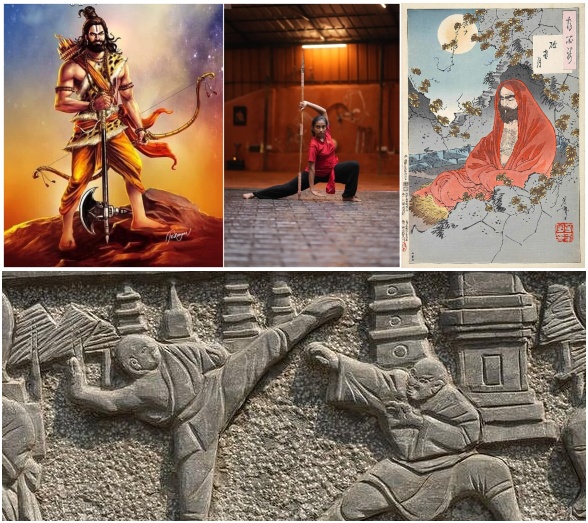
Kalaripayattu is an ancient martial art that originated in the southern Indian state of Kerala, and it is widely regarded as one of the oldest martial arts in the world. The art has been practiced and developed for over 3000 years, and its techniques have been used in warfare, self-defense, and physical fitness.
Kalaripayattu is closely associated with Lord Parashuram, a revered figure in Hindu itihaasa, who is said to have created the art form. According to legend, Lord Parashuram was an accomplished warrior who developed Kalaripayattu to train the Kshatriyas, the warrior caste of ancient India. Kalaripayattu is also believed to have influenced the development of Kung-Fu, a Chinese martial art.
History of Kalaripayattu

The origins of Kalaripayattu are shrouded in mystery, but it is believed to have developed from an ancient system of combat known as the Dhanurveda.
The Dhanurveda was a comprehensive system of military science that included archery, swordsmanship, and wrestling. The techniques of the Dhanurveda were eventually codified into a martial art that became known as Kalaripayattu.
The practice of Kalaripayattu was originally centered around the kalari, a training ground that was usually located outdoors. The kalari was a rectangular pit that was dug into the ground and filled with mud. The mud provided a soft surface for practitioners to train on, and it also helped to absorb the impact of falls and throws.
In addition to the kalari, Kalaripayattu also made use of a variety of weapons, including swords, spears, and daggers. The art also included unarmed combat techniques, such as kicks, punches, and grappling.
Kalaripayattu and Lord Parashuram

As mentioned earlier, Lord Parashuram is often associated with the creation of Kalaripayattu. According to legend, Lord Parashuram was a fierce warrior who was determined to rid the world of evil. He was said to have been skilled in the use of the axe, which was his weapon of choice.
It is believed that Lord Parashuram developed Kalaripayattu as a way to train the Kshatriyas, the warrior caste of ancient India. He is said to have taught the art to his disciples, who then passed on the knowledge to future generations.
Kalaripayattu and Kung-Fu

There is a long-standing belief that Kalaripayattu was instrumental in the development of Kung-Fu, a Chinese martial art that is believed to have originated in the Shaolin Temple in the 5th century. According to legend, the Indian monk Bodhidharma, who is credited with bringing Buddhism to China, also brought the knowledge of Kalaripayattu with him.
It is said that Bodhidharma taught the monks at the Shaolin Temple the techniques of Kalaripayattu, which they then incorporated into their own martial art. This influence is believed to have given rise to the distinctive style of Kung-Fu that is known as Shaolin Kung-Fu.
The Spread of Kalaripayattu

Kalaripayattu gained popularity in Kerala and spread to other parts of India. It was also practiced in Sri Lanka, Malaysia, Singapore, and other parts of Southeast Asia. Some believe that Kalaripayattu was also taken to China by Bodhidharma, where it influenced the development of Shaolin Kung Fu.
Bodhidharma and Kalaripayattu

Bodhidharma was a Buddhist monk who is credited with the development of Chan (Zen) Buddhism in China. According to legend, he also introduced Kalaripayattu to the Shaolin Monastery in China, where it influenced the development of Shaolin Kung Fu.
Bodhidharma is said to have traveled from India to China during the 5th or 6th century AD. He is said to have taught meditation and physical exercises to the monks at the Shaolin Monastery, which eventually developed into the Shaolin Kung Fu style.
Some historians believe that Bodhidharma was a historical figure, while others believe that he is a legendary figure. It is difficult to separate fact from fiction when it comes to his life and teachings.
Kalaripayattu Techniques

Kalaripayattu includes both armed and unarmed combat techniques. The unarmed combat techniques include strikes, kicks, locks, throws, and grappling. The armed combat techniques include the use of weapons such as swords, spears, daggers, and shields.
Some of the unique techniques of Kalaripayattu include:
- Urumi: A flexible sword made of steel or brass that is extremely dangerous and difficult to master.
- Marma points: Vital points on the body that are targeted in Kalaripayattu to inflict maximum damage on the opponent.
- Chuvadu: A series of pre-arranged movements that are used to develop speed, agility, and coordination.
- Kalari Payattu Fitness: A unique form of physical fitness training that includes a combination of strength training, flexibility training, and cardiovascular training.
Kalaripayattu Today

Kalaripayattu is still practiced in Kerala, and there has been a resurgence of interest in the martial art in recent years. Kalaripayattu schools have been established in other parts of India and around the world.
Kalaripayattu has also influenced other martial arts such as Silambam, a stick-fighting martial art from Tamil Nadu, and Gatka, a Sikh martial art from Punjab.
Conclusion

Kalaripayattu is an ancient Indian martial art that has a rich history and cultural significance. It is one of the oldest and most sophisticated martial arts in the world, and it has influenced the development of other martial arts such as Shaolin Kung Fu.
Kalaripayattu has survived for centuries because of its practicality, effectiveness, and spiritual significance. It is a testament to the rich cultural heritage of India and the resilience of the human spirit.
It is important to preserve and promote traditional martial arts like Kalaripayattu so that future generations can benefit from their teachings and understand the rich cultural heritage they represent.
References
- “The History of Kalaripayattu.” Kalaripayattu World Federation, www.kalaripayattu.org/history.html.
- Zarrilli, Phillip B. “The Martial Traditions of South India and the Subcontinent.” Asian Martial Arts, vol. 5, no. 4, 1996, pp. 42-63.
- “The Legend of Parashurama.” The Mahabharata, www.sacred-texts.com/hin/m04/m04006.htm.
- Subramanian, T.S. “Kalari Guru: Parashurama or Kannappa?” Frontline, vol. 26, no. 18, 2009, www.frontline.in/other/article30163833.ece.
- “The Legend of Bodhidharma.” China Daily, 24 Oct. 2016, www.chinadaily.com.cn/culture/2016-10/24/content_27104043.htm.
- “Bodhidharma and Shaolin Kung Fu.” Shaolin Temple UK, www.shaolintempleuk.org/history/bodhidharma-and-shaolin-kung-fu.
- Zarrilli, Phillip B. “When Did the Chinese Become Aware of Indian Fighting Traditions?” Journal of Asian Martial Arts, vol. 12, no. 1, 2003, pp. 8-29.
- Shah, Parth. “Did Kalaripayattu Really Influence Chinese Martial Arts?” Live History India, 28 Aug. 2021, www.livehistoryindia.com/story/history-daily/did-kalaripayattu-really-influence-chinese-martial-arts.