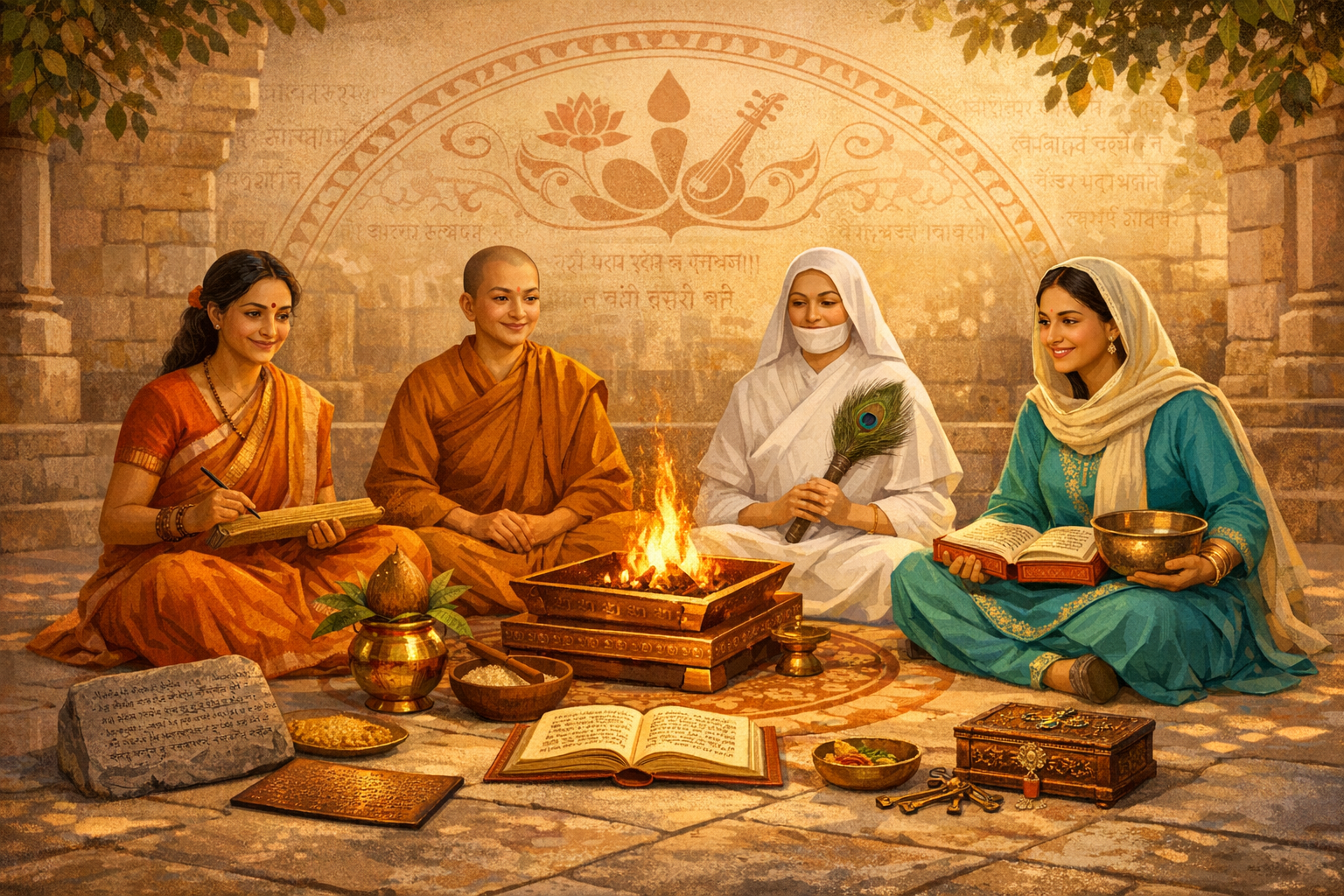
Across civilizations, the civility of a society is often measured by the respect it extends to women. Within Vedic culture in Ancient India, normative frameworks of Hinduism emphasized women’s dignity and centrality to dharma. Evidence from the Vedas, Upanishads, Dharmashastras, Smritis, and epigraphy reveals a consistent pattern of spiritual agency, education, ritual partnership, and economic rights. The purpose is not to romanticize the past, but to evaluate sources with rigor and clarity to understand how women functioned as co-creators of household, society, and sacred order.
Textual foundations in the Rigveda and early Vedic literature attest to female seers (ṛṣikā-s) such as Lopāmudrā, Viśvāvarā, Ghoṣā, and Apalā, whose hymns reflect learned authorship and experiential spirituality. The celebrated Devī Sūkta (Rigveda 10.125), voiced by Vāk Ambhṛṇī, proclaims the cosmic sovereignty of the feminine principle. These testimonies show that women composed, transmitted, and contemplated Vedic knowledge. The lexicon brahmavādinīapplied to women devoted to study and teachingindicates recognized pathways for female scholarship within Vedic Traditions.
In the Upanishadic corpus, Gārgī Vācaknavī publicly challenges Yājñavalkya in rigorous philosophical debate, while Maitreyī pursues inquiry into immortality (amṛtatva) and ātman in the Bṛhadāraṇyaka Upaniṣad. Such dialogues highlight the intellectual participation of women in the formation of Upanishadic thought. The social ideal of the sahadharma-cāriṇīone who walks with a partner in dharmalinks learning, household life, and spiritual purpose in a single ethic.
Vedic ritual literature (Śrauta and Gṛhya Sūtras) makes the patnī indispensable to many rites; soma sacrifices and domestic fire rituals require her presence and participation in specified offerings and vows. Rather than passive attendance, this role enacts shared responsibility for sacred order (ṛta). The ritual unit is not the isolated male sacrificer, but the household, with woman as co-officiant within defined liturgical roles that sustain continuity across generations.
Texts and commentarial traditions distinguish between women who dedicated themselves to lifelong learning (brahmavādinī) and those who entered household life after study (sadyovadhū). Normative prescriptions varied by school (śākhā), period, and region; nonetheless, the conceptual space for women’s education is visible across Vedic literature and later Dharmashastras. This record complicates modern assumptions that formal learning was wholly closed to women in Ancient India.
Smṛti literature delineates strīdhanāproperty that a woman could own, manage, and bequeathincluding gifts from parents, relatives, and spouse at marriage and thereafter. Juristic traditions (e.g., Yājñavalkya, Nārada, and later Mitākṣarā and Dayābhāga schools) debate details of inheritance and guardianship, but the baseline recognition of women’s independent property remains consistent. Epigraphic records from classical and early medieval India further attest endowments, land grants, and donations executed by queens and noblewomen, indicating practical exercise of economic agency.
Vedic and later texts describe multiple marriage forms, emphasize consent-oriented practices such as svayaṃvara, and articulate mutual duties within the household. Early sources acknowledge practices like niyoga within tightly regulated ethical frameworks; later jurisprudence narrows such options. Across these shifts, a core value remains: companionship in dharma. Woman is envisioned as gṛha-lakṣmī and sahadharma-cāriṇīcentral to prosperity, ritual continuity, moral instruction, and the cultivation of culture at home.
Classical legal discourse in the Dharmashāstras and the Arthaśāstra addresses offenses against womenranging from harassment to physical harmwith fines, restitution, and corporal penalties calibrated to context. While actual practice varied by polity and era, the textual intent to deter violence and safeguard honor (yaśas) and bodily autonomy is clear. This juridical concern aligns with the Vedic commitment to social order (dharma) as the foundation of a just civilization.
Philosophically, the Vedic revelation culminates in a theology of Śaktielaborated in Purāṇas and Tantraswhere Sarasvatī, Lakṣmī, and Durgā personify knowledge, prosperity, and protection. Concepts such as Ardhanārīśvara express metaphysical complementarity rather than hierarchy. The Devī Sūkta’s voice’I alone give form to the Father of this universe’encodes a civilizational insight: honoring women aligns society with the very structure of reality.
Parallels across Dharmic traditions reinforce this vision. Buddhism institutionalized the bhikkhunī saṅgha, affirming a full renunciant path for women; Jainism sustains robust communities of sādhvī-s who embody ahiṃsā and tapas; Sikhism articulates spiritual and social equality, exemplified by figures such as Mai Bhago and the sangat–langar ethic. Despite doctrinal distinctions, Hinduism, Buddhism, Jainism, and Sikhism converge on the conviction that women possess complete spiritual capacity and are essential to a compassionate, well-ordered society.
Methodologically, normative texts prescribe ideals, while archaeology, inscriptions, and regional histories reveal how communities adapted those ideals. Across Vedic, epic, and classical periods, women’s experiences differed by region, clan, class, and era. A balanced reading avoids both romanticized golden-age narratives and reductive decline stories, instead mapping continuities and changes with textual, philological, and socio-historical rigor.
Contemporary relevance is direct. Educators, community leaders, and families seeking to strengthen Cultural Heritage can draw from Vedic sources that foreground women’s education, property rights, and ritual partnership. In civic life, policies that protect safety, expand educational access, and secure economic agency echo enduring Dharmic principles. In spiritual communities, emphasizing sahadharma and the sacred feminine deepens inclusivity without erasing tradition.
When Dharmic traditions are read together, a shared ethic emergesreverence for the feminine principle, respect for women’s scholarship, and commitment to equitable participation in spiritual and social institutions. Reviving these principles in present contexts strengthens families, enriches public culture, and renews the moral fabric envisioned in Vedic culture.
The standing of women offers a reliable measure of societal civility. In Vedic culture and its Dharmic kin, the recordtextual and historicalpresents women not as marginal figures but as thinkers, ritual partners, property holders, and exemplars of spiritual attainment. Restoring this multi-dimensional legacy offers a practical pathway to dignity, harmony, and shared flourishing in contemporary society.
Inspired by this post on Dandavats.