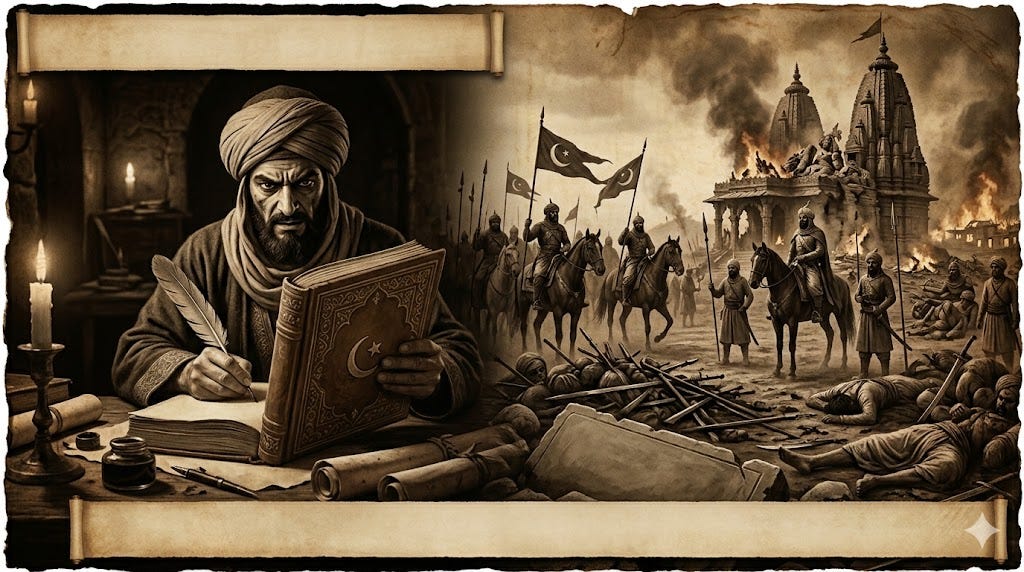
Across medieval India, Arabic and Persian court chronicles did more than record events; they engineered collective memory. By detailing campaigns, treaties, regnal years, successions, and sacred time, these texts framed how later generations would understand the rise of polities from Ghaznavid and Ghurid frontiers to the Delhi Sultanate and early Mughal formations. Their afterlife remains potent in present discussions on Indian history, civilisational continuity, and the plural ethos cherished by Hindu, Buddhist, Jain, and Sikh traditions.
In the Arabic and Persian traditions, many chroniclers presented conquest as part of a providential design and narrated it with devotional intensity. Within that rhetorical universe, victories over lands described as Darul Harb were cast as signs of divine favour and historical inevitability. Ziauddin Barani, the influential 13th–14th century historian, articulated this world-view explicitly by treating political expansion as an unfolding of a divine plan. Such ideas positioned the writing of history as a tool of legitimation as much as a record of happenings.
At the level of social psychology, these triumphalist narratives served a dual purpose. First, they mobilised adherents by sustaining a sense of sacred mission and war-readiness directed at territories outside Darul Islam. Second, they reassured courtly and clerical constituencies that political order and spiritual truth marched together toward ultimate victory. Read alongside the genres of panegyric poetry and homiletic preaching, the result was a literature that aimed to inspire, consolidate, and vindicate authority.
Modern observers have occasionally documented how that older rhetoric resurfaced in popular settings. Sri Sita Ram Goel, for instance, recalled a pre-independence sermon that celebrated the sweep of Islamic conquests across Arabia, Egypt, Morocco, Syria, Algeria, and Iran, but described India as a “kambhakt mulk,” still “crawling with kufr.” That anecdote illustrates how medieval tropes can migrate into modern mass speech. It does not typify the diversity within Muslim communities or Islamic letters; rather, it shows how a triumphalist strand within historical memory can persist across centuries.
Scholarly engagement benefits from a comparative lens. Medieval Christian crusade narratives, Mongol imperial histories, and several early modern European court chronicles likewise used providential frames to sacralise state power. Indo-Persian historiography should therefore be read as one instance of a broader, cross-cultural pattern in which power, piety, and patronage intersected to produce stirring yet partial accounts.
Two literary lineages shaped Muslim historical writing relevant to India: Arabic and Persian. Although Persian eventually dominated writing at the courts of North India, it drew inspiration from Arabic precedents. The oldest formal efforts in Arabic adapted the pre-Islamic qasidametered odes, often genealogicalinto historical praise-poetry and narrative, from which a range of technical genres cohered.
Key genres became standard across Indo-Persian historiography. Sirah denoted biographical works, initially centred on the Prophet and later on rulers and saints. Ansab compiled lineages, grounding political claims in ancestry. Tabaqat arranged biographical sketches by classes or generations, mapping intellectual and spiritual lineages. Tarikh encompassed annals and universal histories that sequenced events by regnal years or hijri dates. Malfuzat collected discourses and recollectionsespecially of Sufi masters and rulerswhile Maghazi focused on campaigns, strategy, and spoils. Maktubat preserved letters and administrative correspondence, revealing the logic of governance and diplomacy.
In many courtly texts, structure and rhetoric followed a recognisable pattern: invocatory benedictions; the rise of Muhammad; the virtues of the Rashidun; the deeds of exemplary Ghazi; and then a telescoping toward the author’s own time. Eventscampaigns, treaties, victories, judgments, prodigieswere often interpreted through scriptural citation, weaving political time into sacred time. That hermeneutic served the didactic aims of rule, modelling sovereign piety as historical agency.
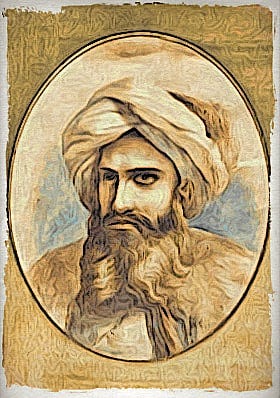
One recurring feature was the close alignment of conquest with sanctity. The more energetically a ruler enforced order, collected tribute, or expanded frontiers, the more readily chroniclers cast him as a model of zeal and justice. Patronage structures encouraged panegyric; professional historians were frequently jurists, preachers, secretaries, or men of letters attached to courts and madrasas, and their livelihoods depended on praising exemplary kingship. K.S. Lal’s observation that much of Islamic historiography bore a clerical imprint captures one strand of this ecosystem, though it coexisted with administrative registers, legal digests, and devotional literature that recorded different textures of life.
The voices of conquered and tributary populationsespecially rural Hindus, Buddhists, Jains, and later Sikhsrarely appear directly in these sources except as collective types. As Vincent Arthur Smith lamented, readers often long for accounts from the perspective of those who suffered dislocation or loss. Yet counter-archives exist: Sanskrit and Prakrit inscriptions, temple copperplates, Jain prabandhas, bhakti hagiographies, Sikh janam-sakhis, vernacular charitas and kavyas, and the Rajatarangini tradition that preserved a remarkably self-aware historical prose in Kashmir. Triangating court chronicles with these indigenous sources yields a fuller, fairer picture.
Another well-attested motif is the celebrationat times, in stark languageof iconoclasm, enslavement after battle, and public humiliation of defeated elites. It is essential to read these passages as rhetorical topos within a competitive, confessional world of late-medieval statecraft rather than as an unvarying norm representing all Muslims across all times and places. The same hermeneutic caution applies when studying crusader chronicles, Ottoman campaign books, or Iberian reconquista narratives, which likewise parade victory tropes that compress complex human realities into emblematic scenes of triumph and penitence.
Historians such as R.C. Majumdar noted that certain Indo-Persian texts treated extreme measures as congruent with a theory of holy war. He discusses, for example, a letter ascribed to al-Hajjaj criticizing Muhammad bin Qasim for leniency after the Sind campaignsan exemplar of the didactic voice that urged harsh retribution against non-combatant resistance. Whether or not every reported phrase is verbatim, the ascription illustrates how epistolary literature could be marshalled to instruct governors in exemplary severity.
The reputations of some rulers rose in lockstep with the ferocity of their methods as narrated by their chroniclers. In panegyric logic, largesse to soldiers, discipline in tax collection, and uncompromising pursuit of victory signified justice and godliness. Modern readers should remember that such praise registers patronal ideals and literary conventions rather than simple reportage.
A balanced appraisal also acknowledges the diversity within Islamic intellectual life in India. Alongside conquest narratives were Sufi malfuzat emphasising ethical reform, philosophical works engaging Sanskrit traditions, administrative manuals standardising revenue systems, and multilingual literary courts where Persian, Hindavi, Sanskrit, and regional vernaculars mingled. These materials show a textured world in which conflict and cooperation coexisted, and where dharmic communities developed adaptive strategies to preserve rituals, rebuild temples, cultivate monastic networks, and compose devotional canons.
For families across Hindu, Buddhist, Jain, and Sikh communities, these histories are not only academic. They echo in intergenerational memorystories of flight and return, of monasteries refounded, of images re-consecrated, of scriptures recopied, and of new institutions established to safeguard learning. Readers often experience a mix of sorrow for what was lost and pride in a civilisational resilience that refused to be extinguished.

The objective of studying these chronicles today should be constructive: to understand how propaganda and piety converged in a genre; to separate rhetorical flourish from recoverable fact; and to reclaim a dharmic sense of history that deepens unity among Hindu, Buddhist, Jain, and Sikh traditions. Ahimsa, anekantavada, maitri, karuna, sarbat da bhala, and dharma-yuddha’s restraints provide a shared ethical frame to examine the past without reproducing old enmities.
A rigorous method helps. First, practice genre literacy: distinguish Tarikh annals from Malfuzat discourses, Maghazi campaign narratives from Sirah biographies, and Maktubat letters from Tabaqat compilations. Second, map patronage and audience: who commissioned the text, who copied it, and who recited it. Third, interrogate language: note honorifics, scriptural allusions, and formulae that mark panegyric. Fourth, cross-check with epigraphy, archaeology, numismatics, and vernacular sources. Fifth, situate each claim within regional political economy and interfaith contact zones.
Representative Indo-Persian works illuminate the method. The Tabaqat-i Nasiri (Minhaj-i Siraj), Tarikh-i Firuz Shahi (Barani), Futuh-us-Salatin (Isami), and later court histories under the Lodi and Mughal polities, as well as the Chachnama and Baladhuri’s Futuh al-Buldan for earlier phases, each display distinct aims and conventions. Read synoptically with temple inscriptions, Jain prabandhas, bhakti charitas, and Sikh janam-sakhis, they allow historians to reconstruct both disruption and continuity.
Terms such as Ghazi, Darul Harb, and Ghazwa shaped moral geography and political rhetoric; grasping their semantic range prevents anachronism. Likewise, recognising how the qasida heritage informed Indo-Persian prose clarifies why chroniclers paired extravagant praise with unsparing depictions of victory.
None of this warrants fatalism. The subcontinent’s civilisational matrix repeatedly transformed periods of destruction into phases of creative renewalrestoring shrines, founding mathas and viharas, reformulating law codes, and composing new philosophical syntheses. Jain mendicants, Buddhist monks, Sikh gurus, and Hindu acharyas responded in ways that strengthened ethical norms and social cohesion.
K.M. Munshi warned that political conquest often sought cultural domination. The antidote, borne out by history, was not reciprocal hatred but the deliberate cultivation of knowledge systems, institutions, and virtues that make plural life possible. By reading medieval Arabic and Persian chronicles criticallyneither dismissing them nor mistaking them for complete truthscholars and citizens can reinforce a shared civilisational confidence rooted in dharma.
In sum, unmasking the psyche of conquest in medieval Indo-Persian historiography is not an exercise in blame. It is a scholarly and ethical project aimed at clarity: to discern how propaganda, patronage, and piety fashioned narratives of power; to centre indigenous counter-archives; and to channel the insights toward stronger unity among India’s dharmic traditions.
Inspired by this post on Dharma Dispatch.