
Open-ocean survival has few accounts as sobering as the World War II ordeal chronicled in Laura Hillenbrand’s Unbroken. In that narrative, Louis Zamperini and two crewmates endured 47 days adrift after a B‑24 crashed into the Pacific, subsisting on fish, evading sharks and strafing, and ultimately washing ashore at the Marshall Islands only to be taken as prisoners of war. That benchmark of human endurance illuminates what the Pacific demands of any vessel, crew, or idea that dares to cross it.
Five years later, Thor Heyerdahl sought to subject a sweeping historical hypothesis to the same oceanic scrutiny. With the Kon‑Tiki expedition (1947), he attempted an experimental-archaeology proof of concept: could a prehistoric-style balsa wood raft, built with period-faithful materials and technologies, ride Pacific currents from South America to Polynesia over roughly 5,000 miles? The voyage was not a reenactment of a known journey but a technical trial of feasibility in one of maritime history’s most demanding theaters.
Heyerdahl’s migration hypothesis argued that at least some of Polynesia’s population or culture could have originated from South America. Much popular commentary then and since invoked botanical clues; the strongest pre‑Columbian indicator, however, is not pineapple but the sweet potato (Ipomoea batatas), a South American domesticate that appears archaeobotanically and linguistically across Polynesia. He also noted stylistic resonances between certain Polynesian and pre‑Columbian Andean stone forms. His claim was bold, but his methodletting the Pacific’s currents, winds, and waves decidewas austere and exacting.
It is essential to distinguish the test of a vehicle from the test of a migration model. The dominant scholarly consensusgrounded in linguistics, archaeology (notably Lapita culture), genetics, and the ethnoscience of wayfindingplaces Polynesian origins within the Austronesian expansion out of Island Southeast Asia. That consensus recognizes Polynesian mastery of blue‑water voyaging in double-hulled and outrigger canoes and a timeline in which Eastern Polynesia was settled much later than the western arcs. Heyerdahl’s raft could test seaworthiness, not languages, pottery sequences, or deep-time demography.
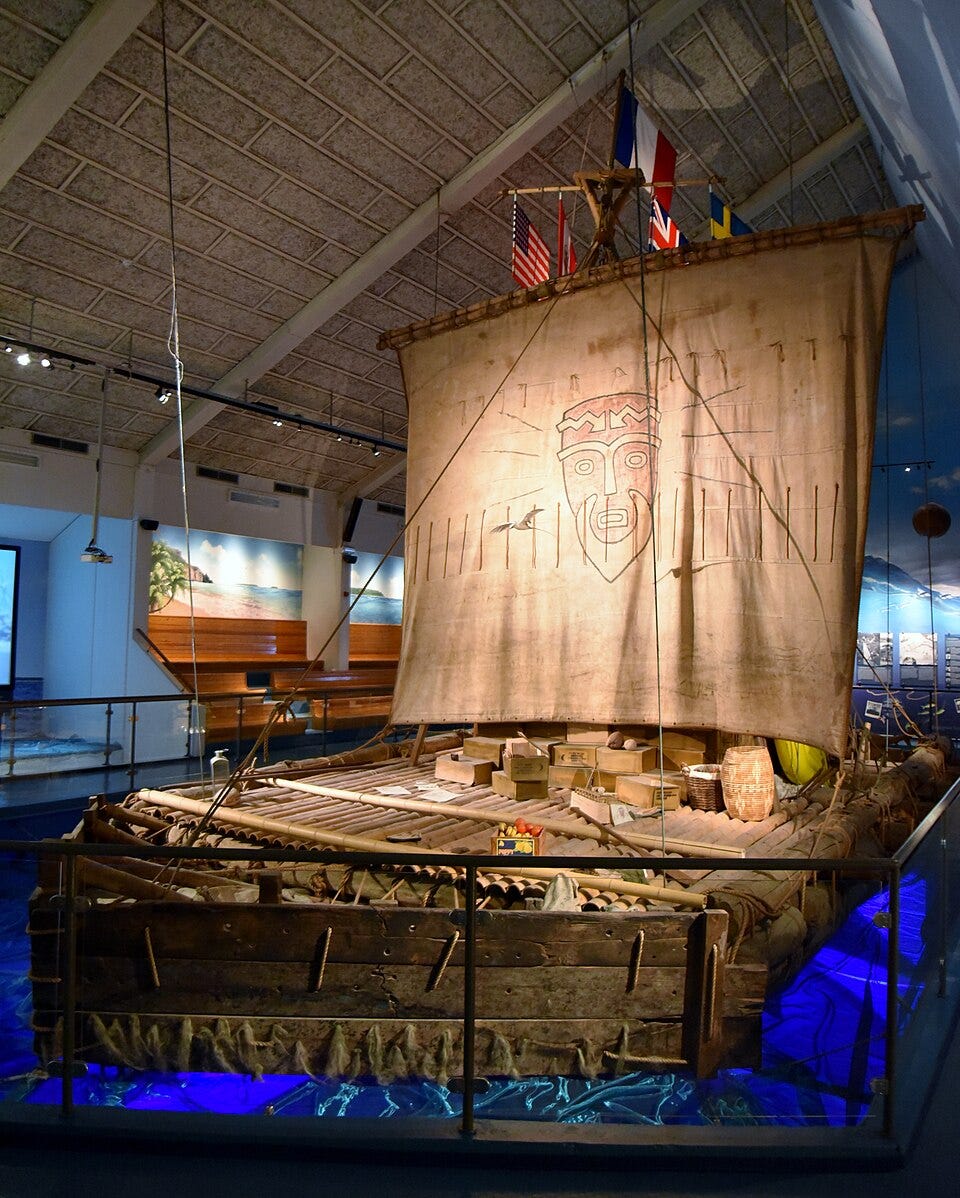
The Kon‑Tiki raft was deliberately archaic in concept but sophisticated in hydrodynamic logic. Nine massive balsa logs were lashed with vegetable fiber; crossbeams stabilized the platform; a bamboo-and-thatch deckhouse offered shelter. Directional control relied on a square sail and a set of hardwood centerboards (guaras) that acted as variable-depth leeboards, allowing the crew to trim the raft’s drift angle relative to wind and current. No metal fasteners were used, and the design prioritized resilience and flexibility over rigiditycritical traits for surviving repeated wave impacts.
Built on Peru’s coast and launched from Callao in April 1947, the raft’s performance envelope was tuned to the ocean’s energy budget. The navigational concept exploited the Humboldt (Peru) Current flowing northward along South America and, crucially, the westward South Equatorial Current and southeast trade winds that dominate tropical Pacific circulation. In theory, a raft that could hold a steady west-by-south drift track would be conveyed toward the Tuamotu Archipelago, provided storms did not shear it off toward the Galápagos or back toward the continent.
Heyerdahl’s crew of sixdrawn from Norway and Sweden and including expertise in navigation, engineering, and radiobrought modern instruments for safety and documentation: a sextant, timepieces, charts, and radio equipment. These tools did not change the raft’s fundamental constraints; they did, however, allow the crew to fix positions, report progress, and monitor weather, embedding the trial squarely within a testable framework of maritime science.
Daily life aboard Kon‑Tiki reflected the ecology of the tropical Pacific. Flying fish landed on deck overnight; mahi‑mahi shadowed the raft; sharks patrolled beneath the hulls. The crew fished for protein, captured rainwater, and rationed stores. A dramatic shark encounterculminating in a successful harpooning and recoverydemonstrated both danger and opportunity in such a food web. For readers who have watched tradewinds fill a sail or scanned a swell line for cues, the rhythms are instantly recognizable.
Storm systems tested the raft’s low freeboard and flexible lashings. There were credible fears that waterlogged balsa might gain perilous weight. In practice, the wood’s cellular structure remained sufficiently buoyant, and the raft’s “loose” construction dissipated, rather than transmitted, wave energy. Marine growth added drag but also stabilized motion. Incrementally, the crew learned the fine art of balancing sail trim and guara settings to coax small but meaningful changes in headingenough to stay in the conveyor of the South Equatorial Current.
Celestial navigation provided position checks; radio yielded lifelines to the outside world; seamanship remained the constant variable. The juxtapositionancient platform, modern instruments, modern risk assessmentepitomized experimental archaeology: simulating ancient constraints while preserving contemporary standards of documentation and safety. The Pacific, indifferent to theory, functioned as the experiment’s uncompromising adjudicator.
After roughly 101 days at sea, the raft struck the reef of Raroia in the Tuamotu Archipelago in August 1947. The landfall validated the core proposition that currents and trades could deliver a prehistoric-style raft from Peru into Eastern Polynesia. Depending on route reconstruction, the voyage covered approximately 4,300–5,000 statute miles, an extraordinary drift passage by any measure in naval history.
What Kon‑Tiki decisively proved was engineeringly specific and historically limited. It showed that a balsa wood raftfaithful to hypothesized Andean design principleswas structurally viable, controllable in a coarse sense, and capable of exploiting Pacific circulation patterns to reach Polynesia. In the vocabulary of maritime history and anthropology, the expedition established transport feasibility under particular environmental conditions and loading assumptions.
What the expedition did not prove was demographic directionality or cultural primacy. The weight of evidence still supports a Southeast Asian origin for Polynesians within the wider Austronesian dispersal, reinforced by Lapita archaeological horizons, cognate phonologies and lexica, canoe-building traditions, and the ethnomathematics of wayfinding. Polynesian navigators developed a sophisticated, non-instrumental system grounded in stars, swells, birds, and bioluminescent cuesan intellectual heritage distinct from Andean raftcraft.
Nevertheless, research since Heyerdahl has added nuance. The pre‑Columbian presence of the sweet potato in Polynesia suggests contact with South America. Recent population-genetic studies indicate limited but real gene flow between Polynesians and Indigenous peoples of the South American Pacific rim centuries before European arrival. These findings do not reverse the predominant migration narrative; they do, however, admit the possibility of episodic, two‑way encounters across the world’s largest ocean.
From a methodological standpoint, Kon‑Tiki’s greatest contribution lies in validating experimental archaeology and open-ocean trials as complements to textual, linguistic, and archaeological inference. By constraining variables and publishing navigational outcomes, such expeditions help define what is environmentally plausible, not what necessarily occurred. In this way, they sharpen the questions historians and anthropologists ask of artifacts, oral traditions, and settlement chronologies.
The cultural memory of the voyage has been powerfully shaped by cinema. The Norwegian film Kon‑Tiki (2012) dramatizes storm sequences and pelagic predators with striking underwater cinematography, introducing new audiences to the tension between oceanographic determinism and human agency. Its Academy Award nomination underscored the story’s global resonance across disciplinesmaritime history, anthropology, and the philosophy of exploration.
There is also a wider human context to consider. Oceans do not merely separate; they connect, transmitting technologies, crops, stories, and skills. That connective power echoes the dharmic ideal of Vasudhaiva Kutumbakamthe world as one familyinviting respect for multiple paths of knowledge and coexistence. Recognizing Polynesian navigational genius alongside Andean raftcraft, rather than pitting one against the other, models an inclusive understanding of civilizational achievement.
For anyone who has studied a nautical chart or felt a steady trade wind fill a sail, the Kon‑Tiki experiment illuminates a universal lesson: humility before the sea and openness to plural explanations often yield better history than grand, single-cause narratives. In balancing what the expedition proved with what it could not, one finds a template for scholarly rigoranchored in data, widened by empathy, and guided by the shared human pursuit of truth across cultures and traditions.
Inspired by this post on Varnam.
