
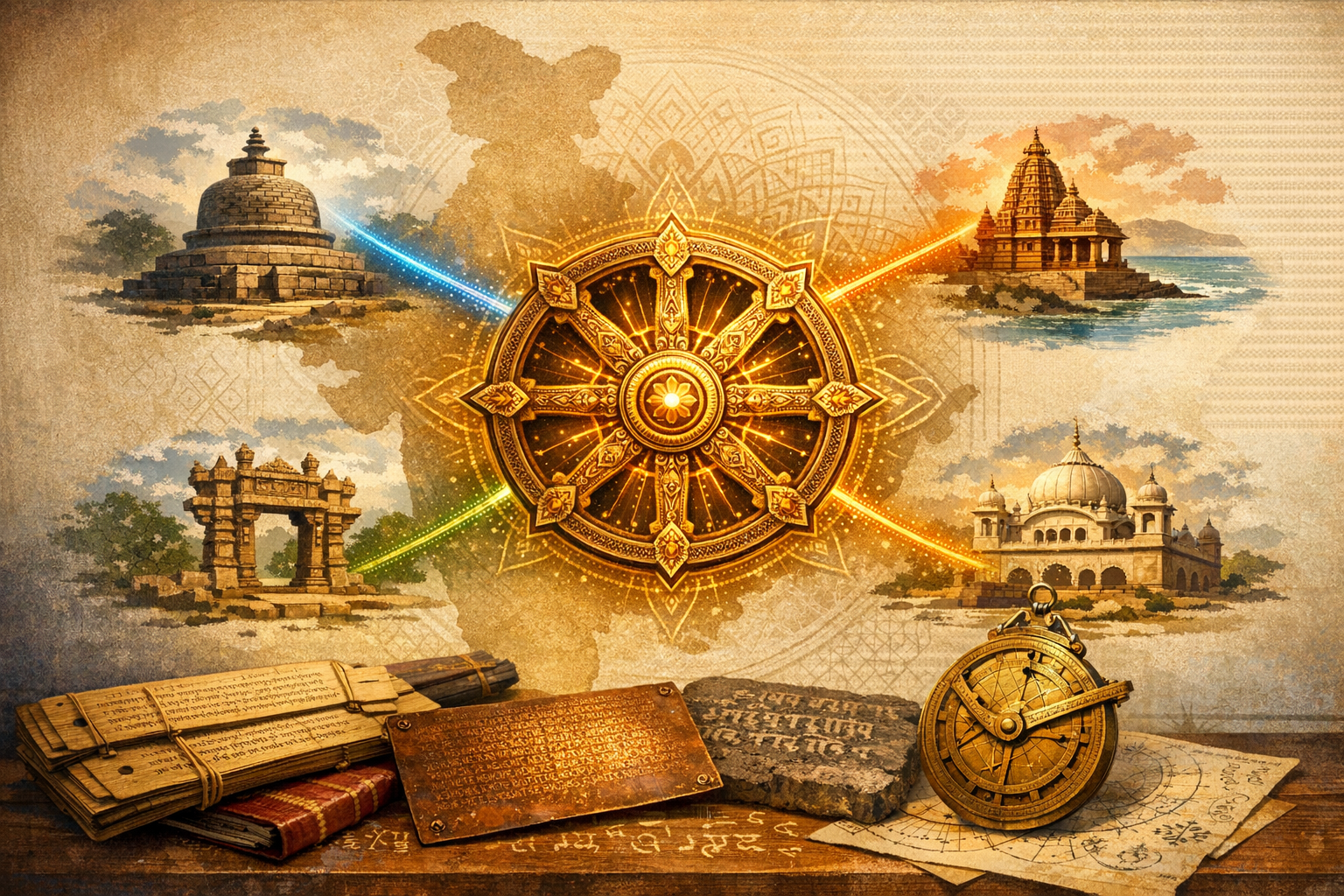
Part 3 examines a long struggle that was never solely about armies or territory. It was, above all, a contest for meaning, memory, and moral authority. Across centuries of political upheaval and colonial reordering, a civilizational grammar rooted in dharma, pluralism, and local self-organization proved remarkably resilient. The core thesis here is straightforward: projects that sought to homogenize the subcontinent’s diverse religious and cultural life confronted a philosophical ecosystem designed to absorb, adapt, and outlast. That is the war they could not win.
The inquiry turns on three frontsepistemic, legal-administrative, and economic. Epistemically, attempts were made to impose singular narratives upon an inherently many-sided experience of truth. Legally and administratively, central regimes tried to standardize flexible customary practices. Economically, endowments and institutional lifelines for temples, vihāras, mathas, and gurdwaras were restructured to fit imperial revenue and control systems. Yet, at each front, dharmic lifeworlds evolved new responses grounded in philosophical breadth and lived community practice.
At the heart of that breadth lies a shared civilizational logic. In Hindu Dharma, the acceptance of Ishtadiverse valid paths to the divineundercuts any monopoly on salvation. In Jain thought, Anekantavada, the doctrine of many-sidedness, trains minds to hold complexity without coercion. In Buddhism, upāya or skillful means prioritizes compassionately tailored methods over doctrinal rigidity. In Sikhism, the ethos of seva and the aspiration for sarbat da bhala support a public ethic of solidarity beyond sectarian closure. Such architectures of pluralism confer resilience without requiring uniformity.
Methodologically, this study triangulates insights from historiography, epigraphy, archaeology, textual traditions, and oral memory. Inscriptional corpora, from early copper-plates to the Gahadavala inscriptions, and manuscripts such as the Bower Manuscript, complement literary sources like the Upanishads, Puranas, and Buddhist and Jain canons. Field-based ethnography of pilgrimage circuits adds texture to archives and chronicles, while a comparative lens on religious institutions clarifies how decentralized authority can anchor long endurance.
On the epistemic front, British Colonialism invested early and heavily in knowledge production. The English Education Act of 1835 and associated curriculum designs elevated a narrowly framed canon while marginalizing gurukul pedagogies and Sanskritic, Prakrit, and Pali scholarship. Missionary grammars and philology contributed important linguistic insights, but the classificatory impulse also hardened fluid categories into fixed identities. Over time, these moves shaped what later became standard textbook common sense.
The census from 1871 onward disciplined populations into checkbox uniformities that bore little resemblance to lived pluralism. Flexible jati-groupings, syncretic local cults, and overlapping ritual worlds found fewer places to sit within official ledgers. Legal codification in Anglo-Hindu law assembled a selective mosaic of shastric norms into an administratively tractable package, smoothing nuance and context. Customary law and regional variation, once the rule, often became exceptions to be explained away.
Economically and institutionally, the Religious Endowments Act of 1863 and allied policies altered the governance of sacred trusts. Administrative oversight re-channeled local autonomy, especially in high-traffic shrines. Pilgrim taxes at certain centers, including the Jagannath Temple in Puri, exemplified a fiscal approach later rolled back under criticism but not before it reshaped expectations and routines. This tension between central supervision and community custodianship would recur well into the twentieth century.
Intellectual battles over origins and identity added layers to this landscape. Debates under the rubric Aryan Migration -vs- Out of India grew entangled with civilizational self-perception. Across the twentieth and twenty-first centuries, archaeology, historical linguistics, and, more recently, archaeogenetics contributed evolving evidence while also warning against simplistic, totalizing conclusions. The larger point endures: histories become vulnerable when framed as unilinear myths, less so when cultivated as rigorous, many-sourced narratives.
Twentieth-century historiography, especially certain Marxist-influenced schools, provided vital socioeconomic analysis yet sometimes flattened complex religious and cultural dynamics into monocausal templates. The challenge for contemporary Historiography is not to replace one master narrative with another, but to re-center multiplicity and method. Decolonization, in this scholarly sense, is precision work: source criticism, context-sensitivity, and the humility to let archives, inscriptions, and living practices correct theory.
On the ground, resilience manifested most clearly where ritual, memory, and service converged. Pilgrimage circuits like the Chardham, Sapta Badri in Uttarakhand, Jagannath Puri, Sabarimala, and other tirtha networks operated as civilizational logistics: distributing texts and tunes, arts and ideas, while binding distant regions into shared calendars and ethical time. These were not merely religious routes; they were arterial flows of language, patronage, and pedagogy.
The Jagannath Temple in Puri offers a case study in continuity under pressure. British officials administered, taxed, and later stepped back from direct involvement, but the Rath Yatra, embedded in Odia society and imagination, persisted. What survived was not only a festival; it was a philosophy of public religionwhere sacred and civic rhythms reinforce each otherresisting reduction to either a revenue stream or an antiquarian exhibit.
Somnath, repeatedly disrupted across earlier centuries, exemplifies another mode of recovery. Beyond the famous modern re-consecration, the temple’s long arc shows how sacred geography and communal will can scaffold an iterative restoration ethic. The logic of pratishtha, of re-establishing presence, shows a civilizational comfort with renewal that frustrates any finality of defeat.
Sikh institutional history captures a third pathway of endurance through reform. The Akali movement and the Sikh Gurdwaras Act of 1925 marked the community’s reclaiming of custodianship and codification on its own terms. Here the Khalsa ideal was not only martial; it became juridical and organizational, calibrating modern corporatization with historical memory. Seva scaled into institution-building, and the sangat-sarbat relationship translated into durable governance.
In the Buddhist sphere, the Mahabodhi Society founded in 1891 and wider revivals in the twentieth century signaled a Pan-Asian reweaving of heritage. Scholarship, diplomacy, and restoration campaigns converged on sites such as Bodh Gaya. Contemporary initiatives around Nalanda University similarly point to an academic and cultural renaissance grounded in cross-border exchange while remaining faithful to a legacy of inquiry that never feared debate.
Jain communities illustrate yet another resilience mechanismknowledge preservation through mercantile networks and philanthropic endowments. Manuscript libraries, temple-based learning, and the ethic of ahimsa anchored a civil society of record-keeping and ethical commerce. Over centuries, this distributed architecture diffused risk; no single political shock could extirpate a tradition whose archivists were also its everyday practitioners.
The 1857 War of Independence, while militarily inconclusive, catalyzed a broad civilizational introspection. It exposed both the costs of administrative centralization and the power of cultural cohesion. Chapati circulationhowever debated in intentsymbolizes how ordinary networks carry signals long before formal institutions recognize them. The memory of 1857 subsequently animated diverse reform agendas, many of which fused devotional energies with civic self-organization.
Underneath these case studies runs a common grammar of learning and transmission. Gurukul and pathshala methods did not vanish; they evolved, encountering print culture, sanghas, akharas, mathas, and gurdwaras. Kirtan, kathas, pravachans, and granthi recitations translated complex metaphysics into accessible, communal pedagogy. Knowledge did not require a single gate to enter public life.
Science and philosophy, too, traversed this braided stream. Works associated with Aryabhata and Varahamihira demonstrate robust astral mathematics and observation-based reasoning interwoven with a Vedic and later classical inquiry ethos. The Upanishads modeled disciplined questioning rather than dogmatic closure. This intellectual posture policed no frontier between contemplation and calculationa fact that matters when narrating what kinds of knowledge colonial syllabi sought to replace.
Epigraphy and archaeology provide the material counterpoint to textual and oral histories. From hero stones to temple inscriptions, from the Gahadavala corpus to the Bower Manuscript, evidence points to social compacts, land grants, artisan guilds, and ritual economies that co-produced religious life. The Archaeological Survey of India’s modern cataloging has helped, but local custodians and regional scholarship remain indispensable in decoding context, idiom, and intent.
Decolonization, then, is not an abstract slogan but a research and policy program. It calls for historiography that tests claims against inscriptions and stratigraphy, for linguistics that resists weaponized etymologies, and for pedagogy that keeps Sanskrit, Prakrit, Pali, and classical vernaculars in live conversation with contemporary languages. It also invites comparative religion courses that teach difference without rivalry, and common ethics without erasure.
Curricular reform can foreground civilizational tools of coexistenceAnekantavada, ahimsa, Ishta, upāya, and sevaalongside hard historical skills such as source criticism, periodization, and material culture analysis. Schools and universities can pair Itihasa-Purana reading practices with archaeology labs and local heritage mapping, making knowledge of place a rite of civic passage. Such education prepares citizens to recognize the many in the one and the one in the many.
Inter-dharmic councils and study circles can institutionalize the unity that everyday life already manifests. Hindu, Buddhist, Jain, and Sikh scholars and practitioners can co-curate festivals, archives, and research agendas, ensuring that unity in spiritual diversity is lived as collaboration rather than merely asserted as a slogan. This honors doctrinal integrity while reinforcing a shared civic ethic.
Heritage governance should prioritize subsidiarityplacing decisions as close to communities as possible, with transparent oversight. Temples, vihāras, mathas, and gurdwaras flourish when endowment management blends professional standards with cultural literacy. Public accountability and sacred autonomy are not enemies; they are partners in stewardship when designed with care.
The digital era offers new leverage for preservation and pedagogy. High-resolution imaging of manuscripts, 3D scans of inscriptions, and open-access catalogs enable broad participation in heritage work. Crowd-sourced epigraphy, when supervised by domain experts, can accelerate discovery while training a new generation in patient, evidence-based inquiry.
Policy discourse benefits from avoiding the twin errors of over-centralization and romantic localism. The former can flatten living traditions; the latter can ignore equity and the rule of law. A balanced framework ensures that communities are primary stewards, that interfaith rights are robust, and that the public goodsafety, accessibility, conservationguides state support without cultural micromanagement.
How, then, is success measured in this unending contest? Not by erasure of difference, but by the vitality of institutions that house it. Not by triumphalist narratives, but by the ease with which an Odia pilgrim, a Tamil Jain scholar, a Punjabi Sikh volunteer, and a Ladakhi Buddhist monastic recognize kinship across distinct practices. When archives grow, festivals remain inclusive, curricula widen, and scholarship becomes both more rigorous and more humane, the center holds.
At a human level, the civilizational memory of lullabies, processions, shared meals, and open sanctums creates solidarities that paperwork cannot easily disrupt. These lived experiences are not mere anecdotes; they are repositories of ethical learning. They make the public square thick with meaning and resource communities in times of strain.
Ultimately, the war they could not win was a war against plurality sustained by principle. Dharma, understood here as a norm of right relationbetween self and other, text and context, liberty and responsibilitydoes not need a single throne to endure. It lives in adaptable institutions, in self-correcting scholarship, and in the ordinary grace of service. That is why empires fall, ideologies tire, and yet the civilizational chorus remains in tune.
In sum, the task ahead is disciplined and hopeful: deepen Decolonization as method, refine Historiography as craft, and fortify unity in spiritual diversity as everyday practice. Doing so neither weaponizes the past nor evacuates it, but honors the resilience that has long defined the subcontinent’s dharmic traditions. The series thus affirms a future in which many paths continue to be not merely tolerated but cultivated as equal routes to truth and the common good.
Inspired by this post on SikhNet – News.








