

May 11, 2026 marks seventy-five years since the consecration (Pran Pratishtha) of the restored Somnath Temple, and the year also completes a millennium since the first major recorded assault on this sacred ground in 1026 CE. Viewed across these long horizons, Somnath stands as a rigorous case study in cultural resilience, architectural reconstruction, maritime-connected pilgrimage, and the deep civilizational memory that binds India’s dharmic traditions.
Located at Prabhas Patan in Saurashtra, Gujarat, on the Arabian Sea littoral, Somnath is venerated as one of the twelve jyotirlinga shrines of Shiva. Celebrated in the Skanda Purana’s Prabhāsa-khaṇḍa and remembered in the Mahabharata for the sanctity of Prabhasa-kṣetra, the site embodies the living institution of tirtha-yatra. Its coastal setting—open to monsoon winds and Indian Ocean trade lanes—made the shrine both a beacon of faith and, historically, a coveted target for plunder.
Evidence about Somnath’s past emerges from a triangulation of sources: Sanskrit puranic references and later prabandha literature; inscriptions and architectural typologies in the Maru-Gurjara (Chaulukya-Solanki) tradition; Persian and Arabic chronicles associated with the Ghaznavid Invasions and later Sultanate periods; and modern archaeological surveys at Prabhas Patan. While these genres carry differing aims and rhetorical styles, read together they supply a robust, cross-verified narrative of continuity, destruction, restoration, and ritual life.
Long before the 11th century, Prabhas Patan functioned as a major pilgrimage hub. Textual memory situates the tirtha in sacred time—Mahabharata traditions associate Prabhasa with the Yadava episodes and the closing arcs of Krishna’s earthly life—while local topography anchors practice in space through the Triveni Sangam of the Hiran and Kapila streams with the Arabian Sea. This interweaving of story, site, and seascape shaped a powerful ritual economy centered on Someshvara, the Lord of the Moon.
The first great recorded assault on Somnath occurred in 1025–1026 CE amid Ghaznavid expansion into western India. Persian chronicles emphasize both the symbolic and fiscal motives of the campaign, highlighting temple treasuries linked to agrarian endowments and maritime commerce. Modern historiography cautions against accepting medieval tallies of casualties and wealth at face value; even so, cross-referenced accounts converge on the facts of iconoclasm, loss of life, and large-scale plunder. The consequent trauma entered collective memory as a civilizational wound—and a prompt for renewal.
Reconstruction began swiftly. Regional power centers under the Solanki king Bhima I, alongside the Paramara king Bhoja, are credited in textual traditions with rebuilding the shrine in the 11th century. The revival coincided with the consolidation of Maru-Gurjara architecture, seen across Gujarat and Rajasthan, and with the strengthening of coastal trade that again sustained pilgrimage flows and endowments.
By the 12th century, Somnath had re-emerged as a principal node in the religious landscape of western India. Courtly patronage, community donations, and guild-based artisanal expertise in stone carving reinforced the temple’s institutional ecology. As elsewhere in ancient and medieval India, the temple served as both sanctum and socio-economic hub—coordinating ritual cycles, charity, records, and local livelihoods.
Further attacks followed with the late-13th-century incursions linked to the Delhi Sultanate’s expansion into Gujarat. Sources note the desecration of the shrine in 1299 during the campaigns of Alauddin Khalji’s generals. Subsequent centuries saw intermittent turbulence—episodes connected to Zafar Khan (later Muzaffar Shah I), pressures during the 15th century under Mahmud Begada, and policies under Aurangzeb in the late 17th century. Although details vary by chronicle, the broad pattern is clear: repeated disruption met by persistent reconstruction and the reassertion of worship.
A signal restoration occurred under the remarkable Maratha ruler Ahilyabai Holkar in 1783. Her patronage re-established active temple life at Somnath and exemplified a wider late-18th-century resurgence of pilgrimage institutions across India. In this period, the shrine’s identity as a resilient sanctuary—capable of revival after violence—was renewed in public consciousness.
Colonial-era surveys documented the site’s remains, but comprehensive rebuilding would be a task for independent India. In 1947, Sardar Vallabhbhai Patel visited Prabhas Patan and resolved to restore Somnath as a matter of national heritage and cultural self-respect. The Shree Somnath Trust was formed in 1949, with sustained leadership from K.M. Munshi, whose historical reflections in Somanatha: The Shrine Eternal helped situate the temple within a larger conversation on historiography, identity, and constitutional secularism.
The new temple, designed and constructed in the Maru-Gurjara idiom by master Sompura shilpis, was consecrated on May 11, 1951. The Pran Pratishtha, performed in the presence of India’s President, Dr. Rajendra Prasad, signaled a civilizational continuity rooted in pluralist ethics: the state remained neutral in creed, while society honored its living traditions. Sardar Patel had passed away by then, but the consecration realized his vision—restoring a historic tirtha without rancor, and with a spirit of reconciliation.
Architecturally, the present Somnath is a textbook expression of Maru-Gurjara craft. The shikhara rises approximately 50 meters above the garbhagriha, whose plan aligns with classical prescriptions for sanctum, antarala, and mandapas articulated in the Shilpa Shastras. Intricate carvings, rhythmic projections and recesses, and a well-proportioned elevation reflect the mature idiom of the Chaulukya-Solanki style. The famed Bāṇasthambha (Arrow Pillar) near the seafront carries an inscription pointing symbolically to uninterrupted ocean to the south—an evocative statement about cosmic and geographic vastness.
The temple’s ritual calendar integrates daily abhishekam and āratī with seasonal observances that crest during Mahashivaratri and the holy months of Śrāvaṇa and Kārttika. These liturgical rhythms knit together pilgrims, priests, volunteers, and local households. For many visitors, the sunset āratī—its conch-calls braided with the surf—conveys a palpable sense of return: a homecoming to collective memory as much as to a sacred shore.
Somnath’s history cannot be separated from the Indian Ocean. From nearby Veraval to Khambhat, maritime commerce linked Gujarat to Aden and beyond, shaping a coastal economy that helped fund temples, caravansaries, and community kitchens. References to Gujarati trade among medieval Jewish Geniza records—such as those connected to Abraham bin Yiju—attest to a cosmopolitan seascape in which faith, goods, and ideas traveled together. In such milieus, a great temple was also a lighthouse of trust and law.
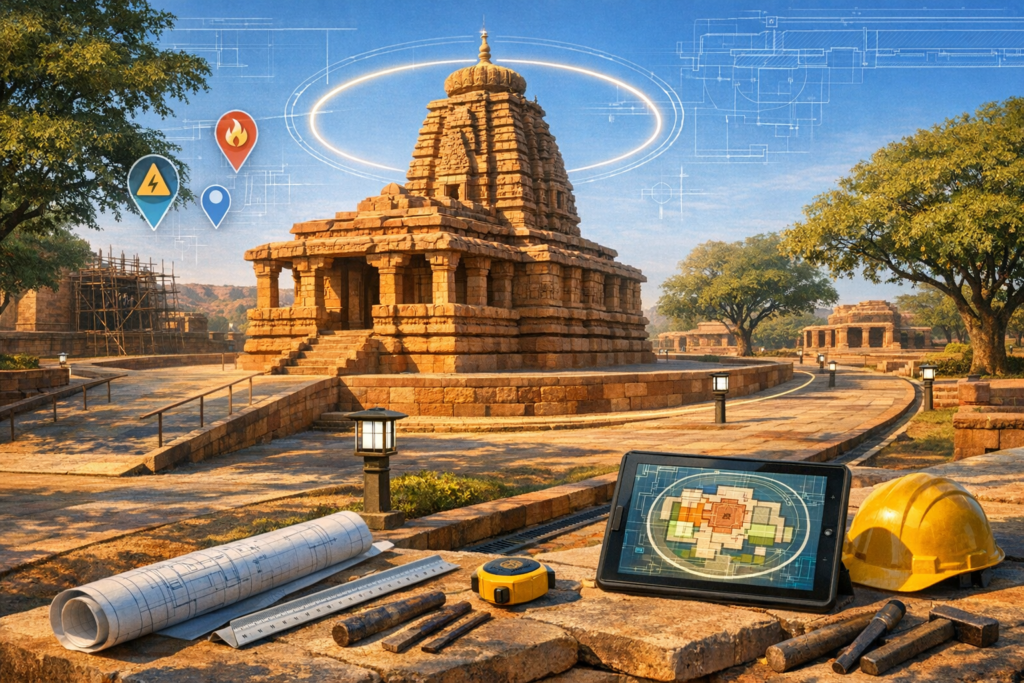
As a heritage institution, Somnath today also represents a living archive. Epigraphic fragments, reused stones, and memory traditions furnish scholars with data on land grants, guilds, and patronage. Conservation specialists and architects continue to study salt-laden sea air, load paths in stone superstructures, and traditional joinery—technical concerns that matter for coastal monuments globally. The shrine’s custodianship has fostered collaborations for documentation and resilience planning, complementing broader archaeological and historical research in the region.
Beyond architecture and annals, Somnath speaks to a shared dharmic sensibility visible across Hinduism, Buddhism, Jainism, and Sikhism. The tirtha-yatra archetype resonates with the Buddhist emphasis on mindful journeying; the Jain principle of Anekantavada encourages humility about partial perspectives in reconstructing the past; and the Sikh ethos of seva animates the generous hospitality seen at great pilgrimage centers. Far from being a symbol for one community alone, Somnath’s long survival illustrates how India’s dharmic families have, together, nurtured spaces of worship, dialogue, and service.
It is vital, therefore, to narrate Somnath’s past with scholarly sobriety. Medieval iconoclasm, a phenomenon found in many parts of the world, did inflict grievous harm here; yet the analytic task is not to incite present animosity, but to understand causes and contexts—strategic, economic, and ideological—and to measure their effects on communities and institutions. This balance of empathy and evidence honors both those who suffered and those who rebuilt.
The modern restoration exemplifies that ethical balance. The 1951 Pran Pratishtha unfolded within a constitutional framework that protects all faiths. Public discourse around Somnath—advanced by figures like K.M. Munshi and Sardar Patel—insisted that recovery of heritage could proceed without diminishing the rights or dignity of any citizen. In this sense, the project became a national seminar in reconciling historical truth with contemporary pluralism.
The site’s sacred geography heightens its meaning. The Triveni Sangam at Prabhas, the ceaseless thrum of the Arabian Sea, and the temple’s axial alignment together yield a phenomenological experience of orientation—toward the horizon, the pole, and the still point within. Such embodied orientation is a quiet constant across dharmic practice, whether in the calm of a Buddhist vihara, the ascetic precision of a Jain derasar, the kīrtan-filled warmth of a gurdwara, or the mantra-suffused garbhagriha of a Hindu temple.
For cultural historians, Somnath offers a rare longitudinal dataset: recurrent cycles of devastation and rebuilding over ten centuries; the endurance of ritual even when structures fell; and the reconstitution of patronage networks in changing political economies. For architects and conservationists, it illustrates the durability of stone craft, proportion, and drainage in a salt-spray environment; and the value of guild knowledge as a living technology.
For communities, Somnath affirms an ethic: that resilience is not merely return to former shape, but a creative re-articulation of form and meaning. Each reconstruction—11th century, late 18th century, and the mid-20th century—reinscribed devotion in new stone, embedding hope without erasing scars. In this layered palimpsest, prayer becomes a practice of memory.
As 2026 foregrounds both the 75th anniversary of consecration and the 1000-year horizon (1026–2026), initiatives such as Somnath Millennium Celebrations reflect a scholarly and civic impulse to curate archives, document oral histories, and deepen interfaith conversations around heritage. Properly framed, such efforts can strengthen the social fabric, advancing unity among India’s dharmic traditions and enriching the global discourse on cultural preservation.
In sum, Somnath’s story is neither a tale of perpetual victimhood nor a triumphalist epic. It is a measured chronicle of loss, courage, craft, and continuity—anchored in facts, enlarged by empathy, and oriented toward a future in which sacred spaces foster dialogue, learning, and seva. That is why Somnath continues to feel, to countless pilgrims and students of history alike, like the steady pulse of an eternal flame.
Inspired by this post on Hindu Blog.






Leave a Reply
You must be logged in to post a comment.