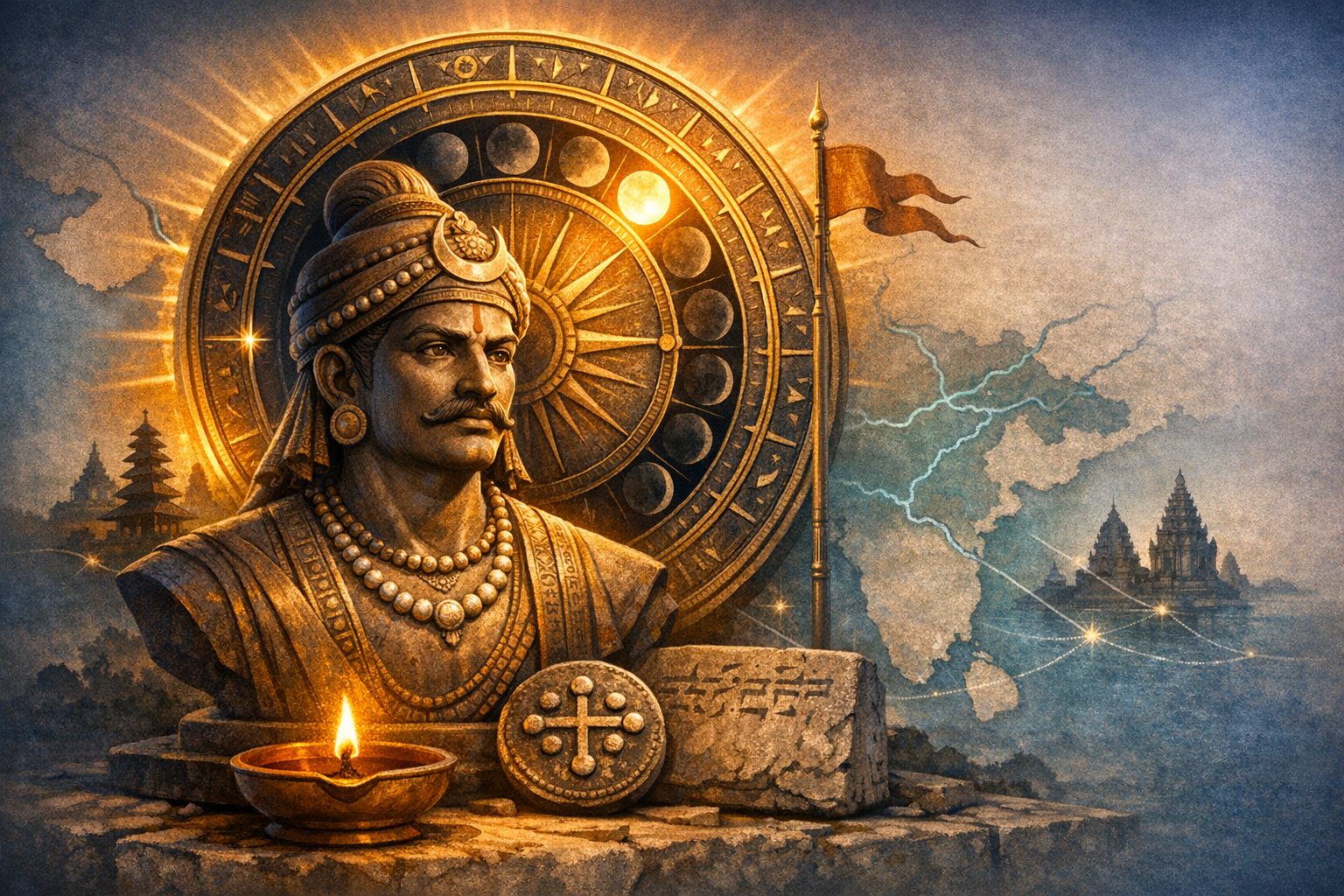
Shalivahana Jayanti in 2026 falls on 28 March, observed on Dasami in Shukla Paksha of the Chaitra monthtraditionally referred to as Chaitra Vijaya Dashami. The commemoration honors King Shalivahana, a figure associated in later Indian tradition with Gautamiputra Satakarni, the paramount Satavahana ruler renowned for defending sovereignty in the Deccan. The day also foregrounds the Shalivahana erabetter known as the Saka Samvatwhose epoch (78 CE) underpins the Indian national calendar and informs cognate calendrical traditions across parts of Asia.
Calendarically, Chaitra Vijaya Dashami is the tenth tithi (Dasami) after the new lunar month begins, counted in the bright fortnight (Shukla Paksha). In most Indian panchangas, Jayanti observances are aligned to the tithi prevailing during sunrise (or as prescribed locally), so minor regional variations in the civil date can occur across time zones. For 2026, mainstream Indian almanacs align Dasami, Shukla Paksha, Chaitra, to Saturday, 28 March. As with all tithi-based observances, practitioners often verify local timings through the regional panchang.
In historical memory, “Shalivahana” functions both as a dynastic signifier and as a cultural emblem. Later literary traditions identify Shalivahana with Gautamiputra Satakarni (r. c. 106–130 CE), a pre-eminent Satavahana sovereign. Epigraphic evidence such as the Nasik (Naneghat/Nasik caves) records attributed to his mother, Gautami Balashri, praises Gautamiputra for humbling the Sakas (Scythians), Yavanas (Indo-Greeks), and Pahlavas (Indo-Parthians). While scholars distinguish between the legendary stature of “Shalivahana” and the securely attested Gautamiputra Satakarni, the convergence of memory and epigraphy helps explain why the Jayanti crystallized around this name and ideal.
The Satavahana dynasty governed a wide Deccan swath bridging the Godavari–Krishna basins and vital trade corridors. Their coinage (including bilingual legends), patronage of Buddhist and Hindu establishments, and pragmatic administration reveal a statecraft grounded in regional pluralism. Prakrit inscriptions of the period showcase a political language of dharma, order, and protection of subjectsmotifs that later narratives subsumed into the Shalivahana archetype of just rulership.
The Shalivahana era, popularly called the Saka Samvat, begins in 78 CE. Distinct from the Vikram Samvat (57–56 BCE epoch), the Saka era is the backbone of the Indian national calendar, standardized and officially adopted in 1957 following the Calendar Reform Committee’s recommendations. In this civil system, Chaitra is the first month; Chaitra 1 typically falls around March 22 in a common year (March 21 in a leap year), aligning the solar year with an Indian lunisolar framework for administrative and scientific use.
Beyond the subcontinent, the Saka reckoning traveled with maritime trade, intellectual exchange, and temple–monastery networks. The Balinese Saka calendarstill vibrantstructures the observance of Nyepi (Day of Silence) and frames ritual cycles. Java historically used a Saka-based system before the later Javanese calendar reform under Sultan Agung. In mainland Southeast Asia, cognate systems (such as the Chula Sakarat) and Khmer epigraphy demonstrate how Saka-era chronologies, month names (Chaitra, Vaishakha, etc.), and computational methods informed Buddhist and Hindu ritual calendars. In Cambodia, aspects of Buddhist calendrics preserve these shared Indic time-reckoning features even as localized eras and the Buddhist Era came to the fore.
Hence, Shalivahana Jayanti resonates across the dharmic ecumene. While rooted in the Deccan’s historical experience, the observance speaks to Hindu, Buddhist, and Jain calendars that have variously used or dialogued with Saka-era timekeeping; Sikh communities, too, have engaged with Indic calendrical vocabulary in broader South Asian time traditions. The day therefore becomes a moment to acknowledge a common civilizational grammar of timeone that has long supported shared festivals, harvest cycles, and temple–monastery liturgies.
Ritually, households and community groups mark Shalivahana Jayanti with snana (purificatory bath), deepa (lighting of lamps), a simple sankalpa noting Chaitra Shukla Dashami, and readings or talks on Satavahana history. Public programs often feature epigraphy- and coins-focused lectures, storytelling for children, and group recitations that extol rajadharma, truthfulness, and public welfare (lokasangraha). Acts of dana (charity) and seva (service) are encouraged to honor the ideal of ethical governance associated with Shalivahana/Gautamiputra’s memory.
Given its calendrical positioning in Chaitra, Shalivahana Jayanti regularly falls close to Ugadi and Gudi Padwa, which celebrate the onset of the new year in regional traditions. Although distinct in purposeJayanti centers on a royal commemorative ideal while Ugadi/Gudi Padwa inaugurate the new Samvatsaratheir proximity reinforces a season of renewal, ethical resolve, and cultural learning. Communities in Maharashtra, Telangana, Andhra Pradesh, and Karnataka especially foreground Satavahana heritage during this period.
From a technical perspective, the tithi system defines Dasami when the longitudinal difference between Moon and Sun spans 108° to 120°. Because the Moon’s mean motion varies and tithis can begin or end at any civil hour, the observance follows the tithi present at sunrise (with some local traditions preferring madhyahna timing or temple-specific protocols). This astronomical basis explains why the civil date for Shukla Paksha Dashami may shift marginally across locales even when the festival name remains uniform.
Students and enthusiasts often use the Jayanti to explore primary sources. The Nasik cave inscriptions (Prakrit) cast invaluable light on Satavahana titulature, royal lineage, and political ideology. Coin hoards from the Deccan reveal metrological standards, iconography, and trade linkages to western India and beyond. Comparative study with Western Kshatrapa issues or Kushan coinage helps map the geopolitical contour implied by epigraphic claims of “humbling Sakas, Yavanas, and Pahlavas.” Such inquiry situates the Jayanti within the concrete textures of early historic India rather than as a merely legendary veneer.
Equally important is the ethical dimension. Jayanti observances highlight rajadharma: protection of the vulnerable, fair taxation, patronage of learning, and reverence for diverse spiritual paths. Inscriptions from the Deccan repeatedly point to endowments that served both Buddhist viharas and Hindu shrines, exemplifying an inclusive patronage ethos. Commemorating Shalivahana in this frame foregrounds unity-in-diversityan enduring principle across Hinduism, Buddhism, Jainism, and Sikhism.
Those wishing to observe the day meaningfully can structure it around three anchors: remembrance, reflection, and service. Remembrance entails learning a reliable historical outline of the Satavahana age and the Saka Samvat. Reflection invites personal and collective resolve to uphold fairness, pluralism, and civic responsibility. Service translates ideals into actionsupporting education, healthcare, or heritage conservation projects in one’s locality, in the spirit of lokasangraha.
On the calendrical front, the Saka Samvat and its alignment to Chaitra reinforce India’s scientific standardization efforts in the twentieth century. The Indian national calendar’s adoption created a harmonized framework for meteorological data, administrative publications, and public broadcastingshowing how an ancient era can serve modern requirements. That synthesis of heritage and utility is emblematic of what Shalivahana Jayanti remembers: the capacity to carry forward a civilizational inheritance in service of the present.
Across families, the day often becomes a quiet intergenerational exchange. Elders recount how month names like Chaitra and Vaishakha flow through Sanskrit, Prakrit, and regional vernaculars; younger members discover how the same names appear in Balinese and historical Javanese contexts. The realization that shared calendars structure temple festivals in India and monastery observances in Southeast Asia fosters an emotional recognition of a larger dharmic kinship.
For educators and community leaders, Shalivahana Jayanti offers a natural platform to curate exhibitions on inscriptions, coins, and trade routes of the Deccan. Mapping sites from Paithan (Pratishthana) to Amaravati allows viewers to visualize how the Satavahana sphere connected coastal emporia with inland markets, and how that connectivity nourished the spread of time-reckoning practices associated with the Saka era.
In scholarly debates, the genesis of the Saka era has been variously discussed. While literary tradition strongly associates the era with Shalivahana, academic studies weigh multiple hypotheses about its formal institutionalization in 78 CE. Commemoration on Shalivahana Jayanti does not hinge on tribunal certainty over the exact founder; rather, it marks the moment when South Asian polities stabilized an epoch that became a durable common frame across regions and traditions.
Practically, observers may consult local panchangas for Chaitra Shukla Dashami muhurtas in 2026, remembering that Jayanti sankalpas typically note the lunar month (Chaitra), fortnight (Shukla Paksha), and tithi (Dasami). Where temples organize public talks, it is customary to begin with a brief invocation and end with dana-annadana, aligning memory with service. Individual practice may be simplelighting a deepa at dusk and reading a translated excerpt of a Satavahana inscription or a concise historical overview.
In conclusion, Shalivahana Jayanti 2026 on 28 March anchors three interlinked strands: a date and tithi in the Hindu calendar (Chaitra Shukla Dashami), a historical memory of just rule personified in Shalivahana/Gautamiputra Satakarni, and a pan-Asian calendrical legacy in the Saka Samvat. Observed thoughtfully, the Jayanti affirms unity among dharmic traditions and renews a common resolve to translate heritage into ethical action.
Inspired by this post on Hindu Pad.