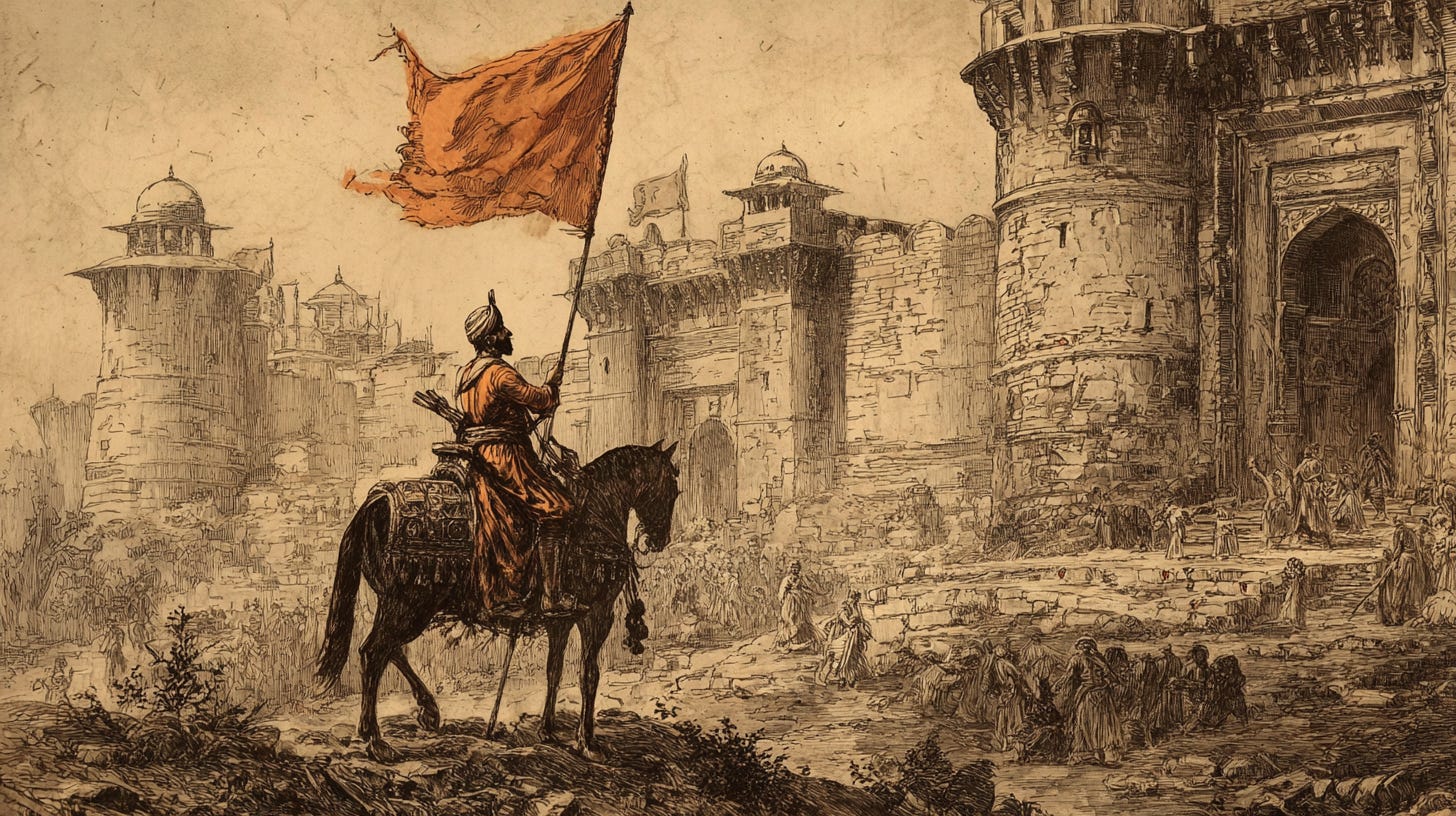
In the historical consciousness of Bharatavarsha, Chhatrapati Shivaji occupies a place comparable to Chandragupta Maurya, Senapati Pushyamitra Shunga, Shatru-shatru Vikramaditya, and Emperor Skandagupta. As Shakti-putra, he reversed a civilizational retreat and redirected it toward disciplined advance, much like Skanda revitalizing the divine sena. This repositioned the course of Indian history and affirmed an indigenous model of leadership that fused courage, restraint, and vision.
The epithet Shakti-putra rests on a rigorous synthesis of shakti (force) and yukti (strategy). Facing the Mughal Empire under Aurangzebamong the era’s most formidable rulersShivaji paired statecraft with military innovation, compelling a powerful imperial apparatus to recalibrate. This achievement galvanized Hindu society and, more broadly, the dharmic imagination, restoring confidence that just power can flourish without abandoning ethics.
Predecessors such as Prithviraj Chauhan, Maharana Sanga, and Maharana Pratap embodied extraordinary valor; yet their reluctance to match deceitful warfare with discerning stratagem often proved costly. Shivaji corrected this asymmetry by integrating viveka with kshatra, demonstrating that authentic strength arises when prudence and power converge. In this sense, his leadership exemplified Kshatra Dharma grounded in intelligent ethics rather than brute force.
Shivaji cannot be reduced to a mere conqueror akin to Alexander, Caesar, or Napoleon. He upheld a distinctive dharmic code: restraint in victory, protection of civilians, honor toward women as mothers, sisters, and daughters, and respect for places of worship and religious preceptors. These principles, intrinsic to the Hindu way of life, resonate across Buddhism, Jainism, and Sikhism in their shared emphasis on compassion, dignity, and plural worship.
These ethical commitments were tested in a violent early modern world, characteristic of many imperial conflicts. Even then, Shivaji maintained non-negotiable limitseschewing sacrilege, rejecting cruelty, and distinguishing tyrannical conduct from communities as a whole. The emphasis remained on resisting oppression rather than stigmatizing any faith, preserving the plural texture of society while opposing injustice.
The durability of this restraint flowed from Sanatana Dharma. Guided by Jijabai, inspired by the saints of Maharashtra, and drawn to the living presence of Goddess Bhavani, Shivaji balanced relentless action with inner renunciation. Close association with Saint Tukaram and Samarth Ramdas deepened humility; triumphs did not inflate ego, and contemplation of kala (time) cultivated detachment. This spiritual depth grounded his public life in sadhana.
Without this spiritual practice, Shivaji’s portrait would shrink to that of a clever tactician. Recognizing the primacy of sadhana explains both his magnanimity and effectiveness, clarifying why his legacy stands as a model for ethical leadership rather than a catalogue of fortunate coincidences. His example shows how inner clarity steadies outward action.
The lesson for contemporary civic nationalism in India is clear: vitality arises when public life draws upon the ethical grammar of Sanatana Dharmatruth, compassion, restraint, and courageprinciples equally cherished by the broader dharmic family. A nationalism severed from these values may overpower an adversary yet fail to secure the welfare of the motherland. By contrast, dharmic nationalism aligns strength with conscience, enabling durable social harmony.
Dharmic ethics distinguish between tyrannical behavior and communities, permitting resolute resistance to oppression while preserving pluralism. In the present age, this demands vigilance against totalitarian ideologies and violent extremism of any stripe, using calibrated means to protect life, liberty, and spiritual diversity. Such an approach safeguards society without sacrificing moral clarity.
Shivaji’s statecraft focused on the living threat, not the defeated past. He deployed every legitimate resourcestrategy, diplomacy, and proportionate forcewhile refusing sterile debates that blunt timely action. The orientation remained forward-looking: identify the current source of injustice and neutralize it within the bounds of Dharma, embodying the disciplined ethos of Dharma-Yuddha.
As long as dharmic nationalism remains animated by the synthesis of shakti and viveka, it will meet contemporary challenges without succumbing to hatred. For Hindus, Buddhists, Jains, and Sikhs alike, the shared blueprint is clear: protect the vulnerable, uphold sacred spaces, dignify women, and pursue justice without malice. This unity in diversity strengthens the civilizational fabric of Bharatavarsha.
Viewed in this light, Shakti-putra Shivaji stands as both strategic genius and moral exemplarreviver of Kshatra Dharma and guardian of plural worship. His life offers a timeless blueprint for just power, showing how spiritual discipline can anchor statecraft and how inner renunciation can elevate public duty. This is the enduring contribution of the Maratha Empire’s foremost leader to Indian history and cultural heritage.
Inspired by this post on Dharma Dispatch.