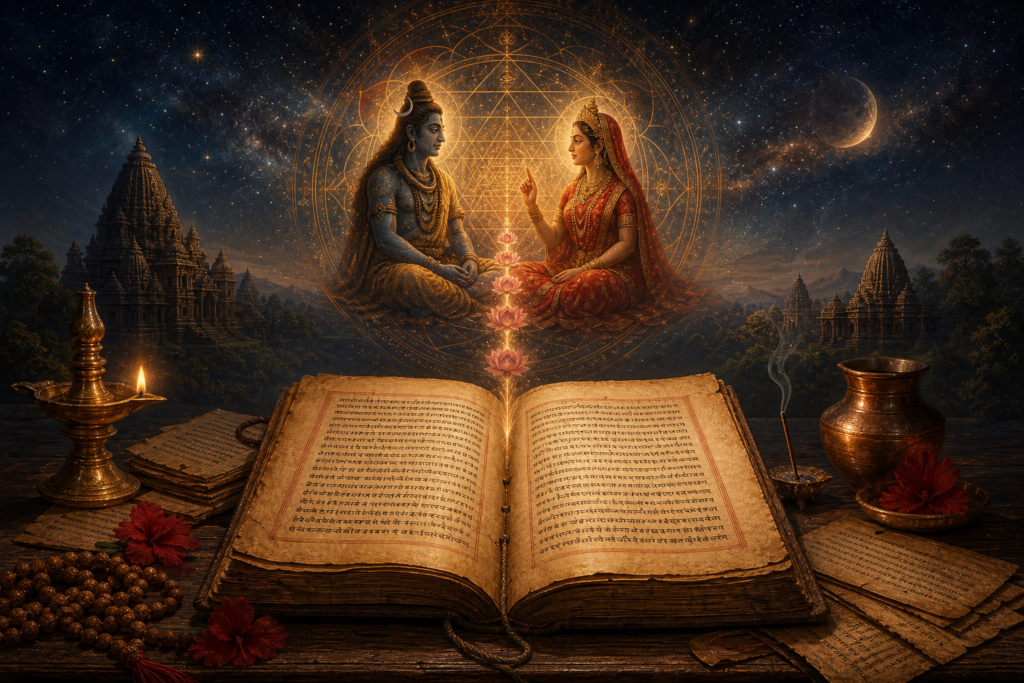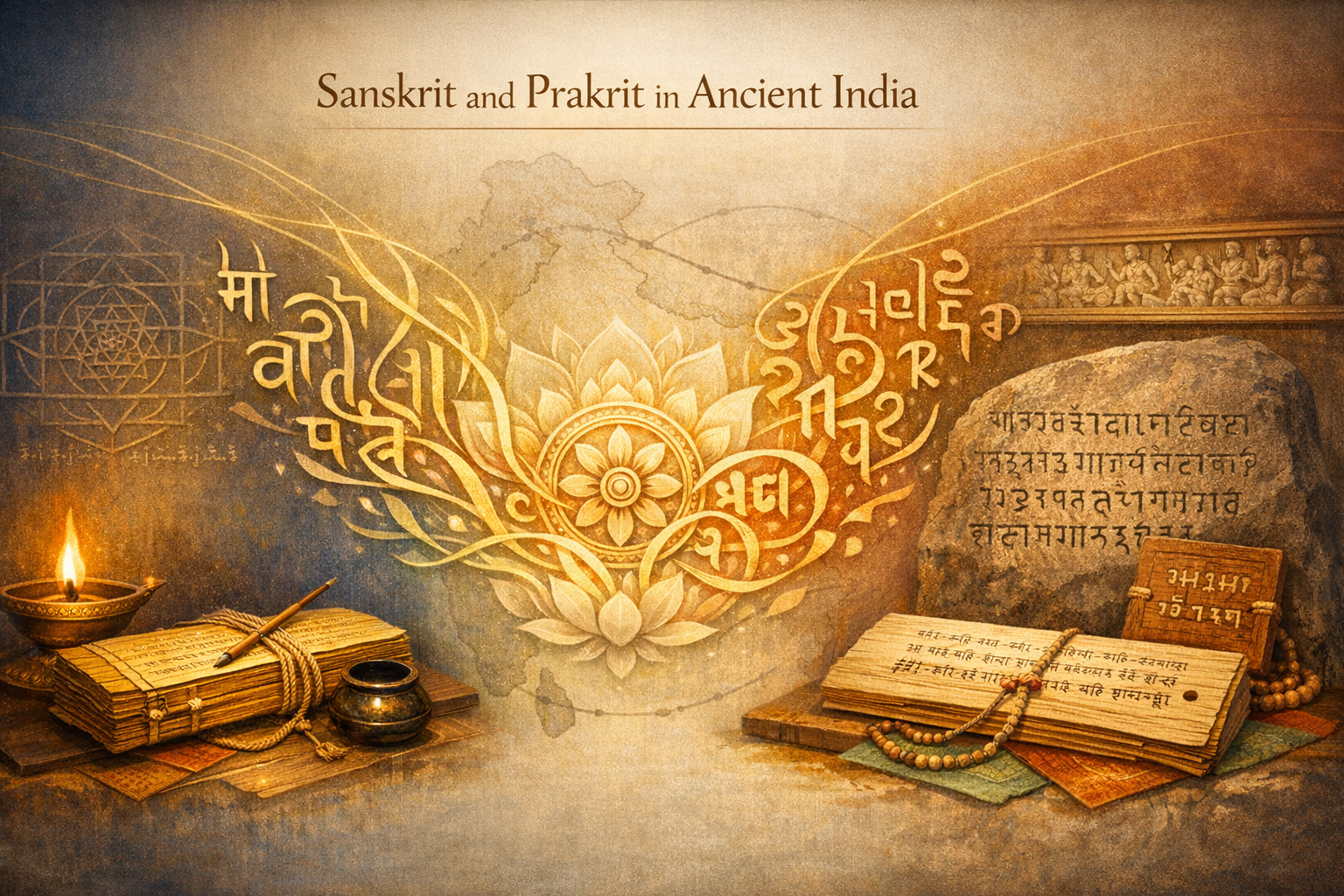
Across Ancient India, two great streams of speechSanskrit and Prakritwove a sacred dialogue that shaped devotion, governance, literature, and everyday life. Far more than mere codes of communication, they carried metaphysical insight, aesthetic beauty, and social meaning, allowing dharmic traditionsincluding Hinduism, Buddhism, Jainism, and in later centuries Sikhismto speak to diverse communities with clarity and grace. The popular image of Sanskrit as a “divine language” and Prakrit as “the people’s voice” captures a truth about status and function, yet the lived reality was more fluid: the two coexisted in a dynamic, mutually illuminating relationship that defined the cultural heritage of Ancient India.
From a historical-linguistic view, Sanskrit belongs to Old Indo-Aryan (OIA), with its earliest records in the Vedic hymns and later standardization as Classical Sanskrit. Prakrit is a collective term for Middle Indo-Aryan (MIA) languages and literary dialectssuch as Māhārāṣṭrī, Śaurasenī, Māgadhī, Ardhamāgadhī, and Païśācīused widely in inscriptions, drama, poetry, and the canons of Buddhism and Jainism. Pāli, while not always labeled a “Prakrit proper,” is a closely related Middle Indo-Aryan language that preserves the Theravāda Buddhist Canon. Together these traditions formed a historical bridge from Old Indo-Aryan to the New Indo-Aryan languages (Hindi, Bengali, Marathi, Gujarati, Punjabi, Odia, and others).
Chronologically, the continuum runs broadly from Vedic Sanskrit (second millennium BCE) to Classical Sanskrit (first millennium BCE onward), followed by Middle Indo-Aryan stages (roughly from the mid–first millennium BCE through the early first millennium CE) and then to the New Indo-Aryan period. This evolution is not a simple replacement but a layered ecology: Sanskrit retained prestige and transregional scope, while Prakrits diversified regionally and socially, adapting to new literary forms and devotional movements. The result is a rich archive of Ancient Texts that still informs philosophy, ritual, and law.
The sociolinguistic picture is best described as diglossic. Sanskrit frequently served as the supra-regional, scholastic, and liturgical medium of the śāstras (philosophy, law, ritual, grammar, astronomy, mathematics, and poetics), while Prakrits flourished in drama, popular verse, narrative literature, sermons, and administrative inscriptions. Yet the boundaries were porous: many Buddhist and Jain scholastic works appear in Prakrits and Pāli, and conversely, substantial Buddhist and Jain philosophical corpora also exist in Sanskrit. The Natyashastra codified this multilingual world on stage: high-born male protagonists spoke Sanskrit, while heroines and many other characters spoke Śaurasenī or Māhārāṣṭrī; Māgadhī signaled origin and social persona; songs and lyrical gāthās loved the cadences of Māhārāṣṭrī. This staged multilingualism mirrors a culture comfortable with layered identities and registers.
Within dharmic traditions, language choices supported a shared ethical lexicon and complementary pathways of practice. Hindu Vedic ritual, Upanishadic inquiry, Smriti literature, and classical philosophical schools (darśanas) moved primarily in Sanskrit; Jains preserved their canonical scriptures in Ardhamāgadhī and later in Śaurasenī and Māhārāṣṭrī, while Buddhists preserved the Pāli Canon and also transmitted a vast Sanskrit Buddhist scholastic tradition and Buddhist Hybrid Sanskrit texts. These linguistic ecosystems spread key conceptsdharma/dhamma, karma/kamma, ahiṃsā, saṃsāra, mokṣa/nibbānaacross communities, strengthening unity in spiritual diversity. Centuries later, Sikh scripture drew on Punjabi and Braj with deep Sanskritic and Prakritic layers, testifying to an enduring civilizational conversation.
Epigraphy crystallizes these roles in stone. Emperor Aśoka’s edicts (3rd century BCE) employed Prakrit in Brahmi and Kharoshthi scripts to reach a broad public in a language intelligible across vast regions; in the northwest, Greek and Aramaic versions attest to inclusive communication strategies. The earliest long Classical Sanskrit inscription, the Junagadh inscription of Rudradāman I (c. 150 CE), signals a parallel trajectory in which Sanskrit becomes a dominant epigraphic medium by the Gupta period. As scripts evolvedBrahmi branching into regional scripts and eventually Nagari, and Kharoshthi thriving in the northwesta shared visual culture of writing took shape, supporting the preservation of Ancient Sanskrit Manuscripts and Prakrit texts alike.
Literary genres developed distinctive but intertwined aesthetics. Sanskrit kāvya glories in the works of Kālidāsa, Bhāravi, Māgha, and others; the Mahābhārata and Rāmāyaṇa set narrative and ethical horizons; the Purāṇas reimagined sacred history; the śāstras framed inquiry across disciplines. Prakrit literature thrived in the lyrical Gāthāsaptaśatī (attributed to Hāla), Jain narrative cycles, didactic verse, and dramatic dialogue. Pāli’s Sutta and Vinaya Piṭakas exemplify clarity and moral persuasion, while later Apabhraṃśa bridged Middle and New Indo-Aryan and became a powerful vehicle for Jain poets and nascent bhakti voices. The cumulative effect is a multilingual canon that speaks in many registers yet resonates with shared philosophical intent.
Codification and grammar endowed these languages with extraordinary precision. Pāṇini’s Aṣṭādhyāyī (with Patañjali’s Mahābhāṣya and Kātyāyana’s vārttikas) yielded a generative model of grammar unmatched in antiquityits metalanguage and rule economy still inspire modern linguistics and computer science. Prakrit traditions, too, received systematic attention: Vararuchi’s Prākṛtaprakāśa and Hemacandra’s Siddha-Hema-Śabdānuśāsana mapped Prakrit and Apabhraṃśa with rigor, and Jain scholastic centers functioned as hubs for this comparative-linguistic science. Across the spectrum, śikṣā (phonetics), vyākaraṇa (grammar), and chandas (meter) ensured both memory and transmission.
Systematic sound correspondences between Sanskrit and the Middle Indo-Aryan languages reveal the internal logic of change. Common Middle Indo-Aryan developments include simplification of consonant clusters and mergers of aspirated voiced stops; Sanskrit diphthongs ai and au often yield e and o; ṛ frequently becomes a or i; and sandhi rules ease. Illustrative pairs include: dharma → dhamma, karma → kamma, kṣetra → khetta, kṣatriya → khattiya, agni → aggi, śraddhā → saddhā, putra → putta. Such patterns vary by dialect (Māgadhī, Śaurasenī, Māhārāṣṭrī, Pāli), but together they chart the Middle Indo-Aryan pathway from Classical Sanskrit phonology to the textures of the later vernaculars.
Morphology and syntax likewise streamlined from Sanskrit to Prakrits and Pāli. The eight-case nominal system tended to reduce in everyday usage; genitive singular Sanskrit -asya typically appears as -assa (Pāli and many Prakrits); locatives often simplify; the verbal system relies more on periphrastic pasts and participles, while inherited aorists and optatives retreat in frequency. Participial constructions become central narrative tools, supporting clarity in sermons and stories. These are not losses but reorganizations that privileged analytic clarity and communicative efficiency, fitting the needs of broader audiences without sacrificing nuance.
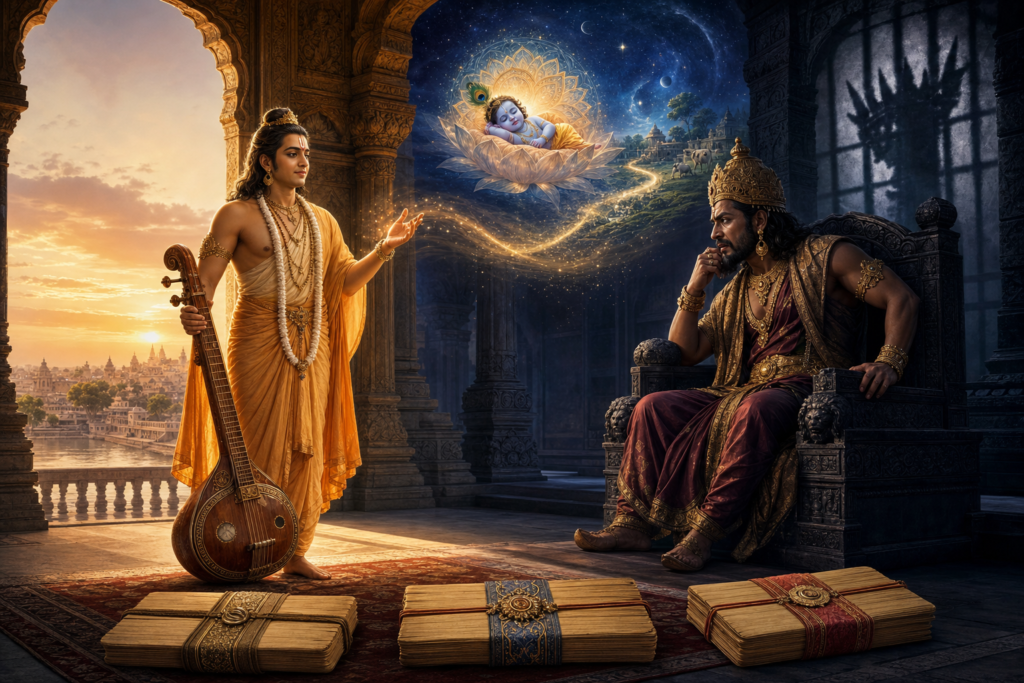
Performance traditions make the social layering vivid. In classical drama, the hero’s Sanskrit is not an exclusionary code; it establishes śāstric authority and elevated tone. The heroine’s Śaurasenī and lyrical Māhārāṣṭrī bring intimacy, wit, and musicality. Māgadhī colors regional identity. The effect is not a hierarchy of worth but a choreography of voice: each language registers character, mood, and setting, creating empathy and emotional connection while honoring the audience’s linguistic comfort.
Knowledge moved fluidly across these codes. Early Buddhist prose shows Middle Indo-Aryan clarity, while later scholastic Buddhism flourished in Sanskrit across Nālandā University and other centers. “Buddhist Hybrid Sanskrit” preserves traces of Middle Indo-Aryan within largely Sanskritized forms, attesting to the long arc of textual transmission. Jain scholasticism exhibits a similar spectrumfrom Ardhamāgadhī scripture to Prakrit and later Sanskrit treatisesunderscoring that dharmic traditions prized accessibility and precision in equal measure.
The long-term legacy is visible in New Indo-Aryan languages through tatsama (direct Sanskrit borrowings), tadbhava (Sanskrit via Prakrit/Middle Indo-Aryan reflexes), and deśī (non-Sanskritic, often local) layers. Everyday Hindi, Bengali, Marathi, Gujarati, and Odia balance these strata: muh (tadbhava of mukha) coexists with tatsama mukha in formal registers; śrama appears alongside colloquial counterparts; poetic traditions favor Braj and Maithili rich in Sanskritic and Prakritic cadences. This balanced layering is a civilizational signature: the learned and the lived have never been at odds, only differently attuned.
Script and manuscript cultures amplified this synthesis. Brahmi, the great mother of most Indic scripts, underwrote the epigraphic expansion of Prakrit and, later, Sanskrit; Kharoshthi held sway in the northwest; and over centuries, Gupta and Nagari hands matured into the book culture that preserved Ancient Texts with remarkable fidelity. The manuscript traditions of Kashmir, Bengal, Maharashtra, and Tamil country exhibit shared conventions of orthography and commentary, while regional scriptsŚāradā, Siddham, Granthashow how form followed function without fracturing the unity of the textual world.
Popular binariesSanskrit as “elite,” Prakrit as “vernacular”obscure the more instructive truth. In Ancient India, communities moved with ease between registers. Householders heard sermons in their own dialects and sang gāthās; the same individuals might sponsor Sanskrit ritual or consult Sanskritic law and astrology. Monastics trained in precise grammar to preserve meaning, yet preached in words that resonated in marketplaces and village squares. The ethical coreahiṃsā, satya, dāna, karuṇāremained shared, and language served that core.
For the broader dharmic family, this is a lesson in unity. Hinduism’s śāstric precision, Buddhism’s lucid compassion, Jainism’s disciplined ethics, and Sikhism’s later devotional universality all rest on a shared linguistic soil nourished by Sanskrit and Prakrit. When a Vedic śloka and a Prakrit gāthā are heard side by side, the effect is not division but recognitionthe same moral horizons spoken through complementary instruments. In that sense, Sanskrit and Prakrit together realize the civilizational ideal often framed as Vasudhaiva Kutumbakam: the world as one family, addressed in many voices.
The sacred dialogue endures. Inscriptions still speak from rock faces, manuscripts breathe in archives, and living languages carry forward the intertwined legacies of Sanskrit and Prakrit. Understanding their historiesphonology and grammar, epigraphy and dramaturgy, canon and commentarydoes more than satisfy scholarly curiosity. It reconnects contemporary society to a proven model of plural expression: authoritative yet accessible, local yet universal. In a plural, dharmic India and diaspora, that balance is not only heritageit is guidance.
Inspired by this post on Hindu Blog.