

You may be trying to resolve a question that public debate usually flattens: if Hindu civilisation endured centuries of foreign rule, in what sense did it decline, and in what sense did it survive? You don’t have to choose between denying the damage and declaring the civilisation dead.
The clearer answer is that sovereignty, institutions, and economic power can contract while a civilisation’s practices, ideas, languages, arts, and communities continue to reproduce themselves. That distinction helps you read the past without turning it into either a grievance slogan or a comforting legend. It also shows what civilisational continuity requires from us now.
Separate political decline from civilisational disappearance
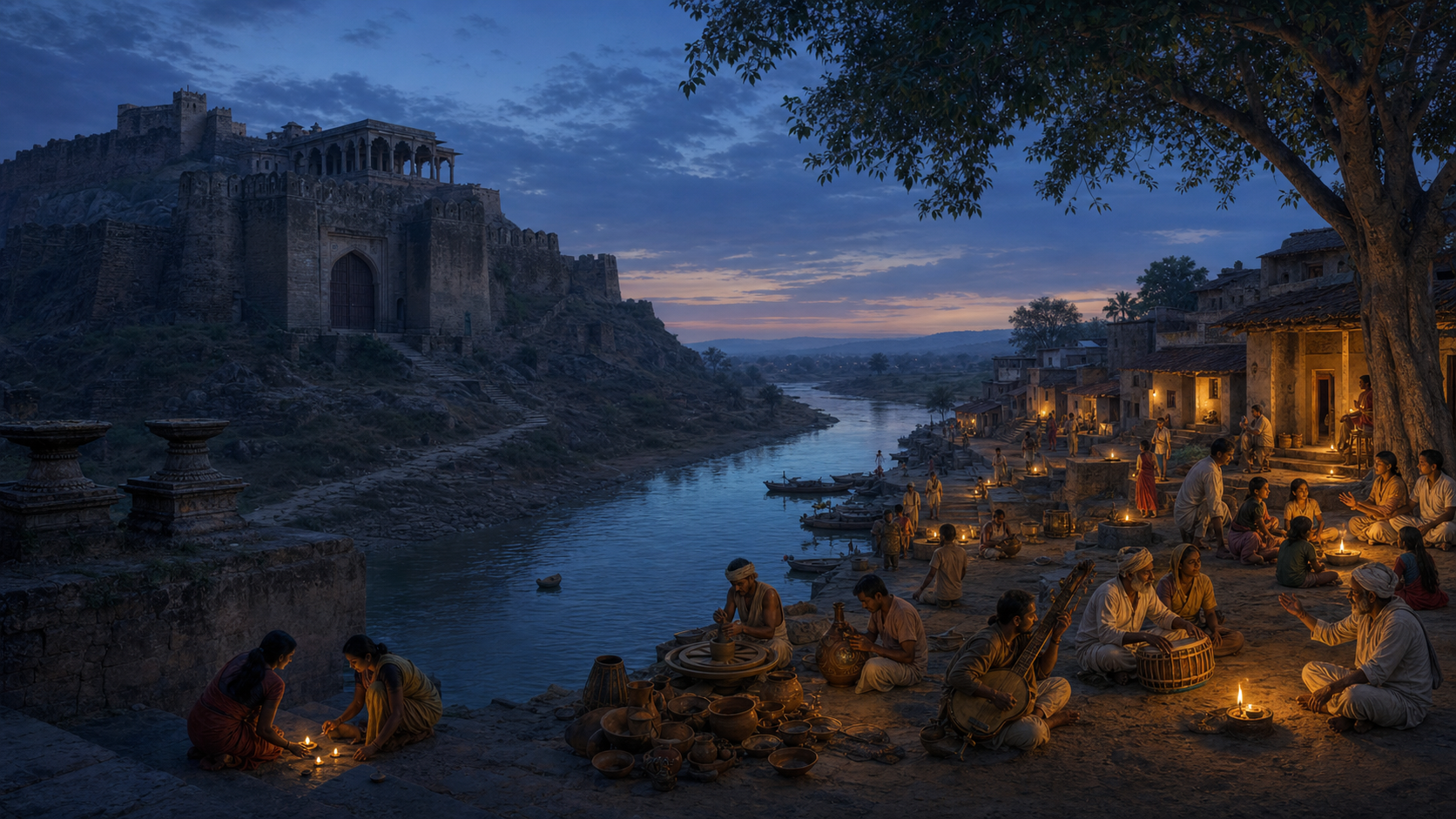
Start by asking what the word “decline” refers to. It can describe at least four different conditions:
- Political sovereignty: Who controls taxation, law, armed force, frontiers, and diplomacy?
- Institutional capacity: Can temples, mathas, monasteries, guilds, schools, courts, and charitable networks acquire resources and transmit knowledge?
- Social reproduction: Can families and local communities pass on languages, rituals, festivals, stories, disciplines, and sacred memory?
- Civilisational grammar: Do ideas such as dharma, ahimsa, anekantavada, seva, and the legitimacy of multiple spiritual paths still shape conduct and public imagination?
These layers can move in different directions. A kingdom may lose its capital while pilgrimage continues. A temple may survive architecturally while losing land, teachers, or control over its revenue. A monastic university may disappear even though parts of its philosophical inheritance enter other lineages. A devotional movement may expand precisely because courtly institutions have become less reliable.
This distinction defeats two common errors. The survival of worship does not prove that conquest caused no civilisational damage. The loss of political power does not prove that Hindu civilisation ceased to exist. You must identify the layer, region, and period before the claim becomes historically meaningful.
Hindu continuity also developed within a wider Dharmic ecology. Hindu, Buddhist, Jain, and Sikh traditions have distinct doctrines and institutions, but they have interacted across the same civilisational landscape. Their shared or overlapping commitments – including ahimsa, seva, disciplined inquiry, and plural approaches to ultimate truth – created more than one channel through which civilisational memory could travel. Treating the traditions as identical would erase real differences; pretending that they developed in isolation would erase equally real exchanges.
Subjugation damaged the institutions that carried dharma
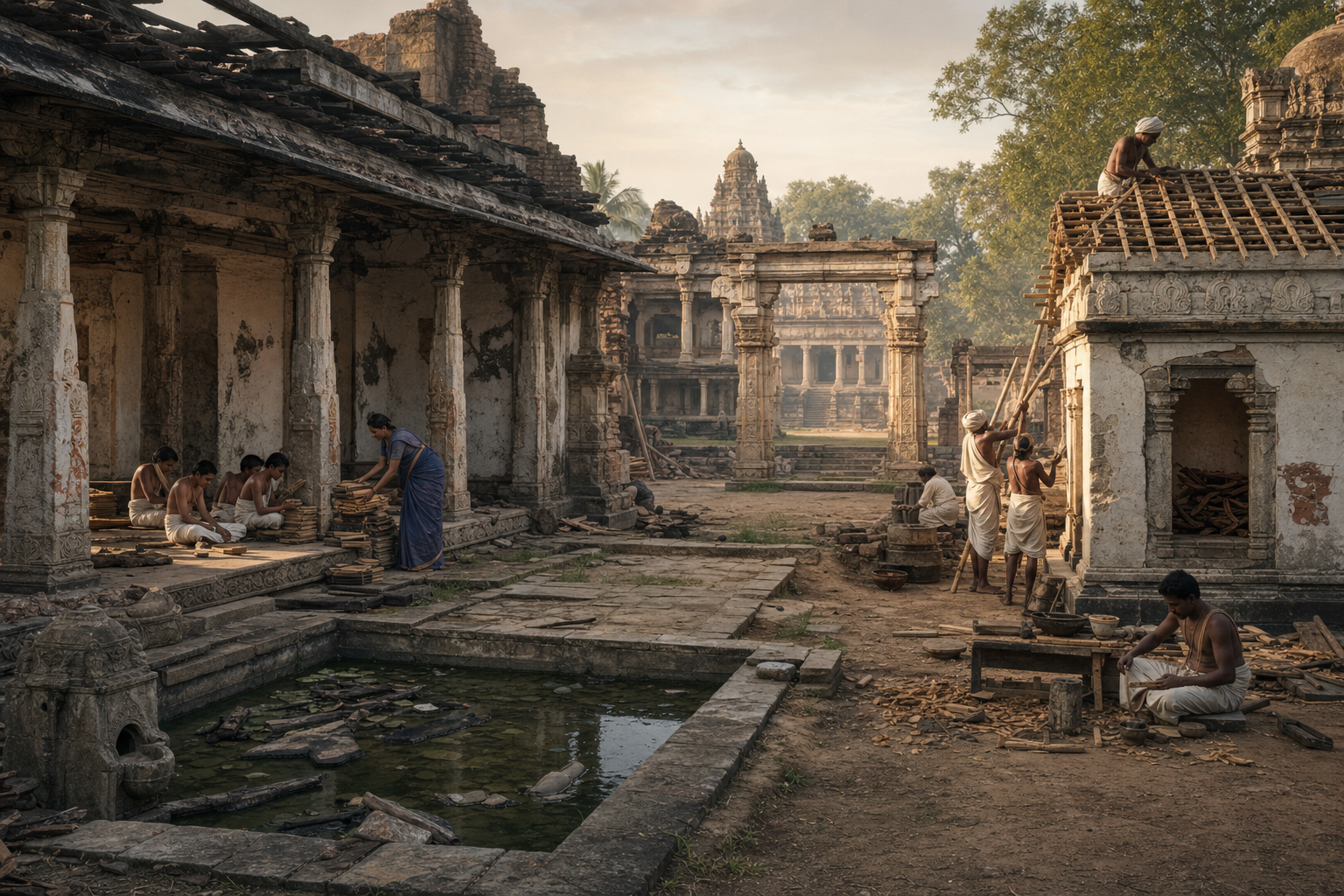
Political conquest matters because rulers do more than occupy thrones. They redirect taxation, distribute land, determine which institutions receive protection, and decide where administrative authority will sit. When those arrangements change, the effects reach teachers, artisans, pilgrims, merchants, libraries, and local systems of charity.
Before the major upheavals of the second millennium, the subcontinent possessed extensive intellectual and commercial networks. The Gupta milieu is associated with figures such as Aryabhata, Varahamihira, and Brahmagupta. Sanskrit and Prakrit connected scholarly communities, while routes across the Ganga-Brahmaputra plains, the Malabar coast, and the Indian Ocean connected guilds, artisans, courts, and religious institutions. Temples were not merely places of private devotion; many also held land, commissioned art, supported learning, and participated in local economic life.
This earlier world was never one permanently unified state. Between the eighth and twelfth centuries, the Chalukyas, Rashtrakutas, Palas, Cholas, Gahadavalas, and other regional powers built sophisticated administrative and temple-centred systems. Their strength, however, was often organised regionally. Rival courts could flourish culturally while still failing to create a durable security structure across vulnerable frontiers.
From around 1000 CE, Turkic raids and subsequent Ghurid expansion placed these arrangements under sustained pressure. The outcome in 1192 opened important routes into the upper Indo-Gangetic plain. Mobile cavalry archery, composite bows, operational speed, and the difficulty of coordinating Rajput confederacies all mattered. Indian armies were not universally or permanently inferior in technology; the deeper weakness lay in rapid coalition-building, logistics, strategic depth, and the ability to fund sustained defence across dispersed polities.
That is an important correction to civilisational fatalism. A failure of coordination is not proof that a culture lacks intelligence or courage. It is an institutional problem: local capability exists, but the mechanisms needed to combine it at the required scale are missing. When you encounter a sweeping claim that “India could not resist,” ask which polity, in which campaign, with what revenue system, and under what logistical constraints.
Under the Delhi Sultanate, iqta assignments altered the distribution of revenue and power, while new administrative centres reoriented urban life. Temple destruction and the relocation of sacred images are historically attested, but their motives should not be flattened into one formula. Some acts functioned as political domination or resource capture; others involved explicit iconoclasm. The distinction is necessary for accuracy, not for minimising the loss.
Buddhist monastic institutions show how several pressures can converge. The destruction associated with Bakhtiyar Khalji at Nalanda around 1193 became the clearest symbol of rupture, but Buddhist decline in India had begun within a larger environment of reduced endowments, changing trade routes, doctrinal contestation, and the absorption of some practices into broader Hindu settings. Here, continuity and loss occurred together: ideas travelled, but institutional centres capable of sustaining whole communities of scholarship did not necessarily survive.
The south prevents us from projecting one regional experience over the whole subcontinent. Vijayanagara sustained a major political and cultural counterweight for roughly two centuries. Its temple-centred cities, agrarian organisation, craft production, military adaptation, and trade through the Malabar and Coromandel coasts supported a substantial renewal of art and philosophy. A civilisation under pressure was not a civilisation moving everywhere at the same speed or in the same direction.
Mughal rule likewise requires more than a single adjective. Administrative centralisation, mansabdari, large revenue systems, architectural patronage, and cultural synthesis coexisted with sharp changes in religious policy. Aurangzeb’s reimposition of jizya and disputes involving temple endowments intensified friction, while regional courts and vernacular cultures remained active. Neither a picture of uninterrupted harmony nor one of undifferentiated darkness explains this combination.
European expansion then changed the mechanism of subjugation. Portuguese naval power after Diu in 1509 altered the Indian Ocean balance. The East India Company combined credit, artillery, diplomacy, and revenue acquisition; Plassey in 1757 and Buxar in 1764 helped transfer fiscal sovereignty to a commercial corporation. Control over land revenue could now finance further conquest, making extraction and expansion parts of the same system.
Permanent Settlement, Ryotwari, and Mahalwari did not operate identically, but each reorganised relationships among cultivators, intermediaries, property, and the colonial state. Tariff arrangements and industrial policy contributed to the decline of older manufacturing sectors. Dadabhai Naoroji’s drain-of-wealth thesis identified the outward transfer of resources as a defining feature of the colonial economy. Meanwhile, the codification of “Hindu law,” new educational curricula, and imperial bureaucracy shifted authority away from many temples, mathas, gurukulas, guilds, and local jurisprudential settings.
This is why political subjugation cannot be treated as a superficial change of rulers. Once a foreign power controls revenue, education, legal categories, trade policy, and the recognition of institutions, it can narrow the material space in which a civilisation renews itself.
Internal faultlines mattered without excusing conquest
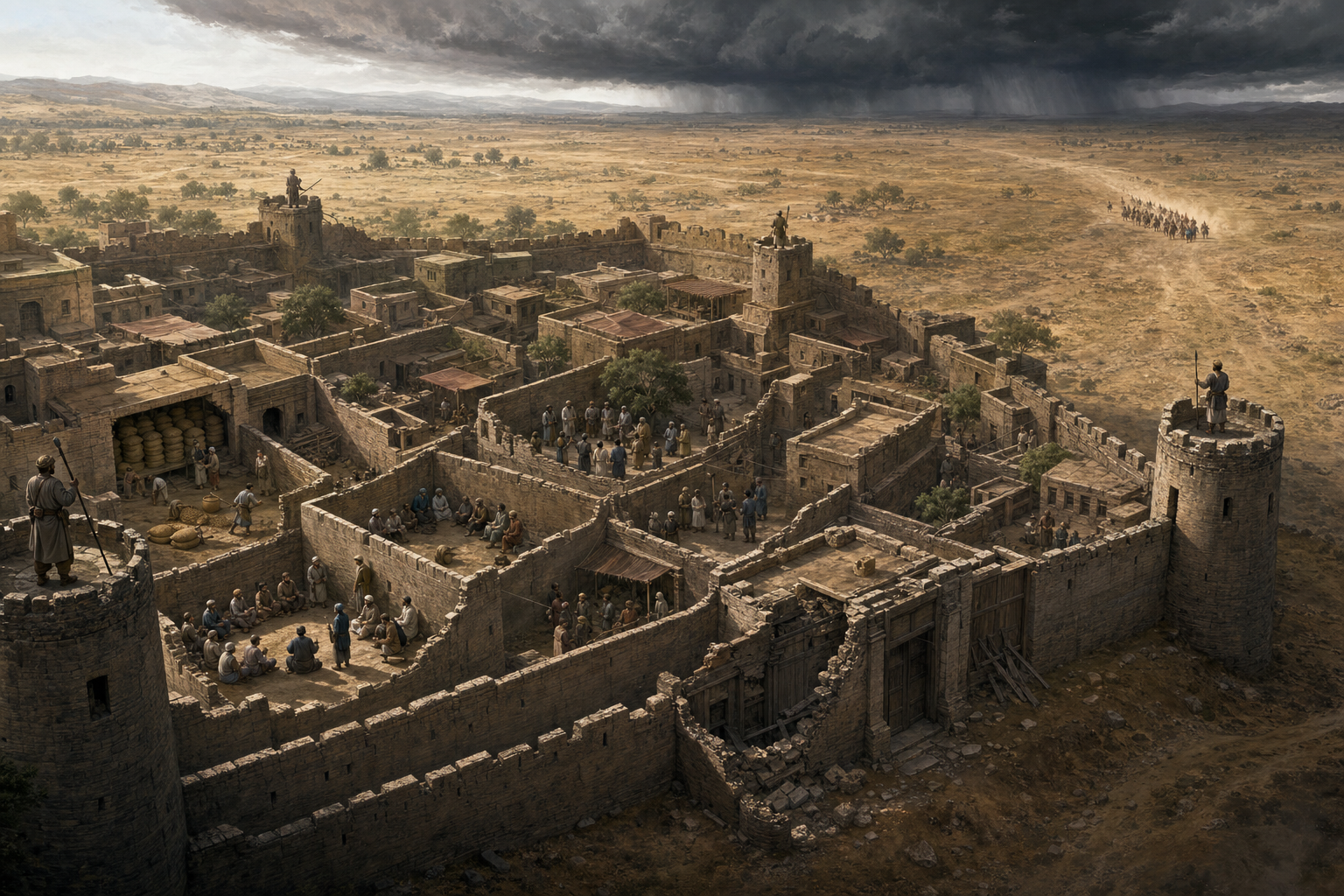
External aggression and internal weakness are not rival explanations. An aggressor is responsible for aggression; a society must still understand the weaknesses that made resistance or recovery harder. Identifying a vulnerability does not legitimise the force that exploited it.
The first vulnerability was political fragmentation. Regional diversity itself was not the problem. It produced strong courts, languages, artistic schools, and local forms of administration. The danger arose when rival polities could not coordinate frontier defence, sustain common war aims, or subordinate short-term dynastic advantage to long-term security. Local excellence could not automatically generate a pan-regional response.
The second vulnerability concerned access to talent. Where jati restrictions became rigid and movement between social or sectarian roles narrowed, the civilisation reduced its own pool of administrators, soldiers, teachers, artisans, and innovators. The point is not to project one condition onto every region or century. It is to recognise a general rule: institutions weaken when inherited status prevents capable people from serving where they are most needed.
The third vulnerability was uneven intellectual renewal. Earlier traditions of astronomy, mathematics, philosophy, linguistics, medicine, and statecraft demonstrate a formidable capacity for inquiry. Yet parts of the learned world later rewarded repetition more reliably than experimental extension or strategic application. Preserving a text is valuable; preserving the habits of observation, argument, and adaptation that produced it is more demanding.
You can apply three diagnostic questions to any period of civilisational stress:
<!– wp:list {