
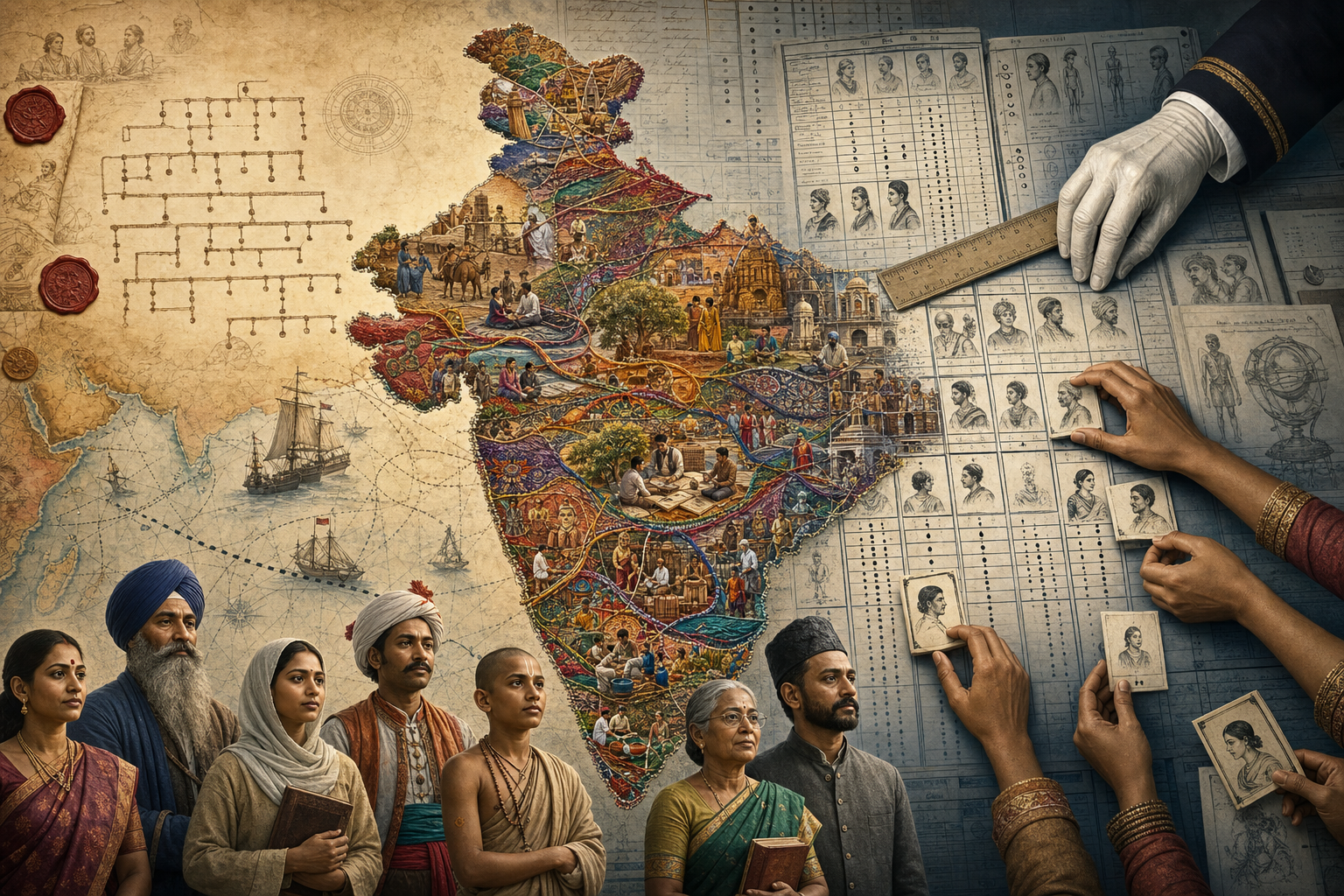
Modern discussions of caste often begin with India and proceed as though the familiar expression “caste system” were a transparent description of an ancient, uniform institution. A closer examination produces a more complicated history. The category through which Europeans organized Indian social differences developed within European debates about religion, ancestry, nobility, blood, race, and imperial government. Understanding that intellectual background does not require denying hierarchy or discrimination in Indian history. It requires distinguishing lived social realities from the conceptual framework through which colonial observers selected, translated, ranked, and eventually administered them.
This distinction matters because classifications do more than describe the world. They determine which differences appear fundamental, which communities become comparable, and which forms of evidence are treated as authoritative. Once a varied field of regional communities is named as a single “system,” local institutions can begin to look like imperfect instances of one universal structure. The resulting model may then be projected backward into the past, making a historically produced classification appear timeless.
The Iberian setting behind the word “caste”
When Vasco da Gama reached Calicut in 1498, Portugal and Spain were emerging from centuries of conflict, coexistence, conversion, and political consolidation on the Iberian Peninsula. The conquest of Granada in 1492 ended the last Muslim-ruled polity in Iberia, while the Spanish monarchy ordered the expulsion of Jews who would not convert. Portugal forcibly converted many Jews in 1497. These measures produced substantial populations of converts and their descendants, conventionally described as New Christians, who remained vulnerable to suspicion even when they professed Christianity.
Religious identity was therefore increasingly interpreted through genealogy. The doctrine known as limpieza de sangre—purity or cleanliness of blood—distinguished Old Christians from people believed to possess Jewish or Muslim ancestry. Early blood-purity statutes appeared in fifteenth-century Castile and later spread unevenly through institutions in Spain and Portugal. Admission to particular religious orders, colleges, offices, guilds, and positions of honour could depend upon genealogical investigations, certificates, witness testimony, or claims about ancestral reputation.
The significance of this doctrine lies in the way it made descent capable of overriding present belief and conduct. Conversion could alter a person’s formal religion without necessarily removing the inherited stigma attached to ancestry. A theological boundary was thus translated into a genealogical one. This was not yet identical to nineteenth-century biological racism, and historians continue to debate how directly blood-purity statutes anticipated modern race. Nevertheless, the doctrine supplied an influential language in which inherited status, collective character, marriage, honour, and social eligibility could be discussed together.
The Portuguese word casta circulated within this environment. In early modern usage it could refer to lineage, stock, breed, kind, or a group understood through common descent. Its semantic range was wider than the later technical meaning of the English word “caste.” Portuguese observers carried this vocabulary into Africa, Asia, and the Americas, where it encountered societies whose own institutions had developed through very different histories. The term consequently did not begin as a neutral translation of a single Indian concept.
Translation became a theory of society
Early European accounts of India encountered numerous names for social, ritual, occupational, kinship, sectarian, and regional associations. Instead of preserving every distinction, observers often placed several kinds of community under the elastic label casta. The label could be applied to groups associated with occupation, descent, religious practice, locality, political rank, or marriage. As European languages adopted the term, “caste” gradually acquired the appearance of a uniquely Indian institution even though its classificatory vocabulary had an Iberian and imperial history.
The translation was consequential because Indian terms were not interchangeable. Varṇa could function as a broad normative or cosmological classification. Jāti commonly referred to a more concrete community of birth, marriage, custom, or social recognition, although its meaning varied across texts and regions. Kula could identify a family, house, or lineage, while gotra marked another form of descent affiliation. Sampradāya concerned transmitted religious traditions, and śreṇi could denote organized occupational or mercantile bodies. No single English word reproduces all these relationships without loss.
Ācāra, meaning customary conduct or an inherited way of life, is especially important. Communities preserved practices through food customs, rites, marriage conventions, occupations, local institutions, ethical disciplines, and forms of worship. Such practices could sustain continuity across generations, but they could also change with migration, royal patronage, economic opportunity, religious affiliation, political conflict, or the rise and decline of professions. The relationship among varṇa, jāti, kula, and ācāra was therefore neither uniform nor mechanically identical throughout the subcontinent.
This complexity does not establish that precolonial Indian society was free from inherited status or exclusion. Endogamy, unequal access to resources, ranked honour, restrictions surrounding occupation, and practices of untouchability existed in historically documented forms. Their severity and configuration differed across time and place, and communities could contest, negotiate, or reproduce them. The analytical point is more precise: the existence of inequality does not prove that every Indian social distinction formed part of one timeless, pan-Indian mechanism corresponding exactly to the later colonial model.
From Christian genealogy to racial classification
Between the sixteenth and nineteenth centuries, European thinking about human difference changed substantially. Genealogies of nobility, confessional boundaries, colonial slavery, natural history, anatomy, philology, and theories of civilizational development increasingly converged. “Race” could initially signify lineage or a people imagined through common descent. It was later reorganized through claims about inherited physical and mental traits, producing taxonomies that ranked human populations as if they were stable natural types.
These transformations were neither linear nor uncontested. Religion, language, climate, bodily appearance, ancestry, and culture were combined differently by different theorists. Yet the growing prestige of classification encouraged European scholars to search for bounded populations with identifiable origins and permanent characteristics. The colonial world became a vast field in which these theories were tested, revised, and institutionalized. India’s communities were increasingly interpreted through a vocabulary that joined descent, endogamy, occupation, social rank, and presumed racial origin.
Philology added another layer. The demonstrated relationship among Sanskrit, Greek, Latin, and other Indo-European languages was gradually converted by some thinkers into a narrative about an “Aryan” people or race. A linguistic hypothesis was thus made to carry claims about biological descent, conquest, and social hierarchy. Indian varṇa and jāti identities could then be arranged within speculative histories of racial mixture, with social rank treated as evidence of ancient racial separation.
This move was methodologically fragile. Languages can spread through trade, education, migration, political prestige, intermarriage, and cultural adoption without mapping neatly onto biological populations. Social communities also change their names, occupations, alliances, and status. Treating a linguistic family, a textual category, a local community, and a biological race as equivalent collapses several independent questions into one. Nevertheless, such equivalences became influential in colonial Indology and anthropology.
Colonial administration made categories operational
British rule did not merely inherit scholarly theories; it gave classifications administrative consequences. Officials needed categories for taxation, law, recruitment, representation, policing, censuses, and the distribution of public benefits. Administrators therefore collected community names, solicited rankings from local informants, compared textual prescriptions with social practice, and fitted inconsistent evidence into standardized schedules. Knowledge and governance reinforced one another: the state required legible populations, while official records made those populations appear more fixed and coherent.
The decennial census, conducted on an all-India basis from 1881, became a particularly powerful instrument. Enumerators had to convert local answers into tabular categories that could be aggregated across provinces. Communities whose identities were contextual or disputed were pressed to provide singular names and positions. Officials debated whether groups should be arranged by occupation, social precedence, religious identity, tribe, race, or relation to the fourfold varṇa model. The published tables concealed much of this uncertainty behind the authority of numbers.
Herbert Hope Risley’s work illustrates the racializing tendency at its most explicit. As Census Commissioner for the 1901 Census of India, Risley sought to correlate social rank with anthropometric measurements, especially the nasal index. His approach assumed that bodily measurement could disclose racial ancestry and help explain caste hierarchy. Later scholarship rejected the scientific validity of such racial typologies, but their administrative influence demonstrates how colonial categories could transform speculative theory into official knowledge.
Legal institutions contributed to the same process. Courts asked which customs governed marriage, inheritance, adoption, temple authority, and community membership. Administrators and judges often sought a definitive rule where practice had been negotiated locally or varied among regions. Texts selected as authoritative were translated, summarized, and applied through Anglo-Hindu law. The search for stable rules could privilege elite textual interpretations, freeze a practice at the moment it was recorded, or turn a flexible affiliation into a legally consequential identity.
Colonial recruitment policies also classified populations according to theories of hereditary collective character. The “martial races” doctrine, for example, treated some communities as naturally suited to military service and others as unsuitable. Ethnographic surveys described entire groups through standardized accounts of physique, temperament, occupation, custom, and presumed origin. Such descriptions did not remain in archives. They affected employment, prestige, political claims, and the vocabulary through which communities represented themselves to the state.
Classification was negotiated, not simply imposed
Colonial subjects were not passive objects of enumeration. Communities petitioned census officials, produced genealogies, commissioned histories, adopted new collective names, disputed assigned rankings, and organized associations to pursue education, employment, or political representation. Some used the idiom of varṇa; others emphasized occupation, regional sovereignty, religious tradition, or descent. Official classification thus generated new forms of political action even while limiting the terms in which recognition could be sought.
This interaction explains why colonial construction should not be mistaken for simple invention. European officials did not create every community, boundary, or inequality from nothing. They encountered existing institutions and conflicts, but selected certain features, translated them through European concepts, and attached new administrative incentives to them. Indian actors then responded strategically to those categories. The modern field of caste emerged through this recursive relationship among precolonial practices, colonial knowledge, state power, and local agency.
The formulation also clarifies a frequent historiographical disagreement. One position treats caste as an ancient religious essence that explains Indian society across millennia. Another suggests that caste was principally a colonial construction. Both become misleading when stated without qualification. Long histories of endogamy, hierarchy, occupational organization, and social exclusion cannot be erased; yet the image of a singular, exhaustive, uniformly ordered “caste system” owes much to colonial translation, enumeration, jurisprudence, and racial theory.
Why “purity” cannot be transferred without analysis
The language of purity presents a revealing example. Iberian limpieza de sangre was concerned with genealogical descent from populations marked by Christian authorities as suspect. South Asian practices used several concepts of ritual fitness, bodily discipline, food, conduct, initiation, lineage, and social interaction. Although both contexts may employ words translated as “purity,” similarity in English does not establish identical institutions or a common historical logic. Translation can create an apparent equivalence that must itself be investigated.
European observers familiar with inherited religious stigma could interpret Indian rules through expectations formed at home. Later racial theorists could then redescribe the same practices as mechanisms for preserving biological separation. Endogamy became evidence of racial closure; occupation became hereditary function; textual varṇa became social class; and thousands of locally situated jātis became subdivisions of a single system. Each step reduced ambiguity while increasing theoretical uniformity.
Modern population genetics does not vindicate the racial hierarchies constructed by nineteenth-century anthropology. Genetic patterns can reveal histories of mixture, isolation, migration, or changing marriage practices, but they do not establish moral rank, inherent aptitude, or a timeless social essence. A population cluster is not a varṇa, a legal category, a ritual community, or a political identity. The history of racial science therefore warns against treating biological data as a replacement for social and historical analysis.
A wider Dharmic and Indian social landscape
The subcontinent’s social history also exceeds any account restricted to one religious community. Hindu, Buddhist, Jain, and Sikh traditions developed institutions of lineage, learning, monastic organization, occupation, patronage, and collective discipline in sustained interaction with regional societies. Communities could share languages, professions, festivals, kinship networks, and political institutions while differing in theology or ritual authority. Conversion or affiliation did not always dissolve older social relationships, nor did inherited identities operate identically within every tradition.
Recognizing this diversity supports neither romanticization nor civilizational condemnation. Dharmic teachings concerning compassion, self-discipline, non-violence, service, and the spiritual worth of living beings provide resources for solidarity, but historical communities did not always embody their highest ideals. A responsible account can acknowledge humiliation, exclusion, and violence while refusing to reduce Hinduism, Buddhism, Jainism, Sikhism, or Indian civilization to a racial hierarchy devised by colonial theory.
This balanced approach is socially important. Descendants of communities that endured discrimination should not be told that their experiences were merely colonial misunderstandings. At the same time, inherited colonial taxonomies should not be treated as infallible maps of India’s past. Historical repair requires both moral clarity about injustice and conceptual clarity about how categories were formed. Otherwise, efforts to overcome division may unknowingly reproduce the very classificatory logic they seek to challenge.
What a decolonized method requires
A decolonized study of Indian society begins by separating analytical levels. Textual ideals must be compared with inscriptions, legal records, regional histories, oral traditions, economic evidence, and observed practice. Prescriptive passages cannot automatically be treated as descriptions of everyday life. A practice documented in one century or province cannot be generalized across the subcontinent without additional evidence. Community names must be studied in their own languages and historical settings before they are inserted into a universal hierarchy.
It also requires examining European concepts with the same scrutiny applied to Indian ones. Terms such as religion, race, tribe, caste, priesthood, law, and purity possess histories rather than universal meanings. Their use may still be necessary, but their assumptions should be made explicit. The central question is not whether every Western category is false or every indigenous category is authentic. It is whether a category illuminates the evidence or compels the evidence to conform to a predetermined model.
Comparative research is most productive when it preserves differences as well as similarities. Iberian blood-purity statutes, Spanish American casta classifications, Atlantic racial slavery, British ethnography, and Indian social institutions belong to connected histories of empire, but they are not interchangeable. Tracing their connections can reveal how concepts travelled and changed. Collapsing them into a single transhistorical institution obscures precisely the historical processes that comparison should explain.
Modern constitutional principles provide the essential normative standard. Independent India abolished untouchability through Article 17 of the Constitution and developed protections and affirmative-action policies for historically disadvantaged communities. Historical reinterpretation must not weaken the commitment to dignity, equality, and remedy. Its purpose is to improve diagnosis: effective reform depends upon understanding whether a present inequality arose from local custom, economic power, political competition, colonial administration, religious authority, or some combination of these forces.
The human stakes become visible whenever an official label is mistaken for a complete person. Individuals inherit family histories and community relationships, yet they also possess moral agency, changing aspirations, multiple affiliations, and constitutional rights. A table can record a category but cannot capture an entire life. The history of caste classification is therefore not only an argument about terminology; it is a warning about the power of institutions to turn partial descriptions into durable social destinies.
A more accurate conclusion
The path from limpieza de sangre to racial anthropology and colonial caste classification was complex rather than direct. Iberian anxieties about ancestry supplied one important conceptual background. European natural history and philology added racial theories. Colonial censuses, courts, ethnographies, and recruitment policies then converted classification into administrative practice. Indian communities negotiated these systems, sometimes resisting them and sometimes using them to pursue recognition or advantage.
The resulting modern idea of caste cannot be understood either as a wholly foreign fabrication or as an unchanged survival from antiquity. It is a historical formation produced through the encounter between diverse Indian institutions and European frameworks of genealogy, race, religion, and governance. That conclusion is less convenient than a single-cause story, but it is more faithful to the evidence.
Recovering distinctions among varṇa, jāti, kula, gotra, sampradāya, śreṇi, and ācāra does not excuse injustice. It makes injustice more historically intelligible and prevents a colonial abstraction from standing in for the whole of Indian society. Such precision can strengthen both scholarship and social unity: communities are better equipped to reform inherited inequities when their histories are studied without racial mythology, civilizational caricature, or denial of suffering.
This analysis draws upon the argument presented in Bṛhat’s “From Purity of Blood to Race: Colonial Frameworks and the Construction of Caste”, alongside the wider debate represented by Martin Fárek, Dunkin Jalki, Sufiya Pathan, and Prakash Shah’s Western Foundations of the Caste System and historical research on caste and its histories in colonial India. These perspectives are most valuable when read as contributions to an ongoing historiographical debate rather than as substitutes for the full diversity of Indian social history.
Inspired by this post on Hindu Post.







Leave a Reply
You must be logged in to post a comment.