
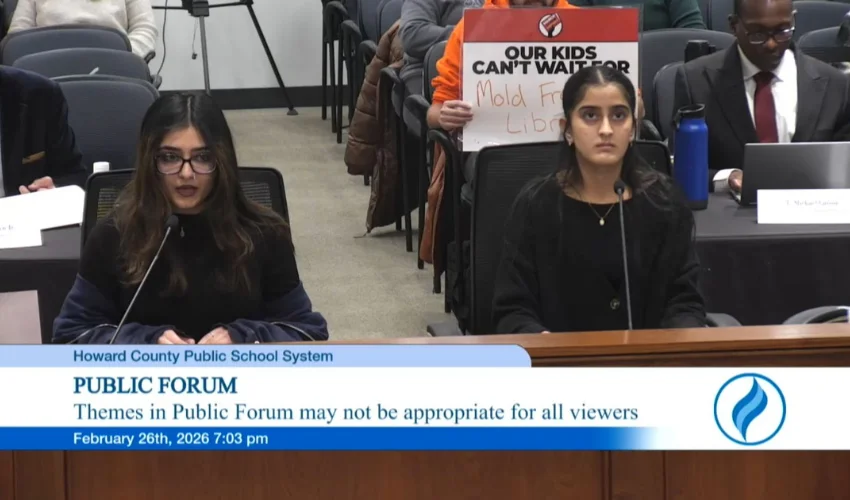
On February 26, 2026, two Hindu high school students, Priya Bakshi and Saisha Vyas, addressed the Howard County Public School System (HCPSS) Board of Education in Maryland with a clear, evidence-based appeal: stop conflating the sacred Swastikaan ancient dharmic symbol of well‑beingwith the Nazi Hakenkreuz, a 20th‑century emblem of genocidal ideology. Their testimony, grounded in historical, linguistic, and cultural scholarship, prompted the Board to initiate a formal review of district policies and references to ensure accurate terminology and culturally informed guidance. A Board representative acknowledged that while public awareness of the Nazi emblem is widespread, the deeper historical context of the Swastika is notand, following the presentation, there would be “no excuse for not knowing.”
The significance of this moment extends well beyond a single meeting room. In K–12 environments, imprecise language around symbols can unintentionally stigmatize students, normalize bias, and hinder authentic cultural belonging. For Hindu American familiesand for Buddhist and Jain communities who also venerate the Swastika as a sign of auspiciousnessmislabeling has practical impacts on classroom climate, discipline protocols, and curriculum design. Precision protects all learners: it upholds historical accuracy, advances Cultural context, and ensures that responses to hate symbols target perpetrators without marginalizing dharmic traditions. This clarity also aligns with the broader civic goal of interfaith respect, including Sikh neighbors who consistently advocate dignity for all sacred symbols in a plural society.
Historically, the Swastika (from Sanskrit svastika: su “good, well,” asti “to be,” with the suffix -ka) signifies well‑being, auspiciousness, and harmony. It has appeared for millennia across South and East Asia in Hindu, Buddhist, and Jain art, architecture, manuscripts, and ritual lifeon temple thresholds, sacred textiles, wedding altars, and protective diagrams. In these contexts, the Swastika is a symmetrical, continuous sign associated with mangala (auspiciousness), cyclical time, and cosmic order. Its meanings are devotional, philosophical, and cultural, not political.
By contrast, the Nazi Hakenkreuz (“hooked cross”) is a modern political emblem tied specifically to the ideology and crimes of the Third Reich (1920–1945). Its graphic conventions are distinctive: typically rotated at 45 degrees, black on a white disk against a red field, and deployed as part of a totalitarian visual system. Equating the sacred Swastika with the Hakenkreuz collapses millennia of dharmic spirituality into a 20th‑century European hate icon and perpetuates historical error. Crucially, disambiguation does not dilute the unequivocal condemnation of Nazism and antisemitism; rather, it reinforces accuracy so that schools can confront hate without criminalizing or stigmatizing sacred symbols of Hinduism, Buddhism, and Jainism.
Priya and Saisha’s HCPSS presentation distilled these distinctions for educators and policymakers. They outlined the symbol’s dharmic provenance, contrasted it with the Hakenkreuz’s modern political semiotics, and recommended practical policy language to safeguard religious use while preserving firm responses to hate incidents. They further emphasized how clear definitions improve student services, ensure equitable discipline, and aid teachers in handling sensitive discussions with confidence and care.
The Board’s response was immediate and concrete. HCPSS tasked its Policy Committee and staff to review existing references to the symbol across policy manuals, curricular materials, and public communications. The aim is to align terminology with historical and cultural accuracy, support teacher training, and enhance incident‑response protocols so that genuine hate speech and vandalism are addressed firmly while dharmic religious expressions are neither penalized nor pathologized.
Soon after the Board appearance, on March 15, the students delivered the same educational presentation at a Vaishnav Temple event hosted at Sherwood Elementary School in Sandy Spring, Maryland. Joined by their fathers, they connected historical analysis to lived experience: what it feels like in the diaspora to see a sacred sign misunderstood, and how civic engagement can meaningfully repair that harm. One parent reflected that working with civil‑society organizations deepened his family’s understanding of Sanatana Dharma and encouraged youth to participate in constructive community servicean approach that centers knowledge, empathy, and shared responsibility.
A recording of the original HCPSS testimony resonated powerfully with attendees, who recognized in it a model of effective, non‑adversarial advocacy: precise facts, respectful tone, and actionable recommendations. For many Hindu familiesand for Buddhist and Jain community members in the audiencethe video validated years of quiet discomfort. It demonstrated that when students speak with clarity and courage, institutions listen, and policies evolve.
The emotional stakes are real. When a sacred Swastika drawn on a notebook for a festival is mistaken for a hate emblem, students can feel shame for their heritage, and educatorsacting in good faithmay inadvertently escalate a misunderstanding. Clear, district‑wide guidance prevents such harms. It affirms that condemning Nazism and safeguarding Jewish safety are non‑negotiable, while also protecting dharmic religious expression. This is how pluralism works in practice: by being specific, historically accurate, and fair.
From an education policy perspective, the students’ work points to a replicable framework for school districts nationwide. First, define terms with precisionuse “Hakenkreuz” or “Nazi symbol” for hate incidents and “Swastika” for sacred, dharmic contexts. Second, embed clarifying notes in student codes of conduct, dress codes, curricular glossaries, and communications style guides. Third, provide professional learning for teachers, counselors, and administrators that includes case studies, discussion protocols, and referral pathways. Fourth, update art, social studies, and world history units to contextualize the Swastika’s dharmic meanings alongside modern European history that addresses the Holocaust and antisemitism. Fifth, convene a community advisory groupincluding Hindu, Buddhist, Jain, and Sikh representatives and Jewish partnersto ensure accuracy, sensitivity, and trust.
Implementation benefits from practical tools. Districts can deploy incident‑triage checklists that distinguish intent and context, craft parent‑communication templates that reduce confusion, and annotate library/catalog metadata so that images of dharmic art are not auto‑flagged as hate content by digital filters. Metricssuch as staff training completion rates, incident reclassification accuracy, and student climate surveyshelp track progress and maintain accountability over time.
There is growing institutional precedent for this approach. Museums, universities, and several jurisdictions have begun differentiating between sacred swastikas in religious or cultural use and the Nazi Hakenkreuz in hate contexts; some state‑level frameworks explicitly protect religious displays while preserving penalties for hateful conduct. While legal regimes vary, the policy principle is consistent: precise definitions enable targeted enforcement against hate while safeguarding legitimate religious expression.
Interfaith solidarity is strengthened by such clarity. Jewish safety and remembrance of the Holocaust remain paramount in education; accuracy about the Hakenkreuz ensures that hate incidents are recognized and addressed with urgency. Simultaneously, honoring the sacred Swastika within Hinduism, Buddhism, and Jainismand acknowledging Sikh commitments to respect for all sacred symbolsmodels Vasudhaiva Kutumbakam and demonstrates how communities can protect one another’s dignity without compromise.
This episode in Howard County illustrates a powerful civic lesson: youth‑led, community‑supported advocacy can translate into concrete policy improvements when anchored in scholarship, empathy, and collaboration. By pairing rigorous definitions with practical implementation steps, schools can advance EducationInitiatives that are both culturally responsive and unequivocally opposed to hatean outcome that benefits every learner and strengthens the social fabric.
Inspired by this post on CoHNA.
