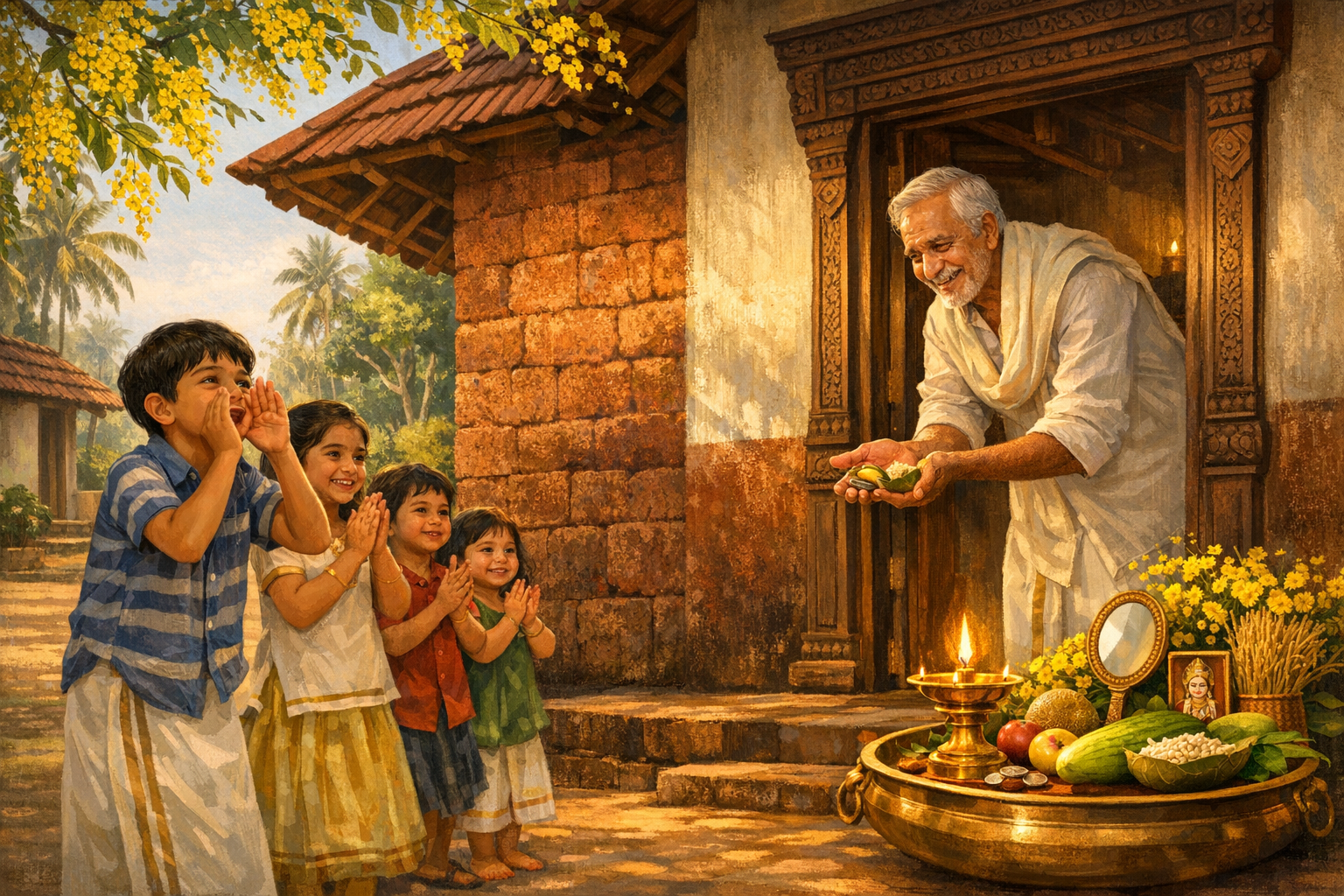
Vishukkani Vili is a cherished village ritual of North Malabar in Kerala that unfolds at dawn on Vishu, the Malayalam New Year. Rooted in the region’s agrarian and coastal settlements across Kannur, Kasaragod, and northern tracts of Kozhikode, this practice centers on children moving in groups from one household to another while rhythmically calling out ‘vishukaniye, vishukaniye.’ Their voices, clear in the still morning air, signal both the exchange of greetings for the new year and the sharing of auspiciousness that Vishu represents in Kerala culture.
The practice is anchored in the broader symbolism of Vishu, which marks the sidereal solar transit into Medam (Mesha Saṅkrānti) and is widely regarded in Kerala as the astronomical new year. While the civil new year is often observed in the Chingam month, Vishu retains an authoritative place in ritual timekeeping, reflecting a calendrical logic that privileges the Sun’s sidereal ingress. Etymologically linked to vishuvam (equinox), Vishu’s timing today aligns with Aries ingress in the sidereal zodiac due to precession, a reminder of how living traditions map cosmic order to cultural practice.
At the heart of Vishu lies the Vishukkani—literally, the “auspicious first sight” of the year—prepared the previous night so that family members open their eyes at dawn to a tableau of sanctity and abundance. A typical Vishukkani includes a lit nilavilakku (traditional lamp), val kannadi (hand mirror), kani konna (the golden Cassia fistula flowers that bloom in April), sheaves of paddy, rice, seasonal fruits and vegetables (such as cucumber), a sacred text (often the Bhagavad Gita or Ramayana), coins or gold, betel leaves and areca nut, and an image or murti of Sri Krishna or Guruvayurappan. The act of seeing this carefully curated arrangement forms a ritualized interface between individual intention and collective prosperity for the year ahead.
Vishukkani Vili extends the sanctity of that dawn moment across the village. As groups of children arrive at thresholds with the call ‘vishukaniye, vishukaniye.’, households respond by inviting them to share in the day’s auspiciousness. In many places, elders greet them warmly, sometimes guiding a brief darshan of the family’s Vishukkani, and then bestowing small gifts—commonly coins (vishukkaineettam), bananas, coconut, puffed rice, or homemade sweets. This exchange formalizes the spirit of dāna (generosity) and mangala (auspicious goodwill) that characterizes Kerala tradition on Vishu.
Field recollections from North Malabar consistently emphasize how the ritual sounds before it is seen. The steady chorus—neither a performance nor a demand—announces community presence and continuity. In certain hamlets, the group proceeds with gentle clapping; in others, the call alone suffices. The form is simple and resilient: there is no elaborate choreography, no script, just a locally intelligible greeting that converts private festivity into shared celebration.
The offerings given to children are modest by design and meaning. Vishukkaineettam, the elder’s token coin or note, symbolizes the transmission of blessings and responsibility from one generation to the next. Fruits and grains mirror the Vishukkani’s grammar of abundance, signaling that well-being is communal and cyclical, arising from the land, the household, and the village together. Families frequently recount how the first ring of children at dawn evokes memories of their own youthful circuits—evidence that the ritual educates through experience, cultivating gratitude, humility, and joy.
Socially, Vishukkani Vili acts as a light-touch, annual census of goodwill. It stitches houses, lanes, and wards into a recognizable moral geography: every home is a node of care, each threshold a place of exchange. The ritual’s “economy” is best understood as a gift cycle rather than a transaction—its purpose is cohesion, not accumulation. In this sense, it functions as living cultural heritage, reinforcing norms of reciprocity and hospitality that have long underpinned village life in North Malabar.
The practice also resonates with the region’s broader ritual ecology. North Malabar is renowned for Theyyam and Thirayattam—public, performative rites that animate shrines and sacred groves. Vishukkani Vili shares their community-facing orientation, though it remains intimate and domestic. Together, these forms express a Kerala culture that situates spirituality in everyday spaces—thresholds, courtyards, and lanes—rather than isolating it within strictly liturgical confines.
Comparative lenses across dharmic traditions highlight a shared ethos. Tamil Puthandu observes the kani principle with cognate symbolism; Sikh communities mark Baisakhi with seva and prasad distribution; in Assam, Bihu husori troupes visit households with songs and blessings; in many Indic regions, Ugadi and Gudi Padwa inaugurate new-year cycles with neighborly exchange. Though expressions vary, the governing values—dāna, auspicious sight, intergenerational transmission, and community felicity—are common threads that affirm unity in diversity across Hindu, Buddhist, Jain, and Sikh cultural landscapes.
The timing of Vishu carries a seasonal, ecological logic as well. Kani konna blossoms reliably in April, providing the ritual with a local phenological marker. The children’s procession—moving under canopies of yellow racemes and the softer light of early summer—helps embed environmental memory: smells, colors, and textures become part of the festival’s cognitive map. Many elders in Kannur and Kasaragod note that the first sight and first sound of Vishu remain inseparable from the first sight of spring’s gold in the konna trees.
Modern life has prompted adaptations. In urban and semi-urban settings, apartment associations sometimes coordinate safe, time-bound circuits within compound walls, and diaspora Malayali communities recreate house-to-house greetings across smaller clusters or temple-centric gatherings. The core practice—children’s calls answered by neighborly goodwill—endures, aided by community guidelines on safety, inclusivity, and sustainability.
Communities seeking to preserve Vishukkani Vili with care and clarity often emphasize a few practical norms. First, schedule visits within early daylight for visibility and safety. Second, encourage small, meaningful offerings—fruits, puffed rice, or modest vishukkaineettam—to preserve the ritual’s spirit over spectacle. Third, include all children equitably, with sensitivity to differing abilities and backgrounds, ensuring the custom remains a shared cultural joy rather than a competitive display. Fourth, consider eco-friendly practices: locally sourced flowers, reusable lamps, and minimal packaging reduce waste while honoring Kerala tradition.
Oral histories from North Malabar testify to the ritual’s emotional register. Householders recall that the first knock on Vishu morning—followed by the clear call ‘vishukaniye, vishukaniye.’—transforms the private act of seeing the Vishukkani into a communal moment of recognition. The sound becomes mnemonic: it signals the year’s turning, affirms the presence of children as bearers of good fortune, and reminds each household that prosperity grows when shared.
Read in cultural-hermeneutic terms, Vishukkani Vili integrates cosmic order (the new solar month), ritual aesthetics (the curated Vishukkani), and civic ethics (reciprocity and hospitality). It is at once technical—embedded in calendrical and seasonal knowledge—and tender, evoking childhood, kinship, and neighborliness. By keeping the practice alive, North Malabar continues to demonstrate how a Hindu festival can sustain unity not only within Kerala’s diverse communities but also across the larger family of dharmic traditions, where the first sight of the year is best met with the first gift of kindness.
Inspired by this post on Hindu Pad.