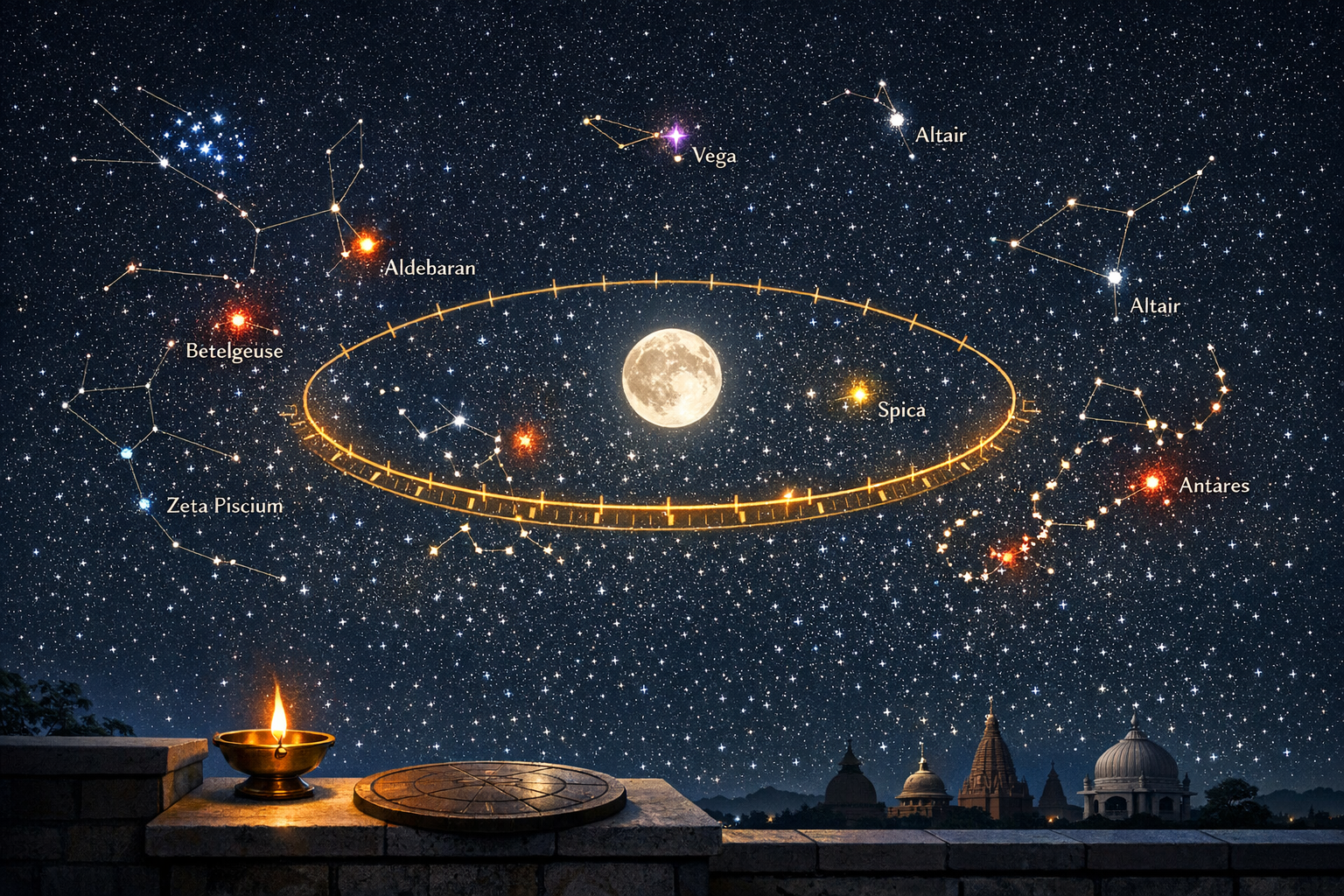
On clear nights, many stand on a terrace or balcony and feel an ancient, quiet wonder as stars shimmer with unequal brightness. Some appear closer, others faint and far, yet all lie at immense distances. Within the Indic knowledge tradition, this living tapestry of light is arranged into Nakshatraslunar mansions that weave the night sky into a precise, sacred map informing ritual timekeeping, cultural rhythms, and contemplative insight across Hinduism, Buddhism, Jainism, and Sikh communities that share India’s calendrical heritage.
Nakshatras are 27 equal partitions along the Moon’s path (the ecliptic), each spanning 13°20′ of celestial longitude. They constitute one of the five limbs of the traditional Panchang (lunar day or tithi, weekday or vara, lunar mansion or nakshatra, yoga, and karana) and function as both astronomical markers and symbolic anchors in Vedic culture. A 28th intercalary asterism, Abhijit, is sometimes counted for muhurta (electional timing), reflecting an early, nuanced astronomical practice.
The foundation of Nakshatras is simultaneously empirical and symbolic. Empirical, because the Moon completes a sidereal cycle in roughly 27.3 days, passing successively by recognizable star groups; symbolic, because each mansion holds a deity, mythology, and a distinctive shakti (potency) that guide ritual and ethical life within Hindu Dharma and its broader dharmic milieu. This dual naturesky mechanics wedded to meaningillustrates how Vedic astronomy and Vedic philosophy evolved together as a civilizational science.
Canonical references to Nakshatras emerge in the Rigveda and become explicit in texts such as the Taittiriya Samhita, Atharva Veda, and the Vedanga Jyotisha attributed to Lagadha. Classical treatises including the Surya Siddhanta and the works of Aryabhata and Varahamihira develop computational rules, precession (ayanamsa) awareness, and calendrical precision. Across centuries, ancient astronomers refined models of celestial geometry while priests, poets, and philosophers articulated the ethical and spiritual significance that communities still draw upon today.
Because the Moon’s background shifts against the star-field, each Nakshatra offers an observational cue. Many are anchored by prominent stars: Krittika aligns with the Pleiades, Rohini with Aldebaran, Ardra with Betelgeuse, Chitra with Spica, Swati with Arcturus, Jyeshtha with Antares, Shravana with Altair, and Revati with ζ Piscium. These anchors enabled reliable, naked-eye timekeeping long before mechanical clocks, providing agricultural schedules, festival dates, and auspicious windows for samskaras (rites of passage) under the broad umbrella of Hindu Dharma.
Dharmic unity is reflected in practice. While theological emphases differ, shared calendrical science (jyotisha) historically informed observances among Hindu, Buddhist, and Jain communities using Vikram Samvat and related lunisolar systems; Sikh communities historically referenced the Bikrami calendar for gurpurabs before modern solar reforms. In this light, Nakshatras can be appreciated as a civilizational commonsastronomical knowledge serving plural spiritual paths and cultural life across the subcontinent and its diasporas.
What follows is a concise, technically grounded tour of the 27 Nakshatras (with an interlude on Abhijit), noting classical star anchors, presiding deities, and the Vimshottari dasha rulers used in Vedic astrology. The descriptions preserve the academic character of the tradition while highlighting how observation, symbolism, and ethical intent cohere in practice.
Ashvini (0°–13°20′ Aries): Presided over by the Ashvins (Nasatya and Dasra), symbolized by a horse’s head and associated with healing, swiftness, and restoration. Astronomically, it spans β and γ Arietis (Sheratan, Mesarthim). Dasha ruler: Ketu. In ritual calendars, Ashvini is linked with beginnings, quick remedies, and journeys.
Bharani (13°20′–26°40′ Aries): Governed by Yama, symbolized by the yoni, and associated with discipline, restraint, and the power to bear. It lies in the Aries asterism to the east of Ashvini. Dasha ruler: Venus. Bharani’s ethical emphasis often relates to boundaries, vows, and stewardship of life’s responsibilities.
Krittika (26°40′ Aries–10° Taurus): Ruled by Agni (fire), identified with the Pleiades (Krittika). Symbolism includes purification, ignition, and transformation. Dasha ruler: Sun. In Panchang-guided ritual, Krittika favors consecrations requiring clarity and a purificatory thrust.
Rohini (10°–23°20′ Taurus): Presided over by Prajapati (Brahma), anchored by Aldebaran (α Tauri). It symbolizes fertility, growth, and artistry. Dasha ruler: Moon. Many traditions hold Rohini as especially auspicious for nurturing endeavors and household prosperity.
Mrigashirsha (23°20′ Taurus–6°40′ Gemini): Ruled by Soma (Chandra), associated with the head of Orion (notably λ Orionis). It symbolizes inquiry, seeking, and refinement. Dasha ruler: Mars. Often selected for research, learning, and measured exploration.
Ardra (6°40′–20° Gemini): Presided over by Rudra, anchored by Betelgeuse (α Orionis). It symbolizes catharsis, resilience, and the power of renewal after storms. Dasha ruler: Rahu. Ardra’s timing can be used to initiate honest self-assessment and transformative discipline.
Punarvasu (20° Gemini–3°20′ Cancer): Ruled by Aditi, associated with the twin stars Castor and Pollux (α and β Geminorum). It symbolizes restoration, return, and generosity. Dasha ruler: Jupiter. Punarvasu is favored for homecomings, reconciliations, and acts of inclusion.
Pushya (3°20′–16°40′ Cancer): Presided over by Brihaspati (Guru); stellar anchors lie within Cancer (notably γ, δ, θ Cancri). It symbolizes nourishment, counsel, and dharmic instruction. Dasha ruler: Saturn. Classical texts often esteem Pushya as intrinsically auspicious for rites of learning and community welfare.
Ashlesha (16°40′–30° Cancer): Ruled by the Nagas (serpents), associated with stars near Hydra. It symbolizes coiled energy, discernment, and the capacity to bind or release. Dasha ruler: Mercury. When used mindfully, Ashlesha supports depth-work, healing, and the ethics of speech.
Magha (0°–13°20′ Leo): Presided over by the Pitrs (ancestral beings), anchored near Regulus (α Leonis). It symbolizes lineage, honor, and continuity. Dasha ruler: Ketu. Magha is a prime choice for ancestral remembrance and the reinforcement of intergenerational bonds.
Purva Phalguni (13°20′–26°40′ Leo): Ruled by Bhaga (lord of share), associated with δ and θ Leonis. It symbolizes enjoyment, partnership, and creative unions. Dasha ruler: Venus. It is often selected for celebrations that renew social warmth and artistic expression.
Uttara Phalguni (26°40′ Leo–10° Virgo): Presided over by Aryaman, with Denebola (β Leonis) near the boundary region. It symbolizes contracts, patronage, and reliable friendship. Dasha ruler: Sun. Classically chosen for solemnizing oaths, alliances, and dharmic duties among peers.
Hasta (10°–23°20′ Virgo): Ruled by Savitar, linked with the Corvus asterism. It symbolizes skilled hands, craftsmanship, and benevolent initiative. Dasha ruler: Moon. Hasta timings support artisanal work, healing touch, and benevolent service.
Chitra (23°20′ Virgo–6°40′ Libra): Presided over by Tvashtar (Vishvakarma), anchored by Spica (α Virginis). It symbolizes design, beauty, and precise formation. Dasha ruler: Mars. Chitra is suited for architecture, aesthetics, and structural planning.
Swati (6°40′–20° Libra): Ruled by Vayu (wind), anchored by Arcturus (α Bootis). It symbolizes independence, flexibility, and the ethics of fair exchange. Dasha ruler: Rahu. Swati is often chosen for trade agreements, travel, and diplomacy.
Vishakha (20° Libra–3°20′ Scorpio): Presided over jointly by Indra-Agni, with anchors near α and β Librae. It symbolizes objective-driven focus and the harnessing of dual energies. Dasha ruler: Jupiter. Vishakha supports sustained endeavors and disciplined aspiration.
Anuradha (3°20′–16°40′ Scorpio): Ruled by Mitra, associated with δ Scorpii (Dschubba) region. It symbolizes loyal friendship, cooperation, and devotional steadiness. Dasha ruler: Saturn. Anuradha aids team-building, sangha cohesion, and long-term commitments.
Jyeshtha (16°40′–30° Scorpio): Presided over by Indra, anchored by Antares (α Scorpii). It symbolizes seniority, guardianship, and protective leadership. Dasha ruler: Mercury. Jyeshtha timings are used for assuming responsibility and crisis management.
Mula (0°–13°20′ Sagittarius): Ruled by Nirriti, associated with the Scorpius tail and the direction of the Galactic Center. It symbolizes roots, deconstruction, and truth-seeking. Dasha ruler: Ketu. Mula assists in honest inquiry, detachment, and ethical reconstruction.
Purva Ashadha (13°20′–26°40′ Sagittarius): Presided over by Apas (waters), with anchors near δ Sagittarii (Kaus Media) and adjacent stars. It symbolizes invigoration, purification, and the advocacy of truth. Dasha ruler: Venus. Favored for pilgrimages, vows, and restorative practices.
Uttara Ashadha (26°40′ Sagittarius–10° Capricorn): Ruled by the Vishwadevas (universal deities), linked to ζ Sagittarii (Ascella) and neighbors. It symbolizes unwavering virtue, consensus, and universal values. Dasha ruler: Sun. It is suited to public service and principled leadership.
Shravana (10°–23°20′ Capricorn): Presided over by Vishnu, anchored by Altair (α Aquilae). It symbolizes attentive listening, learning, and the sacred transmission of knowledge. Dasha ruler: Moon. Shravana’s timing favors study, scriptural recitation, and pedagogical clarity.
Dhanishtha (23°20′ Capricorn–6°40′ Aquarius): Ruled by the Vasus, associated with the Delphinus asterism. It symbolizes rhythm, generosity, and the prosperity of shared endeavor. Dasha ruler: Mars. Dhanishtha supports music, teamwork, and community resourcefulness.
Shatabhisha (6°40′–20° Aquarius): Presided over by Varuna, anchored by λ Aquarii (Hydor). It symbolizes healing, guardianship of cosmic order, and the veiling–unveiling of knowledge. Dasha ruler: Rahu. Its windows are used for research, remedy, and reflective solitude.
Purva Bhadrapada (20° Aquarius–3°20′ Pisces): Ruled by Aja Ekapada, linked with α Pegasi (Markab) and adjacent stars. It symbolizes intensity, transformative vision, and ethical fire. Dasha ruler: Jupiter. It is invoked for austerity, vows, and deep spiritual commitments.
Uttara Bhadrapada (3°20′–16°40′ Pisces): Presided over by Ahir Budhnya, associated with stars in the Pegasus–Pisces region. It symbolizes depth, stability, and the still waters of contemplation. Dasha ruler: Saturn. Favorable for meditation, long-term study, and institutional stewardship.
Revati (16°40′–30° Pisces): Ruled by Pushan, anchored by ζ Piscium (Revati). It symbolizes safe passage, nourishment, and completion. Dasha ruler: Mercury. Classically chosen for journeys, completion rites, and compassionate service.
Abhijit (intercalary, approximately 6°40′–10°53′ Capricorn by some traditions): Associated with Vega (α Lyrae) and revered in muhurta literature for auspicious undertakings. Although seldom used in natal analysis today, its presence in classical sources illustrates the flexibility and depth of early Jyotisha in India’s knowledge systems.
Each Nakshatra comprises four padas (quarters) of 3°20′, mapping into the Navamsa scheme and producing nuanced qualities at fine angular resolution. Naming conventions (namakarana) often draw syllables from the janma-nakshatra and pada, a living practice that ties personal identity to the sky’s seasonal cadence and the lineage of Vedic literature.
In applied Jyotisha, the janma-nakshatra underpins the Vimshottari dasha sequence that times life periods with remarkable internal coherence. Muhurta selections for samskarasmarriage, griha pravesh, upanayana, and travelconsider the day’s Nakshatra alongside tarabalam and chandrabalam. While interpretive schools vary, the shared premise is that alignment of will, virtue, and time (kala) enhances clarity and communal well-being.
Observationally, Nakshatras invite anyonehouseholder, monk, studentto watch the Moon’s nightly progress. For instance, when the Moon nears the reddish eye of Taurus (Aldebaran), Rohini is active; passing Orion’s shoulder (Betelgeuse) evokes Ardra; approaching the bright blue Spica signifies Chitra; and gliding near Arcturus heralds Swati. Such sky-literacy transforms the night into a participatory calendar, strengthening bonds between practice and place.
From an academic standpoint, the tradition integrates precession through ayanamsa corrections in sidereal frameworks (with families such as Lahiri and Raman), enabling continuity despite the slow drift of the equinoxes. This mathematical sensitivity is one reason Vedic astronomy dialogued fruitfully with other world traditions that also recognized 27–28 lunar stations, including Chinese xiu and Arabic manāzil, underscoring the universality of tracking the Moon’s path for culture and ritual.
Ethically, the Nakshatra system supports the dharmic principle of lokasangrahaworking for the cohesion and uplift of society. In this shared spirit, communities across Hinduism, Buddhism, Jainism, and Sikh heritage use lunisolar timing for festivals, fasts, and learning cycles, while honoring distinct theologies. The result is cultural harmony through knowledge, a practical embodiment of Vasudhaiva Kutumbakam.
Temples and sacred campuses often host Nakshatra vanams (star gardens) and iconographic circuits that educate visitors about the lunar mansions and their deities. In many regions, yatra schedules, kirtan festivals, and study retreats are attuned to Nakshatra cycles, offering an experiential pedagogy that blends astronomy, ecology, and contemplative arts within everyday life.
Ultimately, Nakshatras present a unifying bridge between the measurable and the meaningful. They are rigorous enough to support Panchang calculations and flexible enough to nourish devotion, ethics, and aesthetics. Standing once more under the night sky, one recognizes not merely scattered lights but a deliberate, compassionate grammar of timean inheritance of ancient astronomers and sages whose insights continue to guide modern seekers toward clarity, connection, and peace.
Inspired by this post on Hindu Pad.