
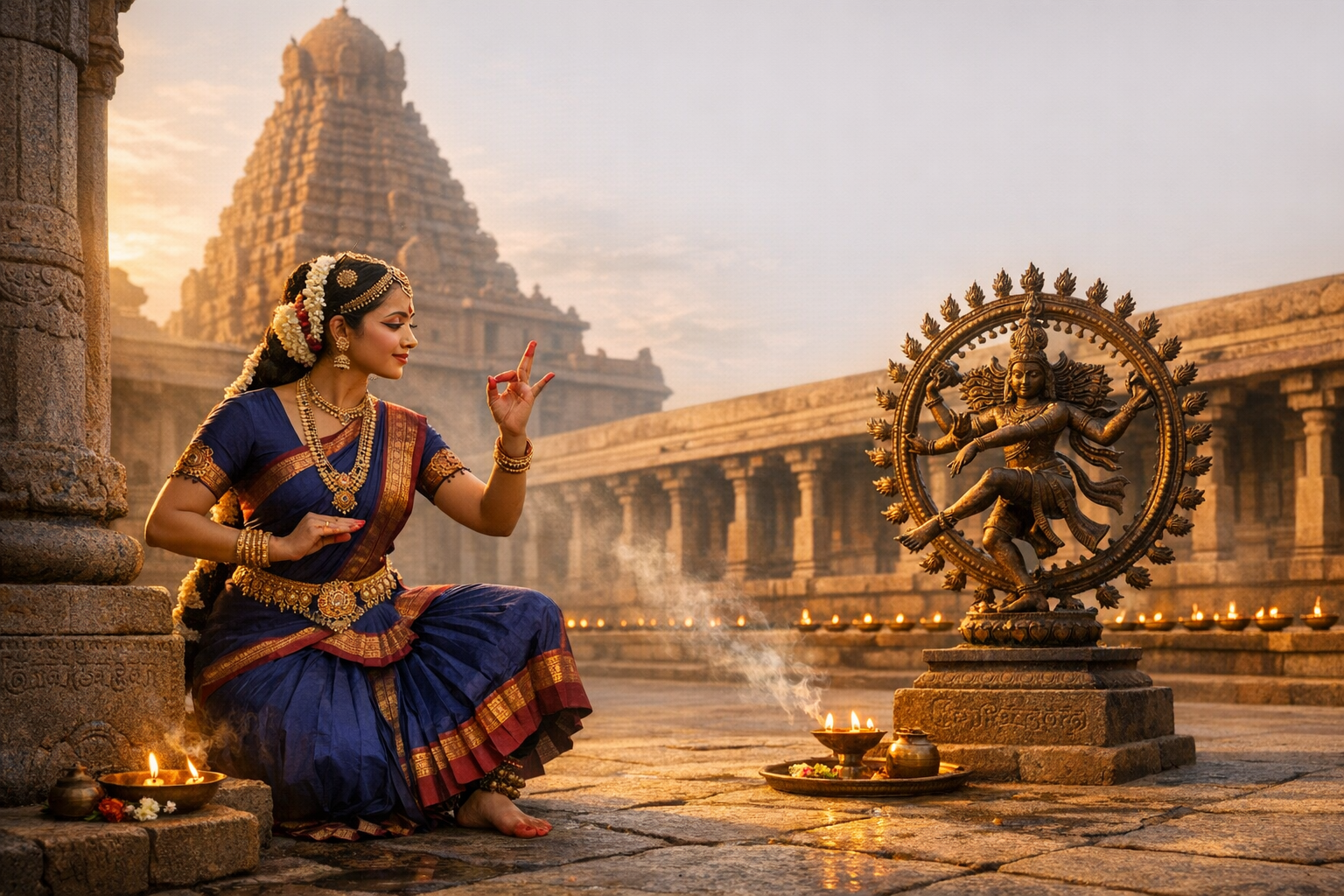
Mathura, remembered in Thanjavur’s sacred memory as a beautiful, chaste, and profoundly pious dancer of the 10th century CE, stands as a luminous figure in the cultural and devotional landscape shaped under Sri Rajarajachola (Rajaraja Chola I). A staunch devotee of Lord Shiva, she is associated with the ritual and aesthetic life that flourished around the great temple city during the apogee of the Chola Dynasty. Her life, though concise in recorded detail, captures a larger truth of the period: that sacred dance in South India was not mere spectacle, but an embodied form of worship, learning, and service to the divine.
Born to Maran and Veniyammal, Mathura remained unmarried throughout her life, choosing an existence defined by vrata (vow), discipline, and seva (service). Sources that recount her story consistently emphasize moral rectitude and devotional intensity. In a milieu where temple institutions were living centers of education, economy, and artistic excellence, Mathura’s identity as a dancer was inseparable from her identity as a devotee.
Thanjavur in the Chola age formed a vibrant node in the larger network of South Indian temples, arts, and trade. Under Rajaraja Chola I (r. c. 985–1014 CE), statecraft and sacred culture were deeply interlinked. The Brihadeeshwara Temple (Rajarajesvaram), now a UNESCO World Heritage Site and one of the “Great Living Chola Temples,” was a monumental expression of this synthesis. Its stone, bronze, music, and ritual cycles formed a convergent ecology in which dance and devotion were co-constitutive.
Epigraphic records from the Chola period attest to sophisticated institutional arrangements around major temples: endowments for perpetual lamps (deepa-dana), ritual feeding (annadanam), musicians’ guilds (melakkarar), and groups of dedicated temple dancers (devaradiyar). Inscriptions famously enumerate several hundred women attached to Rajarajesvaram, indicating a structured, salaried, and ritually integrated role for dance in the temple economy. Within this documented world, Mathura’s remembered piety aligns with a pattern in which devotion, discipline, and artistic excellence were honored as sacred duties.
Local accounts portray Mathura as one who offered a significant share of her earnings and time to Shiva’s service, supporting ritual cycles, festivals, and temple needs. Such contributionstypical of the periodranged from oil endowments for lamps to gifts timed with major utsavas, ensuring that the aesthetic of the temple remained inseparable from its liturgical precision. In this ethos, a dancer’s gifts were not merely monetary; they also comprised countless hours of practice, ritual purity observances, and the offering of perfected movement and expression as worship.
The artistic framework guiding Mathura’s world drew on the Natyashastra and living lineages of performance that would, over centuries, crystallize into what the modern world recognizes as Bharatanatyam. Core concepts such as anga and upanga (major and minor limbs), abhinaya (expressive communication), and the dynamic interplay of tandava and lasya (vigorous and graceful movement) shaped how devotion was embodied. The sculptural and iconographic programs of the Chola ageespecially the celebrated images of Shiva Natarajavisualized dance as cosmic law in motion, a vision dancers like Mathura translated into living ritual.
Daily and seasonal temple rhythms further anchored dance within the sacred timetable. Offerings occurred at prescribed sandhis (junctions of the day), and festivals animated the streets through processions where music and dance extended the sanctum’s energy into the civic realm. Within this matrix, a dancer’s discipline constituted tapas (austerity) of body and mindan ethical and aesthetic practice forming a pathway of bhakti (devotion).
The socio-legal position of temple dancers in the Chola period was complex yet clearly institutionalized. Devaradiyar held recognized roles, often with stipends, rights, and obligations registered in inscriptions. Their professional identity intersected with property, ritual responsibilities, and community standing. The epithet nityasumangaliconnoting auspiciousnesscaptured an abiding theological respect for the dancer as one who sustained ritual continuity and sacred beauty.
Mathura’s remembered choice to remain a spinster coheres with a devotional ideal in which celibacy, chastity, and single-minded dedication strengthened spiritual focus. In narrative fragments preserved within Thanjavur’s memory, her life models an ethics of restraint yoked to artistic intensity. Even centuries later, this composite of piety and performance offers a powerful template of inward discipline manifest outwardly as precise technique and serene expressivity.
Her story also evokes resonances across the broader dharmic family. In Hindu traditions, music and dance function as upasana (worship); in Buddhist and Jain contexts, ritual arts and architectural spaces (including nrtta- or sabha-mandapas) frame contemplative and communal life; in Sikh practice, kirtan elevates devotion through raga and rhythm. Across these traditions, aesthetics are not separated from ethics: art is a vehicle for self-transformation and service to the community, reinforcing unity in diversity across dharmic paths.
Material culture of the Chola period, especially the masterful bronze images of Shiva Nataraja and Parvati, underscores how theology, metallurgy, and aesthetics converged. These bronzes, still venerated in processions, created a mobile axis for sacred presence. In such contexts, the dancer bridges icon and devoteetranslating metaphysics into movement and enabling collective participation in the divine rhythm.
Historical transitions in subsequent centuriesparticularly colonial-era disruptions and moralizing “anti-nautch” campaignschallenged temple-centered performing arts. Yet the resilience of South India’s dance lineages, later reformulated through the Thanjavur court and pedagogues often grouped as the Tanjore Quartet, sustained and reorganized repertoire (margam) while keeping the essential insight intact: that technique matures into sadhana when oriented toward higher purpose. In this arc of continuity, Mathura’s life shines as an early exemplar of sacred artistry and ethical intent.
For many present-day visitors standing before the Brihadeeshwara Temple’s towering vimana, Mathura’s memory invites a quiet recognition: that art can be prayer, and precision can be compassion when offered to the divine. For dancers and devotees alike, her example encourages a turn toward discipline, humility, and generosityqualities that make aesthetic achievement inseparable from moral clarity.
Mathura of Thanjavur thus remains emblematic of the Chola synthesiswhere statecraft fortified temples, temples cultivated the arts, and the arts lifted hearts toward Shiva’s grace. Situated within the legacy of Sri Rajarajachola and the enduring heritage of Thanjavur, her story affirms a unifying insight shared across Hinduism, Buddhism, Jainism, and Sikhism: that the highest purpose of culture is inner refinement and shared upliftment. In remembering Mathura, the living traditions of Bharatanatyam, temple worship, and dharmic pluralism find a common, elevating center.
Inspired by this post on Hindu Pad.










