A recurring question in Hindu religious history and iconography asks why many deities are associated with seemingly small or humble animalsmost famously Ganesha with a mouse and Subramanya (Skanda/Murugan) with a peacock. The answer reveals a carefully constructed symbolic language (vāhana symbolism) that encodes psychology, ethics, cosmology, and aesthetics, while nurturing reverence for all living beings. Far from being ornamental details, vāhanas serve as didactic anchors: they depict the energies each deity masters, the instincts transmuted into virtue, and the intimate continuity between the human mind, nature, and the divine.
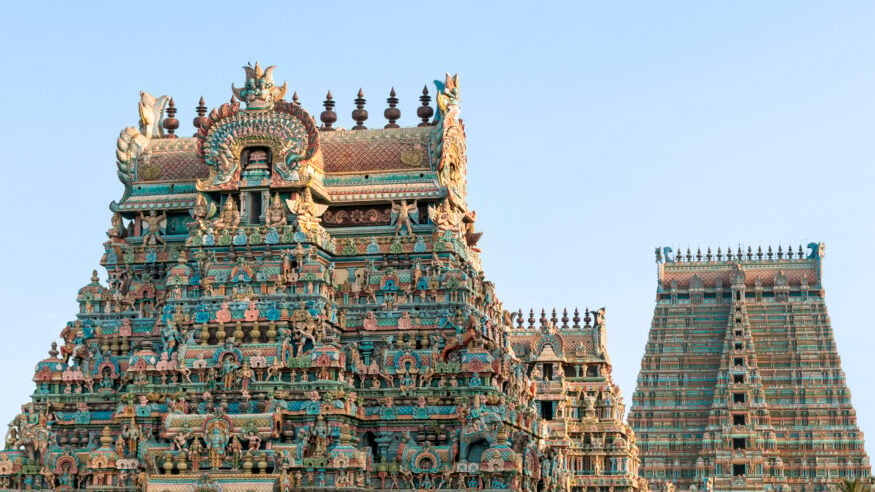
In Sanskrit, vāhana derives from the verbal root “vah,” to carry or convey. Across the Purāṇas and Āgamas, and in technical treatises such as the Viṣṇudharmottara Purāṇa’s Citrasūtra and the South Asian śilpa-śāstra corpus (for example, Mayamata, Mānasāra, and Aparājitapṛcchā), vāhanas are not arbitrary. They are specified companions that “carry” a deity’s function and meaning into view. In temple practice, this grammar extends to space: Nandi faces the Śivaliṅga; the Garuḍa-stambha or mandapa announces Viṣṇu’s presence; and lion (siṁha) or tiger platforms herald Devī’s processional forms. Iconography, architecture, and ritual converge to broadcast theology in a language of images.
Although popular examples often feature small creatures (the mouse for Ganesha), vāhanas vary widely in scalebull (Nandi), eagle (Garuḍa), lion, owl, crow, buffalo, and more. Size is not the point; symbolism is. Whether minute or massive, each vāhana embodies a pattern of instincts, elements, or cosmic forces that the deity illumines, harmonizes, and redeploys toward dharmic ends.
Three complementary lenses clarify why deities “ride” animals. First, the ethical-psychological: animals personify raw drives (kāma, krodha, mada, moha) and sense-tendencies (indriyas). The deity’s mastery signals transmutation of impulse into insight and service. Second, the cosmological-ecological: vāhanas align with elements (bhūtas), directions (dikpālas), and cyclical time, rooting worship in a living ecology. Third, the pedagogical-devotional: a small or familiar creature under divine guidance teaches humility and accessibilityreminding that no being is insignificant, and that the subtlest habit, once tamed, can carry the highest wisdom.
Ganesha and the mouse (mūṣaka) offer a textbook case. The mūṣaka is stealthy, nocturnal, and nibblingapt metaphors for the mind’s distractions and subterranean desires. In the Ganesha Purāṇa and Mudgala Purāṇa, narratives preserve the transformation of a disruptive force (Mūṣakāsura) into a devoted carrier. The visual paradoxa vast, elephant-headed intelligence poised upon a tiny mountdeclares that intellect and discernment (buddhi and viveka) can guide and sublimate even the most restless impulses. The “remover of obstacles” (Vighneśvara) first masters the smallest inner obstacles; the outer world follows.
Subramanya (Skanda/Murugan) and the peacock (mayūra), called Paravāni, dramatize a different alchemy. The peacock’s iridescent beauty hints at pride (mada), yet it devours snakespoisons and latent fears. As the commander of divine forces, Skanda channels valor with grace, speed with stillness, splendor with self-mastery. In Tamil traditions, this synthesis pervades temple and festival aesthetics: the peacock’s fan becomes a living emblem of disciplined energy, where martial excellence and inner poise meet.
Śiva’s association with Nandi, the bull (vṛṣabha), encodes steadfastness, prāṇa-regulation, and dharma. Nandi faces the liṅga as the paradigmatic devotee (śiṣya), his attentiveness teaching the posture for all learningstill, receptive, alert. In yogic keys, the bull’s power is not aggression but conserved vitality, bridled will, and unwavering fidelity to truth.
Viṣṇu and Garuḍa elaborate sovereignty on the vertical axis. As the mythic eagle who parts the heavens and rescues the nectar of immortality, Garuḍa emblematizes discrimination, speed, and fearless ascent. In temple plans, the Garuḍa-stambha signals arrival into a protected field of vision; in ritual, Garuḍa Vāhana sevās enact preservation’s swiftnesstimely, precise, and compassionate.
Devī’s lion or tiger communicates śakti’s ethical ferocity. In the Devī Māhātmya, the Great Goddess defeats adharma not by suppressing power but by sanctifying it. The lion’s roar becomes the voice of clarity, the courage to protect, and the uncompromising defense of balance. Regional variantslion in many iconographies, tiger in parts of the East and Southevoke the same principle: energy refined into fearless care.
Lakṣmī’s owl (ulūka) warns and guides. An owl sees in darkness and remains composed as fortunes cycle. As the goddess of śrī (prosperity), Lakṣmī signals that wealth requires wakeful discernment. Without vigilance, affluence can mislead; with insight, it becomes nourishment for community and justice.
Sarasvatī’s hamsa (swan) and, in some depictions, the peacock, teach vivekathe power to discriminate essence from mixture, celebrated in the proverb that a swan “separates milk from water.” Knowledge in this key is not acquisition but purification: learning that decants clarity from noise, song from sound, meaning from mass.
Other vāhana pairings round out a comprehensive moral-psychological atlas. Śani with the crow mirrors karmic sobriety and patient accountability. Yama with the buffalo signals the inevitability and impartiality of law (ṛta) across life and death. Indra with Airāvata conjoins rulership with rain and renewal. Sūrya’s seven horses variously map to the Vedic meters, colors of light, or vital airs; Candra’s antelope figures gentle luminosity and the rhythms of mind. Agni’s ram expresses quickness and transformative heat; Vāyu’s antelopes evoke speed and delicacy of movement. Ayyappa’s tiger in popular lore telescopes holiness and wilderness into harmonious companionship.
The widespread intuition that Hindu gods ride “small” animals gestures toward a precise spiritual lesson: magnitudes invert under wisdom. What seems negligiblean impulse, a habit, a fearcan dominate life until tamed; what seems insurmountable yields when the subtle is mastered. Vāhana symbolism, therefore, privileges transformation at the most granular scale of attention, where character is daily forged.
Comparative vistas across dharmic traditions reinforce this unity of vision. In Buddhism, lions serve as thrones and companions of fearlessness (the “lion’s roar” of Dharma); Garuḍa (khyung) functions as a protector in Himalayan traditions; animal imagery frequently externalizes inner cultivation. In Jainism, the Tīrthaṅkara lanchhanasbull for Ṛṣabha, lion for Mahāvīra, and othersare not mounts but emblems of perfected virtues, upheld by radical ahiṁsā that honors all life. Sikh teachings, while image-averse in worship, richly deploy animal metaphors in Gurmat to disclose mind’s restlessness, pride, and yearning, guiding the seeker toward nimratā (humility) and disciplined courage. Each stream converges on a shared ethic: instincts are not enemies but energies to sanctify, relationships with nature are pedagogical, and spiritual maturity is inseparable from compassion for living beings.
Temple arts make these principles tactile. Śilpa-śāstra canons define where and how a vāhana appears relative to the mūrti and pedestal (pīṭha), how scale encodes hierarchy without degrading the animal, and how procession (utsava) translates theology into festival movement. Chola bronzes, Pāla-Sena stone, and later regional schools developed distinct yet interoperable idioms: Lakṣmī’s owl gains prominence in Bengal; Murugan’s peacock dominates Tamil landscapes; Durga’s lion varies in physiognomy yet not in meaning. Across mediastone, bronze, wood, and textilethe vāhana remains a constant teacher.
Practical engagement deepens when symbolism meets sādhanā. Daily reflection can ask: what is today’s “mouse”the small distraction that, left unchecked, undermines larger aims? Can breath (prāṇāyāma) and attention (pratyāhāra) harness the “bull” of vitality without spilling it into restlessness? Can one roar once, like the lion, only when protection and justice demand, and otherwise cultivate softness? Such questions turn imagery into method, transforming devotion into developmental ethics.
Finally, vāhana symbolism advances ecological reverence. By enthroning animals as companions of divinity, Hinduism normalizes kinship with biodiversity. This sensibility resonates with Buddhism’s compassion for sentient life, Jainism’s rigorous ahiṁsā, and Sikhism’s insistence on humility and service. In a shared civilizational register, animal images are not trophies of domination but covenants of carea reminder that spiritual progress and planetary well-being are inseparable.
In sum, Ganesha’s mouse and Skanda’s peacock do not trivialize divinity; they magnify it. They teach that greatness is proven by gentle governance of the small, that power is complete only when it protects, and that wisdom rides best upon the instincts it has patiently redeemed. Read this way, vāhanas illuminate the Hindu way of life and, in harmony with Buddhist, Jain, and Sikh insights, offer a unifying grammar of inner transformation anchored in compassion for all beings.
Inspired by this post on Hindu Pad.