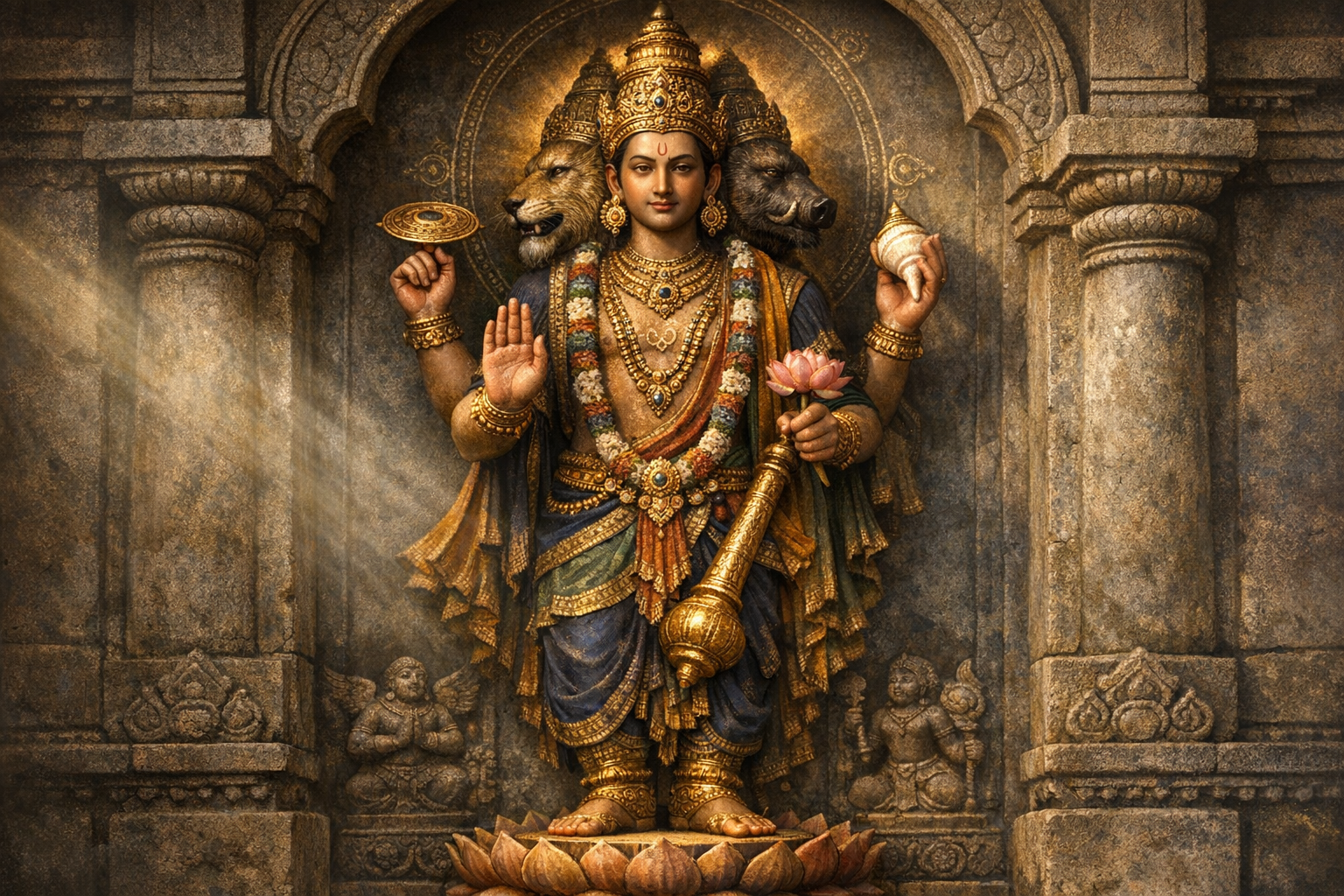
Vaikuntha Chaturmukha Vishnualso known in the artistic literature as Vaikuntha Chaturmurtistands among the most sophisticated and symbolically charged manifestations in Hindu iconography. As a four-faced theophany, it condenses the ontological depth of Vaishnava theology into a single, composite presence: a serene human visage frontally, the leonine power of Narasimha and the porcine might of Varaha to the sides, and a fourth, often fierce, rear face. This configuration invites a multilayered reading that is at once theological, cosmological, and art-historical, making the image a keystone for understanding early medieval Vaishnavism and its Himalayan aesthetic vocabularies.
Emerging prominently in Kashmir from the seventh century CE onwardparticularly under the Karkota and later Utpala dynastiesthis form attained a canonical footing in the Vishnudharmottara Purana. The text’s encyclopedic treatment of the arts and ritual (shilpa and chitra shastras) supplied practitioners with precise iconometric and iconographic frameworks, ensuring that the four-faced Vishnu could be produced with both theological fidelity and visual coherence. Archaeological and museum holdings, from Srinagar’s environs to institutions worldwide, preserve Kashmir’s mastery of this form in bronze and stone, attesting to a sustained cultic and artistic investment that shaped the wider Himalayan region.
In formal terms, Vaikuntha Chaturmukha Vishnu typically presents four faces: the frontal human face in serene composure; to his right, the leonine Narasimha; to his left, the boar-headed Varaha; and a fourth, rear face often rendered as fierce (described in sources and scholarship with terms such as kapila or ghora). This circumambient visage schema expresses omnidirectionality and omniscienceVishnu’s capacity to behold, protect, and sustain the cosmos from every quarter. The ensemble integrates avatara potency (Narasimha and Varaha) with a stabilizing human countenance and a hidden, awe-inspiring aspect that gestures to the ineffable.
Attributes generally conform to Vaishnava orthodoxy: the conch (shankha) and discus (chakra) predominate, accompanied in many Kashmiri examples by the mace (gada) and lotus (padma). Variations occursome images adopt the teaching gesture (vyakhyana-mudra), or pair boons (varada) and protection (abhaya) with a single weaponin keeping with local ritual preferences and textual latitude. Attendants may include personifications of Vishnu’s weapons (Shankhapurusha and Chakrapurusha), door guardians, or Garuda in subordinate scale, reinforcing the deity’s status as supreme protector and cosmic regulator.
Kashmiri craftsmanship imparts distinct stylistic signatures. Sculptors favored a tall kirita-mukuta with crisp tiers, robust yet supple torsos, refined facial modeling, and jewelry that registers both elegance and mass. In metal images, a gleaming skin and taut modeling accentuate divine luminosity (tejas). In stone, polished planes and sharp edges create a rhythmic play of light and shadow. Several early medieval Kashmiri icons depict fitted boots and layered textilesdetails that signal the region’s role as a cultural conduit between the Indic heartlands and trans-Himalayan circuits.
Theologically, the four faces operate as an integrated exegesis of Vishnu’s functions. The human face articulates accessibility, compassion, and the sattvic clarity that sustains dharma. Narasimha embodies protective ferocityan uncompromising defense of the righteous when cosmic order is threatened. Varaha signals restorative strengththe power to retrieve and re-ground the Earth (Bhudevi) when submerged in chaos. The rear, fierce countenance gestures to the beyond of form and language: time’s ineluctable pressure, the terrible sublimity of the absolute, and the veiled profundity that eludes ordinary vision.
Conceptually, the composite resonates with Vaishnava doctrinal structures such as the caturvyūha (Vāsudeva, Saṅkarṣaṇa, Pradyumna, Aniruddha), not as a one-to-one equivalence, but as a theological rhyme. In both, multiplicity remains anchored in unity; differentiated powers proceed from, and return to, a single ontic source. The icon thereby renders visible a key Vaishnava intuition: plurality is not fragmentation but the modal play of an integral, preserving ground.
Ritually, Vaikuntha Chaturmukha Vishnu images functioned as potent cult icons in Kashmir and adjacent Himalayan regions, appearing in sancta and subsidiary shrines, and often linked to Vaikuntha-related observances that celebrate Vishnu’s salvific presence. The circumambulatory logic of the four faces reinforces temple movement: devotees process around the icon, receiving differentiated darshana that culminates in a sense of totalized vision and refuge. In this embodied hermeneutic, movement becomes method; the devotee’s path traces the theology the image teaches.
From Kashmir, the typology radiated into the western Himalayas and Nepal, where local ateliers adapted the form while preserving core semantics. Bronze ateliers found particular affinity with the image’s architectonic symmetry and balance. Across regions, the icon’s success lay in its ability to condense narrative avatara energies and abstract theological insight into a single, contemplatively legible form.
Iconographic analysis benefits from attending to micro-semantics: the Srivatsa mark on the chest, the Vaijayanti-mala, the precise tilt of side faces, the scale and stance of attendants, and the base moldings, which sometimes narrate ancillary scenes or allegories. These details are not decorative surplus; they are integral to the image’s script, guiding the devotee’s gaze through a sequence of recognitionspresence, protection, restoration, and transcendencebefore resolving back into unity.
Comparative perspectives across dharmic traditions illuminate shared visual grammars. Four-directional sanctums in Jain architecture (chaturmukha Jinalaya) express an omnidirectional availability of truth, while multi-faced bodhisattva forms in Buddhism evoke all-seeing compassion. In Shaiva traditions, multi-faced forms such as Sadashiva articulate differentiated aspects of a single absolute. Though each tradition preserves its doctrinal integrity, these visual strategies converge on a civilizational intuition: unity expressed through plurality, and plurality sheltered by unity. Such convergences nurture mutual understanding among Hinduism, Buddhism, Jainism, and Sikhism, where the Sikh articulation of Ik Onkar, too, enshrines a vision of indivisible oneness.
For historians of art, Vaikuntha Chaturmukha Vishnu offers a precise case study in how texts and workshops interlock. The Vishnudharmottara’s shilpa prescriptions provided hermeneutic guardrails, while artisanal lineages in Kashmir elaborated a regional idiomcrown types, garment rendering, metallurgical finishthat gave the image a recognizably Kashmiri profile. The result is a dialogue between norm and nuance: canonical form stabilized across centuries, yet alive to local genius.
For practitioners and seekers, the icon serves as a contemplative map. One may approach the frontal face to rest in clarity and devotion; seek Narasimha’s flank to cultivate courage and righteous resolve; turn to Varaha’s flank to internalize steadfast service and world-upholding labor; and finally, acknowledge the hidden rear face as a reminder of the mystery that outstrips all categories. Read this way, Vaikuntha Chaturmukha is not only beheld; it is practicedan itinerary of spiritual integration.
In contemporary life, the image speaks to plural societies: diverse expressions and convictions can coexist when underwritten by a shared center. This insight aligns with the broader dharmic ethosdifference without division, conversation without collapse into sameness. As such, the Vaikuntha Chaturmukha form does more than preserve an early medieval Kashmiri inheritance; it offers a vocabulary of unity that resonates across Hindu, Buddhist, Jain, and Sikh sensibilities, strengthening an ecumene of mutual respect.
Ultimately, Vaikuntha Chaturmukha Vishnu endures because it binds together what is often kept apart: narrative and metaphysics, devotion and doctrine, local style and pan-Indic meaning. Rooted in Kashmir’s artistic brilliance and the Vishnudharmottara’s intellectual scaffolding, it remains a masterclass in how images thinkand how, through them, a civilization reflects on the harmony of the many in the One.
Inspired by this post on Hindu Blog.