The coastal belt of Karnataka, extending into Manjeshwar and Kasaragod in northern Kerala, preserves a cultural continuum where the land still remembers its spirits. Known as Tulunadu, this region safeguards one of South Asia’s oldest living traditions of ritual spirit veneration, locally called Bhuta Kola or Nema. At the heart of this tradition stands Panjurli Daiva, the sacred boar deity whose presence bridges forest memory and cultivated field, mythic time and agrarian life.
Among the diverse daivas of Tulunadusuch as Pilichamundi, Bobbarya, Koti-Chennaya, and JumadiPanjurli occupies a pivotal place as a guardian of crops, boundaries, and truth. The deity’s animal form evokes the wild boar, a figure both feared and revered across coastal agrarian societies. In Tulunadu lore, Panjurli symbolizes the transformation from kadu (forest) to khet (field), embodying the moment when human communities sought concord with the living landscape rather than conquest alone.
Etymology and oral tradition converge to situate Panjurli within the ecology and language of Tulu culture. Many derive Panjurli from panji (boar, in Tulu), underscoring the deity’s zoological archetype and agricultural relevance. While narratives vary by village, a recurring motif references a covenant between the boar spirit and cultivators: after seasons of ravaged fields, an understanding is sealed through ritual vows and periodic offerings, transforming conflict with the wild into stewardship, reciprocity, and protection.
This agrarian covenant is neither folklore ornament nor antiquarian residue. It constitutes a socio-ecological ethic that encodes water sharing, boundary respect, seasonal rhythms, and community obligations. Panjurli thus functions as a moral agent in the rural public sphere: a watcher over justice whose presence makes cultivation an activity aligned with dharmarighteous conduct toward land, neighbor, and the more-than-human world.
Historically, daiva worship in Tulunadu is attested through inscriptions, oral epics (paddanas), and early modern ethnographic records. While epigraphic details differ by locality, references to daivasthanas (spirit shrines), land grants, and ritual patronage indicate an embedded institution that coexisted with temple networks and royal polities in medieval and early modern Karnataka. The persistence of Panjurli across centuries reflects a robust repertoire of ritual adaptation rather than static custom.
Ritual specialists and custodial families sustain this continuity. In many localities, hereditary performer-ritualists from communities such as Nalike and Parava enact the kola, while poojaris steward offerings and daily rites at the daivasthana. Gurikars or shrine guardians coordinate obligations between households and institutions. The result is a distributed system of ritual labor and social accountability that ties spiritual authority to community consent.
The kola (or nema) season in coastal Karnataka typically follows the post-harvest months, when villages convene for elaborate night-long observances. Preparations cleanse and redress the shrine, reopen ritual containers (bhandara), and recite paddanas that narrate the deity’s origin, travels, pacts, and verdicts. Musicians set the tempo with percussion and wind instruments, and the courtyard becomes a liminal forum in which memory, law, and kinship are renegotiated.
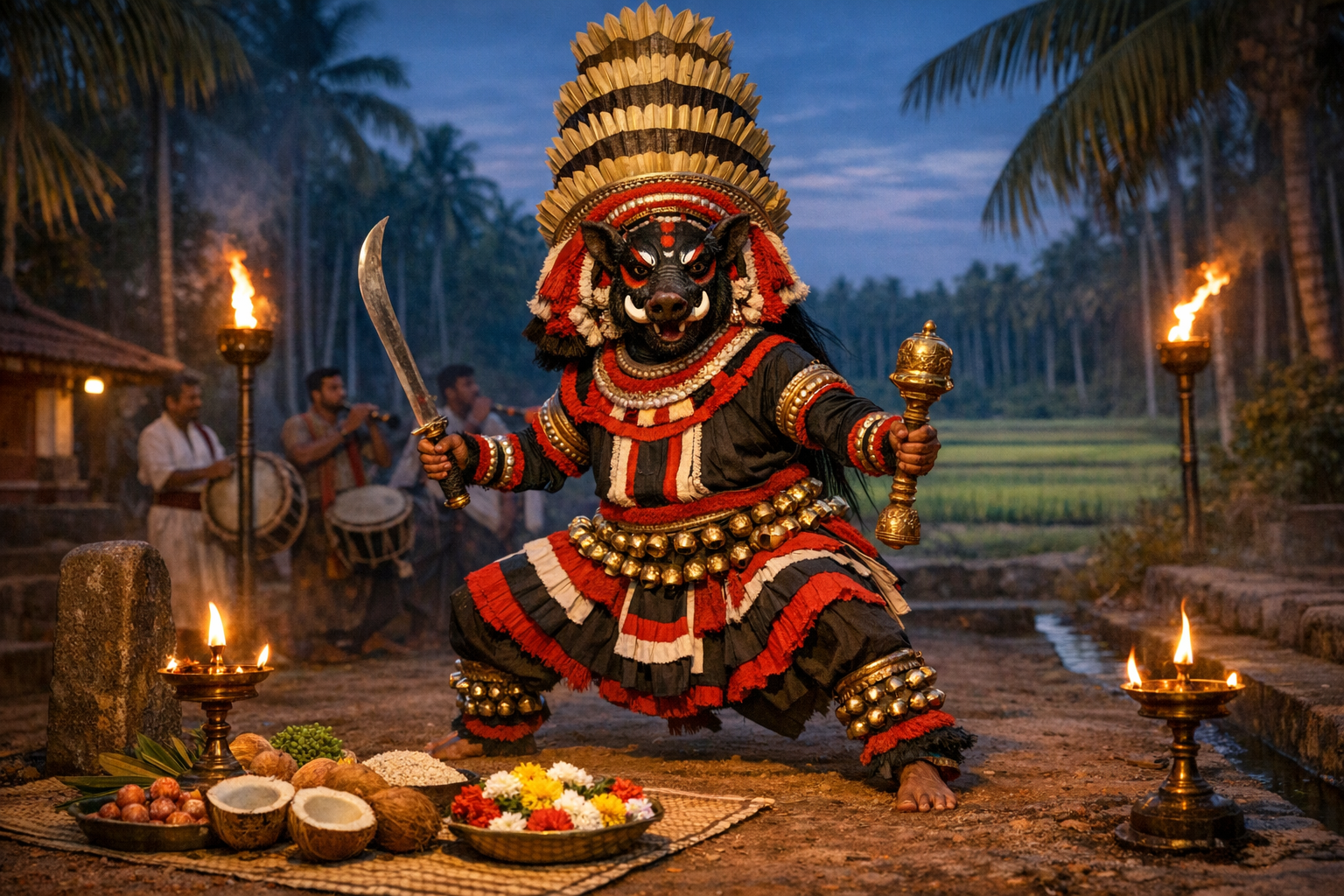
The costume language of Panjurli is at once aesthetic and semiotic. The performer often dons a towering headdress, layered palm-spathe elements, and an ensemble of reds, blacks, and whites that signal purity, ferocity, and auspiciousness. Face painting emphasizes tusk-like features; metal anklets (gaggara) and waist bells convert movement into sound, cueing spectators to the deity’s arrival. Sword, staff, and bells punctuate the performative grammar, translating invisible authority into audible and visible conviction.
As the performance intensifies, the daiva arrives in possession-trance. What follows is a dialogic rite in which devotees petition for relief, confess disputes, and seek judgments. The Panjurli persona listens, questions, and adjudicatesits oracular voice anchoring a customary court that values truth-telling, reparation, and social harmony. Resolutions are issued as practical remedies and future-facing covenants, binding because they are publicly witnessed and ritually sealed.
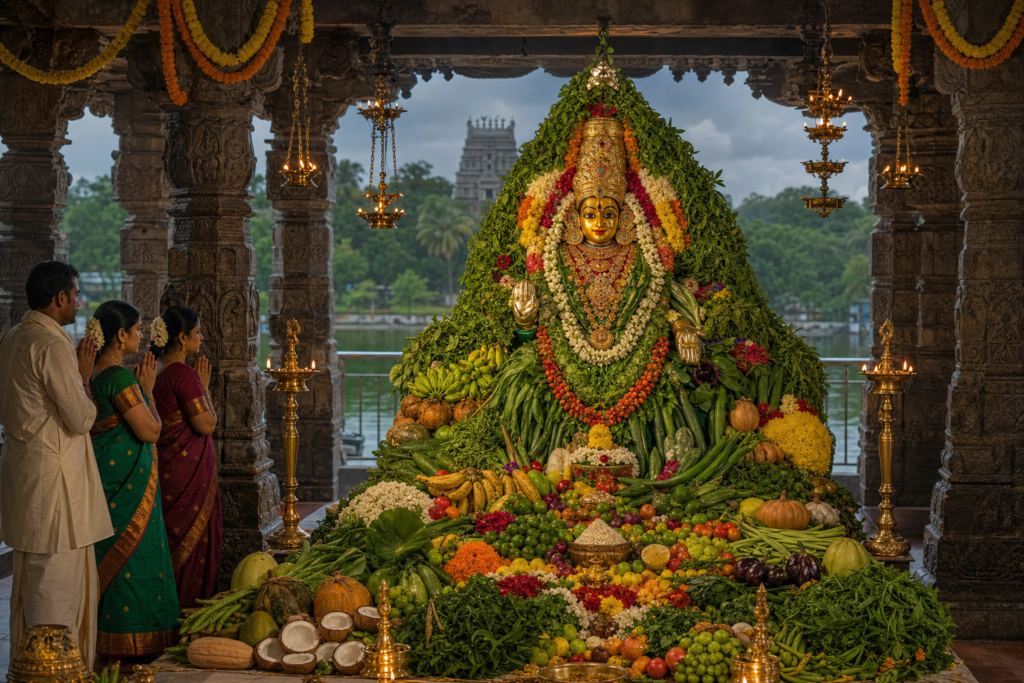
Offerings to Panjurli express an ethic of locality and season. Coconuts, areca nut, rice, flowers, lamps, and other produce mark gratitude for yield and rainfall. In many places, practices evolve toward symbolic offerings while preserving the intention of reciprocity. What remains nonnegotiable is the commitment to return yearlyto remember the promise that sustains field, household, and village.
Panjurli’s visual and narrative profile naturally invites comparison with Varaha, the boar avatar of Vishnu who rescues Earth from the cosmological flood. Within Tulunadu, this is typically understood not as competition between pantheons but as layered equivalence: a local guardian whose form and function resonate with pan-Indic mythic templates. This layered vision exemplifies the dharmic capacity to accommodate plurality without erasing difference.
Comparable performative ecologies exist across the western coast. In northern Kerala, Theyyam and Kaliyattam animate shrines through distinct yet related grammars of dance, costume, and oracular speech. Such parallels underscore a shared coastal heritage that integrates sacred groves, spirit shrines, and agrarian cycles from Kasaragod to Kannur, while preserving regional idioms and lineages.
Crucially, Panjurli’s covenant speaks to the wider family of dharmic traditions. The ritualization of truth, accountability, and care for all beings finds consonance with ahimsa-centered Jain ethics, the holistic compassion found in Buddhist thought, and the Sikh emphasis on truthful living and seva. Within this broader civilizational horizon, Tulunadu’s daiva tradition becomes a pedagogical resource: a reminder that unity in spiritual diversity is sustained by lived practice, not merely by abstraction.
The social footprint of Panjurli includes land tenure memory, boundary marking, and inter-lineage obligations. The kola offers a stage where testimonies are voiced, taboos negotiated, and reconciliations enacted with gravity. In this sense, the daiva operates as both sacred figure and civic institution, ensuring that cultivation never drifts far from conscience.
Environmental humanities perspectives clarify why a boar deity is so durable. Wild boar sit at the seam of forest and field, making them ideal emblems of thresholds. By binding the boar spirit to the farm through vow and ritual, Tulunadu communities ritualize conflict transformation: predation becomes protection, and fear evolves into guardianship. The covenant is ecological jurisprudence in ceremonial dress.
For many in Tulunadu, childhood recollections of a kola night remain vividthe drum’s first tremor, torchlight on areca fronds, the charged hush as the daiva speaks. Visitors, too, often describe an unexpected sense of proximity to justice when the deity questions litigants with a disarming blend of empathy and severity. Such experiences illustrate why Panjurli is not a museum relic but a living interlocutor.
Aesthetic form strengthens ethical force. Choreography moves from measured steps to surges of energy; call-and-response music mirrors inquiry and verdict. Costume heightens the sense of otherworldly proximity, yet the daiva’s speech remains rigorously this-worldly: repair the fence, apologize to a neighbor, pay the promised share, keep the water channel clean. Sacred performance thus converts metaphysics into civic action.
Institutional interfaces between daivasthanas and temples in coastal Karnataka demonstrate integrative religiosity. Household deities, bhuta shrines, and larger temples routinely share calendars, resources, and pilgrimage routes. In Udupi, Dakshina Kannada, and Kasaragod, this interdependence reflects a practical theology: different beings, one moral ecosystem.
Oral literature conveys depth beyond spectacle. Paddanas recount migrations, calamities, broken vows, reconciliations, and newly forged pacts. These epics encode agrarian history and sociopolitical memory, offering scholars a layered archive of settlement, economy, and customary law that formal documents seldom capture with comparable nuance.
Contemporary transformations are palpable yet constructive. Ritual communities adapt to changing livelihoods, codify safety for performers, and emphasize heritage education for youth. Digital documentation expands access and pride while elders mentor apprentices in technique, discipline, and etiquette. The outcome, at its best, is renewal without rupture.
Comparative religion and anthropology situate Panjurli within global patterns of guardian spirits, sacred groves, and agrarian oathsfrom Mediterranean nymph cults to Southeast Asian tutelary deities. What distinguishes Tulunadu is the continuity and civic weight of the kola: not only performance but jurisprudence, not only belief but binding social contract.
For those approaching Panjurli as cultural learners, a few principles aid understanding. Variation is the rule; each village guards its own narrative and rite. Authority is relational; performers, priests, patrons, and public are co-authors of the ritual’s truth. And ethics is empirical; outcomes are judged by restored peace, clean water channels, fair shares, and honored promises.
In the wider Indian cultural discourse, Panjurli offers a template for bridging the sacred and the sustainable. The covenant ethic aligns with contemporary concerns: soil health, watershed care, biodiversity around fields, and the social capital needed to steward shared resources. In coastal Karnataka and northern Kerala, one hears in the kola a vernacular language for ecological responsibility.
In sum, the Panjurli Daiva of Tulunadu exemplifies a living, plural, and profoundly local expression of dharma. By honoring a boar spirit as guardian, the region narrates its passage from forest to farmland without forgetting either. In that remembrance, communities find unity across difference, aligning household, shrine, and field in a shared commitment to truth and care.
As Tulunadu continues to evolve, the kola remains a luminous commonswhere the sacred boar speaks for the land, the people listen, and a timeless covenant is renewed under the coastal night sky.
Inspired by this post on Hindu Blog.