The teaching that the highest happiness appears when the pursuit of happiness comes to an end occupies a central place in Hindu philosophy. Far from recommending passivity or nihilism, this insight names a profound shift: from restless acquisition and anticipation to direct recognition of anandaunchanging blissas the intrinsic nature of consciousness. In this light, authentic happiness is not produced, improved, or secured by new experiences; it is uncovered when grasping relaxes.
Classical Hindu discourse distinguishes sukha (pleasure or comfort) from ananda (bliss). Sukha and dukha are fluctuations in the field of experiencevariable, dependent, and impermanent (anitya). Ananda, by contrast, is understood as a mark of the Self (atma-lakshana), ever-present, independent (nitya), and not contingent upon external stimuli. The paradox is clear: the more happiness is chased as an object, the more it recedes; when the chase quiets, what remains is self-luminous fullness.
Upanishadic sources articulate this pivot with philosophical precision. Katha Upanishad (2.3.14) states, “Yadā sarve pramucyante kāmā ye ’sya hṛdi śritāḥ, atha martyo ’mṛto bhavaty atra brahma sam-aśnute”when all desires lodged in the heart fall away, the mortal becomes immortal and attains Brahman here and now. Taittiriya Upanishad’s ananda-mīmāṃsā investigates increasing orders of joy, culminating in brahmānandathe limitless bliss that is not attained by addition but realized by recognition.
Chandogya Upanishad’s “tat tvam asi” (“that thou art”) and Brihadaranyaka Upanishad’s “neti neti” (“not this, not this”) jointly frame the method: by negating all that is finite, the infinite Self is revealed as one’s very identity. The resulting freedom is not an altered state to be maintained; it is the ground of being that does not begin or end with mental modifications (vṛttis).
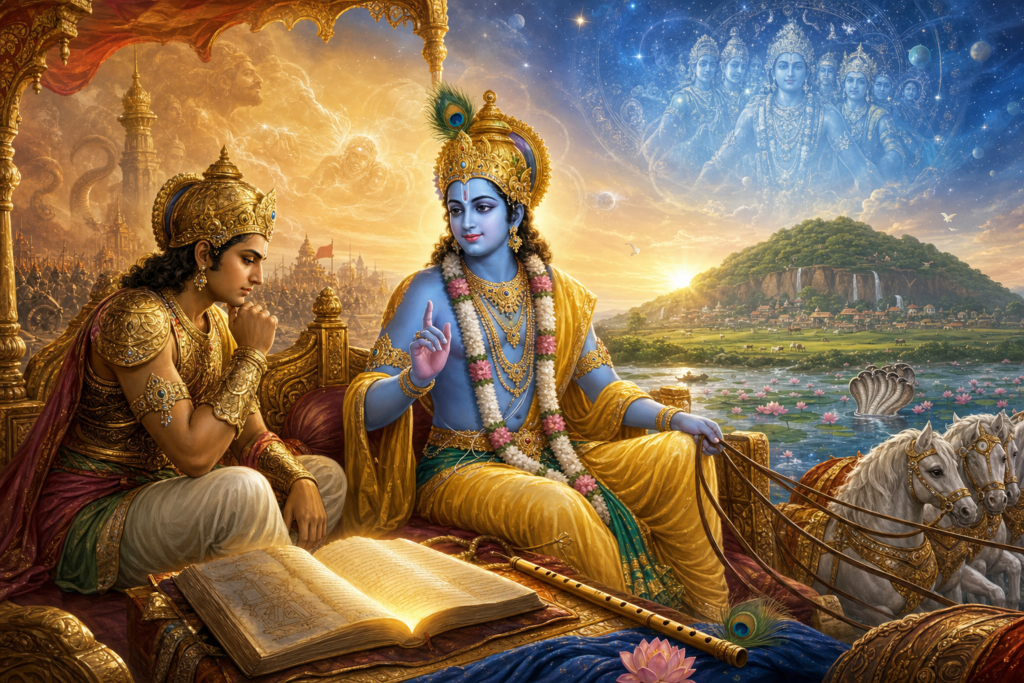
Bhagavad Gita offers a lived psychology of this discovery. The sthitaprajña (person of steady wisdom) is portrayed as free from compulsive craving and aversion (2.55–2.71). Verse 2.71 summarizes the shift: by relinquishing all cravings and moving without possessiveness or ego-claims, one attains peace. Gita 5.21 adds that one who is disinterested in outer contacts “finds happiness in the Self” (ātmani yat sukham), while 6.21–6.23 describes a happiness “beyond the senses,” not shaken by adversityprecisely because it is not produced by gain or guarded by fear of loss.
Patanjali’s Yoga Sutra provides a crisp phenomenology: “yogaś citta-vṛtti-nirodhaḥ” (1.2)yoga is the stilling of the fluctuations of mind. Vairāgya (1.15) is defined as dispassion toward seen and heard objects, a letting-go born of discernment rather than suppression. Niyama includes santoṣa, and 2.42 asserts: “saṁtoṣād anuttamaḥ sukha-lābhaḥ”from contentment arises unsurpassed happiness. The end of the chase is not resignation; it is clarity that ends compulsion.
Vedānta details a rigorous pathwayśravaṇa (systematic listening to Upanishadic teaching), manana (reasoned reflection), and nididhyāsana (deep contemplative assimilation). Through this triad, the mind’s acquisitive habit weakens and the always-available ananda becomes evident. The result is moksha, liberation while living (jīvanmukti), characterized by freedom from existential lack (abhāva-buddhi) rather than the procurement of extraordinary experiences.
Bhakti traditions echo the same resolution in the language of the heart. Śaraṇāgati (wholehearted surrender) replaces self-centric striving with devotional intimacy. Gita 18.66“sarva-dharmān parityajya mām ekaṁ śaraṇaṁ vraja”is often read not as a call to abandon ethical responsibility but as a call to release the egoic project of securing fulfillment by action’s fruits. In that release, love becomes effortless and happiness ceases to be a target because it is the texture of devotion itself.
Karma Yoga operationalizes this freedom in daily life. By offering action and relinquishing anxiety over results (2.47), identification with “seeker of happiness” dissolves. Work retains excellence (yogaḥ karmasu kauśalam, 2.50) while the interior stance is non-grasping. In this quiet revolution, happiness is no longer a wage for effort; it is the ambiance of lucid participation.
Other darśanas elaborate the same end from complementary angles. Sāṅkhya pinpoints suffering at the level of misidentification, and freedom as discriminative knowledge (viveka) between puruṣa (consciousness) and prakṛti (nature). Kashmir Śaivism’s pratyabhijñā (“recognition”) underscores that what is sought is the seeker’s own essence; recognition, not acquisition, concludes the search. Across these streams, the trajectory is consistent: when the mind is no longer a happiness-hunter, ananda is unhidden.
The dharmic family converges on this point, fostering unity across Hinduism, Buddhism, Jainism, and Sikhism. Buddhism’s Noble Truth of cessation (nirodha) identifies the end of craving (taṇhā) as the end of dukkha; Jainism’s emphasis on vairāgya, saṁvara, and nirjarā culminates in kevala-jñāna, an unperturbed blissfulness; Sikhism speaks of sahajeffortless equipoisewhere anand flowers as haumai (egoity) subsides through nām-simran. While metaphysics differ, the shared experiential teaching is unmistakable: the end of grasping reveals innate peace.
This teaching is frequently misunderstood as advocating indifference. In fact, it refines the meaning of non-attachment (asakti-rahita) versus apathy (udāsīnata). Non-attachment preserves care, creativity, and ethical engagement while removing the compulsive agenda that turns life into a transaction. What ends is not participation, but possessiveness; not love, but neediness.
Contemporary psychology and contemplative science offer resonant observations. Hedonic adaptation explains why gains quickly normalize and spur new pursuitsa treadmill that validates the yogic claim that sukha is unstable. Practices that attenuate default-mode rumination correlate with greater well-being, mirroring yogic nirodha and Vedāntic nididhyāsana. Such convergences do not replace scriptural insight but contextualize it in a modern idiom.
A practical blueprint integrates the four classical yogasJnana, Bhakti, Karma, and Raja Yogawithin a Hindu way of life. Daily śravaṇa/manana stabilizes right understanding; bhakti refines emotional life; karma-yoga brings clarity into work and relationships; and rāja-yoga (āsana, prāṇāyāma, pratyāhāra, dhyāna) cultivates a mind available to recognize what is ever-present. The result is cumulative: the search softens as sufficiency becomes natural.
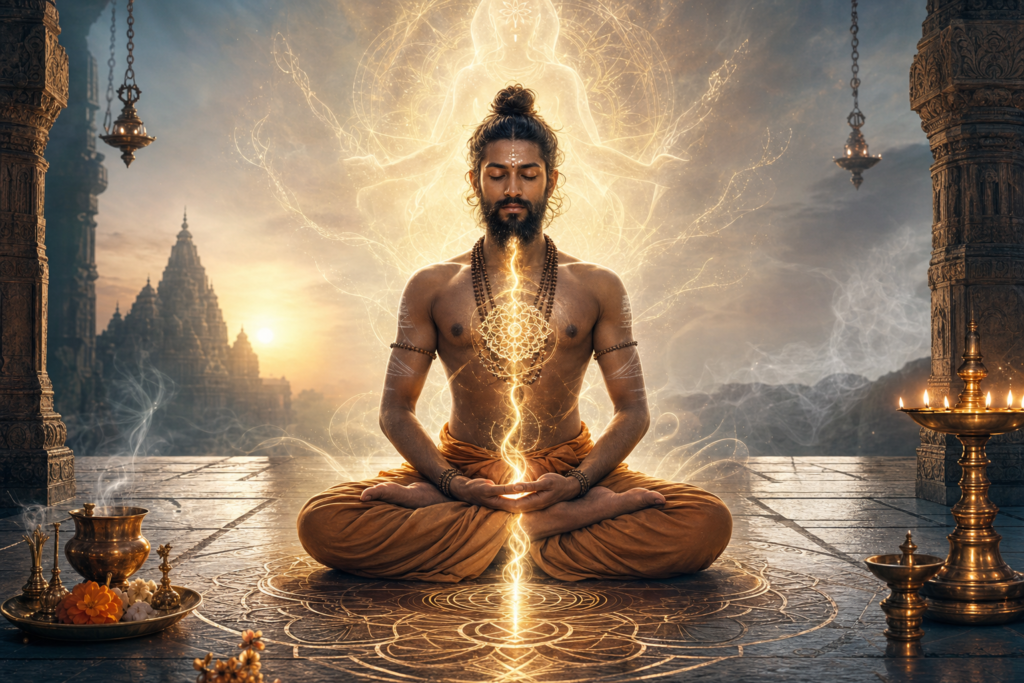
Simple contemplations support this maturation. Periodically observing the breath without a goal, sensing posture and contact with the ground, or resting attention in the stillness between thoughts makes palpable the peace not produced by achievement. In those unguarded instantswatching a sunrise, listening completely to a loved one, finishing a task with carehappiness is found not as an object but as the quality of unobstructed presence.
Ethical foundations are decisive. Yamas and niyamasahiṃsā, satya, asteya, brahmacarya, aparigraha; śauca, santoṣa, tapas, svādhyāya, Īśvara-praṇidhānaquiet the inner noise that fuels pursuit. Aparigraha (non-hoarding) unknots scarcity-thinking; santoṣa interrupts the compulsion to optimize every experience. Ethics, in this view, are not commandments but technologies of freedom.
Common obstacles include spiritualized striving (“I will attain bliss”), subtle bargaining (“I will let go so I can get happiness”), and aversion to discomfort. The corrective is discrimination (viveka): any state that begins, ends, or needs maintenance is not the absolute. Steadily returning to awareness itself, while honoring duty and relationships, dissolves the seeker’s agenda without abandoning life.
In professional and family contexts, the same principle is quietly transformative. Goals can be pursued with care while emotional well-being no longer swings on outcomes. Feedback becomes information rather than threat, collaboration replaces competition, and creative risk is possible because self-worth is not on the line. Such shifts are markers that pursuit is giving way to presence.
There are also wider social implications. Consumerist culture trains the mind to chase ever-subtler objectsstatus, novelty, certainty. A dharmic reorientationfrom extraction to stewardship, from comparison to contentmentsupports ecological responsibility and interfaith harmony. When inner lack is not projected outward, unity in diversity becomes lived reality rather than an aspiration.
Traditional milestones help gauge maturation. There is greater ease with uncertainty; spontaneous gratitude; reduced reactivity; a shift from scarcity to sufficiency; and a felt continuity of awareness beneath changing moods. These are not achievements to catalogue but natural signs that the search is unwinding.
In summary, Hindu philosophy, scriptures, and yogic practices converge on an elegant truth: the genuine state of happiness is unveiled when the compulsion to pursue happiness subsides. Upanishads, Bhagavad Gita, and Yoga Sutra offer a robust theoretical and practical framework for this shift, and related dharmic traditions affirm the same experiential core. The benefit is not escapism but inner freedomananda as the quiet, unlosable background of all experienceempowering lucid action, deep relationship, and a compassionate society.
Inspired by this post on Hindu Blog.