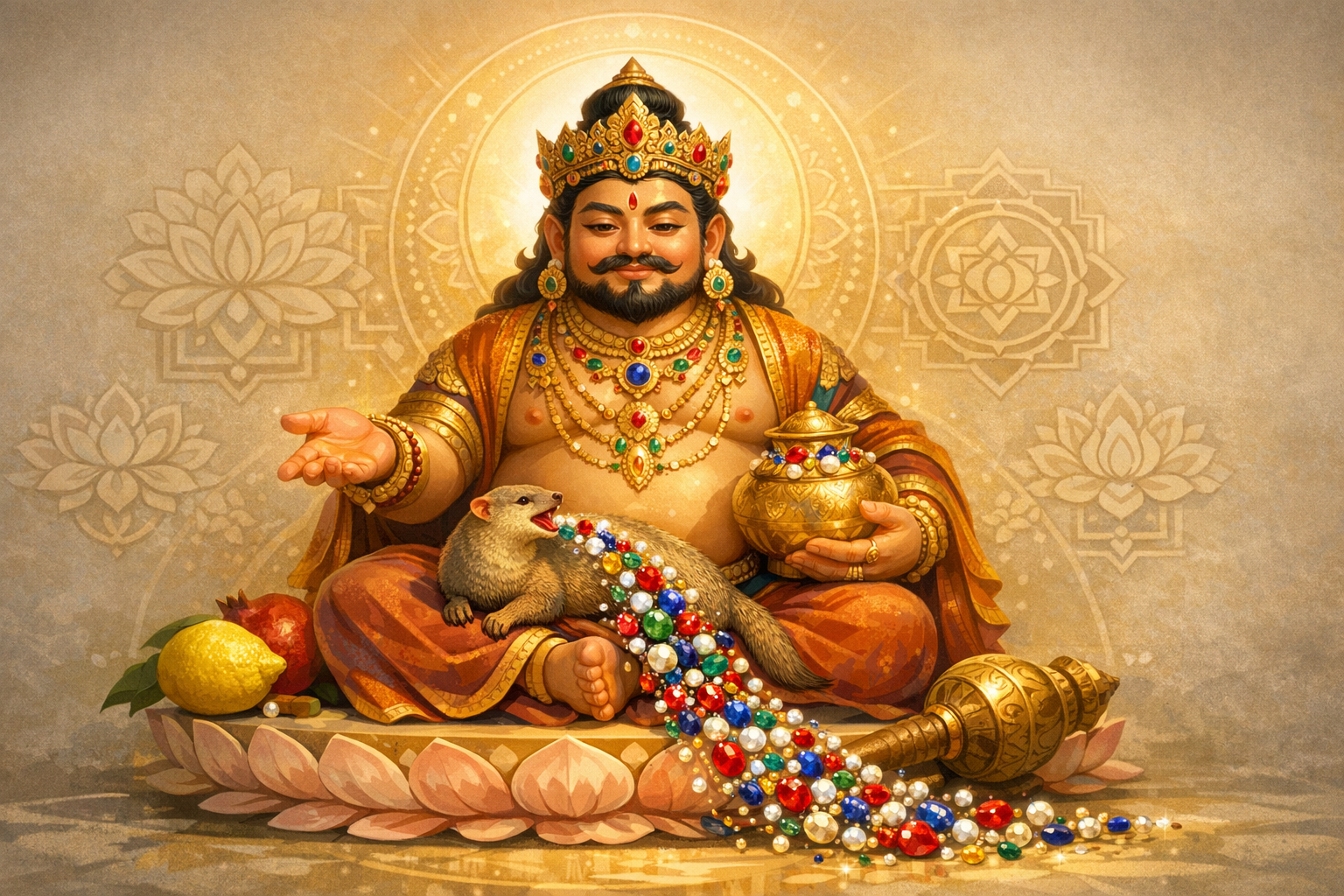
Kubera (Vaiśravaṇa) stands in the shared dharmic imagination as the guardian of wealth (dhanādhipati) and the steward of the world’s treasures. Classical Hindu iconography often renders him pot‑bellied and radiant with abundance, seated at ease while a small mongoose rests upon his lap or near his feet. This seemingly modest creature communicates a complete philosophy of wealth, generosity, and ethical stewardship in Hindu symbolism, with resonances that extend into Buddhist and Jain traditions and harmonize with Sikh ethics of seva.
Across traditions, the unity of meaning is striking. In Hinduism, Kubera appears as the Lokapāla of the North and chief of the yakṣas, patron of the nava‑nidhi (nine treasure‑streams). In Buddhism, the same deity is honored as Vaiśravaṇa and as the prosperity bestower Jambhala, almost invariably paired with a jewel‑spitting mongoose. Jain iconography similarly features yakṣa figures bearing a mongoose to signal the dispensation of riches and the conquest of miserliness. In Sikh thought, while such images are not deployed, the core ethicrighteous earning (kirat karni), sharing through seva and dasvandh, and freedom from lobhaaligns with the mongoose’s message: wealth achieves sanctity when circulated for the common good.
Hindu iconographic grammar is deliberate: attributes (āyudha, upalakṣaṇa) articulate moral and metaphysical ideas. Kubera’s crown and jewels affirm sovereignty over artha, while the wealth‑pot (nidhi‑kumbha), money bag, citron or pomegranate (fertility and auspicious fruition), and the mace (gāda) attest to guardianship and order. The mongoose (nakula) completes this ensemble as a narrative device, interpreting what ethical wealth looks like in practicecourageous, discerning, and above all, generous.
Natural history enriches the symbol. In the subcontinent, the mongoose is famed for its fearless contest with serpents. In Indic mythopoesis, serpents (nāgas) often guard subterranean jewels and reserves of vitality (tejas). By placing a mongoose on Kubera’s lap, the tradition encodes a transformation: the instinct to hoard (serpentine possessiveness) is mastered and redirected into open‑handed distribution. Wealth is not seized from the earth’s guardians; it is ethically released for dharmic purposes.
In Buddhist and Himalayan renderings, the mongoose frequently ejects a stream of gemsjewel‑spitting (ratna‑visṛjita)to dramatize the ideal of dāna (giving). Rather than celebrate accumulation as an end, the image sanctifies circulation: prosperity is most sacred when it flows outward. This is why Kubera’s companion is not a predator’s trophy but a teacherdemonstrating that generosity, not grasping, multiplies value.
The lap placement carries subtle meaning. In classical Indian aesthetics, the lap is a locus of intimacy, affection, and readiness. A creature resting there is tamed, trusted, and integrated. That Kubera cradles the mongooserather than merely brandishing itsuggests that the discernment and bravery needed to steward wealth have become second nature. The symbol conveys calm mastery, not anxious control.
Dharmic ethics situate artha within the puruṣārthasdharma, artha, kāma, mokṣawhere prosperity is legitimate yet bounded by righteousness and oriented to human flourishing. Kubera’s icon states this succinctly: acquire with integrity, protect without fear, and distribute with compassion. The mongoose, ever‑alert and jewel‑spitting, marks the shift from private possession to social blessing.
Traditional epithets reinforce the role: Kubera is Dhanada (the giver of wealth), Nidhi‑pati (lord of treasures), and Vaiśravaṇa (scion of Viśravas). As patron of the nava‑nidhi, he presides over treasure‑streams variously enumerated across sourcesexamples include mahāpadma, padma, śaṅkha, makara, kacchapa, mukunda, kuṇḍika, nīla, and kharvaunderscoring that “treasure” spans liquidity, fertility, stability, skill, and auspicious opportunity rather than mere coin.
Ritual life reflects these themes. During Dhanteras (Dhana Trayodaśī), many households and guilds perform Lakṣmī‑Kubera pūjā, invoking auspicious beginnings for enterprise and ethical stewardship. In business communities, the Kubera‑yantra is honored at ledger openings, a reminder that profit ought to serve dharma. A commonly recited supplication is: “Om Yakshaya Kuberaya Vaisravanaya Dhanadhanyadhipataye Dhanadhanyasamriddhim Me Dehi Dapaya Svaha,” not as a demand for windfall alone but as a vow to steward resources wisely and charitably.
The symbol’s ethical arc is broadly shared across dharmic paths. Buddhism elevates dāna‑pāramitā as the first perfection; Jainism extols aparigraha (non‑hoarding) and anukampā (compassion); Sikhism centers seva and collective care through langar. Read in this light, Kubera’s mongoose becomes a trans‑traditional emblem: wealth is rightfully earned, vigilantly guarded, and intentionally given, so that society’s prosperity is inclusive and uplifting.
Material culture preserves these meanings. From Pāla‑Sena sculptures of eastern India to Newar works of the Kathmandu Valley and Himalayan thangkas, Kubera/Vaiśravaṇa appears with the mongoose as a standard attribute. While stylistic treatments varysometimes a small animal tucked at the base, sometimes a lively figure spitting gemsthe semantic core persists: disciplined power and compassionate distribution.
Himalayan Buddhism intensifies the didactic clarity. As Jambhala, the deity’s posture and the mongoose’s torrent of jewels leave little doubt: wealth should move. This movement is not wasteful flux but sacred circulation, analogous to rains that irrigate fields or breath that vitalizes the body. Stagnation breeds decay; flow creates renewal.
Some images seat the mongoose at Kubera’s feet rather than his lap. Feet ground intention in daily life; they meet the earth and carry one’s weight. Placing the animal there signals that ethical wealth management is lived practicecontracts honored, wages paid on time, debts negotiated fairly, commitments keptmore than lofty aspiration.
Common misreadings deserve correction. The mongoose is not a token of violent conquest; it is an emblem of fearlessness yoked to compassion. Nor does Kubera personify hoarding; as Dhanada, he is archetypal giver. The icon critiques avarice even as it celebrates capability: prosperity is a sacred trust, not an entitlement.
Comparative symbolism situates Kubera among other Hindu deities. Śiva with Nandi represents power domesticated by devotion; Lakṣmī with elephants (Gaja‑Lakṣmī) portrays the rain‑like descent of grace and resources; Sarasvatī with the vīṇā encodes learning made melodious and social. In this grammar, Kubera with the mongoose uniquely teaches that the guardianship of wealth attains its highest merit when it becomes generosity in action.
Read as a practical ethic, the mongoose on Kubera’s lap suggests contemporary guidelines for individuals, institutions, and states. Earn through excellence and fairness; deploy risk with vigilance; prevent leakage through probity; and release surplus as dāna and social investmenteducation, health, heritage, and ecological care. In strategic terms, this is resilience: value multiplies when communities rise together.
Living traditions echo these insights in intimate ways. Householders describe placing a small image of Kubera near ledgers and grain stores, offering a few coins before balancing accounts; merchants recount inaugurating new books on Dhanteras with a vow to keep wages just and credit humane. Such practices feel less like superstition and more like embodied auditsrituals that align intention, livelihood, and duty.
Ultimately, the mongoose on the lap of Kubera distills a timeless teaching shared across the dharmic family: prosperity is not merely counted; it is conducted. Courage overcomes fear, discernment orders ambition, and compassion sends wealth outward where it fructifies as common good. When seen this way, the symbol ceases to be an ornament of a god and becomes a charter for ethical abundanceHindu in origin, Buddhist and Jain in elaboration, and consonant with Sikh commitments to seva and social justice.
The image’s enduring power lies in its synthesis. Strength without generosity can harden into greed; generosity without strength can deplete into naiveté. Kubera’s calm poise and the jewel‑spitting mongoose resolve that paradox: cultivate capability, then give fearlessly. In that movement from possession to blessing, the icon affirms what the dharmic traditions hold in commonwealth aligned with dharma becomes grace.
Inspired by this post on Hindu Blog.