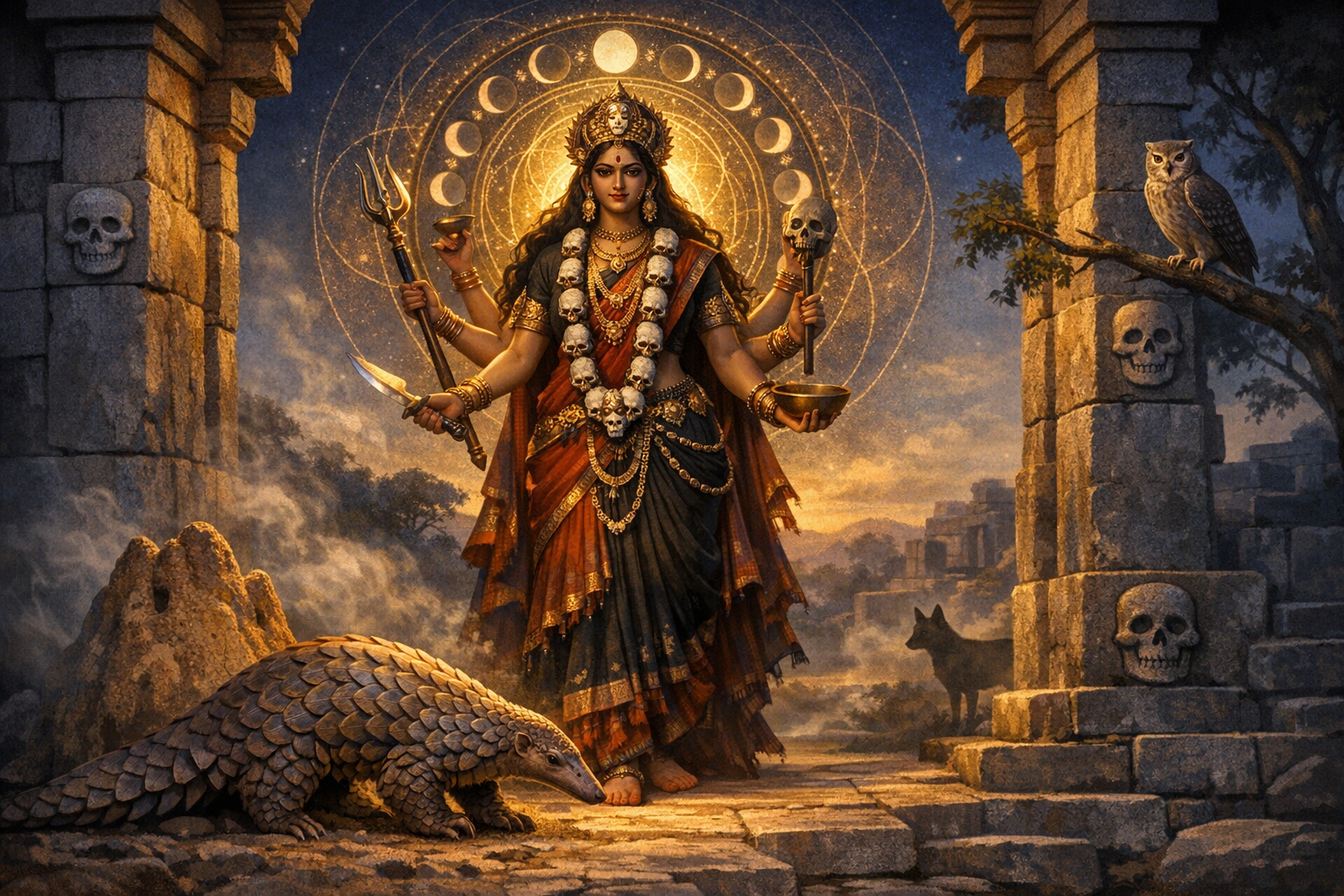
Chamunda (Chāmuṇḍā) stands among the most formidable yet benevolent manifestations of Śakti in Hindu tradition. Emerging, as the Devīmāhātmya narrates, from the brow of Durgā to vanquish the asura brothers Caṇḍa and Muṇḍa, she personifies vāg-śakti, uncompromising discernment, and the devastating compassion that dissolves adharma. Her iconographyemaciated body, garland of skulls, corpse-seat, and companions such as the owl and jackallocates her in the liminal cremation-ground (śmaśāna), where decay and renewal are seen as two faces of the same cosmic process.
Within this well-attested visual repertoire, a striking motif appears in several medieval South Asian sculptures: a small, elongate mammal beside the goddess, frequently catalogued as an “anteater.” Although rarer than her owl or jackal attendants, this creature condenses multiple layers of meaningcosmic cycles, transformation, and vigilant protectionmaking it a powerful key to Chamunda’s philosophical horizon and to broader Hindu symbols in temple art.
A first task is taxonomic clarity. India has no true anteaters (order Vermilingua) and no aardvarks (Orycteropus). The insectivorous mammals with strongest historical and ecological presence in the subcontinent are the Indian pangolin (Manis crassicaudata) and the sloth bear (Melursus ursinus). Sculptors often rendered the pangolin with overlapping chevron or fish-scale patterns, a slender, tapering snout, and a long curling tail; some reliefs even set it near a domed termite mound. By contrast, a sloth bear would be shown with a shaggy mane, robust body, and prominent claws. Early museum catalogues sometimes used the blanket term “anteater” for either, but the scaly texture in many examples strongly favors the pangolin identification.
Iconographic manuals such as the Viṣṇudharmottara Purāṇa, Śilparatna, Rūpamaṇḍana, and the Odiya Śilpa-Prakāśa emphasize Chamunda’s corpse-seat, the jackal, and the owl; they do not explicitly mandate a pangolin-like attendant. This absence does not diminish the motif’s legitimacy. Regional ateliers routinely integrated local fauna into the wrathful goddess’s entourage to express shared theological constantssaṃhāra (dissolution), rakṣaṇa (protection), and śaktithrough images that were immediately intelligible to local communities.
The pangolin’s behaviors provide a natural grammar for meaning. Its methodical harvesting of ants and termitesan unending stream of minute livesmirrors the goddess’s relentless consumption of stale karmic accretions (saṃskāras) and mental impurities (mala). The creature’s elongated, adhesive tongue recalls the protruding tongue seen in ferocious goddesses, a sign of outwardly frightening, inwardly purifying force. When threatened, the pangolin’s armor of keratin scales coils into a near-spherical form, a visual echo of the bindu, seed, and cyclegestures consonant with the goddess who collapses and regenerates worlds.
Read this way, the so-called “anteater” stages the doctrine of cosmic cycles and divine transformation. Ant colonies and termite cities are paradigms of ceaseless construction and ruination; their fast-rebuilding mounds are microcosms of sṛṣṭi–sthiti–saṃhāra, the creation–maintenance–dissolution triad. Chamunda’s śmaśāna abode is not nihilistic: it is the crucible where exhausted forms return to formlessness, a prerequisite for authentic renewal. The insectivore turns waste and wood into nourishment; likewise, the goddess metabolizes the detritus of ignorance into the energy of awakening.
Threshold symbolism deepens the reading. Burrowing animals inhabit borderlandsneither fully surface nor fully subterraneananalogous to the goddess’s own in-betweenness as kṣetrapālinī (guardian of the liminal field). Just as the pangolin passes between realms of light and dark, Chamunda mediates the passage between embodied finitude and boundless consciousness, watching over devotees who traverse fear, grief, and change.
The pangolin’s armor also articulates a theology of protection. In hymns and Tantric liturgies, Chamunda is invoked as kavaca (living armor), a shield against visible and invisible harms. The animal’s imbricated scales, often carefully incised by sculptors, become a material metaphor for mantra and śakti layered around the devotee. What first appears as ferocity reveals itself as motherly careRakṣiṇītransforming dread into fearlessness (abhaya).
Geographically and historically, this creature is most plausibly encountered in central and eastern Indian Matrikā panels and in Deccan ateliers known for meticulous animal studies. Chandella-era works at Khajuraho pair goddesses with local fauna; Odiya compositions in Bhubaneswar and the 64 Yoginī traditions at Hirapur favor evocative animals that key the viewer into Tantric meanings; Hoysala friezes in Karnataka display compelling pangolin vignettes, making the motif visually familiar to artisans. When such a figure is placed near Chamunda, it should be read as regional visual vocabulary expressing a pan-Indic Śākta-Tantra vision.
A practical method aids on-site identification. If the attendant mammal shows a lattice of overlapping scales, a narrow snout, and a long, tapering tailsometimes with the body curledan Indian pangolin is intended. If the form is shaggy, broad, and claw-forward, a sloth bear is likely. Either way, “anteater” is best treated as historical shorthand rather than a zoologically accurate label for Indian contexts. Recognizing the pangolin in particular restores ecological and cultural specificity to Chamunda iconography.
Textually, this symbolism harmonizes with Śākta-Tantra’s triadic processes and bīja-mantra logic. The goddess’s fierce syllableshuṃ, phaṭbreak apart ossified patterns so that sattvic clarity can arise. The insectivore’s economy of consumption and conversion is a living emblem of that same transformation. While primary śilpa-śāstras do not prescribe the pangolin, their silence leaves room for regional hermeneutics that encode metaphysics in local nature, a hallmark of Hindu art’s adaptive genius.
Seen through a dhārmic-unity lens, the motif resonates broadly. In Newar Nepal, Chāmuṇḍā is venerated as one of the Aṣṭamātrikās by both Hindus and Buddhists, exemplifying shared śakti imagery across traditions. The ecological ethic implicit in honoring a shy, nocturnal insectivore converges with Jain ahiṃsā, Buddhist karuṇā, and the Sikh spirit of sevā and sarbat da bhala. The attendant animal thus becomes a quiet ambassador of inter-traditional harmony and environmental responsibility.
This reading also carries a contemporary ethical charge. The Indian pangolin is classified as endangered due to habitat loss and illicit trade. Interpreting temple imagery with zoological precision invites informed reverence, encouraging communities to align ritual sensitivity with conservation. In this sense, Chamunda’s “anteater” does not merely illustrate doctrine; it calls for custodianship of the very beings whose forms sustain the sacred lexicon of Hindu temples.
Many visitors first notice the small creature almost by accident, only to discover that it reframes the entire ensemble. What seemed an obscure detail becomes an interpretive fulcrum: the scaly attendant points to cycles of time, thresholds of being, and the mother’s protective ferocity. That moment of recognitionmoving from fear to insightis precisely the transformation Chamunda bestows.
In sum, the so-called “anteater” in Chamunda iconography is best understood as the Indian pangolin (or, in some cases, the sloth bear), integrated by regional ateliers to express core Śākta principles. Its insectivory figures the goddess’s digestion of impurity; its armor and curling posture encode protection and cyclicality; its liminal ecology mirrors her śmaśāna sovereignty. Clarifying this motif enriches the study of Chamunda, strengthens dhārmic solidarity, and reconnects sacred art to the living ecologies that first inspired it.
Inspired by this post on Hindu Blog.