Screen media does more than entertain; it shapes how communities are perceived and how they understand themselves. For the global Sikh Community, nuanced Sikh storytelling on screen is both cultural preservation and cultural empowerment, connecting generations through language, music, values, and lived experience while advancing Unity in Diversity across dharmic traditions.
Authentic Cinematic Representation of Sikh lives requires more than sporadic characters or symbolic imagery. It calls for research-led narratives, community consultation, and production practices that respect articles of faith—kesh, dastar, kara, and kirpan—while portraying the depth of Sikh history, ethics, and everyday life without stereotype or simplification.
Representation is most durable when anchored in shared dharmic values that resonate across Sikhism, Hinduism, Buddhism, and Jainism. Themes such as seva, compassion, righteous courage, and respect for plural paths reflect a civilizational ethos that supports interfaith harmony, Interfaith Dialogue, and social cohesion. Centering these common values strengthens cultural bridges while allowing Sikh distinctiveness to flourish on its own terms.
A practical pathway begins with development. Writers’ rooms and documentary units benefit from primary sources: oral histories gathered in gurdwaras, community archives, Punjabi and Gurmukhi texts, and lived testimonies of artisans, farmers, athletes, scientists, and entrepreneurs. Triangulating these accounts with scholarly works ensures balanced narratives that go beyond a narrow focus on conflict to include aspiration, innovation, family life, and diasporic creativity.
Language is a core pillar of authenticity. Punjabi’s dialectical richness and register—rural and urban, diasporic and homeland—deserve careful attention. Scripts should preserve idiom, intonation, and code-switching without flattening voices. Accurate captioning and subtitling extend accessibility while maintaining linguistic fidelity and respect for poetic textures in gurbani and kirtan.
Respectful depiction of faith practices matters. Basic production literacy regarding the Sikh Rehat Maryada helps teams approach ardas, kirtan, langar, and community service with informed care. The kirpan should be framed as an article of faith grounded in ethical duty, not a prop of menace. Head coverings, footwear norms in sacred spaces, and camera placement near the Guru Granth Sahib warrant consultation with local gurdwara committees.
Casting choices influence both screen truth and audience trust. Authentic casting—especially for turbaned roles—avoids superficial costuming and instead trains performers in appropriate dastar-tying styles and day-to-day care. Dialect coaches, cultural advisors, and on-set guardians of protocol reduce error, while nurturing Sikh talent pipelines in acting, writing, production design, hair and makeup, and post-production creates lasting capacity beyond a single project.
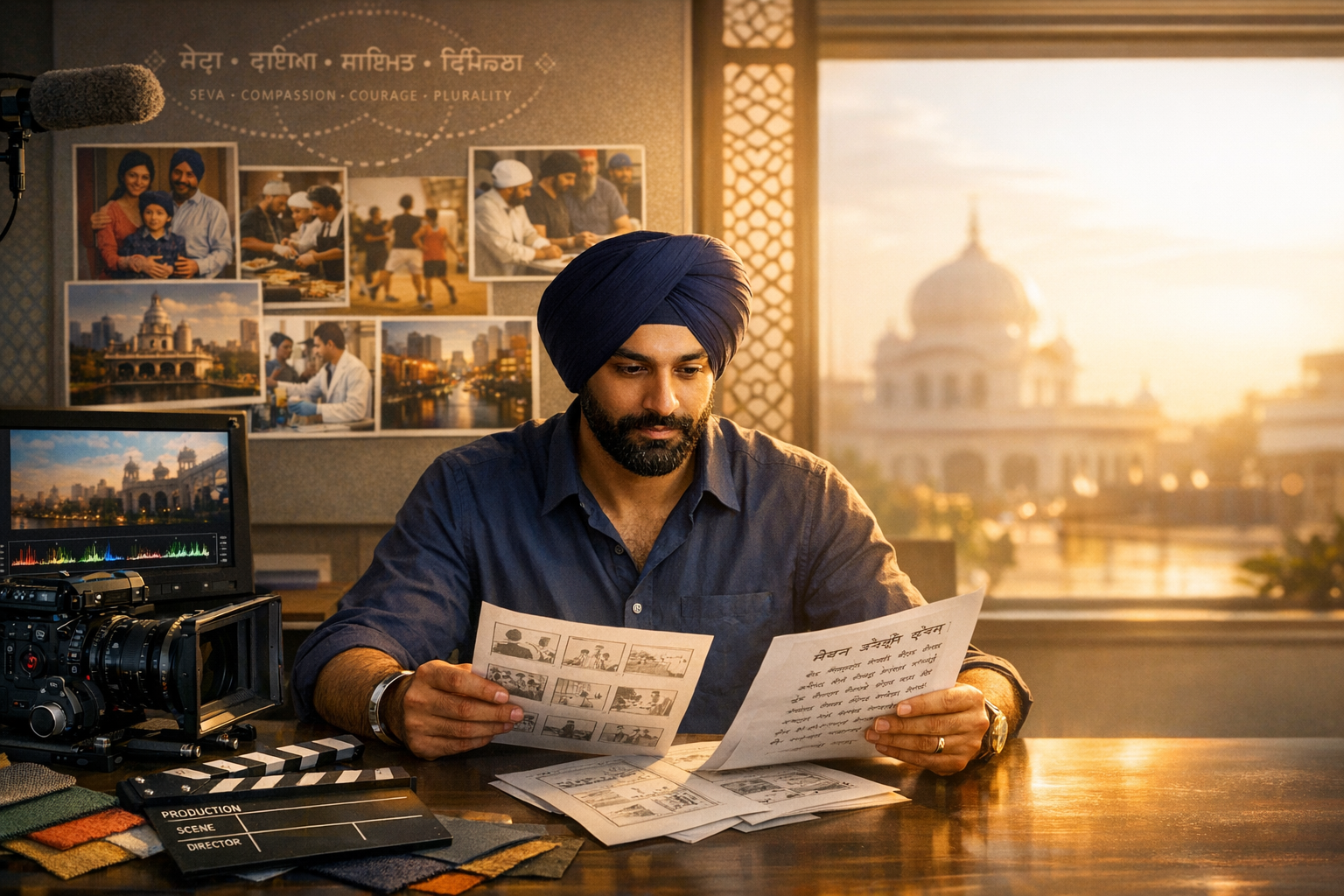
Technically, the screencraft around Sikh representation benefits from deliberate choices. Wardrobe tests should evaluate cloth textures and colors of the dastar against the sensor’s dynamic range to avoid moiré and color clipping. Lens selection can prevent caricature through perspective distortion; extreme wide angles close to the face may unintentionally emphasize headgear. Sound teams should capture the acoustic warmth of gurdwara spaces and the timbral nuances of kirtan, respecting ragas and voice-leading without intrusive editing.
Music licensing and textual accuracy merit rigor. Raga selection for devotional scenes should align with time-of-day and mood where contextually relevant, and rights clearances for performances and recordings must be handled carefully. When quoting gurbani, textual fidelity and transliteration standards reduce ambiguity, while context notes in captions can aid younger or non-Punjabi audiences without diluting meaning.
When dealing with sensitive history—such as 1947 Partition, 1984 anti-Sikh violence, or insurgency-era complexities—responsible storytelling is essential. Trauma-informed interviewing practices, survivor consent, and advisory boards comprising historians and mental-health practitioners help maintain dignity while preventing sensationalism. The aim is to educate and humanize, not to polarize or re-traumatize.
Narrative breadth strengthens cultural empowerment. Sikh lives on screen should illuminate arenas too often overlooked: environmental stewardship, sports excellence, entrepreneurial journeys, scientific research, mentorship, and the arts. Diasporic comedies and dramas can capture the friction and joy of intergenerational negotiation, while speculative fiction and animation can introduce younger viewers to ethical problem-solving through Sikh philosophical lenses.
Collaboration frameworks can institutionalize quality. Co-productions that include Punjabi cinema hubs, regional broadcasters, and OTT platforms widen distribution while protecting cultural nuance. Community advisory councils, rotating writers’ rooms with Sikh and non-Sikh contributors, and partnerships with film schools create a common standards vocabulary that evolves with each project.
Measurement clarifies progress. A simple, transparent representation index might track: the number of Sikh roles beyond token appearances; diversity of occupations portrayed; the presence of Sikh creators in key decision-making positions; accuracy in depicting articles of faith; and the range of genres explored. Audience feedback loops—surveys after screenings in gurdwaras, universities, and community centers—can guide iterative improvements.
Distribution strategies should match the community’s global footprint. The Punjabi and Sikh diaspora in Canada, the United Kingdom, the United States, Australia, and Southeast Asia supports day-and-date releases, festival circuits, and community premiere events. Multilingual subtitling and dubbing, audio description, and culturally aware marketing assets invite both insiders and newcomers to engage with respect and curiosity.
Legal and regulatory awareness provides guardrails. In India, Article 25 recognizes the right to wear and carry the kirpan, contextualizing on-screen portrayal as an expression of faith. Producers should also follow applicable certification norms and domestic broadcast codes where relevant, while overseas units should comply with local content and classification standards without compromising dignity.
Ethics extend to locations and sacred imagery. Filming permissions for gurdwaras should be secured with clarity on framing, equipment, and crew conduct. Scenes should avoid trivialization of prayer and refrain from staging comedic gags around turbans or articles of faith. In post-production, editorial choices should prioritize integrity over spectacle, especially when narratives intersect with living religious practice.
Design and costuming departments benefit from research sprints. Region-specific dastar styles, seasonal fabrics, and occupational attire can be cataloged into look-books so that background actors, too, reflect community realism rather than a monolithic silhouette. Prop departments should treat kara and kirpan as integral identity markers, not interchangeable accessories.
Archives and knowledge stewardship are strategic investments. Digitizing oral histories, curating family photo albums, and licensing vintage Punjabi recordings create a reusable library for future projects. A shared “Sikh Screen Style Guide,” updated annually with community input, can codify lessons learned on language, wardrobe, sound, and ethics across studios.
Technology can amplify reach without flattening nuance. Virtual production enables historically grounded reconstructions—from Anandpur Sahib to pre-Partition neighborhoods—when physical access is limited. AI-assisted subtitling and descriptive audio can expand accessibility, but editorial oversight must prevent mistranslation or loss of sacred tone in automated outputs.
Education and capacity building nurture longevity. Fellowships for Punjabi screenwriters, mentorships for Sikh cinematographers, and writers’ labs co-hosted by universities and community institutions cultivate technical excellence alongside cultural fidelity. Short-form incubators—documentary labs, podcast-to-screen pipelines, micro-budget drama challenges—help new voices iterate quickly before scaling to features and series.
Cross-dharmic collaboration strengthens the shared cultural horizon. Projects that highlight seva in parallel with dana and ahimsa in neighboring traditions, or that weave interfaith friendships into everyday plots, demonstrate how civilizational pluralism thrives in practice. Such storytelling enriches both Sikh specificity and interreligious understanding, honoring difference while building common cause.
Recent projects illustrate both promise and caution. Historical epics, athlete biopics, and diaspora dramas have broadened visibility, yet gaps remain in science fiction, workplace comedies, children’s animation, and slow-burn mysteries rooted in Punjabi sociolinguistics. Expanding genre diversity will reduce overreliance on trauma narratives and sustain audience engagement across demographics.
Marketing should be consonant with the values depicted. Visual identity that respects the aesthetics of the dastar, avoids exoticizing the kara, and situates family and community spaces with warmth invites audiences to encounter stories on their own terms. Trailers and social clips should contextualize faith practices rather than using them as novelty hooks.
Accessibility is integral, not an add-on. High-quality captions that preserve Punjabi idioms, audio description that accurately conveys articles of faith, and on-platform glossaries for terms such as ardas, langar, and sangat equip diverse audiences to appreciate unfamiliar contexts without condescension.
Risk management is prudent in polarized environments. Fact-checking across multiple sources, clear distinctions between creative license and documented history, and the use of content advisories for sensitive material protect both the integrity of the work and the dignity of those represented. Security planning for public screenings can anticipate—and de-escalate—misinterpretations.
The economic case for authentic representation is strong. Punjabi and Sikh audiences are loyal early adopters across theatrical, SVOD, and AVOD windows, and transnational word-of-mouth can quickly amplify well-made titles. Cross-over appeal grows when stories offer universal stakes—family, vocation, moral choice—while maintaining local texture.
Documentary storytelling remains a vital companion to fiction. Long-form and short-form non-fiction can track community initiatives in education, healthcare, environmental stewardship, and heritage conservation, providing counterpoints to sensational headlines and building a record for future scholars and creators.
Youth-focused content can anchor continuity. Animated series on ethical dilemmas, science explainers in Punjabi, and hybrid docu-dramas about Sikh innovators can pair classroom relevance with cinematic polish. Schools and community libraries gain curriculum-ready media, while streaming platforms deepen family co-viewing.
Inclusive governance brings it all together. Advisory panels with scholars of Sikh studies, practitioners from the arts, and community elders can resolve dilemmas about depictions before they trigger public controversy. Transparent notes on method—how languages were handled, how rituals were consulted—build trust with viewers.
In the end, Sikh stories belong on screen because they enlarge the shared cultural imagination. They bring to life the ethical grammar of Ik Onkar, the dignity of labor, the discipline of daily prayer, the grace of langar, and the courage to serve. When aligned with a dharmic vision of spiritual coexistence, such storytelling replenishes the cultural commons far beyond its immediate audience.
Every accurate turban fold, every carefully rendered shabad, and every scene of seva becomes a gesture of belonging. For children who rarely see themselves reflected, for elders who carry memory, and for neighbors learning about one another, these moments affirm that plural identities can thrive together—on screen and in society.
Building this future is a craft and a commitment: research-led, ethically grounded, technically assured, and joyfully plural. With shared standards and collaborative practice, the screen can become a home where Sikh stories—and the interwoven stories of all dharmic traditions—are told with clarity, dignity, and heart.
Inspired by this post on SikhNet – News.