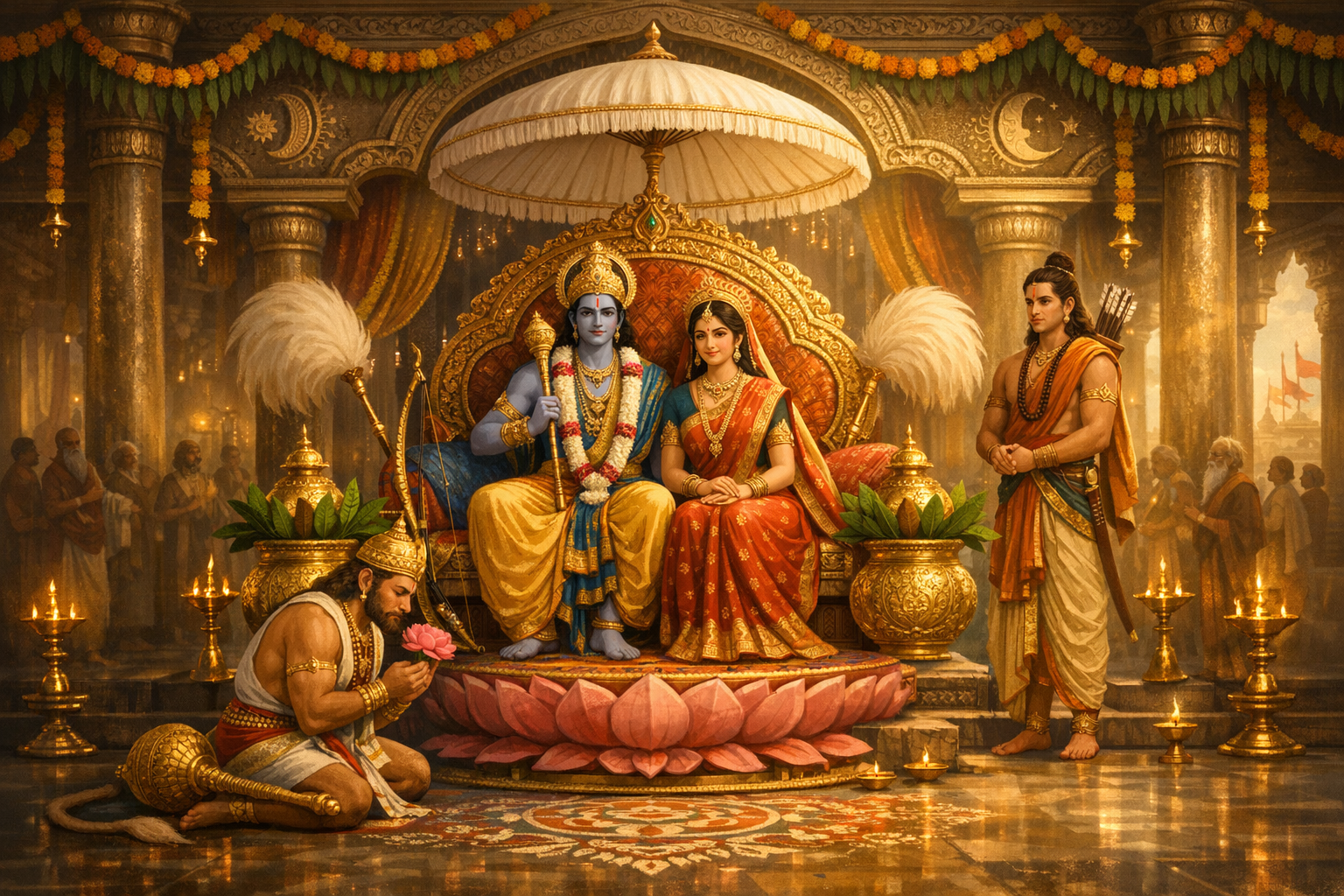
Sri Rama Rajyotsavam (Sri Ram Rajyabhishek) commemorates Sri Rama Pattabhishekamthe coronation of Lord Sri Rama in Ayodhyaand is traditionally observed on Chaitra Shukla Panchami, the fifth lunar day of the bright fortnight in the month of Chaitra. In 2026, Sri Rama Rajyotsavam falls on March 23, aligning the sacred remembrance of coronation with the broader Ram Navami Utsav period observed across India and the global diaspora.
Classical sources locate this event at the conclusion of the Valmiki Ramayana’s Yuddha Kanda, where the narrative of return (Ayodhyagama) culminates in the formal Rajyabhisheka. The coronation is performed under the guidance of Sage Vasiṣṭha with other revered rishis present; sacred waters gathered from auspicious rivers are consecrated in golden kalashas, and Sri Rama ascends the throne in the presence of Sita, Lakshmana, Bharata, and Shatrughna. The scene is the archetype of just kingship restored, establishing the foundation for the idealized order later remembered as Ram Rajya.
Locating Sri Rama Rajyotsavam within the Ram Navami Utsav provides cultural and liturgical coherence. While Ram Navami itself marks the divine birth on Chaitra Shukla Navami, many temple traditions unfold a sequence of festivities across adjacent tithis, including Sita-Rama Kalyanam (divine wedding) and the symbolic Rajyabhisheka. In several South Indian Vaishnava temples, the Kalyanam is performed on Navami and the ceremonial Pattabhishekam follows within a day or two, emphasizing continuity from avatara and dharma-sankalpam to governance and social order.
The textual tradition preserved in calendars and puranic references identifies Chaitra Shukla Panchami as the coronation day, yet regional utsava-schedules may place the ceremonial Pattabhishekam after the Kalyanam on Dasami or within the remaining bright fortnight for practical and congregational reasons. Both patternsscripture-based date adherence and temple-festival sequencingaim to honor the same central truth: the restoration of righteousness in public life through the enthronement of Sri Rama.
From a Panchanga standpoint, a tithi is a lunar day defined by the relative angle between the Sun and Moon (approximately 12° per tithi). Festival assignment typically follows the sunrise rule: the civil date on which the relevant tithi prevails at local sunrise is taken as the observance date. For 2026, Chaitra Shukla Panchami aligns with March 23; however, local sunrise and tithi transitions can cause minor regional variations. It is therefore recommended to confirm with a reliable local Panchang for precise observance in each location.
A meaningful home observance of Sri Rama Rajyotsavam can include sankalpa for the welfare of family and community, purification (achamana), lighting of a deepa, and invocation of Sri Rama, Sita, Lakshmana, and Hanuman before a Ram Darbar murti or picture. Devotees commonly recite Sri Rama Raksha Stotra, Vishnu Sahasranama, Purusha Sukta, and selections from Valmiki Ramayana that describe the return to Ayodhya and the coronation. A brief abhishekam with panchamrita for the deity image (where appropriate), simple naivedya, and arati complete the core rite.
In temple contexts (particularly those guided by Pancharatra or Vaikhanasa Agama), Sri Rama Pattabhishekam is expressed through elaborate snapana (abhishekam), alankara, special archana, and, where customary, homa and rathotsava. The utsava-murtis of Sita-Rama may be ceremonially seated on a throne, with coronation symbolism enacted via consecrated waters, royal ornaments, and umbrella (chhatra) and chamara vahana. These public rites reinforce the civic dimension of the daydharma restored as an inclusive, compassionate social order.
Scriptural and devotional recitations central to the day include the Pattabhisheka portion from the closing sargas of Yuddha Kanda in Valmiki Ramayana, the Nama-ramayana, select sargas from Sundara Kanda, and Sri Rama Ashtottara or Sahasranama. Bhajana traditions often include kirtanas by Tyagaraja and other saint-composers, while many communities chant Hanuman Chalisa to invoke steadfast devotion and service to dharma. The overarching emphasis remains on maryadarighteous conductand loka-sangrahawelfare of all.
For those seeking a muhurta within the tithi, general guidelines favor Abhijit muhurta, as well as auspicious Choghadiya segments such as Shubha, Labha, and Amrita. Observers typically avoid Rahu Kalam, Yamaganda, and Gulika. When feasible, one may consider Tara Bala and Chandra Bala supportive to the janma rashi. Because specific muhurta windows vary by geography and Panchang, local verification is prudent.
Iconographically, Sri Rama Rajyotsavam is represented by the Ram Darbar: Sri Rama enthroned with Sita to the left, Lakshmana standing in devoted vigilance, and Hanuman in humble service. The icon conveys the integration of jnana (wisdom), dharma (righteousness), and seva (selfless action), with the royal paraphernalia underscoring responsibility rather than privilege. This imagery has informed temple murals, manuscript illuminations, and family shrines for centuries, providing a visual grammar of ethical leadership.
As a governance ideal, Ram Rajya emphasizes justice (nyaya), compassion (daya), ethical administration (rajadharma), economic fairness, and ecological balance. The coronation remembrance is therefore more than ceremonial nostalgia; it is a civic meditation on how leaders and citizens might embody integrity, restraint, and accountability in public life. In contemporary terms, Sri Rama Rajyotsavam calls for policy and community action aligned with the common good.
The resonance of Ram Rajya extends beyond denominational boundaries and invites unity across dharmic traditions. The Buddhist notion of the Dhamma Rājarighteous rulershipechoes the ethical core of Ram Rajya; Jain narratives recognize Rāma (as Padma) within their own civilizational memory of exemplary conduct; and Sikh scripture honors “Ram” among the divine names, affirming a shared reverence for righteousness and truth. Sri Rama Rajyotsavam thus offers a common ethical horizon for Hindus, Buddhists, Jains, and Sikhs, reinforcing harmony and mutual respect.
Within the Ram Navami Utsav, communities often continue the culinary and seva traditions associated with Sri Rama: panakam (a jaggery-and-spice drink), kosambari and other sattvic offerings, and annadana to guests and the underprivileged. These practices transform remembrance into lived compassion, allowing the ideal of Rajadharma to be experienced through hospitality and care.
In 2026, observers may note that Sri Rama Rajyotsavam on March 23 (Chaitra Shukla Panchami) can fall on different civil dates outside India depending on time zone and tithi transitions at sunrise. Diaspora communities are encouraged to follow local Panchang guidance or consult their temple’s utsava schedule to align home observances with community celebrations.
Key takeaways for 2026 are clear: Sri Rama Rajyotsavam honors the coronation on Chaitra Shukla Panchami (March 23), integrates seamlessly with Ram Navami Utsav, and centers on the timeless ethic of Ram Rajya. Whether observed through concise home puja or full temple utsava, the day invites reflection on personal maryada and collective welfare. May the remembrance of Sri Ram Rajyabhishek inspire unity, service, and steadfast commitment to dharma across all communities.
Inspired by this post on Hindu Pad.