Navratri 2026 presents two closely linked observances around Day 4 that devotees track through the lunar calendar. In the autumn cycle (Sharad Navratri), the 4th day falls on 14 October 2026 (Ashwin Shukla Chaturthi), traditionally dedicated to Maa Kushmanda. In the spring cycle (Vasant or Chaitra Navratri), 22 March 2026 corresponds to the 3rd day in many almanacs; this civil date is notable for Varad Vinayak Chaturthi and, in some regional panchangs due to tithi overlap, Kushmanda Pujan. Such alignment underscores how the Navratri rhythm is governed by the tithi prevailing at sunrise, rather than by fixed civil dates.
The 4th day’s devotional focus on Maa Kushmanda is central to both Navratri cycles. As the fourth form in the Navadurga sequence (Śailaputrī, Brahmācharinī, Chandraghantā, Kushmāṇḍā), this worship foregrounds vitality, creative intelligence, and auspicious expansion. Communities honor this day to invite inner luminosity, steadiness of prāṇa, and clarity of resolve during the wider nine-night vrata.
Panchang practice explains the dual references to 22 March 2026 and 14 October 2026. The tithi in effect at local sunrise defines the festival day for most domestic rites. When Tritiyā and Chaturthī adjoin or straddle sunrise, one region may count the day as the 3rd of Chaitra Navratri while still observing Vinayaka Chaturthi rites, and another may schedule Kushmanda Pujan on the same or the following civil date. This technicality is customary in the lunisolar reckoning and should be read as a feature, not a contradiction, of observance.
From a calendrical standpoint, the spring cycle follows Chaitra Shukla Paksha and the autumn cycle follows Ashwin Shukla Paksha. Because lunar tithis are variable in length (approximately 19–26 hours) and roll across time zones, the Gregorian dates shift annually and regionally. Hence, while 14 October 2026 is consistently the 4th day of Sharad Navratri, 22 March 2026 aligns with the Chaturthi observance in many locations for Vasant Navratri, with local panchang guidance determining whether Kushmanda Pujan is scheduled that day or the next.
In Devi-tattva, “Kushmāṇḍā” is often glossed as the creative force that shaped the aṇḍa (cosmic egg) through a gentle smile and inner warmth (uṣmā). Textual traditions describe Maa Kushmanda as the source of radiant vitality that sets creation into harmonious motion. Devotees approach this day to kindle joy, resilience, and balance, seeing the worship as an invocation of sustaining energy in body, mind, and community.
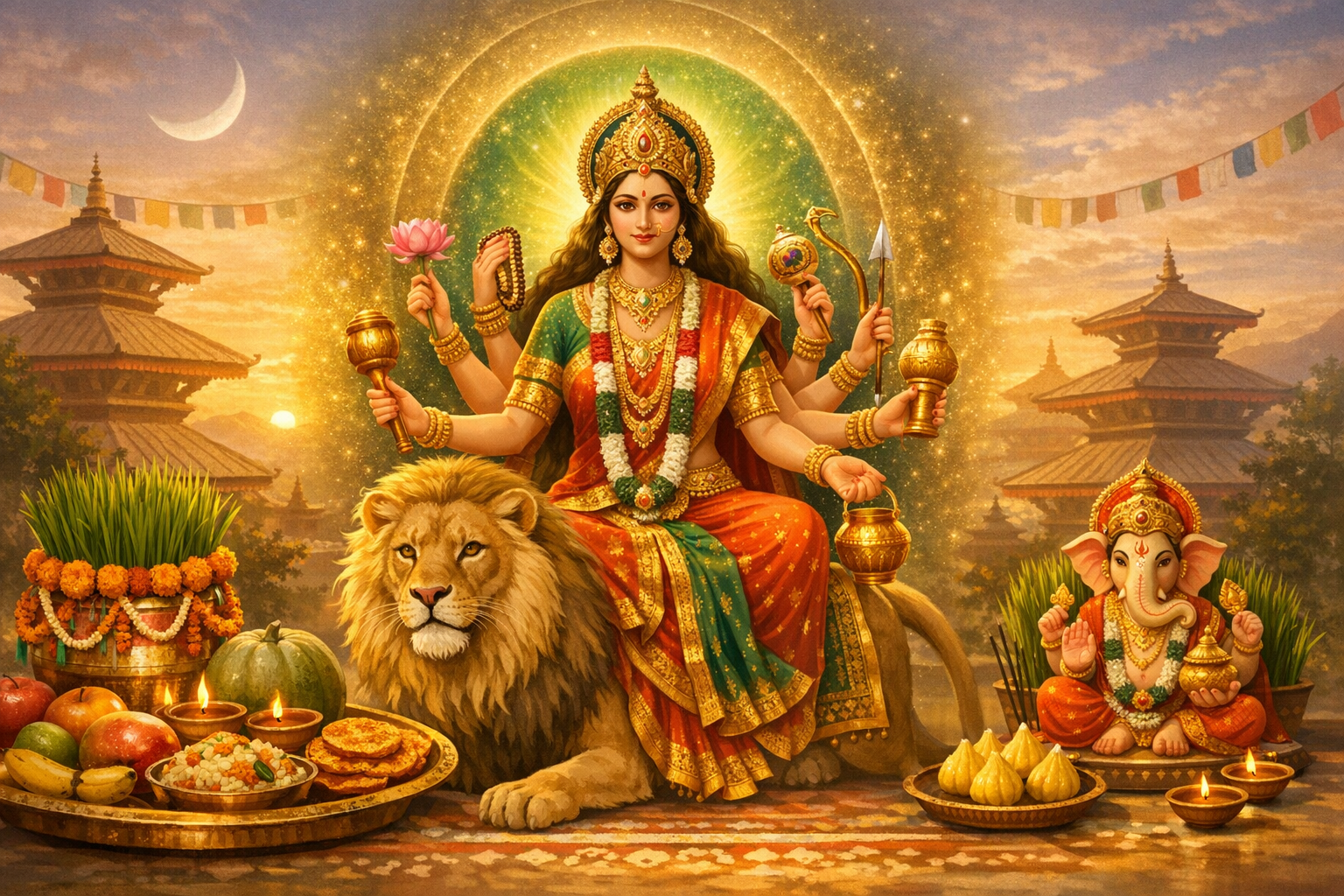
Iconographically, Maa Kushmanda is depicted with a lion as vahana, bearing multiple arms (often eight), holding implements such as a kamandalu, bow, arrow, chakra, gada, and amrita-kalaśa, along with a rosary and lotus. The posture embodies both śakti (dynamic capacity) and śānta (serene benevolence), inviting worshippers to cultivate courage that is tempered by compassion.
Many lineages associate the day’s sādhanā with the anāhata (heart) center, attuning devotion, breath, and mantra to restore balance and generosity. A commonly recited invocation is “Om Devi Kushmandayai Namah,” practiced with steady japa and attentive breath awareness. Practitioners emphasize sattvika preparationclean space, simple offerings, and mental clarityover ostentation, affirming that inner focus is the foremost offering.
Traditional bhog for Kushmanda Pujan includes preparations linked to the ash gourd (kushmāṇḍa) and sweets such as malpua, reflecting the goddess’s nourishing aspect. Households also offer seasonal fruits, milk-based confections, and light phalahar consistent with Navratri vrata. The intent is to express gratitude through purity, restraint, and mindful consumption.
A concise home Puja Vidhi typically includes sankalpa, deepa and dhūpa, simple abhishekam or snāna to the murti or image, naivedya, and ārati, followed by japa and quiet meditation. Where families observe Varad Vinayak Chaturthi on the same date, they often sequence a brief Ganesha worshipdurvā grass, modak or laddoo, and a Ganesha mantra japaeither before or after the Kushmanda Pujan, maintaining devotional continuity.
On Varad Vinayak Chaturthi (the monthly Vinayaka Chaturthi in Shukla Paksha), devotees honor Śrī Gaṇeśa as the bestower of vara (boons) and remover of obstacles. The vrata is typically observed with daytime puja, offering 21 durvā blades and modak, and cultivating a vow of right speech and right action through the lunar fortnight. When this tithi coincides with Navratri, households often weave both practices into a single, serene devotional arc.
In ritual sequencing, many families complete Ganesha worship first as a mangala-kārya (auspicious commencement), then proceed to the Kushmanda Pujan. This integrated approach reflects the complementary symbolism of wisdom (Gaṇeśa) and radiant śakti (Kushmāṇḍā), aligning efforts to remove impediments and amplify vital force during the Navratri sādhanā.
In Nepal, Navratri is celebrated as Dashain, a deeply rooted cultural festival observed by Hindu and many Buddhist communities. The fourth day of Dashain (Chaturthi) continues the daily Durga upasana that follows Ghatasthapana, with households sustaining a rhythm of puja, incense, and mantras. The emphasis lies on invoking protection, prosperity, and communal harmony.
Across Nepal and the broader Himalayan region, the Dashain ambiance reflects family reunions, intergenerational blessings, and community solidarity. While ritual forms vary, a growing number of devotees adopt ahimsa-aligned offerings and satvika naivedya to honor Devi, highlighting a shared dharmic commitment to compassion and reverence for life.
These observances resonate across the wider dharmic family. Hindu, Buddhist, Jain, and Sikh households frequently participate in community gatherings, kirtan, and seva activities that emphasize self-discipline, ethical living, and unity in diversity. The shared valuesdevotion, study, and servicenurture a culture of mutual respect and spiritual kinship.
Muhurta and scheduling are best aligned with the tithi prevailing at local sunrise. For Devi worship, daytime hours within shubha choghadia or Abhijit muhurta are generally preferred, while Rahu Kaal and Gulika Kaal are commonly avoided by many practitioners. For Vinayaka Chaturthi, daytime puja after sunrise is customary, with local panchang consultation guiding the precise window.
For 22 March 2026 in the Chaitra cycle, many panchangs list Shukla Chaturthi during daylight in parts of South Asia, enabling Varad Vinayak Chaturthi rites and, in some traditions observing tithi-adherence amid Tritiya–Chaturthi junctions, Kushmanda Pujan on the same civil date. Where sunrise indicates a different tithi, communities may schedule Kushmanda Pujan on the following day. Devotees in the diaspora should verify time-zone–specific tithi timings.
For 14 October 2026 in Sharad Navratri, Ashwin Shukla Chaturthi is universally mapped as the 4th day, dedicated to Maa Kushmanda. This day naturally centers on Devi upasana, with households performing sankalpa for inner steadiness, collective well-being, and the removal of inner obstructions ahead of the concluding days of Navratri.
Vrata guidance typically recommends a balanced fast suited to individual health. Many adopt phalahar (fruits, milk, light sattvika preparations) and avoid excess stimulants. Those with specific medical needs should follow professional advice and adapt the vrata in a spirit of sincerity rather than severity, reflecting the dharmic principle of compassionate self-care.
Practitioners often describe a perceptible shift in attention and ease on this day: japa becomes steadier, breath slower, and outlook kinder. Communities note that devotion to Maa Kushmanda encourages a luminous warmth in speech and action, supporting families, neighbors, and interfaith friendships with a clear, generous heart.
Regional customs add cultural color. In western India, garba and dandiya-raas during Sharad Navratri create a devotional milieu in which the 4th day’s theme of radiance finds expression in music and dance. In eastern and northern regions, household rites remain intimate, with special prasad and readings from the Devi Mahatmyam reinforcing a contemplative tone.
Sustainability continues to shape contemporary practice. Eco-friendly flowers and biodegradable puja materials, mindful water use in abhishekam, and responsible prasad distribution embody dharmic stewardship. These choices preserve sanctity and align reverence for Devi with care for the living environment.
Families frequently utilize the day for study and reflectionreading a chapter of the Devi Mahatmyam or passages from the Upanishads on inner light and discernment. This combination of ritual and svādhyāya (self-study) frames Navratri as both communal celebration and philosophical inquiry, deepening maturity in faith.
In the spirit of unity among dharmic traditions, many sabhas and community centers host inclusive satsangs where Hindu, Buddhist, Jain, and Sikh participants exchange reflections on courage, service, and wisdom. The shared emphasis on ethical conduct, meditation, and compassion strengthens social harmony during these auspicious days.
Key takeaways for 2026 are straightforward. The 4th day of Sharad Navratri is on 14 October (Ashwin Shukla Chaturthi) with Kushmanda Pujan. In the spring cycle, 22 March aligns with the 3rd day of Chaitra Navratri in many places but features Varad Vinayak Chaturthi and, per tithi conditions in some almanacs, Kushmanda Pujan on the same civil date. Local panchang consultation remains the gold standard for precise timing.
In essence, the 4th day’s devotional current is luminous and practical. It invites disciplined attention, warm-hearted action, and cooperative community spirit. Whether through Devi upasana, Vinayaka vrata, or shared Dashain customs, the day channels a balanced synthesis of wisdom and energyan enduring ideal across the dharmic spectrum.
Inspired by this post on Hindu Pad.