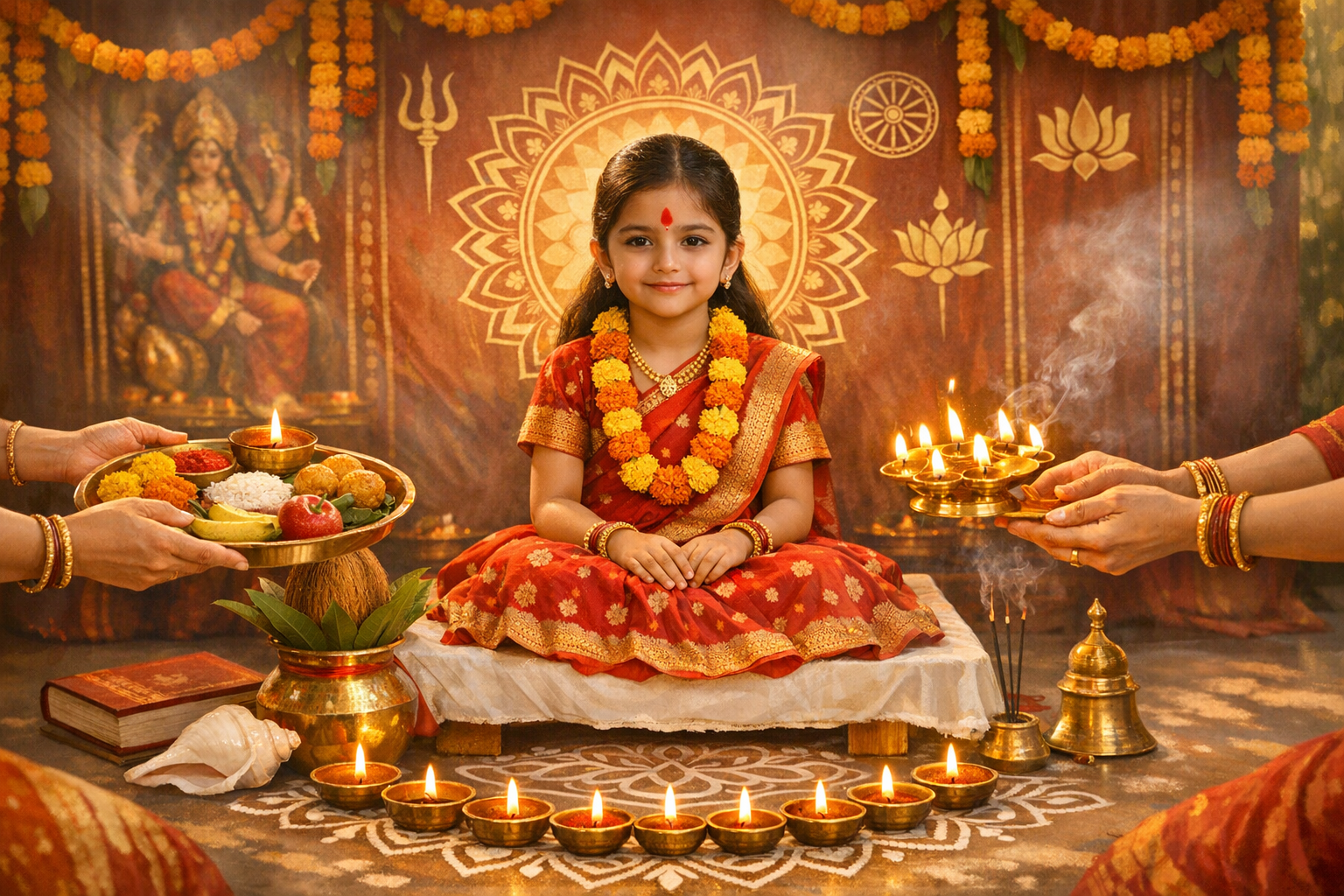
Kumari Puja is a profound Shakta practice that venerates pre‑pubescent girls as the living embodiment of Goddess Durga during Navratri and Durga Puja. Rather than confining divinity to icons alone, this rite foregrounds a central insight of Sanatana Dharma: the Divine Mother (Shakti) is immanent in all beings and can be approached most purely through innocence and compassion. In contemporary communities across South Asia and the diaspora, the ceremony has become a living pedagogyteaching devotion, gender respect, and social inclusion through ritual precision and ethical care.
At its core, Kumari Puja (also called Kanya Puja or Kanjak) enacts a theological axiom that aligns with Vedantic and Shakta metaphysics: sarvam khalvidam brahma. The Devi Mahatmya’s refrain underscores this immanence“Sarvabhuteshu yaa Devi bhakti-ruupena samsthita, namastasyai namastasyai namastasyai namo namah.” By honoring a child as Devi, practitioners ritually affirm that the one Goddess appears in and through the many, and that purity (shuddhi), care (seva), and loving attention (bhakti) are not merely inward dispositions but social virtues realized in community.
Historical practice spans regions and idioms. In eastern India, Kumari Puja became particularly visible within Durga Puja traditions; in the early twentieth century it was institutionalized at prominent monastic centers to emphasize universal motherhood and service. In the Kathmandu Valley, the Newar institution of the living goddess offers a syncretic Buddhist–Hindu expression of reverence toward the feminine divine. In north and west India, Kanya Puja on Ashtami or Navami is widely observed in households and temples, attesting to the pan‑Indic coherence of the rite within Navaratri observances.
Philosophically, Kumari Puja weaves together strands from the Upanishads, Puranas, and Shakta Tantra. The Upanishadic recognition of the Self in all dovetails with the Devi Mahatmya’s portrayal of Shakti as the substratum of cognition, vitality, and moral courage. Shakta sources further frame the young girl as an icon of Brahmacharya (self‑control), Prakriti’s auspicious potential, and the unconditioned presence of the Mother before social roles and projections accrue. In this light, Kumari Puja becomes not an exception to murtipuja but an expansionan encounter with living sacrality.
Festival timing follows regional calendars. During Shardiya Navratri (Ashwin) and Chaitra Navratri, Kumari Puja is most commonly performed on Durga Ashtami or Mahanavami, though some lineages prefer Saptami. In eastern traditions linked with Durga Puja, Ashtami Kumari Puja bears special auspiciousness; in northern customs, Ashtami or Navami Kanya Puja culminates the nine‑night vrata through darshana, padapuja, and anna‑dana for the invited girls.
Symbolism frequently maps the invited girls onto the NavadurgaShailaputri, Brahmacharini, Chandraghanta, Kushmanda, Skandamata, Katyayani, Kalaratri, Mahagauri, and Siddhidatrithereby translating nine nights of sadhana into a single thali of living presence. Some households additionally seat a Batuk (young boy) in protective symbolism, though this varies by sampradaya. The leitmotif remains consistent: to behold, serve, and learn from Devi as innocence and strength conjoined.
Selection is guided by clarity and care. Most traditions invite pre‑pubescent girls from family, neighbors, or the wider community, with the consent and presence of guardians. Health, comfort, and willingness are paramount. Inclusive practice, in keeping with the spirit of dharma and contemporary ethical awareness, encourages invitations that cut across caste, class, and regional lines, transforming the rite into lived sarva‑jana‑samaanata (equality of all persons before dharma).
A typical Kumari Puja vidhi unfolds with sankalpa (statement of intent) to honor Devi in kumaris for inner purification and social harmony. The girls are respectfully welcomed and seated; a brief achamana (ritual sipping) and silent pranayama prepare the worshippers. Padya (water for the feet) and arghya (water for respect) are offered with mantras to Devi‑tattva, followed by tilak with kumkum or sandal paste, pushpanjali (flowers), and akshata. Avahana (invocation) is performed mentally, acknowledging that the Goddess is not compelled but lovingly invited to be honored in the guests. Naivedya includes seasonal fruits and sattvic dishes; the rite concludes with aarti, respectful pranam, dakshina, and a nourishing, dignified meal for the children.
Ritual ethics are non‑negotiable. Guardians remain present; gestures are modest and chaperoned; offerings prioritize comfort and safety; no act objectifies or burdens the children. Photography, if any, is consensual and discreet. The rite is devotional education, not spectacleits measure is the children’s ease and the community’s humility.
Regional idioms animate the shared core. In Bengal and Odisha, Ashtami Kumari Puja appears within Durga Puja pandals and monasteries, aligning with the recitation of the Devi Mahatmya. In the Hindi‑speaking belt, Kanya Puja/Kanjak is anchored in household vrata culture, with nine girls (sometimes more) representing the Navadurga. In Gujarat and Rajasthan, community temples often blend Kumari Puja with garba traditions, embedding reverence for Shakti into festive sociality.
Dharmic unity is a natural extension of this practice. Newar communities in Nepal honor a living goddess within a Buddhist–Hindu continuum; Jain philosophy of ahimsa and reverence for jiva sustains the ethic of non‑harm and care that Kumari Puja exemplifies; Sikh teachings elevate women’s dignityso kyon manda aakhiye jit jamme raajanechoing the moral imperative that devotion must translate into respect for girls and women. Across Hinduism, Buddhism, Jainism, and Sikhism, Kumari Puja can thus be understood as a civilizational gesture: to recognize the sacred feminine as a wellspring of wisdom, courage, and compassion.
From a social and psychological perspective, the rite counters gender bias and performative religiosity by cultivating daily habits of seva, gratitude, and equality. Children experience communal warmth; elders reenact the dharma of hospitality; families learn to see divinity in one another. Research in ritual studies consistently notes that repeated, embodied practices shape values more effectively than abstraction aloneKumari Puja is precisely such an embodied pedagogy.
Contemporary practice adapts responsibly in the diaspora. Temples and homes observe local safety norms, keep the ritual brief, and select sattvic, allergen‑aware menus. Organizers schedule Ashtami/Navami in alignment with local panchanga, communicate clearly with guardians, and prioritize joy and learning over ritual complexity when children are involved. These practical refinements preserve the heart of the tradition while ensuring it thrives globally.
Key takeaways align devotion with method: understanding muhurta within Navratri; preparing a concise yet complete puja vidhi; centering ethics and consent; inviting inclusively across communities; and concluding with dignified anna‑dana that leaves participants feeling honored and at ease. Performed in this spirit, Kumari Puja becomes more than a festival momentit is a year‑round sankalpa to see and serve the Goddess in every being.
In sum, Kumari Puja during Navratri and Durga Puja discloses a layered vision of Sanatana Dharma: metaphysical non‑duality expressed as social equality; Shakti’s cosmic power apprehended as a child’s smile; ritual rigor harmonized with compassion. When communities enact this rite with humility, accuracy, and care, the Living Goddess is not only seen for a day; she is recognized in daily conduct, strengthening unity across dharmic traditions and nurturing a culture rooted in reverence and responsibility.
Inspired by this post on Hindu Blog.