
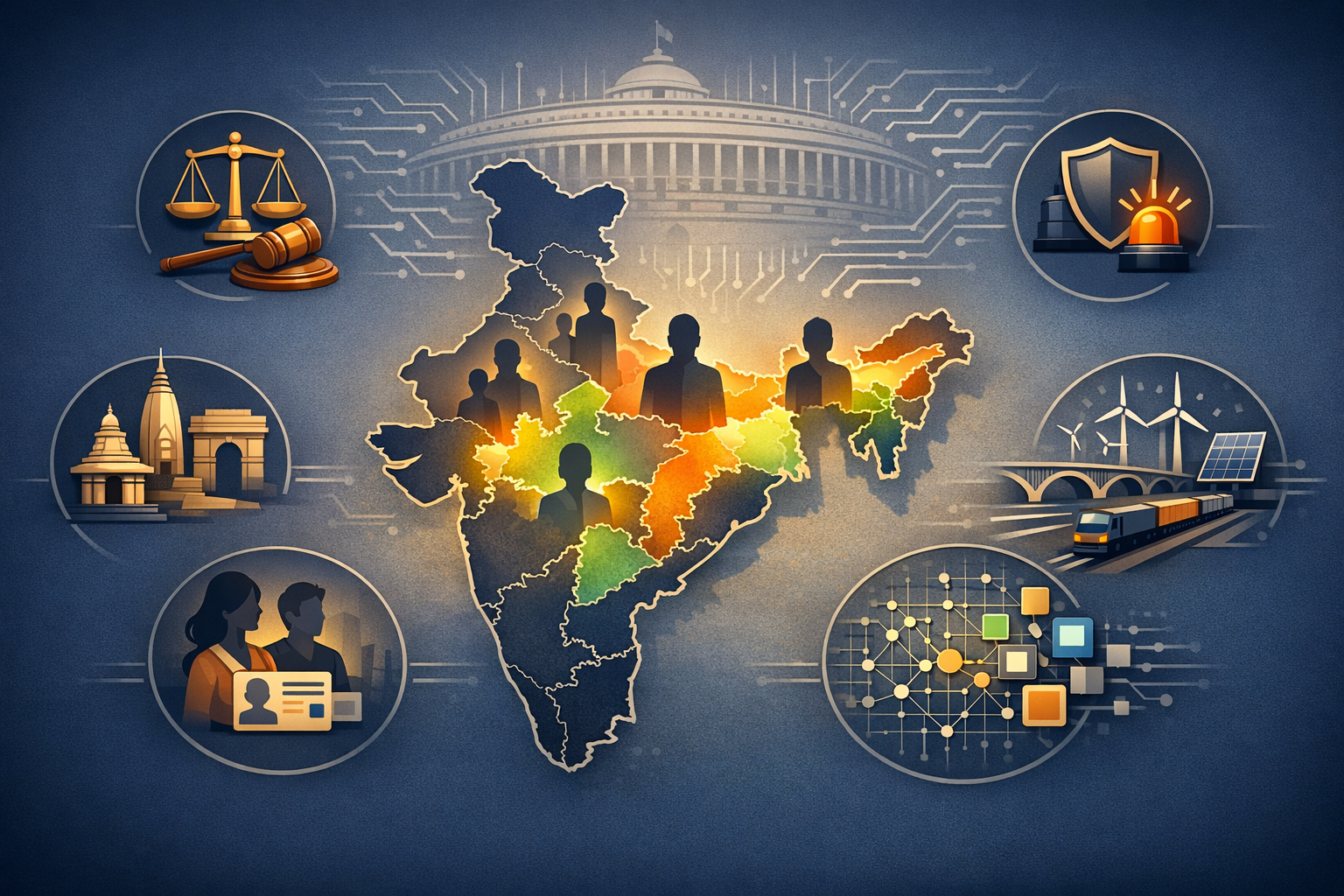
Over the past five years, Bharatiya Janata Party (BJP) has clearly prioritized leaders with strong regional roots while embracing a more assertive Hindutva line in rhetoric, organization, and policymaking. This long-form analysis maps the strategic logic driving that shift, the organizational mechanisms enabling it, the likely governance outcomes, and what this evolution could mean for federalism, Indian Politics, and dharmic unity as the country moves toward pivotal 2026 contests.
The strategic rationale is straightforward. India’s federal, first-past-the-post system rewards parties that marry a cohesive national narrative with state-specific leadership capable of building durable social coalitions. Regionally grounded figures are more fluent in local idioms, caste-dynamics, and administrative constraints, and they can translate central priorities into credible delivery at the constituency and district levels. In effect, the national brand and the regional imprint become complementary rather than competitive assets.
At the organizational level, the BJP’s cadre-based model and the wider ecosystem of the Rashtriya Swayamsevak Sangh (RSS) and allied organizations provide a leadership pipeline, booth-level stamina, and ideological training. The party’s central apparatus offers message discipline and resource allocation, while empowered state units bring executional agility. The result is a hybrid structure that centralizes narrative but decentralizes mobilization and delivery.
Hardline Hindutva, in this context, can be read less as episodic provocation and more as a consistent, institutionalized program. It emphasizes civilizational self-definition, cultural heritage protection, and social order, often articulated through a legal-regulatory agenda. Its hallmarks include moves toward a Uniform Civil Code (UCC), state-level anti-conversion legislation, debates around polygamy restrictions, curriculum and cultural-content recalibration, and greater attention to temple endowments and pilgrimage security. The tone is assertive; the instrument is policy.
Importantly, this ideological consolidation has been tethered to a governance-through-delivery framework. Law-and-order signaling sits alongside visible infrastructure upgrades, welfare targeting, and process digitization—an identity-plus-delivery model in which symbolic politics and material outcomes reinforce each other. When this dual engine runs coherently, it converts affect into trust and trust into votes.
Uttar Pradesh is frequently cited as the archetype of this formula. A strong chief ministerial figure with high personal authority projects clarity on law and order, pairs cultural signaling with expansive infrastructure and welfare schemes, and embeds a granular party machine down to the booth. The net effect is a stable, high-salience narrative that keeps the state in national focus while retaining a region-first cadence.
Assam offers a variant tailored to the Northeast’s political mosaic. The leadership style emphasizes administrative responsiveness, border and identity concerns, anti-trafficking and anti-narcotics measures, and social-sector delivery. The anti-polygamy initiative, debates on migration-linked documentation, and cultural heritage protection together signal an ideology anchored to regional risk perceptions, yet nested within national priorities.
Gujarat, as the BJP’s long-running laboratory, showcases a different equilibrium: organizational depth, predictable economic policy, and calibrated cultural signaling. Here, the party relies on network continuity and institutional memory—stability that allows incremental policy shifts without narrative fatigue.
Maharashtra underlines how coalition architecture and regional leadership can be reimagined to reshape alignments without surrendering ideological clarity. The BJP’s approach blends organizational stamina with flexible alliance management, aiming to protect a statewide footprint while maintaining message discipline on Hindutva Politics, development, and governance credibility.
In states like West Bengal and Telangana, the party has sought to grow via assertive opposition leadership, civilizational framing, and welfare-based contrasts. The calculus is to convert sustained agitation and community outreach into organizational density, building local leaders who can shoulder high-intensity campaigns ahead of 2026 and beyond.
Behind these state-level arcs lies a well-defined organizational spine. The RSS and its affiliates provide ideological formation and local social capital; the party’s election machinery layers digital microtargeting, data-led candidate screening, and beneficiary-mapping onto that foundation. The outcome is a repeatable, learnable model that integrates cadre motivation with analytics-driven campaign design.
Communications mirror this integration. The national message emphasizes civilizational confidence, economic nationalism, and strong governance; state units translate these into local dialects of aspiration, grievance redressal, and pride. This tiered narrative architecture—national brand, regional idiom, constituency cadence—allows the party to vary the mix of identity and delivery based on each state’s political economy.
Electorally, the social-coalition strategy has broadened. While upper-caste consolidation remains, the party has made deliberate inroads among OBC blocs, Dalit sub-groups, women beneficiaries, and first-time urban and semi-urban voters. Welfare schemes, targeted job-creation narratives, and law-and-order signaling together produce a cross-class, cross-caste appeal. For 2026, expect continued focus on women’s welfare, micro-entrepreneurship, skilling, and urban peripheries.
On policy, four clusters merit attention. First, legal reforms: movement toward a UCC in select states, anti-conversion statutes, and family-law harmonization debates. Second, cultural heritage: temple governance rationalization, festival and pilgrimage logistics, and heritage-site upkeep. Third, social order: stronger policing of organized crime, trafficking, and narcotics. Fourth, growth and delivery: expressways, logistics parks, renewable energy corridors, and digitized public services. These clusters map closely to the BJP’s promise of Hindutva Governance paired with development-first administration.
Federalism remains a live axis. The model bets on cooperative federalism in budgetary support and infrastructure, while leveraging narrative centralization for cohesion. Tensions surface on subjects like law-and-order jurisdiction, academic curricula, and social policy. Managing that friction will depend on stable consultative forums, clear fiscal pathways for states, and predictable center–state dispute resolution.
From a dharmic-unity lens, the assertive Hindutva phase will be judged by its ability to preserve India’s deep pluralism. A principled emphasis on Sarva Dharma Sambhava, Anekantavada, and the shared virtues across Hindu, Buddhist, Jain, and Sikh traditions—karuna, ahimsa, seva, and shanti—can align civilizational pride with constitutional fraternity. Where rhetoric risks polarizing, institutional safeguards and consistent rule-of-law application should anchor trust.
Civil society’s experience underscores this balance. For many families, conversations at dinner tables are no longer abstract: they weigh safety, opportunity, identity, and dignity together. Citizens often respond positively to visible delivery and predictable administration; they also expect political communication to respect dignity across communities. The party’s long-run legitimacy will hinge on demonstrating that assertive cultural self-definition can coexist with inclusion, fairness, and legal neutrality.
Risks to monitor include over-centralization that stifles regional initiative, narrative overshoot that spooks investment or social cohesion, and policy design that outpaces institutional capacity. Conversely, the opportunity lies in translating ideological confidence into institutional performance—better courts-facing drafting of social legislation, clean measurement frameworks for welfare and policing, and transparent citizen feedback loops.
Key indicators for 2026 include recruitment and retention in the party’s booth network; beneficiary-to-voter conversion rates among women and youth; state-specific progress on UCC or anti-conversion frameworks; crime and conviction trends; time-to-completion for flagship infrastructure; and third-party assessments of service delivery. Stable or improving metrics across these domains would suggest that ideological consolidation is being matched by administrative competence.
Scenario planning for the 2026 cycle points to three plausible paths. In the first, regionally strong leaders convert identity-plus-delivery into stable majorities in key states, deepening the party’s state-level bench. In the second, narrative intensity outpaces governance in select geographies, generating tighter races and post-poll coalition arithmetic. In the third, new regional actors (including allies and adversaries) reshape coalitions, forcing adaptive strategy on the BJP without materially diluting its core program.
For observers of Indian Politics, the core insight is continuity through adaptation. The BJP’s leadership curation favors figures who can be simultaneously local and national, doctrinally firm yet administratively pragmatic. The assertive Hindutva line is being institutionalized through law, regulation, welfare design, and cultural policy—not merely speechmaking—while regional titans translate that architecture into state-specific outcomes.
Whether this power shift delivers sustained gains will depend on an equilibrium: cultural self-confidence balanced by constitutionalism; strong leadership tempered by cooperative federalism; and ideological clarity expressed as rule-of-law fairness to all communities, including Buddhists, Jains, and Sikhs. If that balance holds, the current model could consolidate into a new normal for 2026 governance. If it wavers, the political market—ever sensitive to delivery, dignity, and stability—will demand recalibration.
Inspired by this post on Struggle for Hindu Existence.










Leave a Reply
You must be logged in to post a comment.