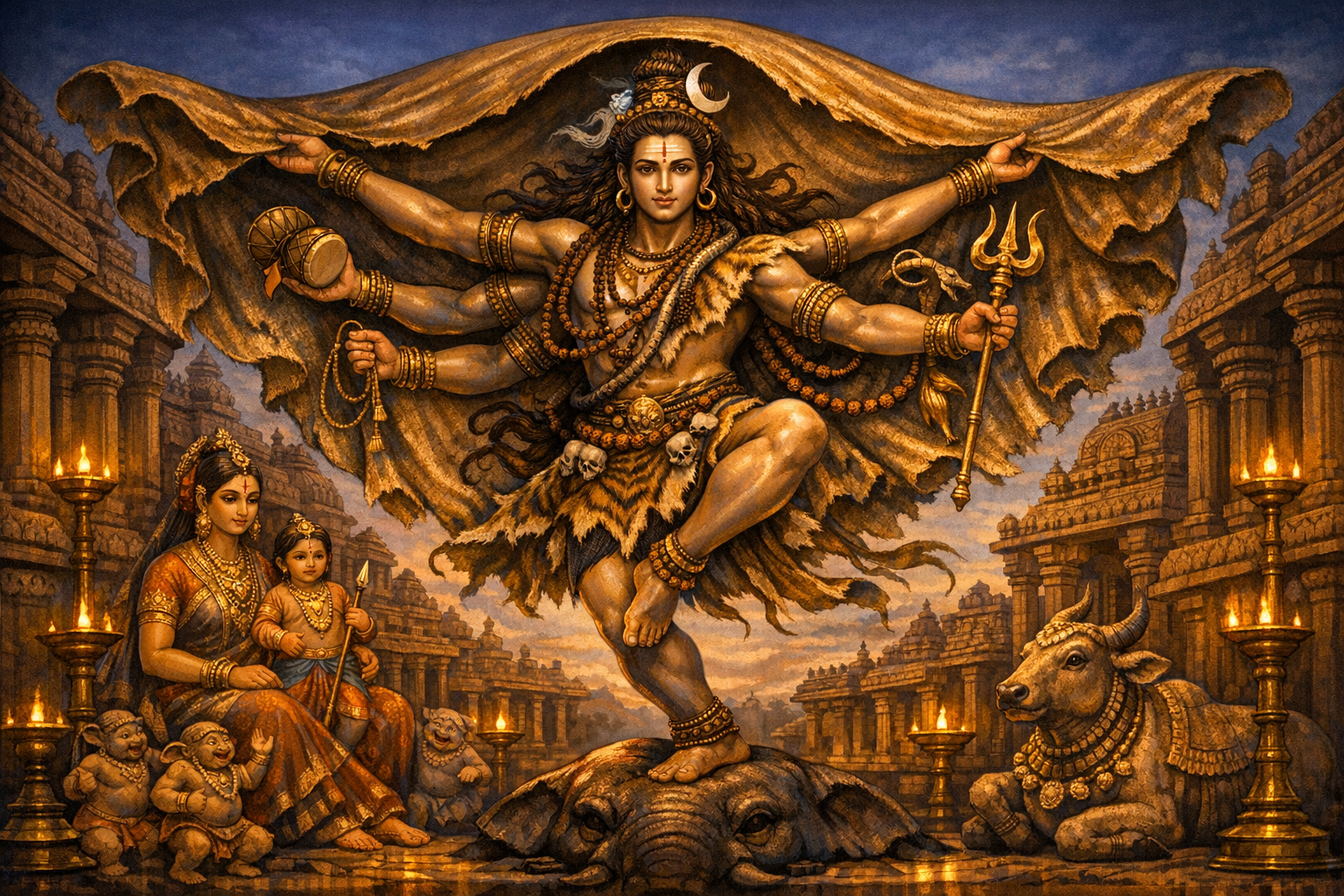
Gajasurasamhara stands among the most arresting images in Hindu iconography, presenting Lord Shiva in a fierce, dynamic manifestation that subdues arrogance and restores cosmic order. As a visual theology in motion, the formoften called Gajasamharamurticaptures Shiva’s raudra tandava (wrathful dance) at the precise moment he flays and wields the hide of the elephant demon Gajasura. For devotees, connoisseurs of South Indian temple art, and scholars of the Agamas and Shilpa Shastras, this image communicates a distilled philosophy: ego (ahaṅkāra) is heavy, formidable, and yet transformable through divine wisdom and discipline.
The sacred narrative, known across Purāṇic and Āgamic traditions, recounts how Gajasura, empowered by austerities and boons, descended into hubris and tyranny. Disrupting sages, devas, and the equilibrium of dharma, the elephant demon became the very emblem of ungoverned pride. Shiva, responding not as a mere destroyer but as a restorer of balance, confronts and overcomes Gajasura. The act culminates in a powerful sign: Shiva’s mantle is the demon’s own elephant hide, stretched aloftan unmistakable visual declaration that destructive ego can be transmuted and worn as a teaching.
In philosophical terms, Gajasurasamhara is less an episode of triumphal violence than a lesson in moral clarity. The elephant’s mass and momentum represent the inertia of pride and delusion; the flayed hide symbolizes stripping away layers of ignorance (avidyā). This ethical insight resonates broadly across the dharmic family: Buddhists speak of conquering the kleshas (afflictions), Jains emphasize mastery over the kashāyas (passions), and Sikhs warn against haumai (ego). Across these traditions, humility, self-knowledge, and compassionate strength are upheld as the means to inner freedom.
Classical texts ground the image in explicit technical canons. Āgamic sources such as the Kāmikāgama, Suprabhedāgama, and Karanāgama, alongside Shilpa treatises like the Mayamata and Śilparatna, prescribe the posture, attributes, and emotional tenor of Gajasamharamurti. While details vary by school and region, the consensus assigns Shiva an intense, whirlwind dynamism: multiple arms, a wide-spread elephant skin, and a dance poised between destructive energy and salvific intent.
Iconographically, Shiva typically appears with six or eight arms. The upper hands often stretch the elephant hide to form a dramatic canopy or arch behind him; other hands carry the ḍamaru (drum) and triśūla (trident), as well as the pāśa (noose) or mṛga (antelope). The face is fierce (ugra), the eyes dilated with focus, and the mouth slightly open to convey breath and the audible force of the tandava. The hair, arranged in a jaṭāmukuṭa, sometimes displays the crescent moon and the flowing Gaṅgā, marking Shiva’s cosmic sovereignty even amid wrath.
Pose and balance are definitive. The active leg commonly pins or subdues the elephant’s head or body, while the other leg extends in a sweeping curve that accentuates movement. Unlike Nataraja’s ānanda tandava (blissful, cosmic dance), Gajasurasamhara resolves a moral and psychological conflict on the terrestrial plane. The prabhāmaṇḍala (flame-ring) that encircles Nataraja is here functionally replaced by the elephant hidean arresting, sculptural device that amplifies velocity, violence contained, and transformation achieved.
Attendant figures enrich the narrative field. Parvati frequently appears, sometimes startled, sometimes composed, her presence humanizing the intensity of the scene. In a number of Chola bronzes and stone panels, a child Skanda (Murugan) clings in fright, a tender counterpoint to Shiva’s ferocity. Gana attendants animate the lower registers, and Nandi may witness from the periphery, anchoring the scene in devotion and service.
Costume and ornaments articulate theology through material signs. A tiger-skin loincloth signals ascetic power harnessed; a serpent may serve as the yajñopavīta (sacred thread), announcing fearlessness amid what others would find terrifying. Rudrākṣa garlands, a kapāla-mālā (skull necklace), and the powerful triśūla articulate Shiva’s roles as ascetic, destroyer of impediments, and guardian of dharma. Each attribute functions as a visual sutra, instructing viewers who read forms as carefully as texts.
Regional styles reveal a compelling evolution. Pallava-period carvings (7th–8th century), seen at sites such as the Kailāsanātha Temple in Kanchipuram, tend toward sculptural economy and linear vitality: torsos are slim, silhouettes clean, and anatomical cues precise. By the Chola era (9th–13th century), especially in Thanjavur, Darasuram (Airavatesvara Temple), and Chidambaram, the form matures into grand dynamism. Bronze Gajasamharamurtis from the Chola ateliers, including celebrated examples in the Chennai Government Museum, exhibit technical daring: swirling torsos, high-kneed extensions, and complex cantilevering that gives metal the visual lightness of flame.
Later Pandya and Nayaka interpretations retain the key schema but often accentuate decorative vigor: elaborated jewelry, pronounced facial modeling, and denser attendant groups. In Karnataka, Hoysala workshops, though famed for their star-shaped plans and filigreed ornament, employ Gajasurasamhara more selectively, often favoring narrative friezes where the drama unfolds across multiple registers. Across these regions, the icon remains instantly recognizable by the signature canopy of the elephant hide.
Processional bronzes (pancaloha, the five-metal alloy) relied on the lost-wax (cire perdue) technique, enabling virtuoso undercuts that stone cannot easily achieve. Artisans calculated mass and balance with mathematical care: the splayed hide, while airy, doubles as a counterweight to the forward thrust of limbs; the demon’s body, while narrative, also acts as a structural support. In this fusion of engineering and devotion, Chola bronzes manifest a grammar of movement that remains a benchmark of world sculpture.
Temples typically situate Gajasamharamurti on the exterior walls or in subsidiary shrines, aligning fierce forms with directional and ritual logics laid out in the Agamas. During specific festivals, select temples bring the icon into public view, allowing congregations to reflect on restraint, courage, and self-governance. While Arudra Darsanam in the Tamil month of Margazhi foregrounds Nataraja, some Shaiva temples also highlight allied dance forms, including Gajasurasamhara, to underscore the spectrum from ananda to raudra.
The contrast with Nataraja is didactically useful. Nataraja’s cosmic ring of fire encodes creation, preservation, and dissolution in perpetual cyclical balance, with Apasmara (ignorance) pressed beneath Shiva’s foot. Gajasurasamhara shifts the visual center from cosmic cycle to ethical crisis: not a dwarf of forgetfulness but a massive, charging elephantthe obstinacy of egomust be stopped and transformed. Where Nataraja instructs in cosmic rhythm, Gajasurasamhara trains the inner warrior to confront pride directly.
The narrative also functions as a community ethic. Pride harms not only the individual but the ecology of relationshipssages, devotees, even devas endure the shockwaves of egoic action. Shiva’s intervention thus serves society at large. For pilgrims in Tamil Naduat Kanchipuram, Chidambaram, Darasuram, Thanjavur, and Tiruvarurstanding before these images often elicits awe, sobriety, and a renewed commitment to ethical self-discipline in family, community, and service.
Dance traditions, especially Bharatanatyam, draw on the same visual grammar. The karanas of the Nāṭya Śāstra inform choreographic choices for Gajasamharam themes: lifted knee lines, sharp torso twists, and explosive tandava sequences translate sculptural rhythm into kinesiology. The Vazhuvoor bani (style) historically engages powerful narrative arcs from Shaiva imagery, and in performance, musicians accent damaru-like pulses to underscore Shiva’s timekeeping function in the dance of transformation.
For art historians and visitors alike, a practical checklist helps identify Gajasurasamhara in temple corridors and museum galleries: look for the high, tensile arc of an elephant hide behind Shiva; count six or eight arms with the upper pair drawing the hide wide; note the presence of the damaru and triśūla; observe the subjugated elephant form underfoot; scan the field for Parvati and a frightened Skanda; and watch for serpents serving as sacred threads or armlets. Each cue corroborates the narrative and anchors the image within Shaiva iconographic canons.
Stylistic chronology further refines connoisseurship. Pallava works present concise musculature and economical drapery; early Chola images enlarge volume and spatial dynamism; high Chola bronzes achieve equilibrium at full velocity; Pandya and Nayaka renderings luxuriate in ornamental flourish. In museums, labels may cite findspots (e.g., Kumbakonam region) or ateliers linked to specific mandalas of the Chola state, enabling viewers to triangulate date, region, and workshop idiom.
Underneath the technical brilliance lies a steady ethical current. The elephant’s hideonce a vehicle of terrorbecomes a teaching garment. The triśūla, which can wound, also cuts through delusion; the damaru, which sounds the beat of time, synchronizes the aspirant’s breath to disciplined practice. In this dual use of force and wisdom, Gajasurasamhara illustrates that genuine strength is inseparable from responsibility and compassion.
Cross-traditional resonance deepens the image’s relevance. Buddhist art often stages the subjugation of Māra, the tempter-ego, through serene resolve; Jain tirthankaras celebrate victory over passions through steadfast ahiṃsā and meditation; Sikh teachings repeatedly caution against haumai and elevate sevā (selfless service). Gajasurasamhara participates in this shared dharmic vocabulary: the enemy is not a person but the inner storm of pride and aggression, and the remedy is disciplined awareness allied to compassion.
From a psychological lens, the elephant’s scale evokes the heft of habitual patterns. Pride often feels justified, even protective; yet, left unexamined, it tramples nuance and relationship. The image’s severity invites rigorous self-inquiry: which reflexes stampede dialogue, learning, or humility? In that sense, standing before a Gajasamharamurti can be an exercise in contemplative ethics, aligning art appreciation with inner practice.
Conservation and heritage stewardship are crucial for these bronzes and stone reliefs. Temperature, humidity, and handling protocols in museums protect delicate surfaces and ancient inlays; in temples, careful ritual maintenance preserves both material integrity and living significance. Heritage professionals frequently collaborate with traditional sthapatis (master sculptors) to ensure that any restoration honors the iconographic shastra while sustaining devotional continuity.
For those planning pilgrimages or field study, select highlights offer layered encounters. The Kailāsanātha Temple at Kanchipuram preserves early formulations of Shaiva imagery in Pallava stone; the Airavatesvara Temple at Darasuram (a UNESCO World Heritage Site) showcases high Chola virtuosity in narrative relief; the Chola bronze galleries of the Chennai Government Museum present masterworks of balance and kinetic form. Each venue, in its way, advances understanding of how Gajasurasamhara evolved in dialogue with theology, ritual, and royal patronage.
In comparative study modules, instructors often pair Nataraja and Gajasurasamhara to illuminate two didactic arcs: cosmic law (ṛta) and ethical law (dharma). Students learn to parse subtle distinctionsthe prabhāmaṇḍala versus elephant-hide canopy, Apasmara versus Gajasura, ananda versus raudraand to connect these cues with textual frameworks in the Agamas. Such study not only sharpens visual literacy but also grounds personal reflection on the uses of strength.
Ultimately, Gajasurasamhara endures because it speaks in multiple registers at once. It is an art-historical lodestar for South Indian temple art, a theological statement on humility, a kinetic lesson for dancers, a meditation prompt for seekers, and a communal ethic for society. Its power lies not in shock but in clarity: pride is heavy, real, and conquerable; transformation is possible; and strength joined to compassion safeguards the world.
Seen through this integrated lensart, scripture, ritual, dance, and ethicsGajasurasamhara remains a timeless guide. It urges the cultivated will, the disciplined heart, and the clear mind. Whether encountered under the high stone cornices of Kanchipuram, in the bronze-lit galleries of Chennai, or in the resonant sabhas of Bharatanatyam, Shiva’s fierce grace continues to unmask ego and unveil freedom.
Inspired by this post on Hindu Blog.