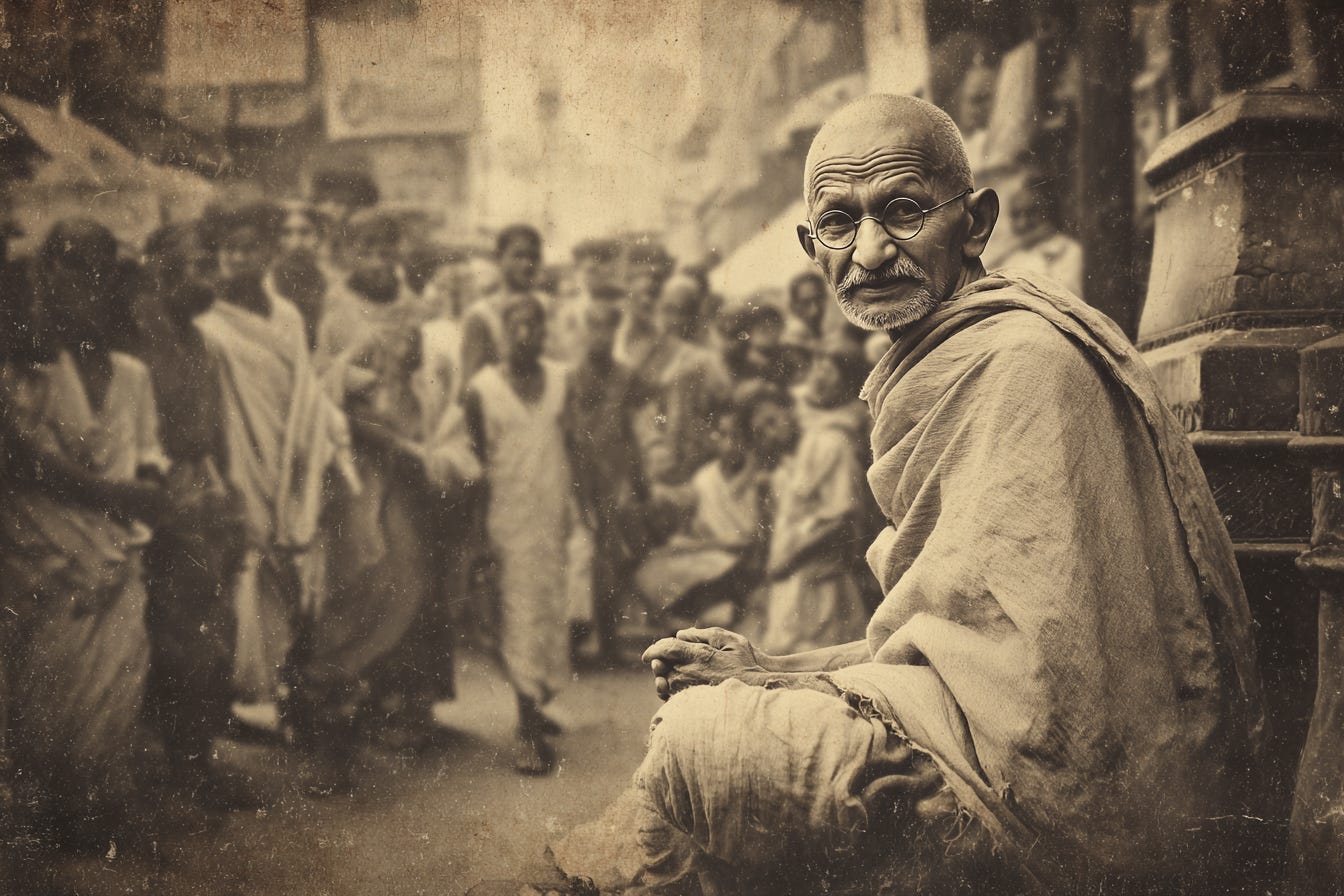
Did Satyagraha by itself win independence for India, or did freedom emerge from a wider constellation of pressures? A careful, evidence-based reading of history shows that Mahatma Gandhi’s Satyagraha was both transformative and strategically indispensable, yet it operated alongside other decisive forceswartime exhaustion of the British Empire, global anti-colonial momentum, civil and military unrest within the Raj, and the varied contributions of leaders and communities across the subcontinent.
Satyagraharooted in satya (truth) and ahimsa (non-violence)shifted the moral terrain of politics. Through the Non-cooperation Movement, the Civil Disobedience Movement, and the Salt March (Dandi March), it converted dispersed discontent into disciplined mass action, delegitimized imperial authority, and redefined political participation as an ethical duty. This approach mobilized students, workers, and rural households, making politics accessible well beyond urban elites and the Indian National Congress’s traditional base.
The method’s ethical core resonated deeply with the subcontinent’s dharmic traditions. Jain emphasis on ahimsa, Buddhist karuṇā and mindfulness, Hindu commitments to dharma and satya, and Sikh ideals of seva and courage met in a shared moral grammar that gave non-violent resistance cultural depth and social credibility. This civilizational harmony across Hinduism, Buddhism, Jainism, and Sikhism fortified unity and widened the freedom movement’s social legitimacy.
Yet Satyagraha faced structural and practical limits. Its success depended on sustained discipline under severe repression, and episodes like Chauri Chaura revealed how fragile that discipline could be. Participation varied by region and class; communal tensionsoften exacerbated by colonial policiesperiodically fractured solidarity. These constraints do not diminish Satyagraha’s significance; they illuminate why complementary forces were also pivotal.
World War II fundamentally altered the calculus of empire. Britain emerged financially strained, indebted, and militarily overextended. Global anti-imperial currents, the Atlantic Charter’s rhetoric, and shifting U.S. and international attitudes undercut the ideological rationale for colonial rule. In this context, mass non-violence inside India intersected with external pressures that the British could neither ignore nor indefinitely manage.
Equally consequential was a crisis of loyalty within the Raj’s coercive apparatus. The Indian National Army (INA) under Subhas Chandra Bosedespite battlefield setbacksignited patriotic sentiment that echoed far beyond its ranks. The INA trials and the Royal Indian Navy mutiny of 1946 signaled to British policymakers that coercion risked cascading unrest across services and cities. The possibility of a broader breakdown of order accelerated the timetable for transfer of power.
Political dynamics in London also mattered. A Labour government, rising costs of imperial maintenance, and the urgency of domestic reconstruction made prolonged colonial engagement untenable. In that setting, Satyagraha’s moral authority and mass legitimacy offered a credible path to a negotiated exit, even as the tragic Partition exposed unresolved communal fissures and the human cost of hurried political settlement.
Historiography reflects this multi-causal reality. Scholars such as R C Majumdar emphasized wartime exhaustion, revolutionary currents, and service mutinies, while others foreground Gandhi’s ethical politics and nation-wide mobilization. Placing these perspectives in dialogue yields a fuller picture: Satyagraha was necessary to delegitimize British rule and organize a nation; international shocks and armed tensions made continued occupation risky; together they formed a decisive synergy.
The movement’s intellectual horizon was broad. Thinkers and leaders ranging from Aurobindo Ghosh to Sardar Patel and Jawaharlal Nehru navigated divergent strategies within a shared quest for Swaraj. Across this spectrum, dharmic values informed civic courage, restraint under provocation, community service, and a commitment to ethical statecraftprinciples that remain instructive for democratic life today.
Collective memory makes these dynamics tangible. Families still recount stories of khadi spinning circles, student boycotts, small-town processions during the Quit India Movement, and quiet acts of solidarity that stitched together a national fabric. These lived experiencesrural and urban, across faiths and regionsreveal how a moral movement gained everyday momentum and durable meaning.
Three analytical lessons stand out. First, ethical resistance can generate unparalleled moral capital, but it must be sustained by broad-based unity across communities and traditions. Second, historical change is often catalytic and cumulativedomestic mobilization gains decisive power when synchronized with international context. Third, preserving unity in diversity, especially among dharmic traditions, is not merely idealistic; it is a strategic asset for nation-building.
A mature conclusion follows: Satyagraha did not act alone, yet without it the freedom struggle would have lacked both moral legitimacy and mass scale. Independence emerged from the interplay of non-violent mass politics, imperial overstretch during World War II, revolutionary symbolism, service mutinies, and deft political negotiation. Honoring this fuller story affirms India’s civilizational capacity to unite ethical conviction with strategic clarityand invites continued solidarity among Hindu, Buddhist, Jain, and Sikh communities in the ongoing work of constitutional democracy and social harmony.
Inspired by this post on Dharma Dispatch.