The Badri-Kedar Temple Committee (BKTC) has clarified temple entry norms ahead of the Char Dham Yatra 2026, emphasizing that non-Hindu visitors will be restricted only from the sanctum sanctorum (garbhagriha) across 47 shrines under its administration in Uttarakhand, while remaining welcome in all outer areas, mandapas, courtyards, and public service zones. This calibrated approach seeks to preserve ritual sanctity at the innermost altar without curtailing access to the wider sacred precincts that pilgrims and visitors of all backgrounds traditionally share.
The Char Dham Yatraencompassing Badrinath, Kedarnath, Gangotri, and Yamunotriis among India’s most significant Hindu pilgrimage circuits. BKTC’s stewardship of Badrinath, Kedarnath, and associated temples coincides with rising annual footfall, infrastructure upgrades, and stringent safety planning in a high-altitude environment. In this context, the policy update functions as a practical and time-tested articulation of temple maryada (norms) rather than an expansion of exclusions.
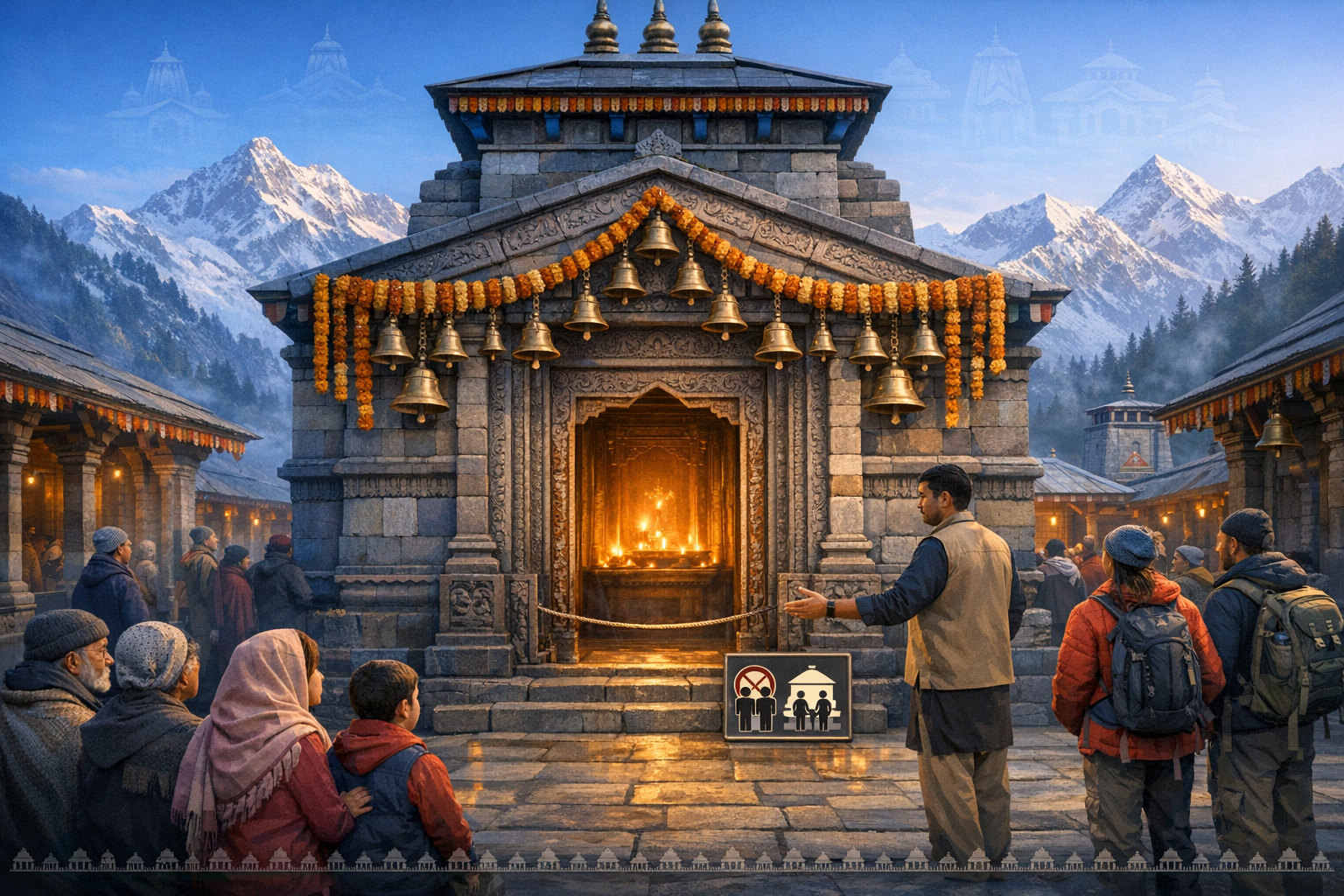
Operationally, the directive draws a clear line at the threshold of the garbhagriha, where only designated priests and ritual functionaries enter for nitya-seva (daily worship). Beyond that threshold, non-Hindu visitorsalong with interfaith researchers, service staff, and touristsretain access to the sabha-mandapa (congregational hall), external circumambulatory paths, viewing galleries, information counters, prasada distribution points, and public amenities. In short, this is not a blanket ban on entry; it is a narrow, site-specific boundary at the innermost sanctum alone.
To support smooth implementation, BKTC is expected to rely on courteous signage, queue guidance, and trained volunteers. The emphasis remains on dignity and hospitality: communication at the sanctum threshold will be respectful and minimally intrusive, and the wider temple experiencefrom darshan at a distance to participation in communal aarti from outer hallsremains intact for all visitors.
For non-Hindu guests, the outer mandapas and courtyards often provide excellent vantage points for witnessing key rituals, bells, chants, and the aesthetic of Himalayan temple architecture. Many visitors report that the shared spacelit by lamps, resonant with mantras, and animated by a flow of devoteesconveys the living heart of the pilgrimage even without entering the garbhagriha. Prasada offerings, guided explanations, and temple museums or interpretive boards (where available) further enrich that encounter.
The rationale for limiting access to the garbhagriha is rooted in Agama Shastra traditions, which define the sanctum as the most ritually charged sphere of a temple’s spatial hierarchygarbhagriha (sanctum), antarala (vestibule), and mandapa (hall). Across India, temples interpret these boundaries in varied ways. BKTC’s formulation is comparatively precise and limited, protecting the altar’s ritual purity while keeping the surrounding sacred commons open to all.
The distinction between sacred zones matters for crowd management as well. The Char Dham’s narrow sanctums and high-altitude settings necessitate careful flow at the altar threshold. By focusing restrictions at the inner corewhere priestly rites, abhishekam, and naivedya occurthe committee balances two legitimate interests: the integrity of essential rituals and the inclusivity of the broader pilgrimage environment.
Service providers, medical teams, porters, security personnel, and volunteers from all backgrounds remain integral to safe operations. The policy does not impede such roles in outer areas or public-facing functions. In life-critical emergencies, standard safety protocols and civil law imperatives naturally take precedence over spatial boundaries.
Seen through a broader dharmic lens, the approach resonates with principles shared across Hinduism, Buddhism, Jainism, and Sikhism: deep reverence for core ritual spaces and a simultaneous commitment to hospitality and seva. While each tradition has its own maryada, the underlying ethic is recognizableprotect the heart of worship, welcome the world to learn and participate with respect, and foster sarva dharma sambhava through lived courtesy.
Constitutionally, the balance is also familiar. Articles 25 and 26 of the Constitution of India safeguard both an individual’s freedom of religion and a denomination’s right to manage its own religious affairs, subject to public order, morality, and health. Indian courts have repeatedly acknowledged the autonomy of religious institutions to regulate access to the core spaces of essential worship, even as temple premises remain places of public significance. BKTC’s decision reflects this twin respect for institutional self-governance and public access.
Temple access practices vary nationwide, shaped by textual traditions, local customs, and architectural constraints. Some shrines reserve the garbhagriha for priests alone; others permit limited entry to lay devotees after ablutions; still others allow proximate darshan from the antarala. In that spectrum, the BKTC policy is measured and clearly communicated: it draws the line at the sanctum, not at the gate.
For those planning the Char Dham Yatra, the practicalities remain unchanged. Pilgrims and visitors should complete the mandatory state registration on official Uttarakhand portals, monitor weather advisories, and follow district administration updates regarding traffic, accommodation, and medical facilities. As in recent seasons, digital queues and time-windowed darshan may be used to smooth peak loads.
High-altitude travel requires preparation. Acclimatization, layered clothing, hydration, and basic fitness screening reduce risk in rarefied air. Weather shifts rapidly in the Himalaya; officials may temporarily regulate movement in response to rain, snow, or landslide alerts. Responsible itinerariesespecially for the elderly or those with comorbiditiesbuild in extra rest days and avoid night travel on mountain roads.
Accessibility and facilitation remain core concerns. The temple administrations typically offer priority arrangements for the differently abled, senior citizens, and those requiring medical assistance, subject to on-ground conditions. Visitors should inquire at help desks for the latest modalities and carry necessary medical documentation to ensure a safe and unhurried darshan from permitted areas.
Cultural etiquette amplifies the experience for everyone. Modest attire, removal of footwear where indicated, mindful photography (or refraining where prohibited), and quiet attentiveness during aarti and mantra recitation align with temple maryada. Waste minimization, plastic avoidance, and sensitive conduct near water bodies support the Himalaya’s fragile ecology and the sacredness of the river origins associated with the Char Dham.
Dharmic visitors from Buddhist, Jain, and Sikh backgrounds often find meaningful resonances at the Himalayan shrines: the shared discipline of seva, reverence for sacred geography, and an ethic of inner purification. Many choose to witness rituals from outer halls, meditate quietly in courtyards, and reflect on the confluence of devotion (bhakti), knowledge (jnana), and action (karma) that informs the wider Indian spiritual tapestry.
The BKTC policy also recognizes the lived reality that the Char Dham Yatra sustains local livelihoods. Porters, pony operators, shopkeepers, hoteliers, guides, and first responders work in concert to welcome millions of pilgrims and visitors. Clear, predictable norms at the sanctum threshold reduce confusion, while open access to shared spaces keeps the temple commons vibrant and economically inclusive.
Common questions arise about definitions. In practice, identification is self-declaratory and handled with courtesy at the sanctum threshold if needed; there is no call for intrusive questioning. Importantly, the policy targets no community; it preserves a ritual boundary. People from all backgrounds continue to learn, observe, and participate respectfully in the wider precincts.
Where identity checks are unavoidablefor instance, at the immediate entry to the garbhagrihaofficials and volunteers are expected to maintain a tone of service and restraint. Well-placed signage that explains the sanctum restriction in multiple languages helps minimize awkwardness and ensures that expectations are set well before the threshold.
Researchers, cultural reporters, and heritage professionals planning documentation should coordinate in advance with temple administrations for permissions appropriate to each zone. The outer halls, architecture, and public-facing rituals offer substantial scope for study and storytelling that respects both religious governance and public interest in heritage interpretation.
Digital facilitation has grown markedly. Live aarti streams, official social updates, and virtual tours provide additional pathways for darshan, including for those unable to travel or to approach the inner halls during peak hours. Such tools extend the temple’s inclusivity while reducing on-site congestion.
In essence, BKTC’s clarification protects the sanctum’s ritual integrity, keeps the sacred commons open, and aligns with constitutional norms, Agama guidance, and contemporary crowd-management realities. The Himalaya’s spiritual magnetism remains accessible to all who approach with humility and care, regardless of background.
Within the broader dharmic family, the policy is a reminder that unity does not require uniformity. Hinduism, Buddhism, Jainism, and Sikhism can affirm one another through mutual respect for sacred spaces and shared values of seva, compassion, and truth-seeking. That spiritvisible in the queues, rest shelters, langar-style community meals along routes, and the everyday kindness of mountain communitieskeeps the Char Dham Yatra both timeless and welcoming.
As with any high-season pilgrimage, procedures may be refined in real time for safety or weather contingencies. Travelers are encouraged to verify updates from official Uttarakhand authorities and temple administrations. With thoughtful preparation and observance of clear, limited sanctum boundaries, this season’s yatra can remain spiritually elevating, operationally smooth, and genuinely inclusive.
Inspired by this post on Struggle for Hindu Existence.